Mushroom Genetics & Strains
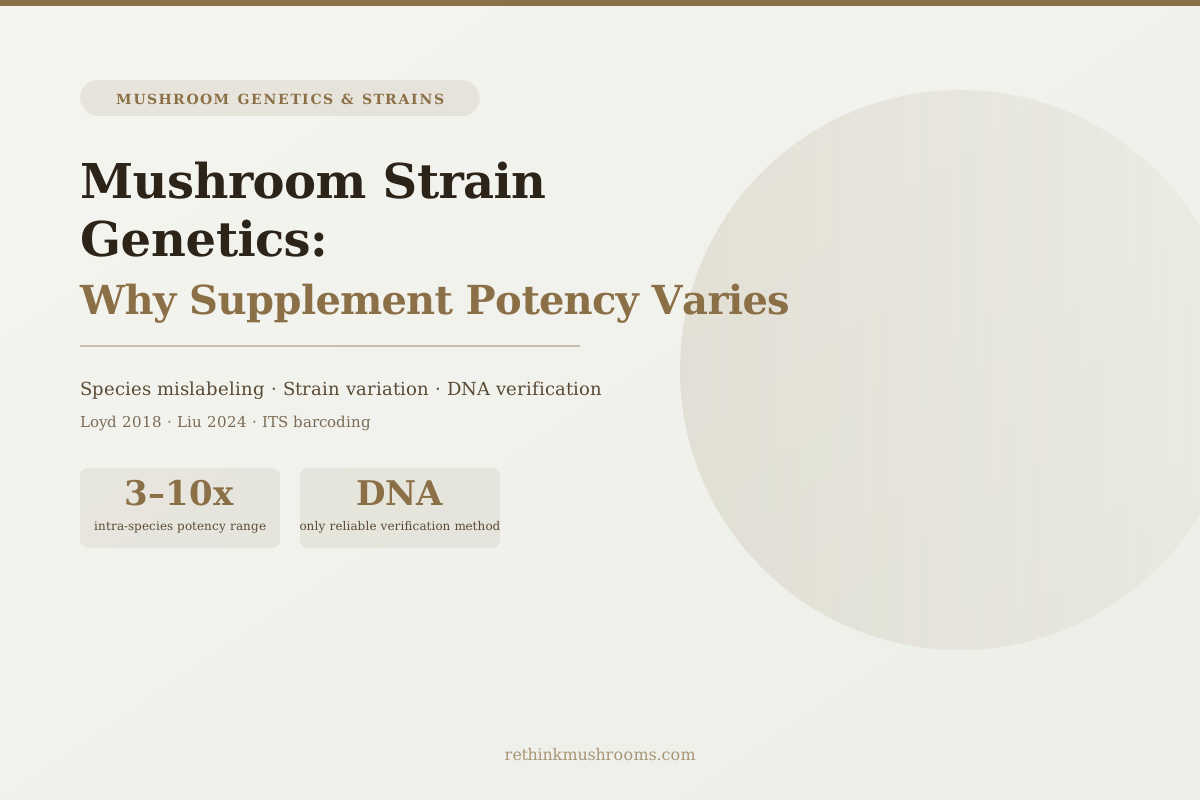
3–10x potency variation
Genetic variation between strains of the same mushroom species can create 3 to 10 times differences in target compound concentrations. DNA testing of commercial reishi products has found multiple Ganoderma species mislabeled, with different triterpenoid profiles than what the label claims.
Loyd et al., Frontiers in Microbiology, 2018
Species mislabeling
commercial reishi DNA-tested and found non-lucidum Ganoderma species inside
Systematic
2024 survey documented widespread counterfeiting in Chinese commercial mushrooms
ITS barcoding
low-cost DNA test that can verify species identity from a supplement capsule
Loyd et al., Frontiers in Microbiology, 2018
 View as image ↗
Two reishi supplements on the same store shelf can contain completely different compounds, even when they share the same species name. DNA testing of commercial reishi products has documented products labeled Ganoderma lucidum that contained other Ganoderma species with different triterpenoid profiles. This is the practical consequence of mushroom strain selection and bioactive variation that supplement labels almost never address. This article explains the genetic mechanisms behind potency variation, what the research shows about how widespread species mislabeling is, and what strain-level evidence consumers should look for when evaluating mushroom supplements.
For the broader question of how supplement form (fruiting body vs. mycelium) intersects with these genetics questions, The Fruiting Body vs. Mycelium: The Great Mushroom Supplement Debate covers that foundational distinction.
Key Takeaways
- Genetic variation between strains of the same mushroom species can create 3 to 10 times differences in target compound concentrations; the same species name on a label does not guarantee equivalent potency
- Loyd and colleagues (2018) DNA-tested commercial reishi supplements and found products labeled as Ganoderma lucidum actually contained G. curtisii, G. sessile, or G. oregonense, species with different triterpenoid profiles
- A 2024 survey of Chinese commercial mushrooms documented widespread counterfeiting and mislabeling, identifying DNA-based authentication as the only reliable verification method
- Genetic analysis of 132 Pleurotus samples revealed 5 distinct genetic clades with significantly different biochemical profiles, demonstrating that genus-level classification conceals major differences relevant to supplement selection
- Regular and white-mycelium cultivars of Antrodia cinnamomea, despite being the same species, show completely different triterpenoid ratios, a direct demonstration that intraspecies strain selection changes medicinal chemistry
- ITS DNA barcoding provides a fast, low-cost method for verifying mushroom species identity in commercial supplements, and its use has been validated against Ganoderma mislabeling specifically
The Commercial Reishi Problem: What DNA Testing Found on Store Shelves
In 2018, Loyd and colleagues published what remains the most compelling consumer-facing evidence of why mushroom strain genetics matter in practice.[1]
They purchased commercial reishi supplements (products labeled as Ganoderma lucidum, the species with the established medicinal profile and most research) and subjected them to DNA sequencing. The finding: multiple products contained Ganoderma curtisii, Ganoderma sessile, or Ganoderma oregonense instead of, or in addition to, G. lucidum. These are not interchangeable species. Different Ganoderma species have different triterpenoid profiles. The compounds in a G. sessile product are not the same as those in a G. lucidum product, even though both might be called "reishi" or "lingzhi" on a label.
The Loyd study is not an anomaly. A 2024 survey by Liu and colleagues examined the state of counterfeited and mislabeled commercial mushrooms in China, the world's dominant mushroom producer, supplying a substantial share of supplement raw materials globally.[2] The survey documented widespread species substitution, mislabeling, and adulteration across commercial mushrooms, with DNA-based authentication identified as the only reliable solution. Given China's role as a primary supplier of mushroom raw ingredients to global supplement manufacturers, the Liu 2024 findings have implications well beyond the Chinese domestic market.
The practical consequence: two products labeled "reishi" or "Ganoderma" can contain genuinely different species with meaningfully different compound profiles. Consumers relying on the species name as a quality guarantee are not getting adequate information.
What "Strain" Means in Mushroom Biology, and Why It Differs From "Species"
Before getting into the variation, the terminology matters.
A species is the broadest classification at play here: Ganoderma lucidum, Hericium erinaceus, Cordyceps militaris are species names. Within a species, a strain is a genetically distinct variant, equivalent to what a plant breeder would call a cultivar. Strains of the same species are genetically related but carry different combinations of alleles that influence which biosynthetic pathways are active, which compounds those pathways produce, and in what quantities.
The analogy from plant breeding is useful: Fuji and Granny Smith apples are both Malus domestica, but no one would expect them to taste the same or have identical nutritional content. Mushroom strain selection works the same way, but the compounds at stake are medicinal rather than culinary.
A 2024 comprehensive review by Tarafder and colleagues covered the current state of genetic tools for studying mushroom diversity: molecular markers (SSR, RAPD, AFLP), phylogenetic analysis, quantitative trait locus mapping, and genome sequencing are all now applied to medicinal mushroom species.[3] These tools have made it possible, for the first time, to characterize the genetic basis of strain-level variation in bioactive compound production, rather than just measuring the variation empirically. These tools reveal why specific strains produce more or less of target compounds.
How Genetic Clustering Predicts Chemical Clustering: The Pleurotus Evidence
The most systematic evidence connecting genetic variation to chemical variation comes from a 2022 study by Lin and colleagues examining 132 Pleurotus samples.[4]
The researchers performed genetic analysis using ITS and LSU sequence regions (the standard DNA markers for fungal identification) and resolved the samples into five distinct genetic clades. They then analyzed polar lipid profiles across the same samples. The result: samples that clustered together genetically also clustered together chemically. Different genetic clades had significantly different lipid compositions.
The implication is fundamental. If you pick a random oyster mushroom supplement, knowing it is "oyster mushroom" (Pleurotus species) is not enough information to predict its chemical profile. The genetic clade it belongs to predicts its chemistry, and genus-level labeling does not tell you which clade you're in.
The same logic applies across medicinal mushroom genera. Compounds promoted for a species' health benefits are produced by specific biosynthetic pathways encoded in the genome. Genetic variation between strains changes the expression level of those pathways, the enzymatic steps they include, and ultimately the compound output. Two strains of the same species can be genetically similar enough to be called the same name while producing different concentrations of every target compound.
Same Species, Different Chemistry: The Antrodia Cultivar Case Study
The clearest single demonstration of intraspecies strain variation affecting medicinal chemistry comes from a 2016 study by Chen and colleagues comparing two cultivars of Antrodia cinnamomea, a rare Taiwanese medicinal mushroom valued for its triterpenoid content.[5]
Regular Antrodia cinnamomea and its white-mycelium variant are the same species. They are grown under comparable conditions and are commercially available under the same name. Chen's analysis found that the two cultivars had dramatically different antrodin and antcin triterpenoid ratios. The specific ratios of related triterpenoid compounds that characterize different cultivars changed significantly between the two strains.
This is not a small, quantitative difference in the same compounds. It is a difference in the qualitative profile of which compounds predominate. A consumer purchasing Antrodia cinnamomea supplements has no way to know which cultivar's chemistry they are getting without strain-specific documentation from the manufacturer.
A 2025 study by Kała and colleagues adds a further layer: for Hericium erinaceus, both the plant-based substrate used during cultivation and the extraction method applied after harvest significantly affected hericenone and erinacine concentrations in the final product.[6] The same genetic strain, grown on different substrates, produced meaningfully different compound levels. Genetics sets the ceiling for what a strain can produce; cultivation conditions determine how much of that potential is expressed.
Why Metabolomics Tells a Different Story Than the Supplement Label
Standard mushroom supplement quality testing measures beta-glucan percentage, sometimes total polysaccharide, occasionally a target compound like cordycepin or ganoderic acid. This approach misses the vast majority of a mushroom's chemical complexity.
Uffelman and colleagues published a 2023 untargeted metabolomics study examining seven common mushroom species: white button, crimini, portabella, Lion's Mane, maitake, oyster, and shiitake.[7] Untargeted metabolomics measures every detectable compound in a sample, not just the ones a researcher decided to look for. Each species produced a unique metabolic fingerprint encoding hundreds of compounds not captured by standard nutrient panels. Lion's Mane showed uniquely elevated concentrations in specific amino acid profiles compared to the others.
The metabolomics picture matters for the genetics discussion in two ways. First, it confirms that species-level uniqueness is real and extensive. Second, it suggests that the genetic variation between strains translates into variation across hundreds of compounds simultaneously, not just the two or three that a standard analysis tests for. A supplement standardized to 30% beta-glucan content by one assay method tells you one number from a very large picture.
For readers interested in how the fruiting body versus mycelium genetic programs change which compounds are concentrated where, Do Fruiting Bodies Have More Bioactive Compounds Than Mycelium? covers that evidence base in depth.
What Strain Verification Looks Like in Practice
The genetic tools to verify strain identity exist and are accessible. Gunnels and colleagues demonstrated in 2020 that ITS DNA barcoding reliably distinguishes Ganoderma lucidum from other Ganoderma species in commercial supplements, using a fast, low-cost sequencing method that is available to any competent analytical laboratory.[8] The same principle applies across mushroom genera: ITS sequencing can establish species identity with high confidence from a supplement capsule.
What this means in practice: brands that prioritize strain verification can offer certificates of analysis (COAs) that include DNA authentication alongside chemical compound testing. This level of documentation is not yet industry standard, but it is technically achievable and is increasingly demanded by quality-conscious buyers.
For consumers evaluating products, the signals that suggest genuine strain-level quality assurance include: a specific strain designation in the product documentation (not just species name); a COA from a third-party laboratory that includes both chemical compound testing and species identity verification; and beta-glucan content measured by a validated assay method (the mushroom-specific triple detection method, not total glucan or fiber assays that count grain starch from mycelium-on-grain products).
What does not provide strain-level confidence: a species name alone, "proprietary blend" labeling, or beta-glucan percentages without specifying the analytical method used.
The genetic diversity and breeding research underlying this field is covered in detail across the companion cluster articles. How Selective Breeding Changes Mushroom Chemistry explains how active breeding programs are using mutagenesis and hybridization to engineer higher-potency strains, and The Genetic Diversity of Medicinal Mushroom Species covers the taxonomic and genetic landscape across species.
For the adulteration context behind these genetics concerns, Mushroom Supplement Adulteration: How Widespread Is the Problem? maps the broader quality assurance landscape, and DNA Testing for Mushroom Supplements: Verifying Species Identity goes into the testing methodology in detail.
The Bottom Line
Genetic variation between mushroom strains of the same species creates 3 to 10 times differences in target compound concentrations. This is not theoretical variation: DNA testing of commercial reishi supplements has found non-lucidum Ganoderma species with different triterpenoid profiles mislabeled as G. lucidum, and a 2024 survey documented widespread counterfeiting in Chinese commercial mushrooms. The genetics-to-chemistry connection is well-established: genetic clustering predicts chemical clustering, and intraspecies cultivar differences can produce completely different compound profiles. ITS DNA barcoding exists as a low-cost verification method that premium brands should be using in their quality assurance programs.
Frequently Asked Questions
Sources & References
- 1RTHM-00981·Loyd, Andrew L et al. (2018). “Identifying the "Mushroom of Immortality": Assessing the Ganoderma Species Composition in Commercial Reishi Products..” Frontiers in microbiology.Study breakdown →PubMed →↩
- 2RTHM-01935·Liu, Jinlin et al. (2024). “The Situation of Counterfeited and Mislabeled Commercialized Edible Mushrooms in China and the Development of Possible Controls..” Foods (Basel.Study breakdown →PubMed →↩
- 3RTHM-02004·Tarafder, Entaj et al. (2024). “Advancements in genetic studies of mushrooms: a comprehensive review..” World journal of microbiology & biotechnology.Study breakdown →PubMed →↩
- 4RTHM-01568·Lin, Pei et al. (2022). “Genetic and Chemical Diversity of Edible Mushroom Pleurotus Species..” BioMed research international.Study breakdown →PubMed →↩
- 5RTHM-00422·Chen, Wei-Lun et al. (2016). “Phenologic variation of major triterpenoids in regular and white Antrodia cinnamomea..” Botanical studies.Study breakdown →PubMed →↩
- 6RTHM-02103·Kała, Katarzyna et al. (2025). “Influence of Plant-Based Substrate Composition and Extraction Method on Accumulation of Bioactive Compounds in Hericium erinaceus (Bull.) Pers. Fruiting Bodies..” Molecules (Basel.Study breakdown →PubMed →↩
- 7RTHM-00856·Uffelman, Cassi N et al. (2023). “Metabolomics Profiling of White Button, Crimini, Portabella, Lion's Mane, Maitake, Oyster, and Shiitake Mushrooms Using Untargeted Metabolomics and Targeted Amino Acid Analysis..” Foods (Basel.Study breakdown →PubMed →↩
- 8RTHM-00615·Gunnels, Tess et al. (2020). “The ITS region provides a reliable DNA barcode for identifying reishi/lingzhi (Ganoderma) from herbal supplements..” PloS one.Study breakdown →PubMed →↩