Mushroom Biology
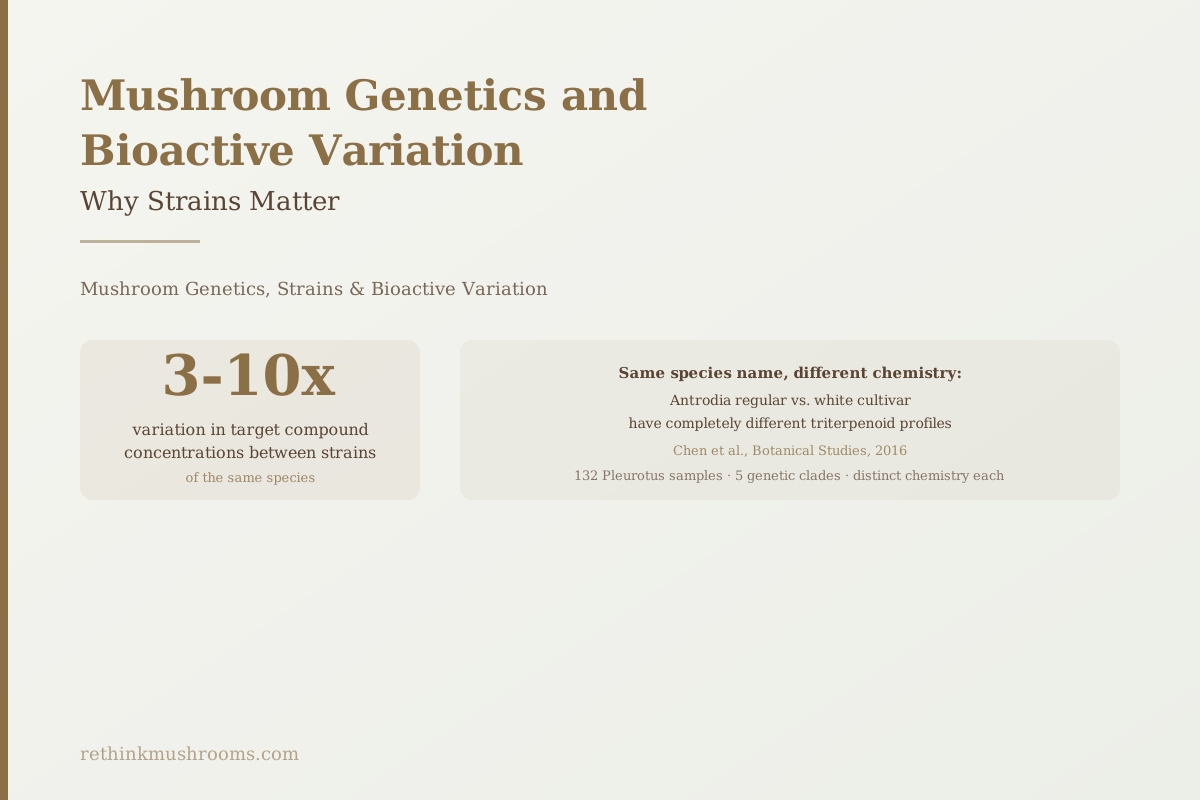
5 genetic clades
Genetic analysis of 132 Pleurotus (oyster mushroom) samples resolved 5 distinct clades. Their polar lipid profiles varied significantly by species, while their sugars, amino acids and fatty acids stayed notably similar. Genetics shapes chemistry, but not every compound class equally.
Lin et al., BioMed Research International, 2022
29 to 854
unique-to-variety compounds per mushroom variety, a 29x spread across seven varieties (Uffelman 2023)
1,344
compounds found in all seven varieties alike, the shared chemical core beneath the differences (Uffelman 2023)
No difference
in triterpenoid composition between naturally occurring white and regular Antrodia strains up to eight weeks old (Chen 2016)
Lin et al., BioMed Research International, 2022
 View as image ↗
Two bottles of Antrodia cinnamomea sit on a supplement shelf. Both carry the same species name. One is made from the standard orange-red strain, the other from a white-mycelium strain, and the second is priced as though the colour signals something. Chen and colleagues actually ran this comparison in 2016, and the result is more interesting than the marketing. The naturally occurring white strain showed no significantly different triterpenoid composition from the regular strain up to eight weeks of age. Meanwhile, the researchers could turn a regular orange-red strain white using nothing but blue light, which changed its secondary metabolism and growth conditions. The same strain, under a different lamp, produced the other strain's most visible feature.[1]
That single study contains the whole problem in miniature. A visible difference between two mushrooms may reflect genetics, or it may reflect the light they grew under. And two genuinely distinct strains may still produce much the same chemistry. The species name on a label is a starting point rather than a guarantee of chemical equivalence, but "different strain" is not automatically a guarantee of difference either. Understanding which parts of this are established and which are assumed is what separates a useful reading of the genetics literature from a marketing claim. For the consumer-facing implications of mushroom processing and part selection, see fruiting body vs. mycelium: the great mushroom supplement debate.
Key Takeaways
- A strain is a genetically distinct variant within a mushroom species, analogous to a cultivar in plant breeding; secondary metabolite production is gene-controlled, so strain genetics is a real input into which compounds a mushroom makes
- Chen et al. (2016) found that the naturally occurring white Antrodia cinnamomea strain did not differ significantly in triterpenoid composition from the regular strain up to eight weeks; white colouration could also be induced in a regular strain by blue light alone, showing that appearance is an unreliable proxy for genotype
- Lin et al. (2022) analysed 132 Pleurotus samples and resolved 5 genetic clades; polar lipid profiles varied significantly among species, but sugars, amino acids, fatty acids and quinone content showed high homogeneity across the same samples
- Uffelman et al. (2023) profiled seven mushroom varieties and found over 10,000 compounds; 1,344 were shared by all seven, while unique-to-variety compounds ranged from 29 in crimini to 854 in lion's mane
- In that same metabolomics data, the three Agaricus bisporus varieties (white button, crimini, portabella) clustered together rather than apart, a useful check on the assumption that same-species variants must diverge chemically
- Berger et al. (2022) attribute wide metabolite variation to substrate chemistry, strain, developmental stage and ecological interactions together, meaning strain is one variable among several rather than the dominant one
- No cited study compares two strains of the same species head-to-head for health outcomes in humans; the genetics evidence is analytical chemistry, not clinical evidence
Strain vs. Species: What Mushroom Genetics Actually Determines
A mushroom species is a biological classification: organisms that share a common evolutionary lineage, can interbreed, and have a defined genetic identity. A strain is a genetically distinct variant within that species, similar in concept to how different dog breeds are all Canis lupus familiaris while differing sharply in traits shaped by selective genetics.
The practical definition of a mushroom strain is any population that has accumulated genetic differences through natural selection, geographic isolation, selective breeding, or deliberate mutagenesis, in ways that can affect which biosynthetic pathways are active and how efficiently they run.
For medicinal mushroom supplements, the strain question matters because secondary metabolite production, meaning the medicinal compounds such as beta-glucans, triterpenes, hericenones and cordycepin, is controlled by genes. Different variants of those genes, or different regulatory signals upstream of them, can produce different compound output.
The honest snippet definition: mushroom strains are genetically distinct variants within a species, and because medicinal compound production is gene-controlled, strain genetics can change which compounds a mushroom produces and in what quantity. How much it changes them depends on the compound and the species, and the species name on a supplement label does not specify which strain was used.
For context on how this plays out specifically in supplement quality and species authentication, see DNA testing for mushroom supplements: verifying species identity and mushroom supplement adulteration: how widespread is the problem?.
The Antrodia Colour Test: When a Visible Difference Isn't a Genetic One
Antrodia cinnamomea (also known as Antrodia camphorata) is a Taiwanese medicinal bracket fungus, endemic alongside its host tree Cinnamomum kanehirae, and valued for polysaccharides and triterpenoids. Chen and colleagues compared regular orange-red strains against white strains in 2016, using thin layer chromatography and high performance liquid chromatography across different growth stages.
Their findings split in two directions, and both matter.
Specific triterpenoids did vary between white and regular strains in the chromatographic profiles. But the naturally occurring white strain did not show a significantly different overall triterpenoid composition compared with the regular strain at the same age, up to eight weeks. The two were far closer than a colour difference might suggest.[1]
The second finding is the more striking one. Blue-light radiation alone could change a regular A. cinnamomea from orange-red to white by altering its secondary metabolism and growth conditions. The blue-light-induced white strain resembled the naturally occurring white strain chemically, while still retaining specific characteristics of the regular strain in the more polar region of the HPLC chromatogram. A visible trait that looks like a strain marker was reproducible with a lamp.
Fact Check
Does a different-looking strain mean different chemistry?
The claim
“A white-mycelium cultivar of a species is a chemically distinct product from the regular strain, so it justifies a different price and different expectations.”
Colour is the most visible difference between cultivars, so it gets treated as a proxy for genetic and chemical difference.
What research shows
OverstatedIn the study most often invoked for this, the naturally occurring white Antrodia strain showed no significantly different triterpenoid composition from the regular strain up to eight weeks of age.
Specific individual triterpenoids did differ in the chromatographic profiles, so the strains are not identical. But white colouration was also inducible in a regular strain using blue light alone, which means colour can reflect growing conditions rather than genotype. Appearance is not a reliable read on either genetics or chemistry.
Chen et al. 2016, Botanical Studies [1]
There is a mechanistic story that connects genetics to triterpenoid output, involving the enzyme cascades that build lanostane-type compounds. What the Chen data show is that this chain does not run automatically from any visible difference to a meaningfully different product. The study also observed that ergostane-type triterpenoids appeared in both young mycelia and older mycelia bearing fruiting bodies in agar-plate culture, suggesting a more diversified biosynthetic pathway under artificial agar-plate conditions than in wild or submerged culture. Growing environment is doing real work here, not just genotype.
This is also what "standardized extract" attempts to address, though it solves the problem at the measurement end rather than the production end. Standardising to a specified percentage of target compounds at least produces a measurable output regardless of which strain was used. It requires analytical chemistry to follow the genetics rather than substitute for it.
Oyster Mushroom Genetics: 132 Samples, 5 Clades, and a Mixed Chemical Picture
Lin and colleagues took a broader approach in 2022, analysing 132 Pleurotus samples using three molecular characteristics to assess genetic diversity across the genus.
Phylogenetic analysis using combined ITS and large subunit ribosomal DNA sequences resolved five clades with strong bootstrap and Bayesian posterior probability support. An intersimple sequence repeat (ISSR) marker produced 94 polymorphic fragments ranging from 10 to 100 base pairs, and the banding profiles clearly distinguished the P. ostreatus cultivated strain P9 from a wild strain. DNA GC content across the genus ranged from 43.3 to 55.6 mol%.[2]
The genetic separation is unambiguous. The chemical picture that accompanies it is more mixed, and this is the part usually left out.
The researchers characterised sugars, amino acids, polar lipids, mycolic acid, quinone and fatty acids across the same samples, and reported that the chemical composition "presented some high homogeneity." Most samples contained mycolic acid. Glucose and arabinose were the main sugars throughout. Aspartic acid, arginine, lysine, tyrosine and alanine were the main amino acids. The main fatty acids were consistent across samples, and the genus contained menaquinone-6 as its sole respiratory quinone.
What did vary significantly were the polar lipid profiles, investigated here for the first time, which differed among Pleurotus species.[2]
Lin et al. (2022) · BioMed Research International
- Population
- 132 Pleurotus samples spanning cultivated and wild strains across the genus
- Intervention
- Combined ITS and LSU sequencing, ISSR markers, DNA GC content, plus characterisation of sugars, amino acids, polar lipids, mycolic acid, quinone and fatty acids
- Finding
- Five well-supported genetic clades were resolved, and polar lipid profiles varied significantly among species. But the broader chemical composition showed high homogeneity, with the same main sugars, amino acids and fatty acids recurring across samples.
mixed Strong evidence that genetic groups are real and separable; partial evidence that they translate into chemical differences, and only for some compound classes.
Lin et al. 2022, BioMed Research International [2]
So the accurate reading is narrower than "oyster mushrooms from different clades are chemically unrelated." A consumer buying unspecified "oyster mushroom extract" may be getting material from any of several genetically distinct groups, and their polar lipid content is likely to differ. Their core sugar, amino acid and fatty acid composition is likely to be broadly similar. Both halves of that sentence come from the same study.
For a consumer-facing explanation of how this variation plays out in supplement quality, see do fruiting bodies have more bioactive compounds than mycelium?.
What Metabolomics Reveals: Variety-Level Chemical Fingerprints
Uffelman and colleagues published an untargeted metabolomics study in 2023 covering seven mushroom varieties: white button, crimini, portabella, lion's mane, maitake, oyster and shiitake. Untargeted metabolomics identifies as many compounds as possible without predetermining what to look for, which makes it well suited to the question of how chemically distinct these mushrooms really are.
Across the seven varieties, more than 10,000 compounds were detected. A total of 1,344 compounds, of which 520 were annotated, were present in all seven. Each variety also carried its own unique compounds, and the spread here was dramatic: from 29 unique compounds in crimini to 854 in lion's mane.[3]
What the Metabolomics Actually Showed
A Shared Chemical Core, Then a Variable Shell
Seven mushroom varieties, one untargeted LC/MS run. The headline is usually “every mushroom is chemically unique.” The fuller result is that they share a substantial common core andcarry a highly uneven set of unique compounds on top of it.
10,000+
compounds detected across the seven varieties combined
1,344
present in all seven — the shared core (520 annotated)
29–854
unique-to-variety compounds per variety — a 29× spread
Unique-to-variety compounds (only endpoints are reported)
How the varieties grouped (principal component analysis)
Grouped together — one species
All three are Agaricus bisporus. Same species, and they clustered similarly — including near-identical amino acid profiles.
Separate clusters — different species
Each formed its own distinct cluster. Lion’s mane and oyster also carried the highest L-ergothioneine of the seven.
Read the direction carefully: this is a study about varieties and species, not about two competing strains of the same species. Its clearest signal is that three varieties of one species looked chemically alike. That is a useful check on the assumption that any two same-species strains must differ substantially.
Source: Uffelman et al. 2023 [3], Foods — untargeted LC/MS metabolomics plus targeted amino acid analysis of white button, crimini, portabella, lion’s mane, maitake, oyster and shiitake. >10,000 compounds detected; 1,344 (520 annotated) common to all seven; unique-to-variety compounds ranged 29 (crimini) to 854 (lion’s mane). Only those two per-variety counts are reported in the source, so the five intermediate varieties are shown as an unlabelled band rather than estimated values.
The clustering result deserves particular attention in an article about strains. Principal component analysis grouped white button, portabella and crimini together, because all three are varieties of the same species, Agaricus bisporus. The other four varieties each formed their own distinct cluster. All three A. bisporus varieties also shared similar amino acid profiles including all nine essential amino acids, while the other varieties contained less methionine and tryptophan. Lion's mane and oyster mushrooms carried the highest concentrations of L-ergothioneine among the seven.[3]
The practical implication is that choosing a species is a compound-selection decision rather than a dosing decision, because the metabolite profiles genuinely differ between species. Choosing between varieties within a species is a weaker lever than the marketing around it often implies.
Lifecycle and Substrate: The Other Variables in the Same Equation
Genetics is not the only thing determining what ends up in a mushroom, and treating it as though it were produces bad predictions.
Berger and colleagues published a 2022 comparison of mycelium and fruiting bodies across the three most widely grown species, Agaricus bisporus, Pleurotus ostreatus and Lentinus edodes, plus some closely related species, examining proteins, polysaccharides, smaller metabolites, metal ions and toxins. Their conclusion names four drivers together: large effects of substrate chemistry, strain, developmental stage and ecological interactions produce wide variation in the concentrations of some metabolites, in both mycelial cells and fruiting bodies.[4]
Strain appears in that list, which supports the article's premise. It appears alongside three other variables, which constrains it. A supplement's compound profile reflects the substrate it grew on and the stage it was harvested at, not only its genetics.
The direction of lifecycle effects is also less settled than commonly stated. Lo and colleagues surveyed lovastatin, GABA and ergothioneine across 15 fruiting bodies and 9 mycelia representing 19 species from 13 genera. For lovastatin, the highest fruiting body value was 628.05 mg/kg in Hypsizygus marmoreus, while the highest mycelial value was more than double that at 1,438.42 mg/kg in Morchella esculenta. For GABA, the fruiting body maximum was 1,844.85 mg/kg in Agaricus brasiliensis, while mycelia of Termitomyces albuminosus reached 2,560.00 mg/kg. For ergothioneine, Volvariella volvacea held the top value of 537.27 mg/kg in both fruiting bodies and mycelia.[5]
Which Life Stage Wins?
It Depends Entirely on the Compound
The most-cited survey of bioactive content across fruiting bodies and mycelia measured lovastatin, GABA and ergothioneine — not polysaccharides. For two of the three, the highest value recorded anywhere in the survey came from a mycelium.
Lovastatin
higher ceiling: mycelium
Hypsizygus marmoreus
Morchella esculenta
GABA
higher ceiling: mycelium
Agaricus brasiliensis
Termitomyces albuminosus
Ergothioneine
higher ceiling: tie
Volvariella volvacea held the top value at 537.27 mg/kg in both fruiting bodies and mycelia — the life stage did not decide the winner here at all.
Values in mg/kg. Axis scaled to 2,600 mg/kg.
The caveat that matters: these are survey ceilings from different species, not a controlled comparison of one organism’s fruiting body against its own mycelium. They establish that mycelium is not automatically the weaker tissue — not that it is reliably the stronger one. In the same survey, Inonotus obliquus fruiting bodies contained none of the three compounds at detectable levels.
Source: Lo et al. 2012 [5], International Journal of Medicinal Mushrooms — lovastatin, GABA and ergothioneine quantified in 15 fruiting bodies and 9 mycelia across 19 species from 13 genera. All plotted values are the maxima reported in that survey. The study did not measure polysaccharides.
That survey did not measure polysaccharides, so it cannot support the frequently repeated claim that fruiting bodies contain more polysaccharide than mycelium. What it does show is that mycelium is not automatically the weaker tissue, and that the answer changes by compound. It also found that none of the three compounds were detectable in Inonotus obliquus fruiting bodies at all.
The underlying biology is that one genome encodes distinct developmental programmes. Mycelium is metabolically oriented toward substrate digestion and nutrient acquisition; the fruiting body is oriented toward reproduction. Different genes run at different stages, which is genuinely a genetics story, just not a strain-genetics one.
Biosynthetic Gene Clusters and the Engineering of New Strains
The mechanism connecting genetics to bioactive output is the biosynthetic gene cluster. Wang and colleagues' 2023 review explains that the genes involved in secondary metabolite biosynthesis are usually clustered adjacent to one another in a defined genomic region, and that recent genetic and genomic technologies have enabled the identification of many cryptic or previously uncharacterised clusters along with the metabolites they produce. CRISPR/Cas systems have accelerated fungal genetic engineering and enabled the discovery of novel bioactive compounds, though the review is explicit that meaningful challenges and limitations still hamper broader exploration of industrially important secondary metabolites.[8]
Tarafder and colleagues' 2024 review of genetic studies in mushrooms describes CRISPR-Cas9 as enabling precise genome editing, targeted gene knockouts and pathway manipulation, with RNA interference complementing it by downregulating genes to improve yield and pest and disease resistance. The same toolkit supports conservation of rare species, development of more robust strains, and the discovery of novel medicinal compounds, alongside ethical, regulatory and ecological questions the authors treat as part of the field rather than separate from it.[6]
Dong and colleagues reviewed breeding techniques for edible and medicinal fungi in 2022, covering the span from traditional mutagenesis to modern gene-editing approaches. They highlight modern physical mutagenesis methods such as atmospheric and room temperature plasma (ARTP), combinations of physical and chemical mutagens with cross-breeding, and protoplast fusion as routes to superior cultivation strains. With mushroom genome sequencing ongoing, they anticipate better markers for gene-editing breeding via CRISPR/Cas9, and combining metabolic engineering with in-silico analysis for the rational design of novel strains.[7]
Genotype to Outcome
Four Links in the Chain, Graded Separately
“Strains are genetically different” and “this strain works better for you” are separated by three further steps, and the evidence thins out sharply along the way.
- 01Strains and species can be told apart geneticallyWell supported
132 Pleurotus samples resolved into five well-supported clades using combined ITS and LSU sequences, with 94 polymorphic ISSR fragments and DNA GC content spanning 43.3-55.6 mol%.
Lin 2022 [2]
- 02Those genetic groups differ chemicallyCompound-dependent
Polar lipid profiles varied significantly among Pleurotus species — but sugars, amino acids and fatty acids showed high homogeneity across the same samples. And the naturally occurring white Antrodia strain showed no significant triterpenoid difference from the regular strain up to eight weeks.
Lin 2022 [2]; Chen 2016 [1]
- 03Species identity produces a distinct metabolite fingerprintWell supported
Seven varieties, >10,000 compounds detected, each species forming its own PCA cluster — while the three Agaricus bisporus varieties grouped together, as one species should.
Uffelman 2023 [3]
- 04Those chemical differences change health outcomes in peopleNot tested
No cited study compares two strains of the same species head-to-head in humans. Substrate chemistry, developmental stage and ecological interactions also drive wide metabolite variation, so strain is one input among several.
gap; see Berger 2022 [4]
Where the chain breaks: links 1 and 3 are solid analytical chemistry. Link 2 holds for some compound classes and fails for others in the very same samples. Link 4 has not been tested. A strain claim on a label is, at best, an argument about link 1 being sold as if it settled link 4.
Sources: Lin et al. 2022 [2] (clade structure, polar lipid variation, chemical homogeneity); Chen et al. 2016 [1] (no significant triterpenoid difference in the naturally occurring white Antrodia strain to eight weeks); Uffelman et al. 2023 [3] (variety-level metabolite fingerprints and PCA clustering); Berger et al. 2022 [4] (substrate, strain, developmental stage and ecology all drive metabolite variation). Bar widths encode evidence strength qualitatively and are not measured quantities.
The practical implication for consumers is real but bounded. The industry is actively breeding and engineering strains, so two products carrying the same species name may be working with different genetic starting material, and the label will not capture that. What the label also will not capture, and what no current evidence establishes, is whether that difference changes anything you would notice. For related information, see how selective breeding changes mushroom chemistry.
What This Means When You're Choosing a Product
Strain matters as a scientific fact and is largely unusable as a purchasing criterion today, because the information required to act on it is not disclosed and the outcome data does not exist.
What the evidence supports is modest and still useful. Species identity is the strongest chemical lever available, and it is the one thing labels do disclose. Growing substrate and harvest stage influence compound content alongside genetics. A standardised extract with a stated compound percentage tells you more about what you are getting than any strain name, because it measures output rather than asserting provenance.
Practical Caution
LowStrain claims are not health claims
Concern
Marketing language around proprietary strains can imply clinical superiority that no head-to-head human study has established. Strain-level genetic differences are documented in analytical chemistry, not in trials measuring health outcomes.
What the research says
Treat a strain name as provenance information rather than evidence of effect. Where a measurable specification exists, such as a stated beta-glucan percentage from a third-party laboratory, that specification is more informative than the strain designation attached to it.
Particularly relevant for: Anyone comparing medicinal mushroom supplements on the basis of proprietary strain claims
What to do
Prioritise disclosed species, third-party compound testing and stated standardisation over strain branding. This article is educational and is not medical advice; consult a qualified clinician before using mushroom supplements, particularly alongside prescription medication or an existing health condition.
Synthesis of Chen 2016 [1], Lin 2022 [2], Uffelman 2023 [3] and Berger 2022 [4]
The Bottom Line
Strain-level genetic variation within mushroom species is real and measurable, but the chain from genotype to health outcome is only partly supported. Lin et al. (2022) resolved five genetic clades among 132 Pleurotus samples, with polar lipid profiles varying significantly among species while sugars, amino acids and fatty acids showed high homogeneity. Uffelman et al. (2023) detected over 10,000 compounds across seven varieties, with 1,344 shared by all seven and unique-to-variety compounds ranging from 29 in crimini to 854 in lion's mane; notably, the three Agaricus bisporus varieties clustered together rather than apart. Chen et al. (2016) found no significant triterpenoid difference between naturally occurring white and regular Antrodia strains up to eight weeks, and induced white colouration in a regular strain using blue light alone. Berger et al. (2022) place strain alongside substrate chemistry, developmental stage and ecological interactions as joint drivers of metabolite variation. Active breeding and CRISPR work documented by Dong et al. (2022), Tarafder et al. (2024) and Wang et al. (2023) continues to diversify commercial genetics, but no cited study compares two same-species strains head-to-head for human health outcomes.
Frequently Asked Questions
Sources & References
- 1RTHM-00422·Chen, Wei-Lun et al. (2016). “Phenologic variation of major triterpenoids in regular and white Antrodia cinnamomea..” Botanical studies.Study breakdown →PubMed →↩
- 2RTHM-01568·Lin, Pei et al. (2022). “Genetic and Chemical Diversity of Edible Mushroom Pleurotus Species..” BioMed research international.Study breakdown →PubMed →↩
- 3RTHM-00856·Uffelman, Cassi N et al. (2023). “Metabolomics Profiling of White Button, Crimini, Portabella, Lion's Mane, Maitake, Oyster, and Shiitake Mushrooms Using Untargeted Metabolomics and Targeted Amino Acid Analysis..” Foods (Basel.Study breakdown →PubMed →↩
- 4RTHM-00743·Berger, Ralf G et al. (2022). “Mycelium vs. Fruiting Bodies of Edible Fungi-A Comparison of Metabolites..” Microorganisms.Study breakdown →PubMed →↩
- 5RTHM-00256·Lo, Yu-Chang et al. (2012). “Comparative study of contents of several bioactive components in fruiting bodies and mycelia of culinary-medicinal mushrooms..” International journal of medicinal mushrooms.Study breakdown →PubMed →↩
- 6RTHM-02004·Tarafder, Entaj et al. (2024). “Advancements in genetic studies of mushrooms: a comprehensive review..” World journal of microbiology & biotechnology.Study breakdown →PubMed →↩
- 7RTHM-01506·Dong, Yating et al. (2022). “Edible and medicinal fungi breeding techniques, a review: Current status and future prospects..” Current research in food science.Study breakdown →PubMed →↩
- 8RTHM-01815·Wang, Duoduo et al. (2023). “Advances and Challenges in CRISPR/Cas-Based Fungal Genome Engineering for Secondary Metabolite Production: A Review..” Journal of fungi (Basel.Study breakdown →PubMed →↩