Maitake & Liver Health
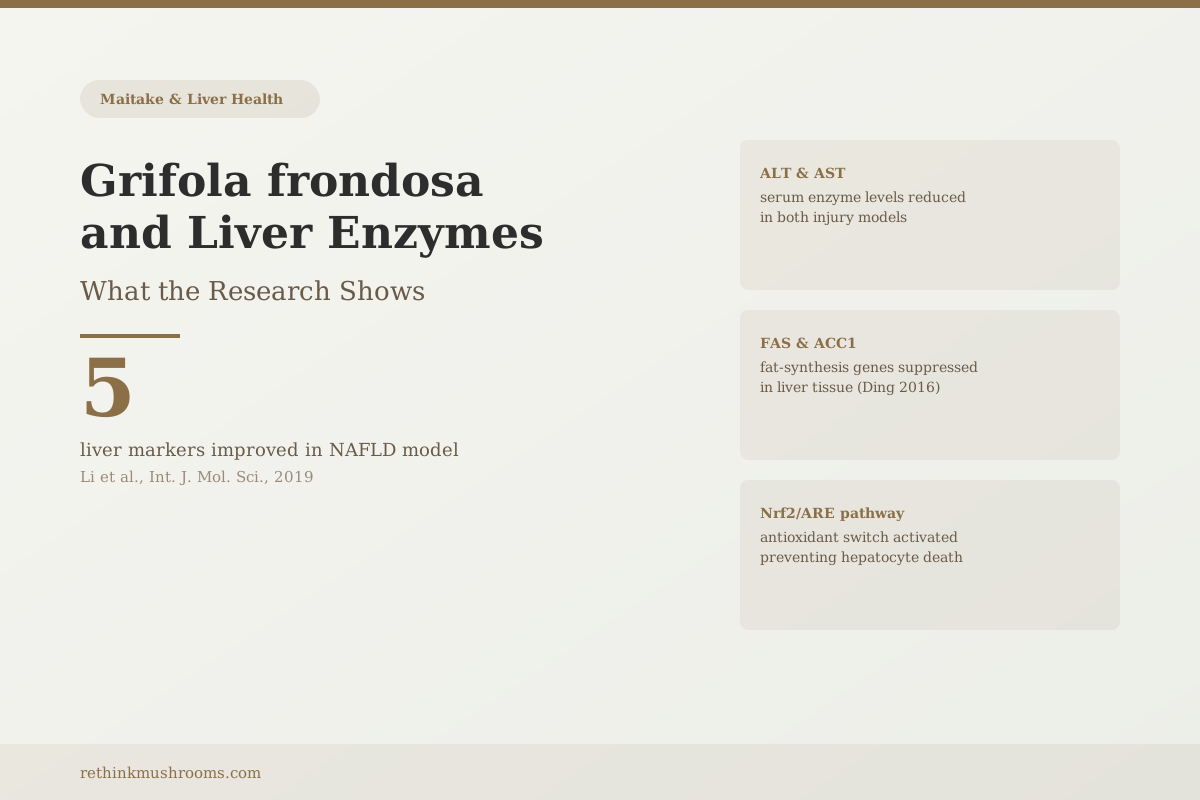
5 liver markers improved
Li et al. (2019) found Grifola frondosa heteropolysaccharide reduced ALT, AST, total cholesterol, triglycerides, and LDL-C while raising protective HDL-C in a NAFLD rat model.
Li et al., International Journal of Molecular Sciences, 2019
2
types of liver injury tested: acute damage and chronic NAFLD
3
distinct liver-protection mechanisms identified across studies
0
human clinical trials specifically measuring maitake's effect on liver enzymes
Li et al., International Journal of Molecular Sciences, 2019
 View as image ↗
Grifola frondosa — the mushroom known as maitake — has demonstrated liver enzyme-lowering effects in multiple animal models of both acute liver injury and chronic fatty liver disease. Meng and colleagues' 2021 study in Food and Function found that Grifola frondosa polysaccharides prevented the surge in liver enzyme levels caused by chemically induced acute liver injury in rats, and identified the specific molecular switch responsible for the protection.[1]
The two liver enzymes tracked in these studies — ALT and AST — are the standard blood markers doctors use when assessing liver health. When liver cells are damaged by fat accumulation, toxic substances, or inflammation, these enzymes leak into the bloodstream and their measured levels rise. Multiple Grifola frondosa studies have targeted exactly this process and shown specific, measurable reductions.
The complete overview of maitake's pharmacology covers the full range of effects. This article focuses specifically on what research shows about liver enzyme regulation: the models tested, the mechanisms identified, and what these findings do and do not establish.
Key Takeaways
- Meng et al. (2021) found Grifola frondosa polysaccharides prevented acute liver injury-induced ALT and AST elevation via the miR-122/Nrf2/ARE signaling axis in rats
- Li et al. (2019) showed GF heteropolysaccharide significantly reduced ALT, AST, total cholesterol, triglycerides, and LDL-C in a high-fat diet NAFLD rat model
- Ding et al. (2016) identified the primary liver lipid mechanism: suppression of FAS and ACC1, the two enzymes that build new fat molecules inside liver cells
- Sato et al. (2013) found dietary maitake upregulated LDL receptor and CYP7A1 genes while downregulating HMG-CoA reductase (the statin target) in mouse liver tissue
- Herasymets et al. (2021) showed maitake thick extract normalized liver indicators in a drug-induced acute hepatitis model
- All direct evidence is from animal studies; no human clinical trials have specifically measured Grifola frondosa's effect on liver enzyme levels
ALT and AST: What These Liver Numbers Actually Mean
ALT (alanine aminotransferase) and AST (aspartate aminotransferase) are enzymes that normally operate inside liver cells. Their job is to help metabolize amino acids as part of normal cellular chemistry.
Under normal conditions, only a small amount of ALT and AST leaks into the bloodstream. Blood levels are typically low and stable. When liver cells are damaged — whether from accumulated fat, a toxic substance, a virus, or chronic inflammation — the cell membranes become more permeable, and these enzymes begin leaking out in larger quantities. Blood tests pick up this increase as elevated ALT or AST.
ALT is more liver-specific than AST. Elevated ALT strongly suggests liver cell damage. Elevated AST can indicate liver damage but also appears with muscle injury and heart conditions. When both are elevated together, liver injury is the most common explanation. In NAFLD specifically, mild-to-moderate ALT elevation is often the first blood marker that alerts doctors to investigate further.
In research on potential liver-protective treatments, measuring whether a treatment prevents ALT and AST from rising in an injury model is a standard way to assess whether it protects liver cells from damage. This is the context for interpreting the Grifola frondosa studies.
Grifola frondosa liver enzyme research has tested two distinct injury scenarios: acute liver injury, where a chemical insult rapidly damages liver cells; and chronic liver damage from high-fat diet-induced NAFLD, where fat accumulation gradually impairs liver function over weeks.
Acute Liver Injury: How Maitake Polysaccharides Block the Enzyme Spike
Meng and colleagues' 2021 study in Food and Function used a well-established acute liver injury model: rats received injections of lipopolysaccharide (a bacterial membrane component) plus D-galactosamine (a sugar compound that specifically sensitizes the liver to inflammatory damage).[1] This combination produces a rapid, severe spike in liver enzymes that mimics what happens during sepsis-related liver injury.
Rats pretreated with Grifola frondosa polysaccharides showed significantly lower AST and ALT levels after the injury compared to untreated controls. The study went further and identified the molecular mechanism.
The protection worked through a pathway involving microRNA-122 (a genetic regulator that controls which genes are active in liver cells) and Nrf2 (a protein that acts as the main switch for the cell's antioxidant defense system). When the bacterial toxin struck, it would normally trigger excessive cell death via oxidative stress — a process where unstable molecules damage proteins and membranes faster than the cell can repair them. The Grifola frondosa polysaccharides kept the Nrf2 switch activated, maintaining the cell's antioxidant defenses at a level that prevented the cascade from becoming fatal.
Herasymets and colleagues (2021) tested a different acute model: drug-induced hepatitis caused by paracetamol (acetaminophen) in rats, directly analogous to the liver stress that occurs during medication overdose.[5] Maitake thick extract normalized liver indicators in this model and showed hepatoprotective, antioxidant, and cell-protective properties. The results were consistent with the Meng findings: Grifola frondosa appears to buffer the liver against chemically induced acute damage.
Chronic Enzyme Elevation: What NAFLD Models Show
Acute injury models test rapid, dramatic liver damage. NAFLD models test what happens over weeks of high-fat diet feeding — the gradual accumulation of fat inside liver cells that represents the most common form of liver disease in developed countries.
Li and colleagues' 2019 study in the International Journal of Molecular Sciences fed rats a high-fat diet to induce NAFLD, then treated one group with Grifola frondosa heteropolysaccharide (GFP).[2] The treated group showed significant reductions in five liver-related markers compared to the untreated NAFLD group:
- Serum ALT and AST (liver enzyme damage markers) came down
- Total cholesterol and triglycerides (lipids that accumulate in the liver) were reduced
- LDL-C (the lipoprotein form of cholesterol associated with liver fat accumulation) decreased
At the same time, protective HDL-C increased, and the antioxidant enzymes SOD and GSH-Px rose — both indicating improved cellular stress management inside liver tissue.
The study also measured gene expression in the liver and found that GFP treatment downregulated Cyp4a1 (a gene whose high activity is linked to liver cell injury under fat overload) and upregulated Cyp7a1 (the gene that converts excess cholesterol into bile acid for elimination — essentially the liver's mechanism for clearing cholesterol out of the body).
The Li study also documented simultaneous changes in gut microbiota composition, suggesting that part of the liver protection worked indirectly: the polysaccharides changed the gut bacterial environment in ways that reduced the amount of fat being transported to the liver in the first place. The gut-liver axis mechanism is explored in more depth in Maitake for Fatty Liver Disease: NAFLD Research.
The Gene-Level Evidence: What Happens Inside Liver Cells
The most mechanistically specific liver enzyme study comes from Ding and colleagues, published in Frontiers in Microbiology in 2016.[3] Using hyperlipidemic rats, Ding's team measured exactly which genes changed in liver tissue after Grifola frondosa treatment.
Two genes showed the most significant downregulation:
FAS (fatty acid synthase) is the enzyme that assembles new fat molecules inside liver cells. When cells take in too much glucose or fructose, they convert the excess into fat using FAS. High FAS activity is a primary driver of liver fat accumulation. Grifola frondosa treatment significantly reduced FAS gene expression, meaning liver cells were building less new fat.
ACC1 (acetyl-CoA carboxylase 1) is the enzyme that performs the first step in the same fat-building process — it creates the raw material that FAS then uses. Suppressing ACC1 at this upstream step compounds the effect: less raw material means FAS has less to work with even if its own activity remains unchanged.
Together, FAS and ACC1 suppression represents inhibition of what scientists call de novo lipogenesis — the liver's process of building new fat molecules from scratch. This is the dominant pathway through which dietary sugar and excess calories become liver fat.
Sato and colleagues (2013) measured hepatic gene expression in cholesterol-fed mice, finding a complementary set of changes.[4] Dietary maitake:
- Upregulated the LDL receptor gene, which pulls LDL-cholesterol out of the bloodstream and into liver cells for processing
- Upregulated CYP7A1, the gene encoding the enzyme that converts cholesterol into bile acid — the liver's main route for eliminating excess cholesterol
- Downregulated HMG-CoA reductase, the liver enzyme that controls the rate of cholesterol synthesis. This is the same enzyme blocked by statin medications
These are three separate gene-level changes, each reducing the overall burden of cholesterol on the liver from a different angle.
The liver enzyme and lipid-metabolism findings in these two studies are explored further in Maitake and Hepatic Lipid Metabolism: Research on Fatty Liver Prevention.
What the Broader Evidence Base Shows
Wu and colleagues' 2021 comprehensive review of Grifola frondosa bioactives in Foods confirmed the hepatoprotective activity as one of the best-supported pharmacological properties of this mushroom, attributing the effects primarily to the beta-glucan and polysaccharide fractions.[6]
Camilleri and colleagues' 2024 comprehensive review in Heliyon identified hepatoprotective and lipid-regulating activity as among the most consistently documented pharmacological properties across the maitake literature, spanning studies from the 1990s through 2024.[7]
The consistency across multiple research groups, multiple animal models, and multiple bioactive fractions (heteropolysaccharides in Li 2019, polysaccharides in Meng 2021, whole fruit body in Sato 2013 and Herasymets 2021) strengthens confidence that the liver enzyme effects are real and not an artifact of one particular experiment.
The broader liver health picture, including the anti-inflammatory mechanisms that complement enzyme regulation, is in Maitake and Liver Health: Hepatoprotective Effects. For comparison with Reishi's liver evidence, Reishi for Liver Health: Hepatoprotective Research covers parallel mechanisms in a related medicinal mushroom.
What This Evidence Does and Doesn't Show
All direct Grifola frondosa liver enzyme evidence comes from animal studies. No human clinical trial has specifically measured maitake's effect on ALT, AST, or other liver enzyme levels.
This matters for how to interpret the findings. Animal liver models are well-validated for studying hepatoprotective mechanisms — the FAS/ACC1 pathway, the Nrf2/ARE axis, and the Cyp4a1/Cyp7a1 gene regulation are all conserved between rodents and humans. The mechanisms identified are biologically plausible and consistent with what is known about liver fat accumulation in human NAFLD.
But whether the specific enzyme reductions seen in rat models translate to clinically meaningful effects in humans — and at what dose and duration — has not been tested. The studies used extracted polysaccharide fractions at doses not directly comparable to what is typically available in food or standard supplement form.
The honest characterization: Grifola frondosa has demonstrated specific, mechanistically coherent liver enzyme-lowering effects in multiple preclinical models. The evidence is strong enough to make this one of the better-supported hepatoprotective claims in the medicinal mushroom literature. Whether it will survive clinical testing is unknown.
The pharmacology of Grifola frondosa provides the mechanistic framework for understanding how these liver effects fit within the broader biological profile of maitake.
The Bottom Line
Grifola frondosa polysaccharides have reduced ALT and AST in both acute liver injury and NAFLD animal models through at least three distinct mechanisms: activating the Nrf2 antioxidant pathway to prevent cell death, suppressing FAS and ACC1 to reduce hepatic fat synthesis, and upregulating CYP7A1 to increase cholesterol elimination. The evidence is mechanistically specific and consistent across multiple research groups, but the entire evidence base is preclinical. No human clinical trial has measured Grifola frondosa's effect on liver enzyme levels.
Frequently Asked Questions
Sources & References
- 1RTHM-01405·Meng, Meng et al. (2021). “The polysaccharides from the Grifola frondosa fruiting body prevent lipopolysaccharide/D-galactosamine-induced acute liver injury via the miR-122-Nrf2/ARE pathways..” Food & function.Study breakdown →PubMed →↩
- 2RTHM-01089·Li, Xin et al. (2019). “The Positive Effects of Grifola frondosa Heteropolysaccharide on NAFLD and Regulation of the Gut Microbiota..” International journal of molecular sciences.Study breakdown →PubMed →↩
- 3RTHM-00778·Ding, Yinrun et al. (2016). “The Mechanisms Underlying the Hypolipidaemic Effects of Grifola frondosa in the Liver of Rats..” Frontiers in microbiology.Study breakdown →PubMed →↩
- 4RTHM-00551·Sato, Mayumi et al. (2013). “Effect of dietary Maitake (Grifola frondosa) mushrooms on plasma cholesterol and hepatic gene expression in cholesterol-fed mice..” Journal of oleo science.Study breakdown →PubMed →↩
- 5RTHM-01366·Herasymets, Iryna et al. (2021). “Application of the thick extract from Maitake mushrooms for correction of metabolic disorders under the paracetamol hepatitis in rats..” Polski merkuriusz lekarski : organ Polskiego Towarzystwa Lekarskiego.Study breakdown →PubMed →↩
- 6RTHM-01455·Wu, Jian-Yong et al. (2021). “Bioactive Ingredients and Medicinal Values of Grifola frondosa (Maitake)..” Foods (Basel.Study breakdown →PubMed →↩
- 7RTHM-01862·Camilleri, Emma et al. (2024). “Unveiling the full spectrum of maitake mushrooms: A comprehensive review of their medicinal, therapeutic, nutraceutical, and cosmetic potential..” Heliyon.Study breakdown →PubMed →↩