Maitake & Liver Health
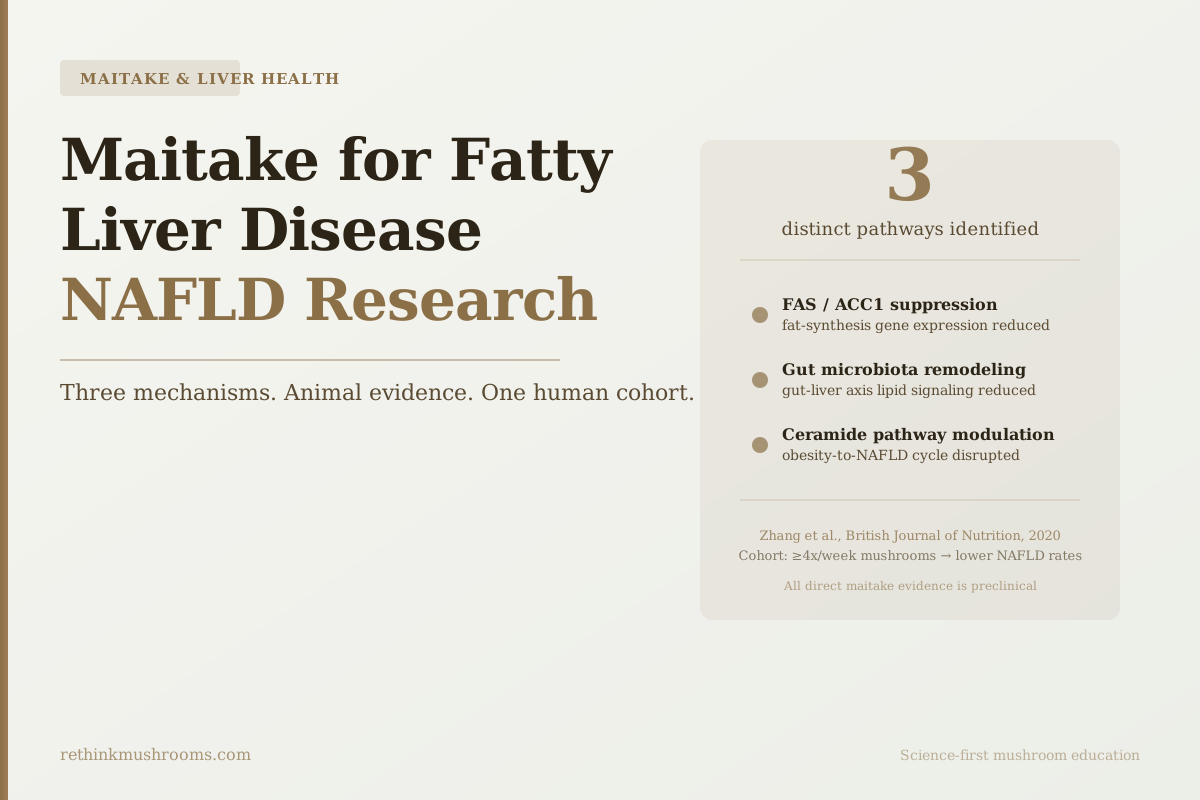
3 distinct mechanisms
Animal studies show Grifola frondosa polysaccharides reduce liver fat through three separate pathways — and a large human cohort found that eating mushrooms four or more times a week was associated with significantly lower rates of newly diagnosed fatty liver disease.
Zhang et al., British Journal of Nutrition, 2020
FAS + ACC1 suppressed
key fat-synthesis genes turned down by GF extracts (Ding et al., 2016)
Gut microbiota remodeled
dual pathway: direct lipid regulation + microbiome-liver axis (Li et al., 2019)
Ceramide pathway identified
novel mechanism linking obesity to hepatic fat accumulation (Jiang et al., 2021)
Zhang et al., British Journal of Nutrition, 2020
 View as image ↗
In a study tracking tens of thousands of adults in China, people who ate mushrooms at least four times a week were significantly less likely to be newly diagnosed with non-alcoholic fatty liver disease (NAFLD) than people who ate them rarely.[1] That was general mushroom consumption, not maitake specifically. But maitake (Grifola frondosa) has the most mechanistically detailed research explaining why mushroom polysaccharides might protect the liver from fat accumulation in the first place.
Grifola frondosa polysaccharides reduce liver fat accumulation in animal models of NAFLD through three documented pathways: suppression of fat-synthesis genes, gut microbiota remodeling, and ceramide signaling modulation. One large human cohort study found frequent mushroom intake associated with significantly lower NAFLD rates.
What follows is a breakdown of the specific studies, what each found, and where the evidence genuinely runs out.
Key Takeaways
- A large Chinese cohort (Zhang et al., British Journal of Nutrition, 2020) found adults eating mushrooms four or more times per week had significantly lower rates of newly diagnosed NAFLD — the only population-level human data on this question
- Li et al. (International Journal of Molecular Sciences, 2019) showed GF heteropolysaccharides reduced liver enzymes (ALT, AST), blood triglycerides, and LDL cholesterol in NAFLD rats, while simultaneously remodeling gut bacteria composition
- Ding et al. (Frontiers in Microbiology, 2016) identified the molecular mechanism: GF extracts significantly reduced mRNA expression of FAS and ACC1, the two enzymes the liver uses to build fat from scratch
- A separate Li et al. study (Food & Function, 2019) found GF polysaccharides reduce liver fat through both direct lipid regulation and gut microbiota changes, demonstrating a dual mechanism
- Jiang et al. (Food & Function, 2021) identified ceramide modulation as a novel third pathway, linking maitake's effects on obesity to its effects on hepatic fat accumulation
- No human clinical trials have specifically tested maitake for NAFLD; the Zhang 2020 cohort covered mixed mushroom intake across many species, not maitake alone
The Only Human Evidence: Eating Mushrooms 4+ Times a Week and NAFLD Risk
Before getting into mechanistic detail, it helps to establish what human evidence actually exists.
Zhang et al. analyzed data from the Tianjin Chronic Low-Grade Systemic Inflammation and Health cohort study, a large Chinese population dataset.[1] They compared mushroom consumption habits in adults with newly diagnosed NAFLD against those without the diagnosis. The finding: eating mushrooms four or more times a week was associated with significantly lower NAFLD prevalence, even after adjusting for other dietary factors and metabolic variables.
The caveat matters, and it matters a lot: this study covered general mushroom consumption, not maitake specifically. Participants ate whatever mushrooms were common in their Chinese diet — shiitake, oyster, wood ear, and others. You cannot extract a maitake-specific effect from a mixed-mushroom dataset.
But the finding still matters as context. It's the only population-level human data linking mushroom intake to NAFLD rates. And when you read it alongside the mechanistic animal research showing how mushroom polysaccharides reduce liver fat, both lines of evidence point in the same direction.
The gap in the evidence base is real: no human randomized controlled trial has specifically tested maitake for NAFLD outcomes. That trial does not yet exist. What exists is a coherent mechanistic picture from animal studies and a population-level association from humans eating mixed mushrooms.
How Maitake Polysaccharides Shut Down the Liver's Fat Factory
The liver makes fat. That's normal physiology. The problem in NAFLD is that the liver produces far more fat than it can export or burn, so fat droplets accumulate inside liver cells. The biological process driving that overproduction is called de novo lipogenesis, which means the liver converting excess carbohydrates and other substrates into fatty acids from scratch.
Two enzymes run this process: fatty acid synthase (FAS) and acetyl-CoA carboxylase 1 (ACC1). In fatty liver disease, both enzymes are overactive. The liver keeps assembling fat even when fat storage is already excessive.
Ding et al. (2016) tested whether Grifola frondosa extracts could change this in hyperlipidemic rats.[3] Their finding: GF significantly reduced the gene-level instructions (mRNA expression) for both FAS and ACC1 in liver tissue. Maitake didn't merely move fat out of the liver — it turned down the biological instruction to make fat in the first place.
This specificity matters. Many compounds that reduce liver fat work by increasing fat export or fat burning. What Ding identified was suppression of the production line itself, at the level of gene expression.
Li et al. (International Journal of Molecular Sciences, 2019) extended this into a purpose-built NAFLD model.[2] Rats fed a high-fat diet developed fatty liver, elevated liver enzymes, and abnormal blood lipid profiles — mimicking human NAFLD. Treatment with Grifola frondosa heteropolysaccharides (GFP) produced significant reductions in ALT (alanine aminotransferase), AST (aspartate aminotransferase), total cholesterol, triglycerides, and LDL cholesterol, alongside increases in HDL cholesterol and antioxidant markers (superoxide dismutase and glutathione peroxidase).
ALT and AST are the standard blood tests your doctor uses to assess liver stress — elevated levels signal that liver cells are being damaged. Reduction in both markers suggests the liver is under less stress. For more on how maitake affects these specific enzyme levels, see Grifola frondosa and Liver Enzyme Regulation.
Beyond the enzyme and lipid numbers, Li et al. also measured two liver metabolism genes. Cyp4a1, which is overexpressed in injured liver cells and associated with hepatocellular damage, was downregulated by GFP treatment. Cyp7a1, which converts excess cholesterol into bile acids for excretion, was upregulated. These gene changes form a coherent story: maitake's compounds appear to both slow fat production and accelerate cholesterol clearance in the liver at the same time.
The Gut-Liver Connection: Why the Bacteria in Your Intestines Matter for Fatty Liver
One finding absent from every competitor article on this topic: Grifola frondosa polysaccharides change the composition of gut bacteria, and that change appears to be part of how they protect the liver.
The gut-liver connection in NAFLD is well-established in research. When the community of bacteria living in the intestines is out of balance — a state called dysbiosis — harmful bacterial products can leak through the gut wall and travel to the liver via the portal circulation, where they trigger inflammation and promote fat storage. Restoring healthy gut bacteria is one of the active frontiers in NAFLD research.
Li et al. (Food & Function, 2019) — a separate study from the same research group, testing a different GF preparation — showed that Grifola frondosa polysaccharides reduced hepatic lipid accumulation and improved blood lipid profiles in high-fat diet rats, at the same time that they measurably restored gut microbiota balance.[4] The gut microbiota restoration tracked with the liver improvements, suggesting the two effects are linked rather than coincidental.
Fontes et al. (2022) reviewed the broader literature on mushroom-enriched diets and NAFLD pathology.[5] Their analysis covers the full pathological picture: mushroom compounds appear to improve insulin resistance, reduce fat droplet accumulation in liver cells (hepatic steatosis), reduce oxidative stress, and dampen inflammation. The review emphasizes gut microbiota modulation as a central mechanism connecting these effects — not a secondary finding.
This dual mechanism matters because it means GF polysaccharides may address NAFLD from two directions at once. The direct pathway suppresses fat synthesis gene expression in liver cells. The indirect pathway reshapes the gut bacteria population that sends inflammatory signals to the liver via the blood supply. For a deeper look at the lipid metabolism side of this picture, see Maitake and Hepatic Lipid Metabolism: Research on Fatty Liver Prevention.
The Ceramide Pathway: Maitake's Novel Connection to the Obesity-NAFLD Cycle
Most people understand that obesity significantly increases NAFLD risk. But the molecular bridge between excess body fat and liver fat accumulation runs through a specific signaling compound called ceramide — and Jiang et al. (2021) found that maitake affects it.[6]
Ceramide is a type of fat molecule that the body also uses as a biological signal. When ceramide accumulates beyond normal levels, it promotes insulin resistance, signals fat cells to release more fat into the bloodstream, and drives inflammatory damage in liver cells. It sits at the intersection of obesity, insulin resistance, and fatty liver disease — not a downstream consequence, but a mediating cause.
Jiang's team fed mice a high-fat diet until they developed obesity and visible liver fat accumulation, then treated them with Grifola frondosa extract. The mushroom reduced body weight, reduced hepatic fat, and measurably modulated ceramide metabolism. This was the first study to identify the ceramide pathway as a molecular target of maitake's liver effects.
The practical implication of this finding is that maitake may not need to directly reach the liver to affect it. By modulating ceramide in adipose tissue and systemically, the mushroom could be influencing the signal that tells the liver to accumulate fat — addressing the disease mechanism upstream of where most studies look.
Lo (2021) adds context on a related signaling cascade.[7] That review covers how mushroom compounds activate AMPK, a cellular protein that functions as an energy-sensing switch. When AMPK is activated, it suppresses SREBP-1c (a gene regulator that normally turns on fat production) and increases PPARα activity (which promotes fat burning rather than fat storage). This AMPK pathway operates in the liver, and it converges with the ceramide and FAS/ACC1 findings to form a coherent multi-target picture. For a comparison with how another hepatoprotective mushroom addresses the same NAFLD pathology, see Reishi and Non-Alcoholic Fatty Liver Disease: Emerging Evidence.
Blood Sugar, Blood Pressure, and Fatty Liver: The Multi-System Picture
NAFLD doesn't develop in isolation from the rest of metabolic health. It's closely entangled with elevated blood pressure, impaired blood sugar regulation, and metabolic syndrome — and research on maitake's effects on these systems adds important context.
Preuss et al. (2010) followed aging female rats treated with maitake extract over an extended period.[8] The treated rats showed reduced blood pressure, improved glucose handling, and amelioration of other chronic metabolic disturbances compared to controls. While this study wasn't designed to measure liver fat specifically, the metabolic profile it documents — better blood pressure, better glucose metabolism — describes exactly the conditions that drive NAFLD progression in humans.
This systemic picture supports the idea that maitake's liver effects aren't an isolated phenomenon. The same metabolic pathways that maitake appears to affect in animal models are the pathways that make someone susceptible to fatty liver in the first place. For a broader view of the pharmacology behind these effects, see The Pharmacology of Grifola frondosa: How Maitake Works.
The connection to compounds found within maitake itself is also worth noting. Ergothioneine, a sulfur amino acid found in measurable amounts in maitake, has its own body of research on liver protection and NAFLD. For that angle, see Ergothioneine and NAFLD: Fatty Liver Protection.
What the Evidence Actually Means, and Where It Runs Out
The research on maitake and NAFLD has genuine substance. Three independent animal studies using different preparations of Grifola frondosa (heteropolysaccharide GFP, standard polysaccharides, and whole fruit body extract) converge on the same basic finding: reduced liver fat, improved liver enzymes, and changes to the metabolic genes governing fat synthesis. That consistency across different labs, preparations, and animal models adds more weight to the preclinical case than any single study would alone.
But the evidence has real limits that anyone reading this deserves to know:
All direct maitake NAFLD research is in animals. Rats and mice with diet-induced fatty liver are useful research tools, but they don't map cleanly onto human NAFLD. Human fatty liver disease develops over years or decades through a combination of genetic predisposition, dietary patterns, microbiome composition, and other lifestyle factors that no animal model fully captures. Effects that are clear and measurable in a controlled animal study may be smaller, absent, or different in the context of human disease.
The one piece of human data covers mixed mushrooms. Zhang et al. (2020) found lower NAFLD prevalence in frequent mushroom eaters, but the study captured everything people were eating — shiitake, oyster mushrooms, wood ear, and others. Maitake contributes no separate signal in that dataset. You cannot attribute the association to any single mushroom species.
No established dose or duration. The animal studies used different preparations at different doses over different time periods. There is no human clinical data from which to derive a dose or treatment duration for NAFLD outcomes.
No human RCTs exist for this indication. This isn't a reason to dismiss the preclinical evidence, but it is the reason why any claim about what maitake "does" to human fatty liver disease would be premature.
The honest summary: maitake has a mechanistically coherent case for reducing liver fat accumulation, supported by multiple independent animal studies identifying three distinct pathways, and consistent with the direction of the only available human cohort data. Whether those animal findings translate to human NAFLD, at what dose, and over what duration, are genuinely open questions.
For a broader overview of maitake's liver-protective research beyond NAFLD specifically, see Maitake and Liver Health: Hepatoprotective Effects and Maitake and Liver Inflammation: Preclinical Evidence.
The Bottom Line
Multiple animal studies show that Grifola frondosa polysaccharides reduce liver fat accumulation through three documented pathways: suppression of fat-synthesis gene expression (FAS and ACC1), restoration of gut microbiota balance that reduces hepatic lipid signaling, and modulation of ceramide — a fat-signaling molecule linking obesity to liver fat accumulation. A large human cohort found that eating mushrooms four or more times a week was associated with significantly lower NAFLD rates, though that data covers mixed mushroom intake. No human clinical trials have specifically tested maitake for NAFLD outcomes.
Frequently Asked Questions
Sources & References
- 1RTHM-01314·Zhang, Shunming et al. (2020). “Association between edible mushroom intake and the prevalence of newly diagnosed non-alcoholic fatty liver disease: results from the Tianjin Chronic Low-Grade Systemic Inflammation and Health Cohort Study in China..” The British journal of nutrition.Study breakdown →PubMed →↩
- 2RTHM-01089·Li, Xin et al. (2019). “The Positive Effects of Grifola frondosa Heteropolysaccharide on NAFLD and Regulation of the Gut Microbiota..” International journal of molecular sciences.Study breakdown →PubMed →↩
- 3RTHM-00778·Ding, Yinrun et al. (2016). “The Mechanisms Underlying the Hypolipidaemic Effects of Grifola frondosa in the Liver of Rats..” Frontiers in microbiology.Study breakdown →PubMed →↩
- 4RTHM-01084·Li, Lu et al. (2019). “Grifola frondosa polysaccharides ameliorate lipid metabolic disorders and gut microbiota dysbiosis in high-fat diet fed rats..” Food & function.Study breakdown →PubMed →↩
- 5RTHM-01515·Fontes, Adriana et al. (2022). “Mushrooms on the plate: Trends towards NAFLD treatment, health improvement and sustainable diets..” European journal of clinical investigation.Study breakdown →PubMed →↩
- 6RTHM-01369·Jiang, Xue et al. (2021). “Anti-obesity effects of Grifola frondosa through the modulation of lipid metabolism via ceramide in mice fed a high-fat diet..” Food & function.Study breakdown →PubMed →↩
- 7RTHM-01398·Lo, Hui-Chen (2021). “Bioactive Components and Possible Activities of Medicinal Mushrooms in Alleviating the Pathogenesis of Nonalcoholic Fatty Liver Disease (Review)..” International journal of medicinal mushrooms.Study breakdown →PubMed →↩
- 8RTHM-00196·Preuss, Harry G et al. (2010). “Maitake mushroom extracts ameliorate progressive hypertension and other chronic metabolic perturbations in aging female rats..” International journal of medical sciences.Study breakdown →PubMed →↩