King Trumpet / King Oyster (Pleurotus eryngii)
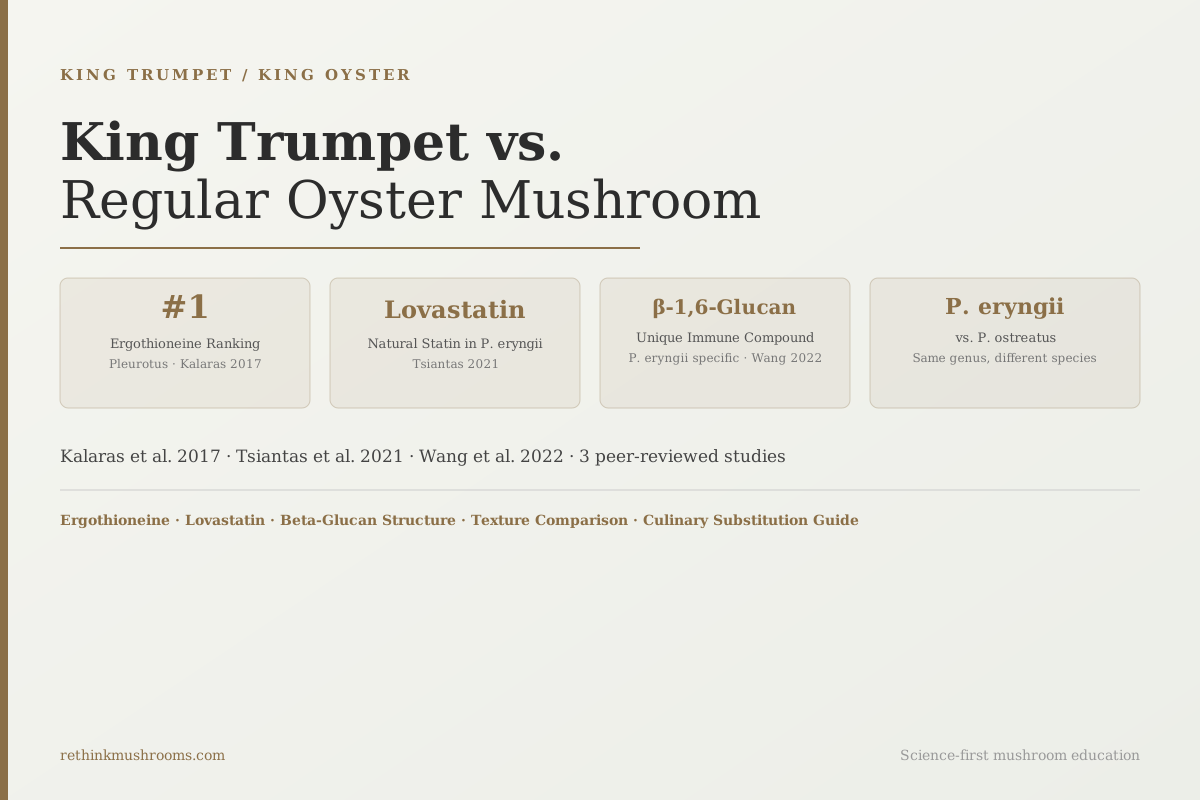
#1 ergothioneine
Among 13 mushroom species tested, Pleurotus species including king trumpet ranked highest in ergothioneine — the mitochondria-targeted antioxidant found almost exclusively in fungi and their soil bacteria.
Kalaras et al., Food Chemistry, 2017
β-1,6-glucan
King trumpet's unique immune compound documented in research (Wang et al. 2022)
Lovastatin
Natural statin quantified in P. eryngii but not prominently in pearl oyster (Tsiantas 2021)
P. eryngii
vs. P. ostreatus — same genus, different species, different nutritional profiles
Kalaras et al., Food Chemistry, 2017
 View as image ↗
Walk into any well-stocked grocery store and you might find three or four mushrooms labeled something like "oyster mushroom." One has thick white stems and a small brown cap. Another has large, fan-shaped silvery-blue caps clustered in a bunch. A third is golden. A fourth is small and delicate. These are not the same mushroom — and the one with the thick white stem is an entirely different species from the others.
King trumpet (Pleurotus eryngii) is not a type of oyster mushroom in the way that a golden oyster is a type of oyster mushroom. It is a distinct species within the same genus, with a different anatomy, different texture, different culinary behavior, and a different nutritional profile. The confusion in naming is real, widespread, and genuinely matters if you are choosing between them for health or cooking reasons.
This article clarifies the differences using primary research where they exist. For a complete look at what king trumpet offers on its own, the full king trumpet guide covers its biology and evidence base in depth.
Key Takeaways
- King trumpet (Pleurotus eryngii) and regular oyster mushroom (Pleurotus ostreatus) are different species in the same genus. "King oyster" and "king trumpet" refer to P. eryngii; "pearl oyster," "blue oyster," or "gray oyster" refer to P. ostreatus.
- P. eryngii has a thick, meaty white stem (stipe) with a small cap; P. ostreatus has a large fan-shaped cap with a thin, off-center stem that is rarely eaten.
- In a 13-species comparison, Pleurotus species including king trumpet ranked highest in ergothioneine — a mitochondria-targeted antioxidant almost exclusive to fungi.[1]
- Tsiantas and colleagues quantified ergothioneine and lovastatin in Pleurotus species — P. eryngii contains measurable natural lovastatin, the same compound targeted by prescription cholesterol-lowering drugs.[2]
- Wang and colleagues identified a β-1,6-glucan from P. eryngii with specific immune-modulating and gut microbiota effects — a structural variant not prominently documented in P. ostreatus.[3]
- For most culinary applications, king trumpet and oyster mushrooms can substitute for each other, but their different moisture content and texture mean different cooking times and methods produce the best results.
Same Genus, Different Species: Why the Naming Is So Confusing
Both mushrooms belong to the genus Pleurotus, which contains more than 40 recognized species worldwide. "Oyster mushroom" is a common name applied to many of them based on their typical shape: a lateral cap that looks like an oyster shell. The problem is that this description fits most species in the genus and nothing else about them is interchangeable.
The species relevant to this comparison:
Pleurotus eryngii — king trumpet, king oyster, king brown, trumpet royale, French horn mushroom. This species is native to the Mediterranean, Middle East, and Central Asia, where it grows in the wild on the roots of Eryngium plants (sea holly). It is now cultivated commercially worldwide. It grows as an individual mushroom rather than in clusters. Its most distinctive feature is a large, dense white stipe (stem) that can reach several centimeters in diameter — far thicker than any other commercial Pleurotus species. The cap is small relative to the stem, typically brown or tan, and sits atop the stem rather than extending laterally.
Pleurotus ostreatus — pearl oyster, gray oyster, blue oyster. This is the mushroom most people mean when they say "oyster mushroom" without qualification. It grows in clusters on dead or dying hardwood, with large fan-shaped gray-to-white caps arranged in overlapping tiers. The stem is thin, firm, and off-center. It is cultivated on straw, sawdust, or logs.
Other species in the genus — golden oyster (P. citrinopileatus), pink oyster (P. djamor), phoenix oyster (P. pulmonarius) — each have their own profiles. None of them are king trumpet.
The name "king oyster" for P. eryngii is itself somewhat misleading. It is not an oyster mushroom that grew larger. It has different wild habitat, different morphology, and different chemistry. The "king" distinguishes it from other Pleurotus species, but the "oyster" creates a taxonomic implication that does not hold at the species level.
The Appearance and Texture Difference That Matters Most in the Kitchen
The physical difference between king trumpet and oyster mushroom is immediately visible and directly relevant to how each is cooked.
King trumpet has almost all of its mass in the stipe. The stem is white, dense, smooth, and firm. It holds its structure during high-heat cooking — it does not collapse or release large amounts of moisture immediately when exposed to a hot pan. Sliced crosswise into rounds, the flesh resembles a scallop. Sliced lengthwise into planks, it can be treated as a meat substitute. Scored and seared, the cut surface develops a golden crust while the interior stays tender.
The cap of king trumpet is small relative to the stem, typically 2-5 cm across, with a slightly fibrous texture distinct from the stipe. It is edible but less valued than the stem.
Regular oyster mushroom is almost all cap. The fan-shaped caps can reach 15-20 cm across and contain significant moisture. When added to a hot pan, they release water rapidly before caramelizing — requiring either high heat and space or sequential cooking to achieve browning. The thin stem is edible but noticeably firmer and sometimes stringy; many recipes instruct to remove it. The texture when cooked is silky and tender, with less resistance than king trumpet.
The practical implication for recipe substitution: king trumpet needs longer cooking at higher heat to fully soften its dense stipe. Oyster mushroom cooks quickly and can become watery if the pan is crowded. If you substitute king trumpet in a quick stir-fry designed for oyster mushroom, allow more cooking time and slicing thinner. If you substitute oyster mushroom in a recipe designed for king trumpet steaks or rounds, the texturally distinct result will be softer and less substantial.
Ergothioneine: The Nutritional Gap Between Species
Ergothioneine is an amino acid derivative produced by fungi and some bacteria. Humans cannot synthesize it and obtain it almost exclusively through diet, primarily from mushrooms. It accumulates in tissues throughout the body that face high oxidative stress, particularly in the mitochondria, where it appears to serve a protective function.
In 2017, Kalaras and colleagues measured ergothioneine and glutathione content across 13 mushroom species.[1] Pleurotus species, including king trumpet, ranked among the highest sources of ergothioneine across all species tested. Glutathione was also elevated in mushrooms compared to most other food sources.
In 2021, Tsiantas and colleagues provided species-level quantification of ergothioneine and lovastatin across Pleurotus species using validated analytical methods.[2] The study measured actual compound concentrations in P. eryngii alongside other Pleurotus species, establishing P. eryngii as one of the richest culinary sources of ergothioneine.
Both species contain ergothioneine, as do most mushrooms. The evidence places king trumpet near the top of the culinary species in ergothioneine concentration. The exact numbers differ across growing conditions, preparation, and measurement method, so no single figure applies universally. The directional finding — that P. eryngii is among the best common food sources for ergothioneine — is consistent across multiple analyses.
An important practical note: ergothioneine is heat-stable. Unlike some antioxidants that degrade during cooking, ergothioneine survives typical cooking temperatures. The ergothioneine in a properly cooked king trumpet is substantially present in the cooked mushroom.
For readers interested in the full ergothioneine evidence base, the bioactive compounds article covers the mechanisms and research in depth.
The β-1,6-Glucan: A Structural Distinction With Immune Implications
Beta-glucans are the primary immune-active compound class in mushrooms. Most mushrooms are characterized primarily by β-1,3-1,6-glucans, where the main chain is β-1,3 linkages with β-1,6 side branches. P. eryngii produces a beta-glucan with a predominantly β-1,6-linked backbone, which is a distinct structural configuration.
Wang and colleagues studied this β-1,6-glucan from P. eryngii in 2022, documenting its specific immune effects.[3] The compound activated macrophages and natural killer (NK) cells and promoted increases in beneficial gut bacteria, specifically Lactobacillus and Bifidobacterium species, in the animal models studied.
This structural distinction is relevant to the species comparison because P. ostreatus has not been reported to contain the same β-1,6-linked backbone structure at comparable concentrations. Both species produce beta-glucans. The specific structural variant documented in Wang 2022 is characterized for P. eryngii and represents a point of biochemical differentiation between the species.
This is preclinical (animal model) evidence. The immune effects of P. eryngii's β-1,6-glucan have not been confirmed in human clinical trials. The structural characterization and cell-level effects are established; the translation to human health outcomes is not yet demonstrated.
Natural Lovastatin: Present in King Trumpet, Less Documented in Pearl Oyster
Lovastatin is a naturally occurring compound in the same structural class as prescription statin drugs. Both natural and synthetic statins work by inhibiting HMG-CoA reductase, the enzyme that controls the rate of cholesterol synthesis in the liver.
The Tsiantas 2021 analysis that quantified ergothioneine also measured lovastatin content across Pleurotus species.[2] P. eryngii contains measurable lovastatin. P. ostreatus has been reported to contain lovastatin in other studies at varying concentrations, but the comparative analysis in Tsiantas 2021 specifically characterizes P. eryngii's content in the context of other Pleurotus species.
The concentrations of lovastatin found in mushrooms are substantially lower than therapeutic statin doses used in prescription medicine. Eating king trumpet is not equivalent to taking a cholesterol-lowering drug. The relevance of dietary lovastatin from food sources is still under investigation. It is, however, a genuine bioactive compound that P. eryngii produces and that regular oyster mushroom is less consistently associated with in the literature.
The fuller picture of how this compound works alongside P. eryngii's beta-glucans and ergothioneine appears in the bioactive compounds article for this cluster.
Cooking and Substitution: Can You Use One for the Other?
For many recipes, yes, with adjustment. For some, the textural differences matter enough to choose the right species.
When king trumpet is the better choice:
- Recipes where you want the mushroom to hold shape: mushroom steaks, rounds, "scallops"
- High-heat searing where a dense, firm texture is needed
- Grilling whole or halved
- Dishes where moisture release would affect the final result (risotto, braises where you want texture contrast)
- Long braising or roasting where oyster mushroom would disintegrate
When oyster mushroom is the better choice:
- Quick stir-fries where fast cooking and tender result are wanted
- Dishes where delicate texture is desirable
- Recipes using the full cap surface area (which oyster provides more of relative to stem)
- When availability or cost is a factor (oyster mushrooms are typically less expensive and more widely available)
- Light soups and broths where a softer texture works well
Nutritional substitution guidance:
If you are eating mushrooms specifically for ergothioneine intake, king trumpet appears to provide a higher concentration per gram than pearl oyster mushroom based on the Kalaras 2017 data.[1] If you are looking for the β-1,6-glucan immune compound specifically characterized in P. eryngii, pearl oyster is not the documented source for that particular structure.
For general dietary mushroom benefits, fiber, B vitamins, and antioxidant content, both species are nutritionally valuable. The differences in compound profiles between them reflect genuine biochemical distinctions, but both are among the more nutritious commonly available mushrooms.
Shelf life difference: king trumpet keeps longer than pearl oyster at refrigerator temperatures. The dense stipe loses moisture more slowly. Pearl oyster is more delicate and should be used within a few days of purchase.
For readers interested in how king trumpet's prebiotic fiber compares to other mushroom species in supporting gut bacteria, the species comparison on which mushrooms are the best prebiotics addresses that question directly.
The Verdict: Different Species, Genuinely Different Profiles
King trumpet and regular oyster mushroom are not the same mushroom. They are related, share some compound classes, and can substitute for each other in many recipes. They have different textures, different culinary applications, and different nutritional profiles that are documented in primary research.
King trumpet holds a documented edge in ergothioneine concentration among culinary mushrooms, contains a unique β-1,6-glucan structure, and produces measurable lovastatin. Regular oyster mushroom has its own nutritional qualities and is more delicate in texture and faster to cook.
The naming overlap — "king oyster" for P. eryngii, "oyster mushroom" for P. ostreatus — is a genuine source of confusion that this cluster addresses. The medicinal potential article covers the full evidence base for P. eryngii's health research, including the only human randomized controlled trial conducted on this specific species. The culinary guide covers preparation in depth.
For readers exploring mushrooms for health reasons, species-level identification matters. Knowing which species has been studied for a specific outcome, and whether the form studied was whole mushroom or extract, is the starting point for evaluating any mushroom's evidence base.
The Bottom Line
King trumpet (Pleurotus eryngii) and regular oyster mushroom (Pleurotus ostreatus) are distinct species that share a genus name but differ meaningfully in anatomy, culinary behavior, and nutritional profile. King trumpet ranks among the highest culinary sources of ergothioneine, contains a unique β-1,6-glucan with documented immune effects, and produces measurable natural lovastatin. Pearl oyster mushroom is lighter in texture, faster to cook, and more widely available. Both are nutritionally valuable, but for applications where specific compound content matters, the species distinction is real and research-supported.
Frequently Asked Questions
Sources & References
- 1RTHM-00476·Kalaras, Michael D et al. (2017). “Mushrooms: A rich source of the antioxidants ergothioneine and glutathione..” Food chemistry.Study breakdown →PubMed →↩
- 2RTHM-00725·Tsiantas, Konstantinos et al. (2021). “On the Identification and Quantification of Ergothioneine and Lovastatin in Various Mushroom Species: Assets and Challenges of Different Analytical Approaches..” Molecules (Basel.Study breakdown →PubMed →↩
- 3RTHM-00801·Wang, Xue et al. (2022). “β-1,6-Glucan From Pleurotus eryngii Modulates the Immunity and Gut Microbiota..” Frontiers in immunology.Study breakdown →PubMed →↩