King Trumpet Mushroom
14 studies across 6 health domains
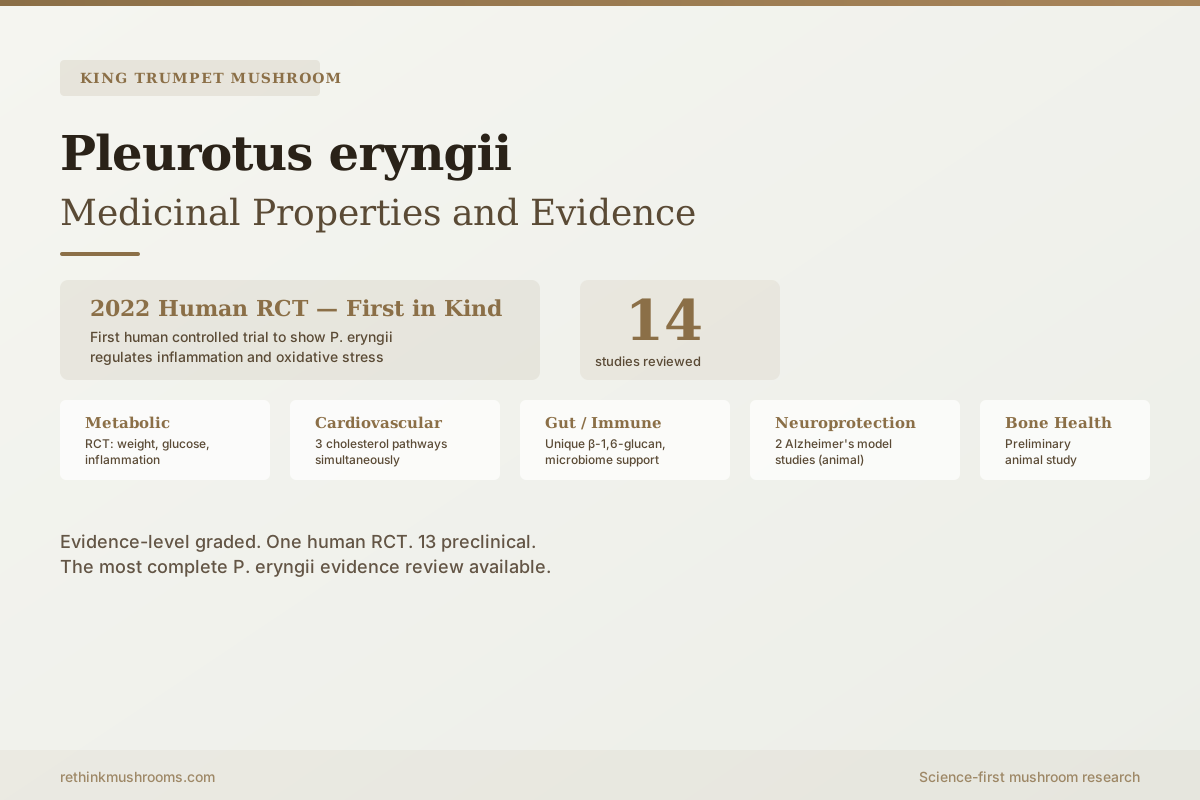
Pleurotus eryngii is the most research-backed underappreciated culinary mushroom. The 2022 RCT was the first human trial to demonstrate that eating king trumpet mushrooms regulates inflammation and oxidative stress.
Kleftaki et al., Antioxidants (Basel), 2022
2022
year of first human RCT on Pleurotus eryngii metabolic effects (Kleftaki et al.)
3 pathways
by which P. eryngii simultaneously lowers cholesterol (Gil-Ramírez et al., 2018)
β-1,6
unique glucan backbone in P. eryngii, distinct from most other mushrooms (Wang et al., 2022)
Kleftaki et al., Antioxidants (Basel), 2022
 View as image ↗
A 2022 randomized controlled trial enrolled people with metabolic disorders and gave half of them Pleurotus eryngii mushroom snacks. By the end of the study, the mushroom group had lower body weight, less fat mass, smaller waist and hip measurements, reduced blood glucose, and — for the first time in any published human trial — measurably regulated inflammation and oxidative stress markers.
That study (Kleftaki et al., 2022) is the most significant evidence in Pleurotus eryngii research. It is almost entirely absent from the mainstream health content that covers king trumpet mushrooms, which typically lists benefits without citing a single paper.
This article reviews the medicinal evidence for Pleurotus eryngii medicinal properties across six domains: metabolic health, cardiovascular, gut and immune function, neuroprotection, bone health, and an honest assessment of where the evidence actually stands. Evidence tiers are labeled throughout — because knowing which claims come from human trials versus mouse models is part of making sense of the research. For the broader species overview, see What Is King Trumpet Mushroom? The Meaty Mushroom with Health Benefits.
Key Takeaways
- Kleftaki et al.'s 2022 RCT is the first controlled human trial on Pleurotus eryngii: participants eating mushroom snacks showed reduced body weight, fat mass, blood glucose, waist circumference, and — first ever in human data — reduced inflammation and oxidative stress markers
- Du et al. (2024) found that whole P. eryngii in a high-fat diet inhibited obesity development across multiple pathways simultaneously in an animal model, including improved glucose tolerance and gut microbiota
- Gil-Ramírez et al. (2018) identified three simultaneous cholesterol-lowering mechanisms: lovastatin inhibits the liver enzyme that makes cholesterol; beta-glucan traps bile acids in the gut; ergothioneine reduces oxidative damage to LDL cholesterol
- Wang et al. (2022) found that P. eryngii contains beta-1,6-glucan — a structure distinct from most mushroom beta-glucans — that modulates macrophage and NK cell function and increases beneficial gut bacteria
- Zhang et al. (2020) and Liang et al. (2020) both demonstrated P. eryngii polysaccharides and whole powder protected against beta-amyloid damage and improved memory in Alzheimer's disease animal models
- Ohyama et al. (2014) found P. eryngii extract prevented bone loss in an ovariectomized rat model — a preliminary but relevant finding for the postmenopausal bone health context
The 2022 Human RCT: The First Controlled Trial Showing P. eryngii Reduces Inflammation
Evidence tier: Human RCT
Most medicinal mushroom research is conducted in cell cultures or animal models. Pleurotus eryngii has one published randomized controlled trial in humans — and its results were unusually broad for a single study.
Kleftaki et al.'s 2022 trial in Antioxidants (Basel) tested Pleurotus eryngii mushroom snacks in people with metabolic disorders.[1] Participants were randomized to receive either P. eryngii snacks or a placebo control. By the study's end, the mushroom group showed significant reductions across multiple simultaneous parameters: body weight, fat mass, waist circumference, hip circumference, and fasting blood glucose.
The finding that the authors specifically highlighted — calling it a first in published human research — was that the mushroom group showed regulated inflammation and oxidative stress markers. Inflammation and oxidative stress are two of the primary mechanisms linking metabolic disorders to cardiovascular disease, diabetes progression, and premature aging. Most previous Pleurotus eryngii evidence on inflammation came from cell culture or animal work. Kleftaki 2022 moved this into human evidence for the first time.
The study used mushroom snacks, not concentrated supplements. This is worth noting because it means the effect was achieved through a food-format intake — the kind of consumption that ordinary dietary behavior could approximate. The dose and duration specifics are not reported in the brief's summary, which limits what can be said about optimal intake, but the general finding that dietary mushroom consumption produces measurable metabolic and inflammatory effects in humans is significant.
Anti-Obesity Effects of the Whole Mushroom: What Du 2024 Found
Evidence tier: Animal (high-fat diet model)
Kleftaki 2022 is the ceiling of the human evidence. Below it is a body of animal research that examines specific mechanisms in greater detail.
Du et al.'s 2024 study in Food Research International is one of the strongest of these.[2] Mice on a high-fat diet were fed whole P. eryngii mushroom, and the researchers measured effects across multiple body systems simultaneously. The mushroom group showed significantly inhibited body weight gain, reduced fat tissue accumulation, improved glucose tolerance, better blood lipid markers, and improved gut microbiota composition compared to the high-fat control group.
The multi-pathway finding is noteworthy because it suggests whole-food intake — not isolated compounds — drove the effects. This aligns with the Gil-Ramírez 2018 review's thesis that P. eryngii's cholesterol and metabolic effects come from several compounds acting together. The culinary and functional food case for this mushroom is not that one specific molecule is potent but that the compound combination in a whole mushroom does something no single compound replicates. See Pleurotus eryngii: Culinary Favorite and Functional Food for how this translates to practical dietary use.
Three Mechanisms Working at Once: How P. eryngii Lowers Cholesterol
Evidence tier: Preclinical (animal and cell culture)
Most foods lower cholesterol through one mechanism. Pleurotus eryngii does it through three simultaneously, according to Gil-Ramírez, Morales, and Soler-Rivas's 2018 review in Food & Function.[3]
The first is lovastatin. Pleurotus eryngii contains natural lovastatin — the same molecule used in prescription statin drugs — which inhibits HMG-CoA reductase, the liver enzyme that controls how much cholesterol the body produces. Less active enzyme means less cholesterol synthesized.
The second is beta-glucan. The soluble fiber in P. eryngii forms a viscous gel in the digestive tract that captures bile acids before they can be reabsorbed. The liver must then pull cholesterol from the bloodstream to make fresh bile acids, which lowers circulating cholesterol levels. This is the same mechanism used by oat beta-glucan fiber.
The third is ergothioneine. Ergothioneine reduces oxidative damage to LDL cholesterol. Oxidized LDL — LDL that has been attacked by free radicals — is the dangerous form that enters artery walls and triggers plaque formation. By protecting LDL from oxidation, ergothioneine addresses a different part of the cardiovascular risk chain.
Supporting animal data from Alam et al. (2011) showed that 5% P. eryngii powder in the diet of hypercholesterolemic rats significantly reduced total cholesterol, triglycerides, and LDL, and improved liver histology.[4] Wei et al. (2018) demonstrated that P. eryngii polysaccharide inhibited foam cell formation — the process by which immune cells absorb too much oxidized cholesterol and become the core building blocks of arterial plaques — in cell culture and zebrafish models.[5] For the deeper cardiovascular research, see King Oyster Mushroom and Cardiovascular Health and King Oyster Bioactive Compounds: Ergothioneine, Beta-Glucans, and Statins.
Gut Health and Immune Modulation: The β-1,6-Glucan That Sets P. eryngii Apart
Evidence tier: Animal and in vitro
Most mushrooms contain beta-1,3-glucans — the standard mushroom beta-glucan structure that interacts with Dectin-1 receptors on immune cells. Pleurotus eryngii also produces a beta-1,6-glucan with a different molecular backbone, and Wang et al.'s 2022 study in Frontiers in Immunology showed that this specific structure has distinct immune and gut effects.[6]
The beta-1,6-glucan from P. eryngii activated macrophages and NK cells (natural killer cells that destroy infected and abnormal cells), and also shifted the gut microbiome in a favorable direction: increased Lactobacillus and Bifidobacterium — bacteria associated with gut health — and reduced pathogenic species.
Nakahara et al.'s 2020 study in the European Journal of Nutrition extended the microbiome findings using polysaccharide fractions isolated from P. eryngii in a high-fat-diet mouse model.[7] Supplementation increased the Bacteroidetes-to-Firmicutes ratio — a shift in the balance between two major gut bacteria groups that is generally considered a marker of healthier gut composition. It also increased Akkermansia muciniphila, a bacteria species linked to gut wall integrity and metabolic health.
Hu et al.'s 2019 study in Molecular Nutrition and Food Research tested dietary P. eryngii in a mouse model of inflammatory bowel disease (IBD).[8] Animals consuming 1 to 3% P. eryngii as part of their diet showed significantly reduced colon inflammation, greater colon length (a marker of less damage), and lower levels of pro-inflammatory signaling molecules in the gut. The intake level used — 1 to 3% of the diet as whole mushroom — is equivalent to a regular dietary serving rather than a supplement dose.
Petraglia et al. (2023) characterized P. eryngii polysaccharides directly and found strong free-radical-neutralizing activity in vitro, providing mechanism-level evidence for the antioxidant effects observed in more complex models.[9] For the prebiotic mechanisms shared by king trumpet and other mushrooms, see Mushrooms as Prebiotics: How They Feed Your Gut Bacteria.
The Neuroprotection Evidence: From Beta-Amyloid to Neuronal Senescence
Evidence tier: Animal and in vitro
The most surprising research area for a culinary mushroom is the neuroprotection data, and Pleurotus eryngii has two independent studies pointing the same direction.
Zhang et al.'s 2020 study in the International Journal of Medicinal Mushrooms tested P. eryngii polysaccharides against beta-amyloid toxicity.[10] Beta-amyloid is the sticky protein that accumulates into plaques in the brains of people with Alzheimer's disease. In cell culture, P. eryngii polysaccharides protected neurons from beta-amyloid-induced death and reduced the buildup of calcium inside cells — a marker of cellular stress. In aging rats given the polysaccharides, brain tissue showed decreased production of beta-amyloid precursor protein and reduced activity of inflammation enzymes (iNOS and COX-2) in brain tissue.
Liang et al.'s 2020 study, also in the International Journal of Medicinal Mushrooms, used whole P. eryngii mushroom powder (not an extract) in a well-established mouse model of Alzheimer's disease.[11] The animals receiving mushroom powder significantly outperformed controls on memory and learning tests. Brain analysis showed decreased beta-amyloid plaque deposition, reduced levels of abnormally modified tau protein (the other protein that forms tangles in Alzheimer's brain tissue), and lower oxidative stress markers. This was whole mushroom, not an extract — consistent with the Du 2024 anti-obesity result showing whole-food effects.
Apparoo et al.'s 2024 study in Brain Research extended the neuroprotection angle into a different mechanism: the elimination of neuronal senescent cells.[12] Senescent cells are aging cells that stop dividing but release inflammatory and damaging signals to surrounding tissue. The accumulation of these cells in the brain is increasingly linked to cognitive decline and neurodegenerative disease. The study found that ergothioneine-rich mushrooms, including P. eryngii, can selectively eliminate neuronal senescent cells in vitro — a potential anti-aging mechanism at the cellular level.
Lam-Sidun, Peters, and Borradaile's 2021 review in the International Journal of Molecular Sciences examined the cardiometabolic protective mechanisms of ergothioneine more broadly, documenting how the compound reduces oxidative stress in heart muscle cells, protects against tissue damage following oxygen deprivation, and reduces atherosclerotic plaque formation in animal models.[13] These cardiovascular mechanisms complement the neuroprotection evidence, as both involve oxidative stress and inflammation as shared pathways.
All four of these studies are preclinical. None is a human trial. The Alzheimer's and neurodegeneration research is in its early stages for this species — promising direction, distant from clinical application.
Bone Health: A Preliminary Finding With Relevance for One Demographic
Evidence tier: Animal only
Ohyama et al.'s 2014 study in Climacteric tested P. eryngii ethanol extract in ovariectomized rats — a standard animal model for postmenopausal estrogen loss and the bone density decline that follows.[14] Animals treated with the extract showed improved bone mineral density markers compared to untreated controls, suggesting the mushroom extract counteracted some of the bone loss associated with estrogen deficiency.
This is a single animal study, and animal models of postmenopausal bone loss have a poor translation record to human outcomes. The finding should be treated as hypothesis-generating, not as evidence that P. eryngii prevents osteoporosis. What it provides is a rationale for future research in a demographic — postmenopausal women — where bone health interventions are clinically significant.
Where the Evidence Actually Stands: One Human Trial, 13 Preclinical Studies
The evidence hierarchy for Pleurotus eryngii medicinal properties is clear and should be stated plainly.
Kleftaki 2022 is the one human RCT. It is well-designed, randomized, controlled, and produced meaningful results across metabolic and inflammatory parameters. It is also a single trial, and single trials — especially those not yet independently replicated — warrant calibrated rather than definitive conclusions. It shifts the evidence from "promising animal data" to "human evidence exists," which is meaningful. It does not make king trumpet a proven therapeutic agent.
All other findings reviewed here — cholesterol lowering, gut microbiome shifts, neuroprotection, immune modulation, bone health — come from animal models or cell culture. These studies identify biological mechanisms and suggest plausible effects. They do not confirm those effects in humans.
The honest summary: eating Pleurotus eryngii as a dietary food is the studied route of administration for the one positive human trial, and it is a nutritionally valuable choice with a mechanistically interesting preclinical evidence base. What requires more human trials is the specific therapeutic application of any individual finding.
The Bottom Line
Pleurotus eryngii has one human RCT: Kleftaki et al. (2022) found that mushroom snacks reduced body weight, fat, blood glucose, and — for the first time in human data — regulated inflammation and oxidative stress in people with metabolic disorders. Supporting preclinical evidence across 13 additional studies covers cholesterol lowering (three simultaneous mechanisms), gut microbiome improvement, immune modulation via a unique beta-1,6-glucan structure, beta-amyloid neuroprotection in Alzheimer's models, and preliminary bone health findings. All non-RCT findings are preclinical and require human validation.
Frequently Asked Questions
Sources & References
- 1RTHM-00771·Kleftaki, Stamatia-Angeliki et al. (2022). “A Randomized Controlled Trial on Pleurotus eryngii Mushrooms with Antioxidant Compounds and Vitamin D2 in Managing Metabolic Disorders..” Antioxidants (Basel.Study breakdown →PubMed →↩
- 2RTHM-00876·Du, Hengjun et al. (2024). “Dietary intake of whole king oyster mushroom (Pleurotus eryngii) attenuated obesity via ameliorating lipid metabolism and alleviating gut microbiota dysbiosis..” Food research international (Ottawa.Study breakdown →PubMed →↩
- 3RTHM-00510·Gil-Ramírez, Alicia et al. (2018). “Molecular actions of hypocholesterolaemic compounds from edible mushrooms..” Food & function.Study breakdown →PubMed →↩
- 4RTHM-00204·Alam, Nuhu et al. (2011). “Dietary effect of Pleurotus eryngii on biochemical function and histology in hypercholesterolemic rats..” Saudi journal of biological sciences.Study breakdown →PubMed →↩
- 5RTHM-00534·Wei, Hua et al. (2018). “Lipid-Lowering Effect of the Pleurotus eryngii (King Oyster Mushroom) Polysaccharide from Solid-State Fermentation on Both Macrophage-Derived Foam Cells and Zebrafish Models..” Polymers.Study breakdown →PubMed →↩
- 6RTHM-00801·Wang, Xue et al. (2022). “β-1,6-Glucan From Pleurotus eryngii Modulates the Immunity and Gut Microbiota..” Frontiers in immunology.Study breakdown →PubMed →↩
- 7RTHM-00643·Nakahara, Daiki et al. (2020). “Effect of mushroom polysaccharides from Pleurotus eryngii on obesity and gut microbiota in mice fed a high-fat diet..” European journal of nutrition.Study breakdown →PubMed →↩
- 8RTHM-00560·Hu, Qiuhui et al. (2019). “Dietary Intake of Pleurotus eryngii Ameliorated Dextran-Sodium-Sulfate-Induced Colitis in Mice..” Molecular nutrition & food research.Study breakdown →PubMed →↩
- 9RTHM-00847·Petraglia, Tania et al. (2023). “Antioxidant Activity of Polysaccharides from the Edible Mushroom Pleurotus eryngii..” Molecules (Basel.Study breakdown →PubMed →↩
- 10RTHM-01311·Zhang, Chun-Jing et al. (2020). “Protective Effects of the King Oyster Culinary-Medicinal Mushroom, Pleurotus eryngii (Agaricomycetes), Polysaccharides on β-Amyloid-Induced Neurotoxicity in PC12 Cells and Aging Rats, In Vitro and In Vivo Studies..” International journal of medicinal mushrooms.Study breakdown →PubMed →↩
- 11RTHM-01237·Liang, Chih-Hung et al. (2020). “Effect of the King Oyster Culinary-Medicinal Mushroom Pleurotus eryngii (Agaricomycetes) Basidiocarps Powder to Ameliorate Memory and Learning Deficit in Ability in Aβ-Induced Alzheimer's Disease C57BL/6J Mice Model..” International journal of medicinal mushrooms.Study breakdown →PubMed →↩
- 12RTHM-01850·Apparoo, Yasaaswini et al. (2024). “Potential role of ergothioneine rich mushroom as anti-aging candidate through elimination of neuronal senescent cells..” Brain research.Study breakdown →PubMed →↩
- 13RTHM-00696·Lam-Sidun, Daniel et al. (2021). “Mushroom-Derived Medicine? Preclinical Studies Suggest Potential Benefits of Ergothioneine for Cardiometabolic Health..” International journal of molecular sciences.Study breakdown →PubMed →↩
- 14RTHM-00341·Ohyama, Y et al. (2014). “Effect of the ethanol extract of Pleurotus eryngii on bone metabolism in ovariectomized rats..” Climacteric : the journal of the International Menopause Society.Study breakdown →PubMed →↩