King Trumpet / King Oyster (Pleurotus eryngii)
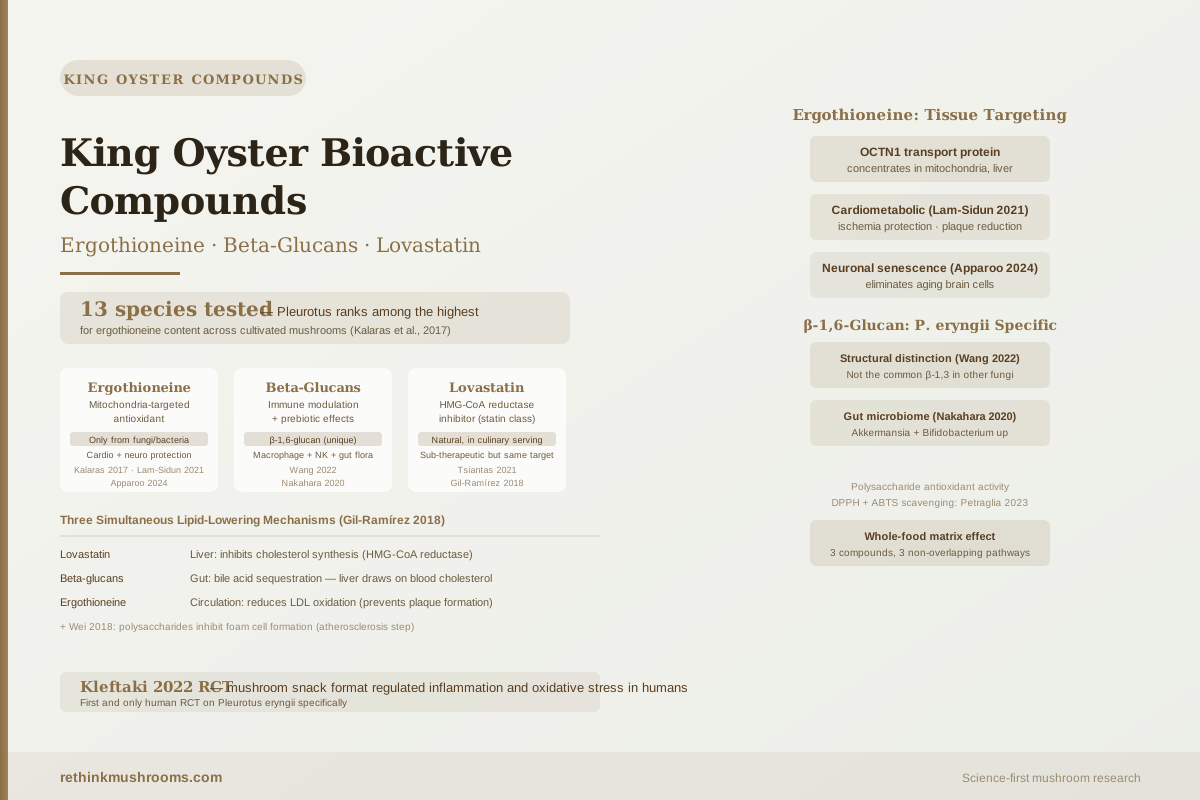
13 mushroom species tested
Across 13 mushroom species, Pleurotus ranked among the highest for ergothioneine — establishing king oyster as one of the richest culinary sources of the mitochondria-targeted antioxidant.
Kalaras et al., Food Chemistry, 2017
Tsiantas 2021
quantified both ergothioneine and lovastatin in P. eryngii — two bioactive compounds in the same culinary mushroom, measured by validated analytical methods
β-1,6-glucan
Wang 2022: P. eryngii contains a structurally distinct glucan not found in most other fungi, with specific immune and gut microbiota effects
3 mechanisms
Gil-Ramírez 2018: lovastatin, beta-glucans, and ergothioneine work simultaneously through non-overlapping lipid-lowering pathways in a single food
Kalaras et al., Food Chemistry, 2017
 View as image ↗
King oyster mushroom (Pleurotus eryngii) contains the same class of compound as prescription cholesterol drugs, ranks as one of the richest food sources of an antioxidant that accumulates specifically in mitochondria, and produces a type of beta-glucan structurally different from what most other mushrooms make. These are measurable compounds. Tsiantas and colleagues quantified lovastatin and ergothioneine directly in P. eryngii tissue in 2021, establishing actual content values rather than just noting their presence.[1]
This article covers the king oyster mushroom bioactive compounds specifically: what each one is, what the evidence shows about its mechanisms, and how they may operate together in a whole-food context. For the broader overview of what king oyster mushroom is as a species — its taxonomy, naming, and clinical evidence — see What Is King Trumpet Mushroom?.
Key Takeaways
- Across 13 mushroom species, Kalaras and colleagues (2017) found Pleurotus species among the highest for ergothioneine content — most common grocery-store mushrooms like button mushrooms contain substantially less
- Tsiantas 2021 quantified both ergothioneine and lovastatin in Pleurotus eryngii using validated methods, establishing P. eryngii as a source of both compounds simultaneously
- Lam-Sidun and colleagues (2021) reviewed preclinical cardiometabolic mechanisms: ergothioneine reduced oxidative damage in heart muscle cells, protected against ischemia-reperfusion injury, and reduced atherosclerotic plaque formation in animal models
- Apparoo and colleagues (2024) identified a neurological mechanism: in cultured neuronal cells, ergothioneine-rich mushroom extracts reduced cellular senescence — a pathway linked to brain aging and neurodegenerative disease (an in-vitro finding, not yet tested in humans)
- Wang 2022 identified P. eryngii's beta-glucan as β-1,6-glucan — structurally distinct from the β-1,3-glucan found in most other fungi, with specific effects on macrophage activation and gut microbiota composition
- Gil-Ramírez and colleagues (2018) documented three simultaneous lipid-lowering mechanisms in Pleurotus: lovastatin (cholesterol synthesis inhibition), beta-glucans (bile acid sequestration in the gut), and ergothioneine (LDL oxidation reduction)
The Compound No Other Common Food Delivers: What Ergothioneine Is
Ergothioneine is an amino acid produced almost exclusively by fungi and certain soil bacteria. Humans cannot synthesize it. We can only obtain it through diet, and mushrooms are the primary food source in most modern diets. The human body has a dedicated transport protein for ergothioneine called OCTN1, which actively pulls it from food and concentrates it in specific tissues: mitochondria, the liver, bone marrow, and the lens of the eye. These are tissues that face the highest levels of oxidative stress. That tissue-specific accumulation is what makes ergothioneine pharmacologically interesting — it's not a diffuse antioxidant that circulates generally, but one that concentrates precisely where oxidative damage is most consequential.
Kalaras and colleagues (2017) measured ergothioneine across 13 mushroom species and found that Pleurotus species consistently ranked at the high end.[2] Porcini (Boletus edulis) also ranked high. Common button mushrooms (Agaricus bisporus) contained substantially less. Among cultivated mushrooms available in grocery stores, P. eryngii stands out as one of the most concentrated sources.
Tsiantas and colleagues (2021) went further by quantifying both ergothioneine and lovastatin across multiple Pleurotus species using validated analytical methods that allow comparison between species and preparation formats.[1] Their work provides actual content values — not presence-or-absence data, but measurable amounts. This is the starting point for determining whether any given food is a meaningful dietary source.
Ergothioneine's Effects: From Heart Cells to Aging Neurons
The cardiometabolic evidence for ergothioneine is reviewed systematically by Lam-Sidun, Peters, and Borradaile (2021) in a preclinical review that covers multiple model systems and mechanisms.[3] The findings span three areas.
In heart tissue, ergothioneine reduced reactive oxygen species inside cardiomyocytes — the cells that make up the heart muscle. In models of ischemia-reperfusion injury (the cellular damage that occurs when blood flow resumes after a period of oxygen deprivation, as in a heart attack), ergothioneine provided measurable protection. In animal models of atherosclerosis, ergothioneine reduced plaque formation in arterial walls.
These are all preclinical findings. No randomized trial has tested ergothioneine supplementation for cardiovascular outcomes in humans. But the mechanistic logic is coherent: ergothioneine accumulates precisely in the tissues where oxidative damage drives cardiovascular disease, and the preclinical data consistently shows it reducing that damage across multiple experimental systems.
The newer finding is from Apparoo and colleagues (2024), published in Brain Research, on a mechanism that has nothing to do with cholesterol.[4] Their work examined what ergothioneine-rich mushrooms do to neuronal senescent cells. Senescent cells are cells that have stopped dividing but remain metabolically active, releasing inflammatory signals that damage the surrounding tissue. In neurons, accumulated senescent cells are associated with cognitive decline and neurodegenerative disease. Apparoo's group screened ergothioneine-rich mushrooms and tested extracts in cultured neuronal (HT22) cells, finding that ergothioneine-rich mushroom extracts reduced cellular senescence — pointing to a molecular pathway for neuroprotection beyond the diffuse antioxidant effect. This is an in-vitro finding rather than a human result, and the highest-ergothioneine species in their screen was shiitake rather than P. eryngii; the relevance to king oyster rests on its shared status as an ergothioneine-rich mushroom. This mechanism is almost entirely absent from consumer mushroom content.
For deeper coverage of the brain aging research, see Ergothioneine and Brain Health: Neuroprotective Research.
Beta-Glucans: Why King Oyster's β-1,6 Structure Is Unusual
Beta-glucans are long chains of glucose molecules linked by specific chemical bonds. Most fungi contain predominantly β-1,3-glucan — the glucose units joined at the first and third carbon positions. The immune-activating properties of mushroom beta-glucans described across the research literature are primarily attributed to this β-1,3 structure binding to the Dectin-1 receptor on immune cells.
Wang and colleagues (2022) identified something structurally specific to P. eryngii: it contains β-1,6-glucan, where the backbone linkage is at the first and sixth carbon positions rather than the first and third.[6] This distinction matters because the structural difference changes how the glucan interacts with immune receptors. In Wang's mouse experiments, P. eryngii β-1,6-glucan modulated macrophage activation and NK cell function, and produced measurable shifts in gut microbiome composition: specifically, increased Lactobacillus and Bifidobacterium abundance — species associated with healthy gut function.
This doesn't establish that king oyster's beta-glucan is more effective than other mushrooms' beta-glucans for any specific outcome. What it shows is that the mechanism operates through a different structural interface, which means generalizing from research on other mushroom species' beta-glucans to P. eryngii specifically may not be accurate.
Nakahara and colleagues (2020) studied P. eryngii polysaccharides in high-fat-diet mice, using isolated polysaccharides rather than whole mushroom to isolate the polysaccharide contribution.[7] Supplemented mice showed reduced body weight and fat accumulation, and significant gut microbiome changes: a higher Bacteroidetes/Firmicutes ratio and increased Akkermansia muciniphila — a bacterium associated with metabolic health and gut barrier integrity. The use of isolated polysaccharides (rather than whole mushroom) establishes that it's the polysaccharide fraction specifically driving these effects, not other compounds in the mushroom matrix.
For the prebiotic evidence in full, see Mushrooms as Prebiotics: How They Feed Your Gut Bacteria.
Polysaccharides as Antioxidants: A Less-Discussed Function
Beta-glucans and mushroom polysaccharides are most often discussed in the context of immune modulation. Their direct antioxidant activity gets much less attention.
Petraglia and colleagues (2023) isolated and characterized polysaccharides from P. eryngii fruiting bodies, then measured their capacity to neutralize free radicals using two standard assays: DPPH and ABTS radical scavenging.[8] Both showed significant activity. This is relevant because it means P. eryngii's polysaccharide fraction contributes to antioxidant activity independently of ergothioneine. Two separate compound classes in the same mushroom converging on oxidative stress reduction through non-overlapping mechanisms.
This finding doesn't change how you'd cook or eat king oyster mushroom. But it helps explain why whole-mushroom interventions — like the animal models in Nakahara 2020 and the human study by Kleftaki and colleagues (2022)[10] — tend to show broader effects than single-compound approaches would predict.
Lovastatin in a Food: How King Oyster Inhibits Cholesterol Synthesis
Lovastatin is a prescription drug used to lower LDL cholesterol. It works by blocking HMG-CoA reductase, the enzyme responsible for a key step in the body's cholesterol synthesis pathway. Block that enzyme and the liver produces less cholesterol. This is the same mechanism shared by the entire statin drug class.
P. eryngii produces lovastatin naturally as a secondary metabolite. Tsiantas and colleagues (2021) measured it directly alongside ergothioneine in Pleurotus species.[1] The amounts in a culinary serving are substantially lower than a therapeutic pharmaceutical dose — king oyster is not a replacement for prescribed statin therapy. But the compound is present, measurable, and operating through the same biochemical mechanism.
Gil-Ramírez, Morales, and Soler-Rivas (2018) reviewed the lipid-lowering mechanisms from edible mushrooms and identified three simultaneous pathways operating in P. eryngii:[5]
First, lovastatin inhibits HMG-CoA reductase inside liver cells, reducing the liver's production of cholesterol directly.
Second, beta-glucans form a viscous gel inside the gastrointestinal tract that physically binds bile acids. Bile acids are synthesized from cholesterol; when they're excreted rather than reabsorbed from the gut, the liver must draw on circulating cholesterol to make more, which lowers blood cholesterol levels. This mechanism acts entirely in the gut, before any systemic absorption.
Third, ergothioneine reduces the oxidative modification of LDL cholesterol. Oxidized LDL is the form of cholesterol that embeds in artery walls and drives atherosclerosis; unmodified LDL is considerably less dangerous. By reducing LDL oxidation, ergothioneine addresses the downstream consequence rather than the synthesis problem.
Wei and colleagues (2018) demonstrated a fourth angle in cell and zebrafish models: P. eryngii polysaccharides inhibited foam cell formation — the process where oxidized LDL is taken up by immune cells inside artery walls to form the fatty deposits that become atherosclerotic plaques.[9] Foam cell data from macrophage cultures and zebrafish doesn't translate directly to human outcomes, but the mechanistic coverage across these four pathways is unusually broad for a culinary food.
For the full cardiovascular evidence, see King Oyster Mushroom and Cardiovascular Health.
Why the Three-Compound Combination Matters
Consumer content tends to isolate one compound per article: ergothioneine benefits, beta-glucan immune support, natural statins in mushrooms. What the research literature shows is that in P. eryngii, these are not separate stories. They're cohabitants in the same food matrix, operating through parallel and non-overlapping pathways.
Gil-Ramírez and colleagues (2018) made this point explicitly in the context of lipid-lowering: the cholesterol-reducing effect of whole Pleurotus mushrooms in animal models exceeds what would be expected from any single compound working alone.[5] The gut-acting beta-glucan effect, the synthesis-blocking lovastatin effect, and the oxidation-reducing ergothioneine effect add up to more than any one of them individually — and Petraglia's polysaccharide antioxidant data adds a fourth contributing mechanism.
This has a practical implication. It suggests that eating the whole mushroom is more aligned with the studied mechanism than taking an isolated ergothioneine supplement or a beta-glucan capsule. The one human clinical study on P. eryngii (Kleftaki and colleagues, 2022)[10] used mushroom snacks — a processed food product, but still whole-mushroom-derived. The animal models that showed anti-obesity and microbiome effects used whole mushroom powder at dietary levels, not extracts.
The honest framing of the evidence hierarchy: one human RCT showing metabolic and antioxidant effects, strong and consistent animal model data, and cell-level mechanistic evidence for the individual compounds. The three-compound synergy argument is pharmacologically coherent but hasn't been tested head-to-head against individual compounds in any controlled human trial.
What does exist is an unusually well-characterized bioactive compound profile for a common culinary mushroom — and the observation that the compounds address different aspects of the same underlying processes, through mechanisms that can't substitute for each other.
This article describes research on the compounds in king oyster mushroom and is not medical advice. The naturally occurring lovastatin in a culinary serving is far below any therapeutic statin dose, and king oyster mushroom is not a substitute for prescribed cholesterol medication. If you take a statin or are managing high cholesterol, talk with your physician before making dietary changes intended to affect it.
The Bottom Line
King oyster mushroom (Pleurotus eryngii) contains three characterized bioactive compounds: ergothioneine (a mitochondria-targeted antioxidant ranked among the highest in cultivated mushrooms by Kalaras 2017), a structurally unusual β-1,6-glucan that modulates immune function and gut microbiota (Wang 2022), and natural lovastatin that inhibits cholesterol synthesis through the same mechanism as prescription statins (Gil-Ramírez 2018). The ergothioneine evidence extends to cardiometabolic protection (Lam-Sidun 2021) and neuronal senescence elimination (Apparoo 2024). All three compounds work through non-overlapping mechanisms. Most evidence is preclinical; the one human RCT (Kleftaki 2022)[10] used whole mushroom in a food format.
Frequently Asked Questions
Sources & References
- 1RTHM-00725·Tsiantas, Konstantinos et al. (2021). “On the Identification and Quantification of Ergothioneine and Lovastatin in Various Mushroom Species: Assets and Challenges of Different Analytical Approaches..” Molecules (Basel.Study breakdown →PubMed →↩
- 2RTHM-00476·Kalaras, Michael D et al. (2017). “Mushrooms: A rich source of the antioxidants ergothioneine and glutathione..” Food chemistry.Study breakdown →PubMed →↩
- 3RTHM-00696·Lam-Sidun, Daniel et al. (2021). “Mushroom-Derived Medicine? Preclinical Studies Suggest Potential Benefits of Ergothioneine for Cardiometabolic Health..” International journal of molecular sciences.Study breakdown →PubMed →↩
- 4RTHM-01850·Apparoo, Yasaaswini et al. (2024). “Potential role of ergothioneine rich mushroom as anti-aging candidate through elimination of neuronal senescent cells..” Brain research.Study breakdown →PubMed →↩
- 5RTHM-00510·Gil-Ramírez, Alicia et al. (2018). “Molecular actions of hypocholesterolaemic compounds from edible mushrooms..” Food & function.Study breakdown →PubMed →↩
- 6RTHM-00801·Wang, Xue et al. (2022). “β-1,6-Glucan From Pleurotus eryngii Modulates the Immunity and Gut Microbiota..” Frontiers in immunology.Study breakdown →PubMed →↩
- 7RTHM-00643·Nakahara, Daiki et al. (2020). “Effect of mushroom polysaccharides from Pleurotus eryngii on obesity and gut microbiota in mice fed a high-fat diet..” European journal of nutrition.Study breakdown →PubMed →↩
- 8RTHM-00847·Petraglia, Tania et al. (2023). “Antioxidant Activity of Polysaccharides from the Edible Mushroom Pleurotus eryngii..” Molecules (Basel.Study breakdown →PubMed →↩
- 9RTHM-00534·Wei, Hua et al. (2018). “Lipid-Lowering Effect of the Pleurotus eryngii (King Oyster Mushroom) Polysaccharide from Solid-State Fermentation on Both Macrophage-Derived Foam Cells and Zebrafish Models..” Polymers.Study breakdown →PubMed →↩
- 10RTHM-00771·Kleftaki, Stamatia-Angeliki et al. (2022). “A Randomized Controlled Trial on Pleurotus eryngii Mushrooms with Antioxidant Compounds and Vitamin D2 in Managing Metabolic Disorders..” Antioxidants (Basel.Study breakdown →PubMed →↩
- 11RTHM-00204·Alam, Nuhu et al. (2011). “Dietary effect of Pleurotus eryngii on biochemical function and histology in hypercholesterolemic rats..” Saudi journal of biological sciences.Study breakdown →PubMed →↩