Meshima Anti-Angiogenesis Research
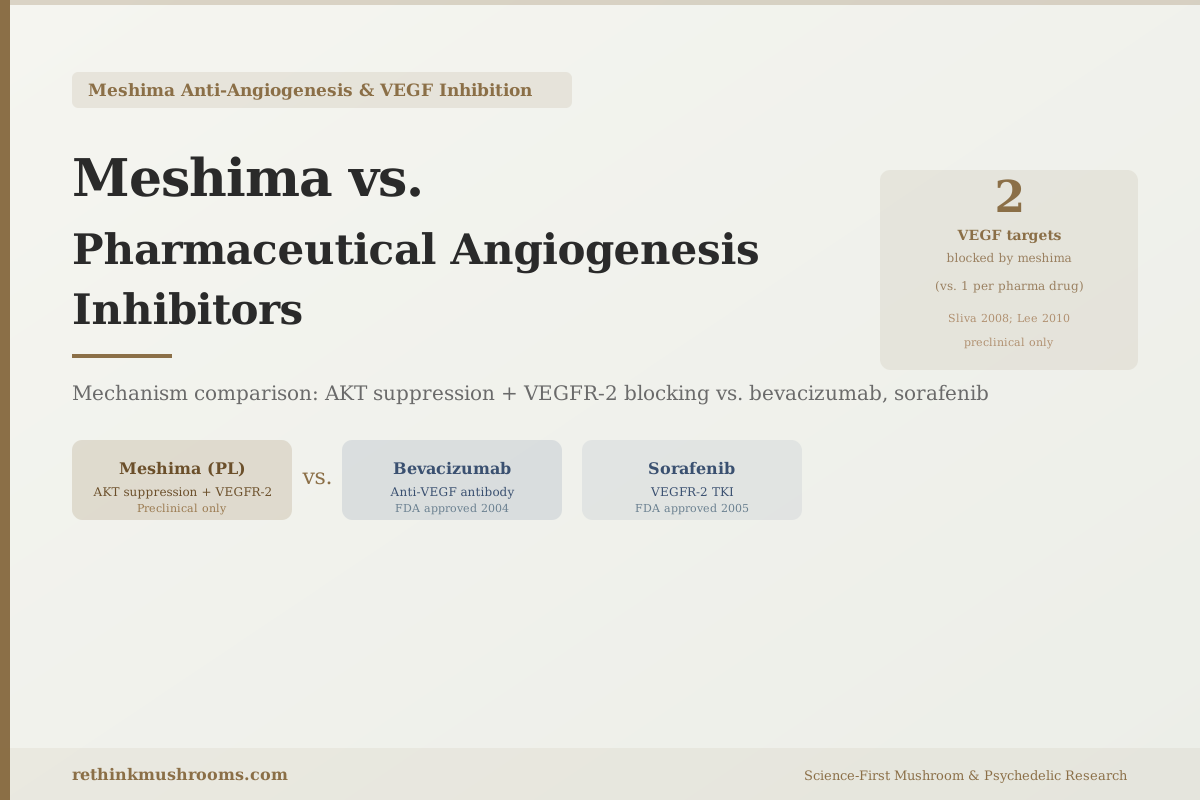
2 targets
The number of independent VEGF pathway points meshima blocks in laboratory models; bevacizumab and sorafenib each target one. The catch: all meshima data is preclinical.
Sliva et al., British Journal of Cancer, 2008; Lee et al., 2010
2008
year Sliva documented PL's dose-dependent VEGF suppression in cancer cells
0
head-to-head clinical trials comparing meshima to pharmaceutical inhibitors
2004
year bevacizumab received FDA approval for cancer treatment
Sliva et al., British Journal of Cancer, 2008; Lee et al., 2010
 View as image ↗
Bevacizumab, the first FDA-approved anti-angiogenic cancer drug, generated $6.8 billion in annual sales at its peak. Sorafenib, approved the following year, treats kidney and liver cancer by blocking the same basic pathway. Both work by disrupting the vascular endothelial growth factor (VEGF) signaling system that tumors use to recruit blood vessels. Both have well-documented side effects, well-documented clinical trials, and well-documented positions in oncology treatment guidelines.
Phellinus linteus, the medicinal mushroom known as meshima, targets the same VEGF pathway. In laboratory models, it does so through two mechanisms that no pharmaceutical drug currently uses in the same combination. As of 2026, it has never been tested against cancer in a human clinical trial.
This comparison matters for understanding what the research on meshima actually shows and what it does not. This article is part of the broader coverage on meshima mushroom, its history, and what the evidence base covers. For a deeper look at the active compounds responsible for these effects, see Phellinus linteus bioactive compounds.
Key Takeaways
- Meshima (Phellinus linteus) inhibits the VEGF pathway through two independent mechanisms: suppressing VEGF production upstream via AKT kinase inhibition, and blocking the VEGF receptor (VEGFR-2) directly in endothelial cells[1][2]
- Bevacizumab targets free VEGF in circulation; sorafenib and sunitinib target the VEGFR-2 kinase domain. Each pharmaceutical targets one point; meshima addresses both in laboratory models
- All mechanistic evidence for meshima's anti-angiogenic effects is preclinical (in vitro and animal models); no human cancer trial has tested these effects
- Tsuji et al. (2010) documented tumor growth suppression in athymic nude mice with advanced prostate cancer, the strongest in vivo evidence for Phellinus linteus anti-tumor activity[4]
- Ku et al. (2022) is the only published human clinical trial on Phellinus linteus; it focused on immune markers, not cancer, and reported no significant adverse events, providing a human safety reference but not a cancer efficacy comparison[5]
- No head-to-head trial comparing meshima to bevacizumab, sorafenib, or any other pharmaceutical inhibitor exists or is currently registered
How Pharmaceutical Angiogenesis Inhibitors Work
Solid tumors cannot grow beyond 2 millimeters without recruiting new blood vessels. Starved of oxygen and nutrients, cells beyond that threshold die. Tumor cells bypass this limit by secreting vascular endothelial growth factor (VEGF), a signaling protein that commands endothelial cells (the cells lining blood vessels) to proliferate, migrate, and form new capillaries directed toward the tumor. This process is called angiogenesis.
Pharmaceutical angiogenesis inhibitors interrupt this process at specific points.
Bevacizumab (Avastin, FDA approved 2004) is a monoclonal antibody that binds directly to VEGF molecules circulating in the bloodstream, preventing VEGF from reaching and activating its receptors on endothelial cells. It is a "neutralization" strategy: VEGF is produced by tumor cells, enters circulation, and is intercepted before it can signal. Bevacizumab is approved for colorectal, lung, kidney, cervical, and other cancers, typically in combination with chemotherapy.
Sorafenib (Nexavar, FDA approved 2005) is a tyrosine kinase inhibitor (TKI) that works differently. Rather than intercepting circulating VEGF, it targets the VEGF receptor (VEGFR-2) on endothelial cells, along with the platelet-derived growth factor receptor (PDGFR) and other kinases. When VEGF tries to activate VEGFR-2, sorafenib is already blocking the receptor's kinase domain, preventing the downstream signal from firing. Sorafenib is approved for kidney cancer, liver cancer, and thyroid cancer.
Sunitinib (Sutent, FDA approved 2006) is another multi-kinase VEGFR inhibitor with similar mechanism to sorafenib, targeting VEGFR-1, VEGFR-2, VEGFR-3, and PDGFR, among others. It is approved for gastrointestinal stromal tumor, kidney cancer, and pancreatic neuroendocrine tumors.
All three drugs have extensive Phase III randomized controlled trial data. All three have known toxicity profiles. Bevacizumab's known risks include hypertension, arterial thromboembolism, hemorrhage, and gastrointestinal perforation. Sorafenib and sunitinib carry risks including hypertension, hand-foot syndrome, fatigue, and GI toxicity.
How Meshima Targets the Same Pathway from Two Angles
Sliva et al. (2008) published the foundational paper on meshima's anti-angiogenic mechanisms, testing Phellinus linteus against MDA-MB-231 breast cancer cells and human aortic endothelial cells in culture.[1] The findings established two things. First, Phellinus linteus decreased VEGF secretion from the cancer cells in a dose-response manner, and that reduction was associated with inhibition of AKT phosphorylation at Thr308 and Ser473. AKT kinase is a central regulator of cellular survival and metabolism; when cancer cells overproduce VEGF, it is often because AKT is keeping the VEGF-production machinery running. Sliva's data showed that PL disrupted that machinery. Second, PL inhibited capillary morphogenesis of human aortic endothelial cells, meaning the cells were less capable of forming the tube-like structures that become new blood vessels.
Lee et al. (2010) added the receptor-level mechanism.[2] Using human umbilical vein endothelial cells (HUVECs), the standard model for angiogenesis research, they showed that Phellinus linteus methanol extract inhibited HUVEC proliferation, migration, and tube formation, and suppressed VEGFR-2 phosphorylation. Lee's group also confirmed angiogenesis inhibition in a live tissue model: the chick chorioallantoic membrane (CAM) assay, which measures actual blood vessel formation in a developing embryo.
What this means mechanistically: Sliva's work showed that PL suppresses the tumor cell's ability to send the VEGF signal. Lee's work showed that PL also blocks the endothelial cell's ability to receive the signal. These are two independent mechanisms acting at different points in the same signaling cascade.
The Mechanism Comparison
The table below maps what each approach targets and what is known about it:
| Drug / Compound | Mechanism | Target | Evidence Level |
|---|---|---|---|
| Bevacizumab | Anti-VEGF antibody | Free VEGF in circulation | Phase III RCTs |
| Sorafenib | Tyrosine kinase inhibitor | VEGFR-2 kinase domain | Phase III RCTs |
| Sunitinib | Multi-kinase inhibitor | VEGFR-1/2/3, PDGFR | Phase III RCTs |
| Meshima (PL) | AKT suppression + VEGFR-2 blocking | VEGF production machinery + VEGFR-2 phosphorylation | In vitro; one mouse xenograft |
Reading the table honestly: the pharmaceutical drugs each target one point with a precise, drug-like mechanism developed through formal medicinal chemistry and tested in thousands of patients. Meshima's effect targets two points in laboratory models, but those models are cell cultures and a chick embryo assay. The evidence scales are not comparable.
Why Upstream Suppression Differs from Blocking Circulating VEGF
The mechanism difference between bevacizumab and meshima has one potentially interesting implication worth understanding, even though it has never been tested clinically.
Bevacizumab works after VEGF has been produced and secreted. The tumor cell produces VEGF, VEGF enters circulation, bevacizumab binds to it. The tumor cell's VEGF production machinery is untouched; tumor cells can theoretically upregulate VEGF production in response to bevacizumab, generating more VEGF than the antibody can capture. This resistance mechanism has been observed clinically.
Meshima's mechanism, as documented by Sliva et al. (2008), works upstream of VEGF secretion: it suppresses AKT activity, which reduces the VEGF production signal itself.[1] If that mechanism holds in a tumor environment, it would target the production source rather than the secreted product. Sliva et al.'s 2010 review noted this upstream suppression across multiple cancer types, including breast, prostate, lung, and colon cancer models.[3]
This is a mechanistic observation from cell culture data. It has not been tested in humans. Tumors in the body are far more complex than cancer cell lines, and AKT is involved in hundreds of cellular processes; whether selectively suppressing AKT via PL in a human tumor environment would produce anti-angiogenic effects similar to what Sliva observed in MDA-MB-231 cells is unknown.
The point is not that meshima has an advantage over bevacizumab. The point is that the mechanisms are genuinely different, and the difference is worth understanding when evaluating what the laboratory data suggests.
Side Effect Profiles: What the Pharmaceutical Drugs Cost
The pharmaceutical anti-VEGF drugs are effective enough to be standard of care in multiple cancers. They are also toxic enough that side effect management is a significant component of treatment.
Bevacizumab's serious risks include hypertension (affecting 30–35% of patients in some trials), arterial thromboembolic events (stroke, heart attack), severe hemorrhage, gastrointestinal perforations, and impaired wound healing. These toxicities reflect the fact that blocking VEGF affects not just tumor vasculature but normal vasculature throughout the body. VEGF plays a role in maintaining blood vessel integrity everywhere, not just in tumors.
Sorafenib and sunitinib carry similar vascular toxicities along with hand-foot skin reaction (painful desquamation of palms and soles), fatigue, diarrhea, and elevated liver enzymes.
For Phellinus linteus, the only human safety data comes from Ku et al. (2022), a CONSORT-randomized, double-blind, placebo-controlled trial that administered PL extract to participants and monitored for adverse events over approximately 8 weeks.[5] The trial was conducted for immune enhancement, not cancer treatment, and no significant adverse events were reported.
That RCT cannot be compared directly to the pharmaceutical trials: PL was tested in healthy or generally healthy adults, not cancer patients on concurrent chemotherapy. Bevacizumab's toxicities emerge in part from the combination with chemotherapy and from the specific disease context of advanced cancer. A fair safety comparison would require testing PL in a similar population at a comparable dose, which has not been done.
What the Ku 2022 data provides is a general safety reference: at doses tested over 8 weeks in adults, PL extract did not produce significant adverse events. The side effect profile of bevacizumab, sorafenib, and sunitinib in cancer patients is far more extensive than anything documented for PL. That gap reflects both the genuine pharmacological difference between a highly targeted drug and a mushroom extract, and the difference between studying something in healthy volunteers versus cancer patients on chemotherapy.
The Evidence Wall: Why This Cannot Be a Clinical Comparison
The most important thing this article can say is also the most frequently omitted thing in content about medicinal mushrooms: Phellinus linteus has never been tested against cancer in a human clinical trial. The VEGF suppression data is from MDA-MB-231 cells in culture. The VEGFR-2 inhibition data is from HUVECs. The mechanism review in Sliva 2010 is a synthesis of cell culture data.[3]
This is not unusual for natural product cancer research. The path from "inhibits angiogenesis in a cell culture assay" to "approved cancer treatment" has proven reliably difficult. Thousands of natural compounds demonstrate anti-angiogenic effects in vitro; almost none become approved drugs. The reasons are complex: concentration gradients in cell cultures are not pharmacologically achievable in tumors; systemic delivery and bioavailability are challenging for plant and fungal compounds; off-target effects become apparent at scale; and cancer cells adapt.
Sliva et al.'s 2010 comprehensive review explicitly noted that the evidence base for PL's cancer-relevant mechanisms was preclinical at the time of writing, and called for human trials.[3] As of 2026, the human trial for PL's anti-angiogenic or anti-cancer properties has still not been conducted.
The In Vivo Evidence: Tsuji 2010
The closest thing to a pre-clinical in vivo test of meshima's anti-tumor effects comes from Tsuji et al. (2010), who administered Phellinus linteus extract to athymic nude mice bearing advanced prostate cancer xenografts.[4] The extract suppressed tumor growth in the xenograft model, meaning tumors in PL-treated mice grew more slowly than in control mice.
Athymic nude mice lack functional T cells and are used to test human cancer cell lines (which would otherwise be rejected). The xenograft model is a step beyond cell culture: the tumor is growing in a living organism with blood supply, immune interactions, and metabolic context. Tsuji's in vivo data does not establish that PL's effect in the mouse was specifically angiogenesis-driven rather than from another anti-tumor mechanism, but it is the strongest available evidence that the cell culture findings translate to a biological effect in a living model.
The gap from athymic mouse to human cancer patient is enormous. Mouse xenograft models are necessary but not sufficient preclinical evidence. The animal does not have a functional immune system (by design, to accept the human tumor); the tumor is a transplant from a cell line rather than a spontaneously arising cancer; and the pharmacokinetics of PL extract in mice may not reflect human pharmacokinetics at all. Mouse xenograft data has repeatedly failed to predict human outcomes in oncology.
Tsuji 2010 is notable, not conclusive. It shows the biological plausibility of meshima's in vivo anti-tumor activity. It does not demonstrate efficacy in human cancer.
Can Meshima and Pharmaceutical Inhibitors Be Used Together?
The adjunct use question is one of the most practically relevant for patients searching for information. Many cancer patients use complementary approaches alongside standard treatment. The Lee 2019 observational study of 41 pancreatic cancer patients who took Phellinus linteus alongside adjuvant chemotherapy found no significant adverse interactions, which is reassuring for basic safety in a cancer treatment context, though that study examined different drugs than bevacizumab or sorafenib.
Since meshima appears to work partly through AKT kinase inhibition and VEGFR-2 blockade, and pharmaceutical anti-angiogenics target the same pathway from different angles, there is a theoretical case for non-redundancy. But there is also a theoretical case for compounding effects on normal vasculature, which could amplify side effects. Neither has been tested.
The broader question of what clinical evidence exists for mushrooms as cancer treatment adjuncts is better answered by reishi (Ganoderma lucidum), which has more human clinical data in the cancer context than meshima. For readers researching adjunct cancer use specifically, that evidence base is more developed. How meshima triggers tumor cell death through apoptosis pathways, a distinct mechanism from angiogenesis inhibition, is explored in the complementary article on apoptosis mechanisms.
For the anti-angiogenesis mechanism cluster, the companion articles explore how meshima starves tumors through angiogenesis research, the three anti-angiogenesis pathways together, the specific VEGF suppression data, and the technical VEGF inhibition evidence for researchers.
The Bottom Line
Meshima (Phellinus linteus) blocks the VEGF angiogenesis pathway through two independent mechanisms: suppressing VEGF production upstream via AKT kinase inhibition (Sliva et al., 2008) and blocking VEGFR-2 phosphorylation in endothelial cells (Lee et al., 2010). No pharmaceutical anti-angiogenic drug currently uses the same combination. But the comparison ends there: bevacizumab and sorafenib have Phase III randomized controlled trial evidence in human cancer patients; Phellinus linteus has in vitro and one mouse xenograft study. Ku et al.'s 2022 CONSORT-randomized human trial showed no significant adverse events for PL extract in healthy adults, but that trial was not designed for cancer. No head-to-head trial comparing PL to any pharmaceutical angiogenesis inhibitor exists.
Frequently Asked Questions
Sources & References
- 1RTHM-00271·Sliva, D et al. (2008). “Phellinus linteus Extract in Breast-Cancer Cell Models: What This 2008 Study Actually Found.” British journal of cancer.Study breakdown →PubMed →↩
- 2RTHM-00349·Lee, Yeon Sil et al. (2010). “Anti-angiogenic activity of methanol extract of Phellinus linteus and its fractions..” Journal of ethnopharmacology.Study breakdown →PubMed →↩
- 3RTHM-00364·Sliva, Daniel (2010). “Medicinal mushroom Phellinus linteus as an alternative cancer therapy..” Experimental and therapeutic medicine.Study breakdown →PubMed →↩
- 4RTHM-00367·Tsuji, Takanori et al. (2010). “Phellinus linteus extract sensitizes advanced prostate cancer cells to apoptosis in athymic nude mice..” PloS one.Study breakdown →PubMed →↩
- 5RTHM-01556·Ku, Yong Ho et al. (2022). “Effects of Phellinus linteus extract on immunity improvement: A CONSORT-randomized, double-blinded, placebo-controlled trial..” Medicine.Study breakdown →PubMed →↩