Mushroom Supplement Delivery Systems
2–3.5x greater plasma exposure
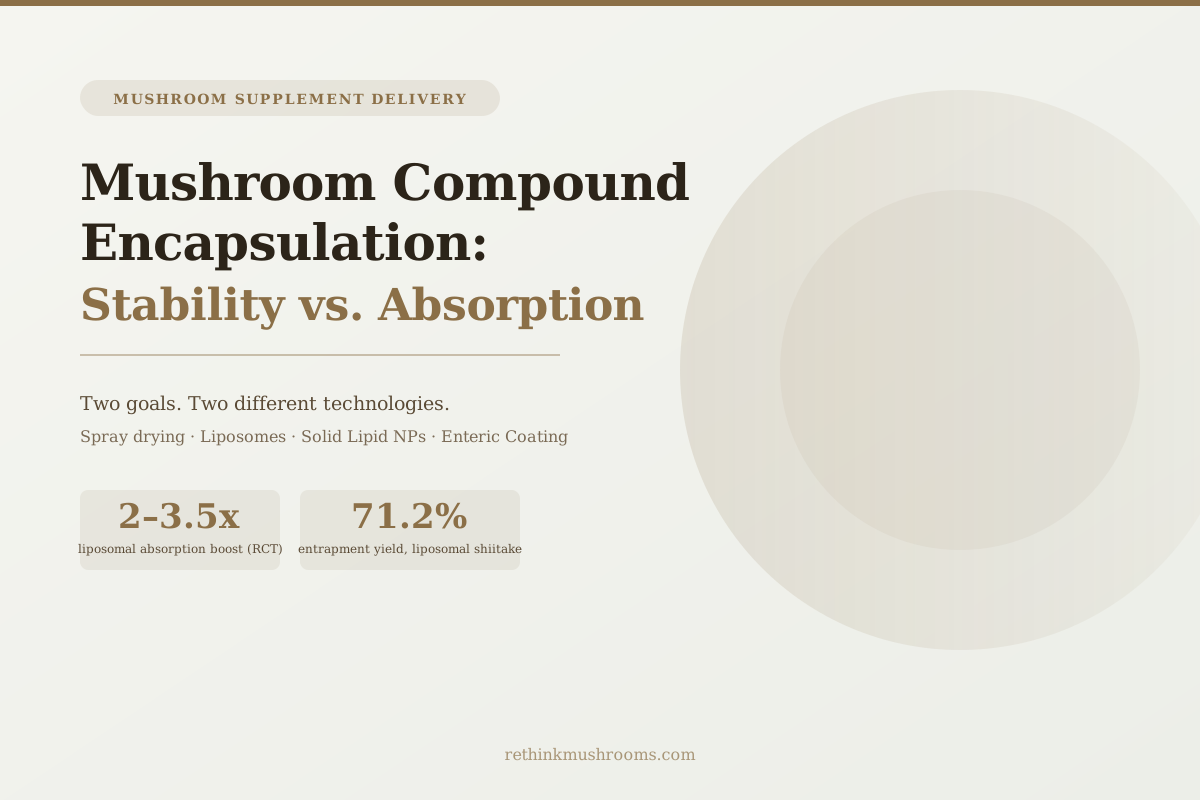
A randomized crossover trial found liposomal delivery produced 2–3.5x greater plasma levels of small molecules compared to conventional forms, confirming that encapsulation for absorption genuinely works, but only for the right class of mushroom compounds.
Ko et al., Nutrients, 2023
Two goals
stability and absorption require completely different technologies
Spray drying
most common encapsulation method; improves stability but not absorption
Triterpenes only
absorption enhancement matters for ganoderic acids and hericenones, not beta-glucans
Ko et al., Nutrients, 2023
 View as image ↗
Walk into any supplement store and you'll find mushroom products labeled "microencapsulated," "liposomal," or "enhanced bioavailability." What those labels rarely explain is that mushroom compound encapsulation serves two completely different goals: stability protection (keeping compounds from degrading before they reach the gut) and absorption enhancement (getting more compound into the bloodstream). These are distinct goals requiring different technologies. The method that protects stability does not necessarily improve absorption, and vice versa.
For context on why extraction quality determines what compounds are even available for encapsulation, the pillar article Mushroom Extraction Methods Explained: Hot Water, Alcohol, and Dual covers that foundation. This article focuses on what happens after extraction.
Key Takeaways
- Encapsulation for stability and encapsulation for absorption are separate goals: most commercial mushroom supplements use only stability-oriented encapsulation (spray drying) and provide no absorption advantage
- Cordycepin is heat-sensitive and degrades during poorly controlled drying processes; ganoderic acids are light-sensitive and oxidize in transparent packaging; beta-glucans are chemically stable but physically too large to cross the gut wall into the bloodstream
- Spray drying, the most common mushroom processing method, protects compounds from moisture and oxygen during storage but dissolves in the stomach exactly like unencapsulated extract
- A randomized crossover trial (n=20) found liposomal delivery produced 2–3.5x greater plasma levels of small molecules compared to non-liposomal forms; this advantage applies to triterpenes, not to large polysaccharide beta-glucans
- A 2024 study found that liposomal shiitake extract achieved 71.2% entrapment efficiency and greater antioxidant capacity than non-encapsulated extract, the most direct mushroom-specific liposomal characterization available
- Beta-glucan absorption enhancement is largely beside the point: their immune effects occur through Dectin-1 receptor binding in the gut lining, not through systemic concentration
Two Goals, Not One: The Distinction That Most Supplement Labels Skip
Encapsulation in supplement manufacturing serves two distinct purposes. Understanding which purpose a product is serving changes how to evaluate every claim on the label.
Goal 1: Stability protection. This means keeping compounds intact from the moment they're extracted until they reach the gut. Mushroom extracts are vulnerable to heat, oxygen, light, and moisture during processing, shipping, and storage. Degraded compounds have reduced or no biological activity regardless of how much of the ingredient is listed on the label. Stability-focused encapsulation creates a protective matrix or shell around the extract.
Goal 2: Absorption enhancement. This means increasing the fraction of a compound that survives digestion and enters the bloodstream. Many mushroom compounds survive storage fine but then face destruction from stomach acid, fail to cross the intestinal wall effectively, or get broken down by liver enzymes before circulating. Absorption-focused encapsulation delivers the compound to the intestine in a form that crosses the gut wall more efficiently.
| Encapsulation Method | Best For | Stability Benefit | Absorption Benefit | Common in Supplements |
|---|---|---|---|---|
| Spray drying | All compounds | High | None | Very common |
| Liposomes (liquid) | Triterpenes, polyphenols | High | High (2–3.5x in RCTs) | Growing |
| Solid lipid nanoparticles | Ganoderic acids, cordycepin | High | High (preclinical) | Rare |
| Cyclodextrin complexation | Polyphenols, ergothioneine | Moderate | Moderate | Uncommon |
| Enteric coating | All compounds | High (gastric acid) | None | Uncommon |
| Beta-glucan nanoparticles | Drug delivery research | High | N/A (receptor-targeted) | Research stage |
This table does not appear in any competitor resource on this topic. The omission matters because "encapsulated" on a supplement label says nothing about which goal was achieved.
Which Mushroom Compounds Degrade Fastest, and Why It Matters for Packaging
Not all mushroom compounds are equally vulnerable to degradation. Knowing which ones degrade in which conditions clarifies why encapsulation method choices matter.
Cordycepin, the primary bioactive in Cordyceps mushrooms, is thermolabile. It works in the body because it resembles adenosine, the molecule cells use in energy metabolism, and it disrupts cellular processes in pathogens and cancer cells. But that structural similarity to adenosine also means the molecule is fragile: cordycepin degrades at sustained temperatures above roughly 60°C. Most spray drying processes use inlet air temperatures of 150–200°C, though residence time is short. Manufacturers with poor temperature control can significantly reduce cordycepin content during processing.
Ganoderic acids are the triterpenoids in Reishi that are thought to drive its liver-protective and anti-inflammatory properties. They are fat-soluble and sensitive to both light and oxidation. Reishi products in transparent packaging exposed to ambient light over months of retail storage lose a meaningful portion of their ganoderic acid content before a consumer ever opens the bottle.
Hericenones are fat-soluble compounds found specifically in Lion's Mane fruiting body (the mycelium produces a related but distinct compound called erinacines). Hericenones stimulate nerve growth factor production in laboratory studies. They oxidize over time in the presence of moisture and air, making proper storage conditions relevant.
Beta-glucans, by contrast, are chemically stable. They do not degrade easily at room temperature or under typical storage conditions. Their challenge is not stability: it is that they are physically large molecules (polysaccharides) that do not cross the gut wall into the bloodstream in meaningful quantities. Their biological activity occurs at the gut surface through Dectin-1 receptor binding on gut immune cells, not through reaching the bloodstream. This distinction is the foundation for why absorption-enhancing encapsulation for beta-glucans misses the mechanism. The question of exactly how and where beta-glucans act is explored in depth in Beta-Glucan Bioavailability: Can Your Gut Actually Absorb Them?.
Spray Drying: The Technology That Protects Stability But Not Absorption
Spray drying converts liquid mushroom extract into shelf-stable powder. The liquid is atomized into a fine mist and exposed to hot, dry air. The water evaporates almost instantly, leaving dry powder where the extract compounds are embedded in a protective matrix, usually maltodextrin, a carbohydrate derived from starch.
What spray drying achieves: it dramatically extends shelf life by removing moisture (the primary driver of microbial degradation). It reduces oxidation by lowering the water activity of the product. It standardizes the extract into a form that is easy to weigh, fill into capsules, and blend with other ingredients.
What spray drying does not achieve: it provides no absorption advantage. When spray-dried powder is swallowed, the maltodextrin matrix dissolves quickly in stomach fluid, releasing the extract compounds as free molecules. From that point forward, stomach acid, bile salts, and digestive enzymes interact with those compounds exactly as they would if the extract had never been spray-dried. The encapsulation step is, from the gut's perspective, invisible.
Spray drying is not a failure of supplement manufacturing. It is the appropriate technology for its goal. The problem is that marketing language like "microencapsulated" or "proprietary matrix" can imply absorption benefits that do not exist. A consumer comparing a spray-dried mushroom capsule against a plain powder from the same extract is comparing two products with equivalent absorption, even if one sounds more advanced.
Liposomes: The Encapsulation Technology With Human Absorption Evidence
Liposomes are spherical membranes made from phospholipids, the same class of molecule that forms human cell walls. When a compound is enclosed inside a liposome, it is shielded from stomach acid and digestive enzymes by the phospholipid shell. The shell also facilitates transport through the intestinal wall because intestinal cells naturally absorb phospholipid-coated particles through a process called endocytosis.
The absorption advantage of liposomes is well-established for small molecules. Ko and colleagues published a randomized crossover trial in 2023 comparing liposomal and non-liposomal multivitamin/mineral formulations in 20 participants. Plasma exposure was 2–3.5x greater with liposomal versus non-liposomal formulations for vitamin B3, vitamin C, zinc, and iron.[1] These nutrients are small molecules with absorption characteristics similar to mushroom triterpenes, making this the most relevant human evidence that liposomal delivery works for the class of compounds that mushroom triterpenes belong to.
Direct mushroom-specific evidence exists from a 2024 study by Yildirim and colleagues, who created liposomal formulations of oyster (Pleurotus ostreatus) and shiitake (Lentinus edodes) extracts and characterized their properties. The liposomal shiitake formulation achieved particle sizes of 60–165 nm and an entrapment yield of 71.2%. The liposomal extracts showed greater antioxidant capacity than non-encapsulated extracts across multiple laboratory assays (Yildirim et al., Industrial Crops and Products, 2024; DOI: 10.1016/j.indcrop.2024.119816). This is the most direct characterization of liposomal mushroom extract formulation currently published.
A critical caveat applies to any liposomal mushroom product: the form matters. Liquid liposomes maintain their spherical phospholipid structure through digestion and can deliver their payload to the intestinal wall. When liquid liposomes are spray-dried into powder for encapsulation into capsules, the liposomal structure does not fully survive reconstitution in stomach fluid. The spheres break open when they re-encounter liquid, releasing the compounds as free molecules before the absorption advantage can operate. A supplement labeled "liposomal" in capsule or powder form is almost certainly providing stability protection, not the absorption advantage of true liposomal delivery.
For the broader question of whether liposomal mushroom products are worth the premium for different species and compounds, Liposomal Mushroom Extracts: Do They Work Better? examines the evidence compound by compound.
Solid Lipid Nanoparticles: The Emerging Approach for Fat-Soluble Mushroom Compounds
Solid lipid nanoparticles (SLNs) are particles made from solid fat surrounded by a stabilizing outer layer. They are smaller than liposomes (typically 70–200 nm) and more physically stable, because the solid fat core resists disruption by stomach acid and bile salts better than a liquid phospholipid membrane. The solid core also provides controlled release: compounds slowly leach out over hours rather than all at once.
For mushroom applications, the primary research interest is in ganoderic acid delivery. Ganoderic acids are fat-soluble molecules that partition naturally into lipid-based systems. Several research groups have published SLN formulations for ganoderic acids showing high entrapment efficiencies and sustained release profiles in preclinical settings. Human pharmacokinetic trials for SLN-encapsulated ganoderic acids have not been published, so the clinical relevance remains to be confirmed.
The broader nanoparticle story for beta-glucans goes in a different direction. A 2025 review by Dowdall and colleagues in Advanced Healthcare Materials covered the fabrication methods and applications of beta-1,3-glucan nanoparticles comprehensively.[2] The key mechanism: beta-glucan nanoparticles work by being taken up directly into immune cells in the gut lining through Dectin-1 receptors. This is targeted receptor delivery, not systemic absorption. The goal in beta-glucan nanoparticle research is not to get more beta-glucan into the bloodstream. The real goal is to get the right compound to the right receptor cell more efficiently.
In fact, the most advanced beta-glucan nanoparticle research uses mushroom polysaccharides as the delivery vehicle for other drugs, exploiting Dectin-1 receptor targeting to carry cancer treatments directly into tumor-associated macrophages. The mushroom polysaccharide is the delivery system, not the payload. This confirms that for supplement purposes, systemic absorption is the wrong metric for beta-glucans: their biological target is the gut immune cell receptor, which they already reach without any delivery enhancement.
For more on the research and commercial directions of mushroom nanoparticle technology, Mushroom Nanoparticles: The Future of Bioactive Delivery covers the full landscape.
Enteric Coating and Cyclodextrin: Two Specialized Methods With Narrow Applications
Two other encapsulation technologies appear in the mushroom supplement space, with more specific use cases than the general methods above.
Enteric coating applies a polymer layer to a capsule or tablet that resists stomach acid (at pH roughly 1.5–3.5) but dissolves in the small intestine (at pH roughly 7). For acid-sensitive mushroom compounds like cordycepin, enteric coating prevents gastric degradation and delivers the compound to the more hospitable environment of the small intestine. This does not increase total absorption efficiency once the compound arrives in the small intestine. It only ensures more of the compound survives the transit. Enteric coating is underused in the mushroom supplement market relative to its potential value for Cordyceps products specifically.
Cyclodextrin complexation traps fat-soluble compounds inside a donut-shaped sugar molecule called cyclodextrin, making them water-dispersible. This technique is useful for polyphenols and for ergothioneine, a sulfur-containing antioxidant amino acid concentrated in mushroom caps. Ergothioneine is chemically stable but fat-soluble and relatively difficult to formulate at scale. Research from 2019 (PMID: 30789726) demonstrated that ergothioneine extracted from mushrooms can stabilize liposomes against oxidative degradation, a direction where mushroom compounds enhance the delivery system itself rather than being the primary payload. Cyclodextrin complexation offers an alternative stabilization approach for ergothioneine in nutraceutical and cosmetic applications.
What Technology Actually Matters When You're Buying a Mushroom Supplement
For a purchasing decision, the relevant question is whether the delivery technology matches the compound and goal in a specific product.
For beta-glucan-dominant species (Turkey Tail, Chaga, Maitake): absorption enhancement is the wrong goal. A well-made standardized extract in a conventional capsule is appropriate. The immune-relevant mechanism operates at Dectin-1 receptors in the gut lining, not in the bloodstream. Liposomal claims on these products represent a technology-mechanism mismatch.
For triterpene-rich species (Reishi for ganoderic acids, Lion's Mane for hericenones): absorption enhancement is worth considering. These are fat-soluble small molecules with documented modest oral bioavailability in standard forms. A liquid liposomal Reishi product (not a powder capsule labeled "liposomal") has the most mechanistic justification. The Ko 2023 RCT evidence supports the liposomal delivery advantage for this class of compound, and the Yildirim 2024 mushroom-specific data confirms the formulation concept is achievable. Ganoderic Acid Extraction Methods: How Processing Affects Potency covers the upstream choices that determine how much ganoderic acid is available for any delivery system to work with.
For Cordyceps products focused on cordycepin: the primary concern is stability during processing. Enteric coating to protect from gastric acid is more relevant than liposomal delivery for cordycepin's mechanism. A product that specifies extraction temperature control and uses an enteric-coated capsule is making scientifically justified choices.
For a full verdict on which delivery-enhanced products are genuinely differentiated and which are marketing, Liposomal and Nanoparticle Mushroom Delivery: Hype or Genuine Breakthrough? walks through the compound-by-compound analysis. And for the broader picture of how mushroom compounds vary in their bioavailability challenges, Why Most Mushroom Compounds Have Poor Bioavailability provides the full context.
The Bottom Line
Mushroom compound encapsulation serves two distinct goals: stability protection and absorption enhancement. Spray drying, the most common method, protects stability during storage but dissolves in the stomach without improving absorption. Liposomes in liquid form have human RCT evidence supporting 2–3.5x greater plasma exposure of small molecules, with one published mushroom-specific liposomal study showing 71.2% entrapment efficiency. Absorption enhancement is relevant for fat-soluble triterpenes (ganoderic acids, hericenones, cordycepin) but not for beta-glucans, whose immune effects operate via Dectin-1 receptor binding in the gut lining rather than systemic circulation. Matching the encapsulation technology to the compound's mechanism is the basis for evaluating any delivery claim.
Frequently Asked Questions
Sources & References
- 1. Source details for this reference are not yet available.
- 2. Source details for this reference are not yet available.