Mushroom Supplement Delivery Systems
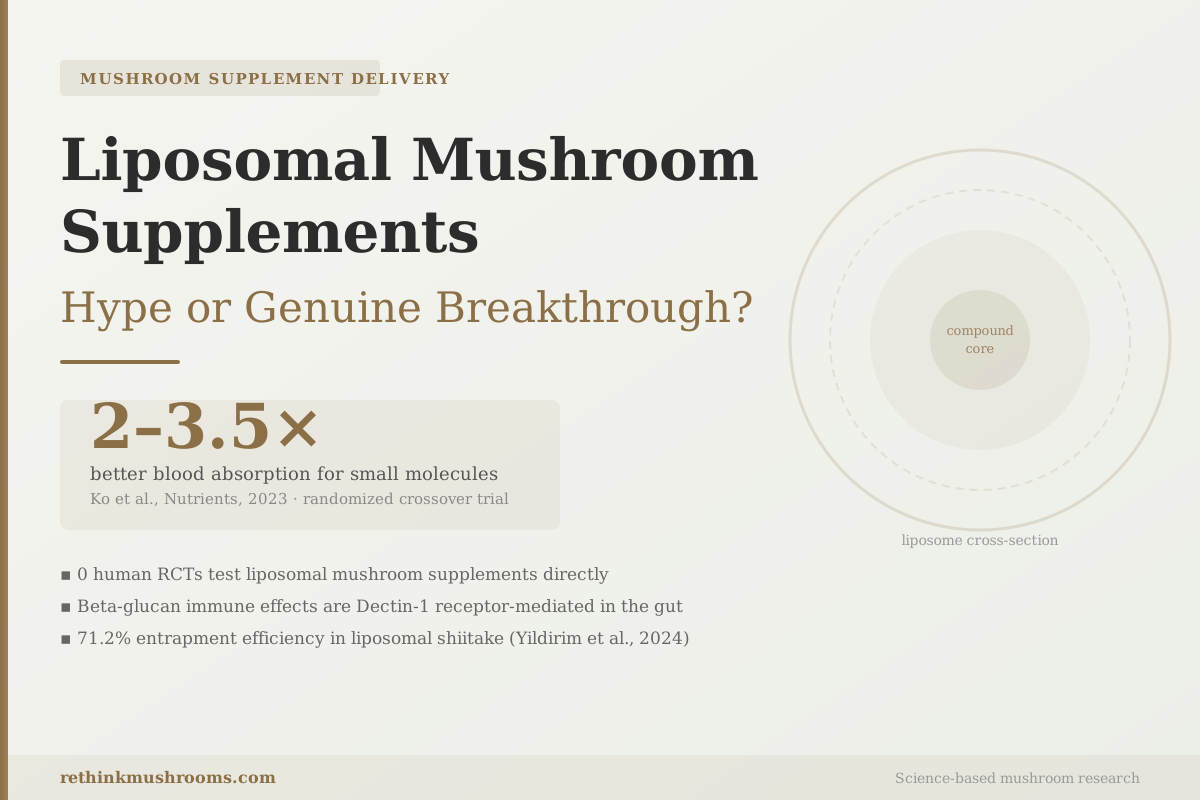
2–3.5× better absorption
Liposomal formulations produced 2–3.5x greater blood exposure than standard capsules in a 2023 randomized trial. That evidence applies to small molecules, not the beta-glucans found in most liposomal mushroom products.
Ko et al., Nutrients, 2023
0 human RCTs
directly test liposomal mushroom supplement absorption
Dectin-1
receptor drives beta-glucan immune effects locally in the gut, not via systemic blood levels
71.2%
entrapment efficiency achieved in liposomal shiitake extract (Yildirim et al., 2024)
Ko et al., Nutrients, 2023
 View as image ↗
Liposomal and nanoparticle mushroom supplements cost two to three times as much as standard capsules. The marketing claims they get far more active compound into your blood. That claim is grounded in real science, but whether the science applies to your specific product depends on which compound is inside and what form it takes. Most liposomal mushroom products sell the technology for the wrong compound, in the wrong form, for the wrong reason. The short answer: liposomal delivery is a genuine advance for certain mushroom bioactives, and a well-marketed irrelevance for others. This article uses the available clinical evidence to give you a compound-by-compound verdict. For background on how mushroom compounds are extracted before they reach any delivery system, see mushroom extraction methods explained.
Key Takeaways
- A 2023 randomized crossover trial (Ko et al., Nutrients) found liposomal formulations produced 2–3.5x greater blood exposure than standard capsules for small molecules; the technology is clinically validated
- That evidence applies to fat-soluble small molecules like reishi's ganoderic acids and lion's mane's hericenones, not to large polysaccharides like beta-glucans
- Beta-glucans activate immune cells through Dectin-1 receptors lining the gut wall; their immune effects don't require high systemic blood concentration (Dowdall et al., 2025)
- Most liposomal mushroom products market the technology for beta-glucan immune support, which is the compound that benefits least from systemic delivery enhancement
- The liposomal powder problem: spray-dried liposomes in capsule form lose structural integrity when reconstituted in the GI tract, likely undermining any absorption advantage
- No human RCT has directly tested liposomal or nanoparticle formulations for mushroom compound absorption specifically
The Technology Is Real. The Question Is Whether It's Applied to the Right Compound
Liposomes are tiny spheres made from the same phospholipid membrane that surrounds every cell in your body. Inside the sphere, fat-soluble compounds are protected from stomach acid and digestive enzymes. When liposomes reach the small intestine, the phospholipid shell fuses with the intestinal wall and deposits its contents directly, bypassing the usual barrier that limits poorly absorbed compounds.
Nanoparticles do similar work through different structures. Solid lipid nanoparticles (particles made from solidified fat) and polymeric nanoparticles (particles made from biodegradable polymers) protect a compound during digestion and release it at the absorption site, often extending the release time to maintain steadier blood levels.
This is not marketing language. Ko and colleagues ran a randomized crossover trial in 20 adults, comparing liposomal and standard multivitamin and mineral formulations.[1] The total amount of each compound measured in participants' blood was 2 to 3.5 times greater with liposomal formulations for vitamin B3, vitamin C, zinc, and iron. A second randomized crossover trial by Tinsley and colleagues in 25 adults confirmed that liposomal delivery produced superior blood concentration profiles for the same class of small molecules.[2]
Both trials tested small, fat-soluble molecules with documented poor oral absorption. Those molecules share important characteristics with certain mushroom bioactives: specifically, the triterpenes found in reishi, lion's mane, and cordyceps. Where the evidence does not extend is to large polysaccharides.
The Beta-Glucan Paradox: Why More Blood Absorption Is the Wrong Goal
Beta-glucans are the polysaccharides that anchor most mushroom immune claims. Reishi, lion's mane, turkey tail, and chaga products are often sold on the strength of their beta-glucan content. Most liposomal mushroom products in the $60-to-$120 range market the liposomal technology as a way to get more beta-glucan into your blood.
This is where the science creates a problem for the marketing.
Beta-glucans are large, branched chains of sugar molecules. They don't stimulate immunity by circulating through the blood in high concentrations. They stimulate immunity by binding to Dectin-1 receptors, which are pattern-recognition proteins expressed on macrophages, dendritic cells, and other immune cells that line the gut wall.[3] The interaction happens locally, in the gut-associated lymphoid tissue. Immune cells in the gut don't need beta-glucans in the bloodstream to respond to them. They need contact with beta-glucans at the intestinal surface.
A 2025 review by Dowdall and colleagues in Advanced Healthcare Materials confirmed this. Even when researchers engineer beta-glucan nanoparticles specifically for drug delivery purposes, the mechanism of immune activation remains Dectin-1 receptor binding in immune cells, not elevated systemic concentration.[3]
The cancer research community illustrates this in a different way. A 2026 review by Ameri and colleagues describes beta-glucan nanoparticles being developed for cancer immunotherapy. The goal is not to flood the bloodstream with beta-glucan. The goal is to use beta-glucan's Dectin-1-targeting ability as a carrier that directs other drug molecules precisely to immune cells and tumor tissue.[4] Beta-glucan's value in this research is as a targeting ligand, not as a compound that needs higher systemic concentration.
The practical implication: if a liposomal mushroom product's pitch is "more beta-glucan bioavailability for immune support," that pitch misunderstands the mechanism. The gut surface is exactly where beta-glucan should act. Getting it into systemic circulation faster and in higher quantities targets the wrong endpoint. For a deep look at why this distinction matters, see beta-glucan bioavailability and gut absorption.
The Compounds That Actually Benefit From Delivery Enhancement
The mushroom bioactives that do benefit from liposomal or nanoparticle delivery are ones that need to reach the bloodstream in meaningful concentrations to do their work.
Ganoderic acids are the triterpenes that give reishi its bitter taste and drive most of its liver-protective and anti-inflammatory effects. They are fat-soluble, poorly absorbed after oral ingestion, and clear from the blood quickly. Packaging ganoderic acid inside solid fat particles (solid lipid nanoparticles) has shown high encapsulation efficiency of around 66% and sustained eight-hour release in preclinical work. That profile would support more stable blood levels compared to the rapid peak-and-clearance pattern of standard capsules. This evidence is animal and laboratory data only; no human pharmacokinetic trial for liposomal reishi has been published.
Hericenones and erinacines are the small molecules in lion's mane responsible for nerve growth factor stimulation in the brain. They cross the blood-brain barrier, meaning they need to enter systemic circulation first. For neuroactive compounds like these, delivery enhancement is pharmacologically relevant. Again, no human trial for liposomal lion's mane exists yet.
Cordycepin is a nucleoside found in Cordyceps species, absorbed systemically, and documented to have anti-fatigue and immunomodulatory effects. It degrades rapidly in the bloodstream through the activity of an enzyme called deaminase. A delivery system that protects cordycepin during digestion and slows its degradation is a sound pharmacological idea, even if it hasn't been tested in a human RCT for mushrooms.
One mushroom-specific liposomal study has been published. Yildirim and colleagues (Industrial Crops and Products, 2024) characterized liposomal formulations of oyster mushroom and shiitake extracts: mean particle diameter 60 to 165 nm, entrapment yield 71.2% for shiitake. The liposomal forms showed higher antioxidant capacity than the non-encapsulated extracts in laboratory testing. That is a real finding, though lab antioxidant capacity is not the same as demonstrated clinical benefit.
For context on how baseline absorption varies across mushroom compounds, see how well your body absorbs mushroom compounds.
The Liposomal Powder Problem: Why Form Matters More Than the Label
There is a manufacturing issue that the industry rarely discusses: the difference between liquid liposomes and powdered liposomes.
Liquid liposomes sold in dropper bottles or sprays maintain their phospholipid sphere structure until they encounter the gut. When you swallow a liquid liposomal supplement, the liposomes travel largely intact through the stomach (stomach acid disrupts some, but not all), reach the small intestine, and deliver their cargo at the absorption surface.
Liposomal powders are different. To make a powder from a liquid liposome, manufacturers use spray drying or freeze drying. Both processes stress the liposome structure. When the resulting powder is swallowed and meets the moisture and digestive enzymes of the GI tract, it reconstitutes into particles that often do not re-form as intact liposomes. The encapsulated compound leaks out before the structural delivery advantage can function.
This is not a theoretical concern. Liposomal structure integrity after reconstitution is an active unsolved problem in pharmaceutical formulation research. Most liposomal supplement capsule products have not published vesicle size measurements, charge stability data, or in-vitro release profiles that would confirm their liposomes survive reconstitution. Without that evidence, a "liposomal powder capsule" is functionally a powder capsule with phospholipids mixed in. That may provide some co-emulsification benefit for fat-soluble compounds, but it is not the same as intact liposomal delivery.
The practical read: if you're considering a liposomal mushroom product for a triterpene-rich species like reishi, the liquid form has the stronger structural case. Capsule forms labeled "liposomal" warrant more skepticism unless the manufacturer publishes particle characterization data. For a broader look at format-by-format comparison, see next-generation mushroom supplement formats.
What the Clinical Evidence Actually Shows
The evidence landscape, stated plainly:
For liposomal delivery as a technology: Two human randomized crossover trials demonstrate 2 to 3.5 times greater blood exposure for small molecules compared to standard formulations. Ko et al. (Nutrients, 2023) and Tinsley et al. (Nutrients, 2022) are the best available evidence, with sample sizes of 20 and 25, respectively.[1][2] The technology is clinically validated for this compound class.
For mushroom-specific liposomal absorption in humans: No RCT exists. The only direct mushroom liposomal data is Yildirim et al. (2024), which showed improved in-vitro antioxidant activity for liposomal oyster and shiitake extracts. That is not a pharmacokinetic trial, not a clinical outcome trial.
For nanoparticle delivery of mushroom compounds: Preclinical evidence for solid lipid nanoparticle formulations of ganoderic acid is encouraging. No human data yet.
For beta-glucan bioavailability enhancement: The question is likely wrong. Dowdall et al. (2025) and Ameri et al. (2026) both describe beta-glucan nanoparticle research framed around Dectin-1 receptor targeting, not systemic concentration improvement.[3][4] The gut-surface mechanism works with ordinary non-liposomal beta-glucan.
The gap between what the technology can theoretically do for mushroom triterpenes and what has actually been tested in humans is where the supplement industry has placed its marketing.
The Industry Reality: Why "Liposomal" on the Label Means Less Than You Think
There is no regulatory definition of "liposomal" for dietary supplements in the United States. Any product can use the word on its label without demonstrating intact liposomal structure, verified encapsulation efficiency, or particle size data. Industry product testing has found that a substantial portion of products labeled liposomal contain no verifiable liposomal structure at all: only the constituent phospholipids and the active ingredient mixed together, without forming the intact bilayer sphere that makes the delivery technology work.
Some manufacturers do invest in particle characterization and publish those numbers. A product citing specific vesicle diameter (say, 80 to 200 nanometers) and encapsulation efficiency above 60 percent has done more verification work than one that simply uses "liposomal" as a descriptor. Third-party testing that confirms these parameters is the most meaningful signal available to consumers.
Without that verification, a premium price is based on the idea of liposomal delivery, not demonstrated liposomal delivery. The label and the contents are not the same thing.
For a broader look at how encapsulation affects stability and absorption across the range of mushroom supplement technologies, see mushroom compound encapsulation: stability and absorption. For the nanoparticle side specifically, see mushroom nanoparticles and bioactive delivery.
The Honest Verdict: When the Premium Is and Isn't Justified
Liposomal technology is real and clinically validated for small molecules, with 2 to 3.5 times better blood exposure shown in RCTs. For mushrooms, the premium is justified only for systemically absorbed compounds like ganoderic acids and hericenones, not for beta-glucans, which work through gut receptors regardless of systemic levels. Most liposomal mushroom products market the technology for beta-glucans, making the premium largely unjustified for those products.
The case for the premium is strongest when:
- The product is a liquid formulation, not a powder capsule (structural integrity concern)
- The mushroom species is triterpene-rich: reishi for ganoderic acids, lion's mane for hericenones and erinacines, cordyceps for cordycepin
- The manufacturer publishes vesicle size data and encapsulation efficiency above 60 percent
- The benefit claimed relates to systemic action (neuroprotection, liver support, energy) rather than immune support via beta-glucans
The case for the premium is weakest when:
- The product is a powder capsule (spray-dried liposomes lose structural integrity)
- The primary claim is beta-glucan immune support (the mechanism works locally at the gut, not in the blood)
- No particle characterization data is published or available from the manufacturer
- The species is primarily valued for polysaccharides (turkey tail, chaga) rather than triterpenes
The honest evidence ceiling: The pharmacological logic for liposomal triterpene delivery from mushrooms is sound, and the analogous small-molecule evidence from RCTs is compelling. But no human pharmacokinetic trial has confirmed that liposomal reishi or liposomal lion's mane produces higher blood levels of ganoderic acids or hericenones than standard extracts. That trial does not yet exist. The premium is backed by pharmacological reasoning and indirect evidence, not direct mushroom-compound absorption data. That distinction matters when deciding whether to pay two to three times more.
For the deeper context on why polysaccharide and triterpene absorption work so differently, see mushroom polysaccharide absorption and the gut immune connection.
The Bottom Line
Liposomal and nanoparticle delivery technology is scientifically validated for small fat-soluble molecules, with human RCTs showing 2 to 3.5 times better blood exposure than standard formulations. For mushroom supplements, the case is compound-specific: reishi's ganoderic acids, lion's mane's hericenones, and cordyceps' cordycepin are plausible candidates for genuine delivery enhancement; beta-glucans are not, because their immune effects operate through gut-surface receptors rather than systemic blood concentration. Most liposomal mushroom products sell the technology for the wrong compound. The form factor matters too: liquid liposomal products have a stronger structural argument than powdered capsules labeled "liposomal." No mushroom-specific human pharmacokinetic RCT exists yet, so the premium is backed by sound reasoning and indirect evidence, not direct clinical proof.
Frequently Asked Questions
Sources & References
- 1. Source details for this reference are not yet available.
- 2. Source details for this reference are not yet available.
- 3. Source details for this reference are not yet available.
- 4. Source details for this reference are not yet available.