Mushroom Pharmacology & Bioavailability
2-3.5x better absorption
Liposomal delivery improved absorption 2-3.5x versus standard formulations in a randomized crossover trial — but only for small molecules like vitamins and minerals. Whether this translates to mushroom compounds depends on which compound you're asking about.
Ko et al., Nutrients, 2023
Beta-glucans
do NOT require systemic absorption to work — they stimulate immunity locally via Dectin-1 receptors in the gut
Triterpenes
ganoderic acids, hericenones, and cordycepin DO need systemic absorption — these are the compounds that benefit from delivery enhancement
Liposomal powder
a critical problem: spray-dried liposomes in capsules often reconstitute in the GI tract and release their contents before the absorption advantage kicks in
Ko et al., Nutrients, 2023
 View as image ↗
The mushroom supplement market has moved well beyond capsules and powder tubs. Supplement shelves now offer liquid liposomes, sublingual sprays, ready-to-drink lattes, gummies, chocolates, and branded nano-vesicle platforms — each claiming superior delivery of next generation mushroom supplement bioactives in new delivery formats. But the meaningful question isn't which format sounds most advanced. It's which mushroom compounds actually need better delivery, and whether any given format reliably provides it.
The answer is compound-specific, and that distinction is absent from almost every product marketing claim. For the baseline picture of how mushroom compounds are absorbed at all, see how well does your body absorb mushroom compounds? For why some mushroom compounds have poor bioavailability to begin with, see why most mushroom compounds have poor bioavailability. This article covers the format landscape — what's available, what the evidence supports, and where the hype outruns the science.
For how extraction methods determine what compounds reach any delivery format in the first place, see the complete guide to mushroom extraction methods.
Key Takeaways
- The key distinction for evaluating any delivery format: beta-glucans work via Dectin-1 receptors in the gut — they do NOT need systemic absorption to work, so "enhanced bioavailability" claims for beta-glucans are largely irrelevant; triterpenes (ganoderic acids, hericenones, cordycepin) ARE systemically absorbed and DO benefit from delivery enhancement
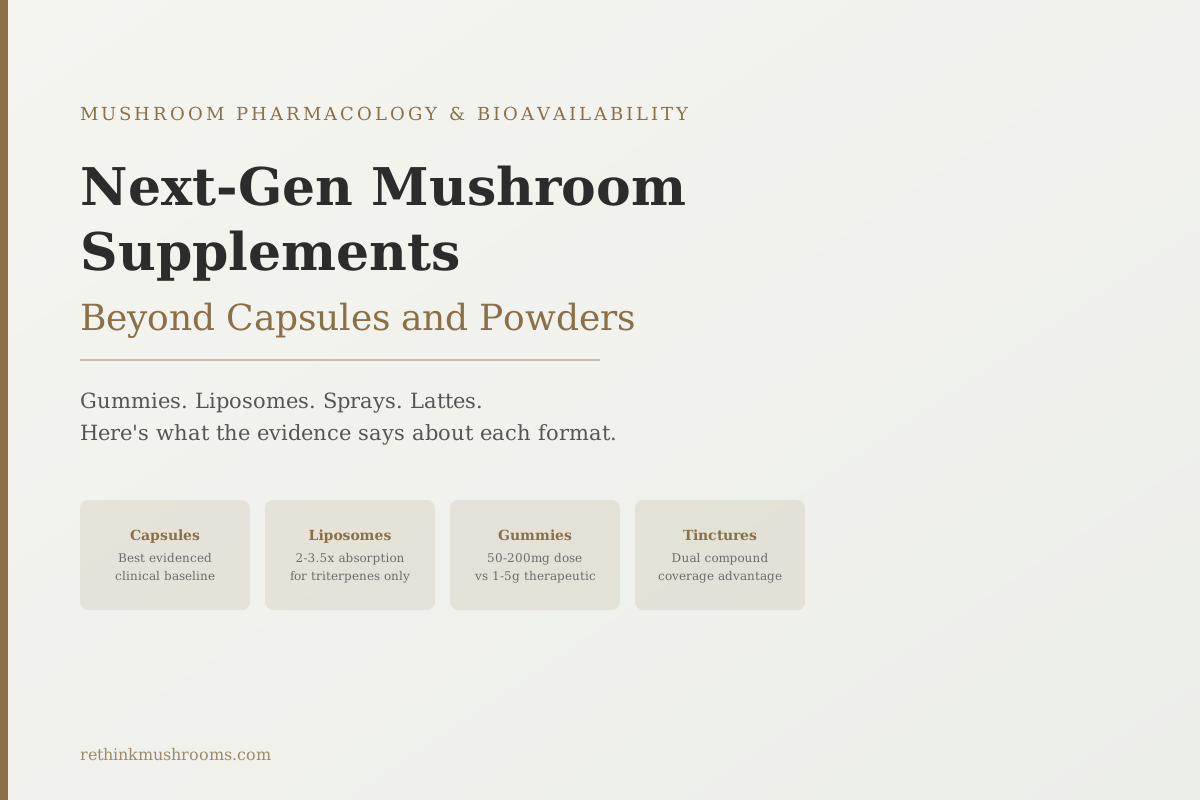
- Ko et al. (2023) in Nutrients ran a randomized crossover trial showing liposomal delivery improved absorption 2-3.5x versus standard formulations for vitamin B3, vitamin C, zinc, and iron — the best available evidence for liposomal absorption, applicable to small systemically-absorbed molecules like mushroom triterpenes
- The liposomal powder problem: liquid liposomes converted to powder via spray drying often lose their structure when reconstituted in GI fluid, releasing encapsulated compounds before any absorption advantage is realized — liquid liposomal products are much more likely to maintain functional liposome structure than powdered capsule versions
- A 2024 study (Macit et al., Food Bioscience) characterized liposomal oyster and shiitake extracts at entrapment yields of up to 71.2%, demonstrating that mushroom-specific liposomal formulation is technically achievable and produces improved antioxidant capacity
- Gummies, beverages, and food products typically contain 50-200mg of mushroom extract per serving versus 1,000-5,000mg in therapeutic capsule doses — these are entry formats for exposure, not therapeutic dosing vehicles
- Dual-extraction tinctures have a genuine and evidence-based advantage over capsules for compound coverage: water extraction captures polysaccharides, ethanol extraction captures triterpenes — a single liquid covers both compound classes
The Central Distinction: Which Compounds Need Better Delivery?
Before evaluating any format, you need to know which mushroom compounds you're actually trying to deliver. The answer changes everything.
Beta-glucans work at the gut surface. Beta-glucans, the long-chain polysaccharide molecules that give mushrooms most of their immune-stimulating properties, bind to Dectin-1 receptors on immune cells that line the gut wall. This is a local interaction: beta-glucan meets receptor, immune cell activates. Beta-glucans don't need to cross the gut lining into the bloodstream to produce this effect. They need to reach the gut intact and bind their receptor.
For beta-glucans, "enhanced bioavailability" in the systemic sense is the wrong target. More beta-glucan in the blood doesn't mean more immune activation. It might mean the opposite — beta-glucan that made it into systemic circulation without triggering the gut immune receptors has already missed its primary mechanism. For a detailed treatment of this counterintuitive point, see beta-glucan bioavailability: can your gut actually absorb them?
Triterpenes need to cross into the bloodstream. Ganoderic acids (the primary triterpenoids in Reishi), hericenones (the nerve-growth-factor-stimulating compounds in Lion's Mane fruiting body), and cordycepin (the primary bioactive in Cordyceps) are all small molecules that do require systemic absorption to reach their targets. Ganoderic acids must reach liver cells, immune cells, and adipose tissue. Hericenones need to reach the gut-blood barrier or directly stimulate peripheral nerve cells. Cordycepin needs to enter the bloodstream and reach target tissues.
These compounds have documented poor oral bioavailability in their standard form. They face degradation in the acid environment of the stomach, competition from liver enzymes that break them down before they reach systemic circulation (a process called first-pass metabolism), and limited solubility in gut fluid. For these compounds, format genuinely matters.
This compound-class distinction is the framework for evaluating every format below.
Standard Capsules and Powders: The Reliable Baseline
Standard capsules and powders are the most-studied mushroom supplement format. Every major mushroom clinical trial — the Zhao 2012 Reishi spore-powder RCT,[1] the Docherty 2023 Lion's Mane RCT,[2] the Torkelson 2012 turkey tail trial[3] — used standard capsule or powder forms. The absorption characteristics, typical doses, and clinical effects are best understood for this format.
A well-made standard capsule using dual-extraction (covering both water-soluble polysaccharides and ethanol-soluble triterpenes) is the baseline against which every other format should be measured. The key quality signals for a standard product are:
- Extraction method (dual vs. water-only vs. ethanol-only)
- Standardized beta-glucan content (measurable, listed on the label)
- Fruiting body vs. mycelium source (relevant to which compounds are present)
- Third-party testing for active compounds
Format is not the limiting factor for a standard capsule. Extraction method and sourcing are. A poorly extracted lion's mane in a liposomal delivery system still delivers poorly extracted lion's mane.
Dual-Extraction Tinctures: A Genuine Compound Coverage Advantage
Dual-extraction tinctures, usually a combination of hot water extract and ethanol extract in a liquid base, have a genuine advantage over standard capsules for compound breadth.
Water extraction captures water-soluble compounds — primarily beta-glucans and other polysaccharides. Ethanol extraction captures fat-soluble compounds — primarily triterpenes, including ganoderic acids and hericenones. A single mushroom species may require both extractions to capture its full bioactive profile.
Standard capsules can contain dual extracts (the extraction happens before encapsulation), so the advantage of a tincture over a capsule is not that one extracts better than the other. The advantage of a tincture is absorption speed and potential buccal uptake. Liquid compounds begin absorbing in the mouth and esophagus before reaching the stomach. Some fraction of small molecules (triterpenes) may enter circulation through the mouth's lining directly, bypassing partial gastric degradation.
This is a theoretical advantage with limited mushroom-specific clinical evidence. But the principle is sound: for triterpene-rich species like Reishi and Lion's Mane, a liquid dual-extraction tincture covers both compound classes and may offer faster absorption onset than capsules.
Liquid Liposomes: The Format With the Most Relevant Evidence
Liposomes are spheres made of phospholipids, the same material as cell membranes. A compound encapsulated in a liposome is protected from stomach acid and enzymatic degradation. When the liposome reaches the gut, its phospholipid membrane merges with gut cell membranes and delivers the compound directly into the cell without requiring transport across a membrane barrier.
This is the same technology used in mRNA vaccines to protect RNA from degradation. Applied to supplement delivery, it's real chemistry with real effects — for the right compounds.
Ko et al. (2023) in Nutrients ran a double-blind, randomized crossover trial in 34 healthy adults comparing liposomal versus non-liposomal multivitamin/mineral formulations. Plasma exposure (area under the curve) was 2-3.5x greater with liposomal formulations for vitamin B3, vitamin C, zinc, and iron. These are all small molecules with molecular weights and absorption characteristics comparable to mushroom triterpenes. Tinsley et al. (2022), also in Nutrients, found similar mineral-absorption advantages in a randomized crossover trial of 25 healthy participants.
For mushroom extracts specifically, Macit et al. (Food Bioscience, 2024) characterized liposomal formulations of oyster (Pleurotus ostreatus) and shiitake (Lentinus edodes) extracts. The liposomal particles showed mean diameters of 60-165 nm and entrapment yields up to 71.2%, with higher antioxidant capacity in liposomal form than in the non-encapsulated extracts — confirming that liposomal encapsulation of mushroom extracts is technically feasible and produces measurable improvement.
The critical caveat: powder versus liquid form.
When liquid liposomes are spray-dried into powder for capsule filling, the process converts them from intact spherical structures to dehydrated film fragments. When the powder is reconstituted in stomach fluid, the liposomes may not reliably reform into intact spheres. The encapsulated compounds can leak into the gastric environment before any absorption advantage is realized.
This means:
- A liquid liposomal mushroom supplement (bottled liquid, taken as a drink or oral spray) is much more likely to maintain true liposomal structure
- A "liposomal mushroom capsule" — a capsule containing spray-dried liposomal powder — is much less likely to deliver the claimed absorption advantage
The distinction matters because the supplement market is full of liposomal capsule products. The liquid form is the one with mechanistic integrity.
When is liquid liposomal worth the premium? For triterpene-rich species — Reishi for ganoderic acids, Lion's Mane for hericenones, Cordyceps for cordycepin — a liquid liposomal formulation with verified liposome integrity is the most evidence-supported upgrade over standard capsules. For turkey tail, Chaga, or other beta-glucan-dominant species taken for immune support, the premium is largely unjustified because the mechanism doesn't require systemic absorption.
Sublingual Sprays: Bypassing GI Degradation
Sublingual and buccal delivery describes absorption through the mucous membrane of the mouth, underneath the tongue or along the inner cheeks. This route delivers compounds directly into the bloodstream through the rich capillary network in the mouth, bypassing the stomach, small intestine, and first-pass liver metabolism entirely.
For small lipophilic molecules — which mushroom triterpenes are — this is mechanistically promising. Ganoderic acids and hericenones have the molecular characteristics (small size, fat solubility) that make buccal absorption feasible.
The limitation is dose. Sublingual sprays deliver small volumes with each application. Therapeutic doses for lion's mane in clinical trials range from 500mg to 3,000mg of extract per day. A sublingual spray delivering 50-100mg per application would require many applications to reach that range. This makes sublinguals more plausible as a format for compounds with low effective doses (cordycepin may be active at lower concentrations) than for compounds where gram-level dosing is the clinical standard.
Mushroom-specific sublingual clinical trials don't exist yet. The format is promising for specific compounds but unproven in the context of medicinal mushrooms specifically.
Gummies, Beverages, and Food Products: Entry Formats
Mushroom gummies, ready-to-drink lattes, chocolates, and mushroom-enhanced foods are the fastest-growing product category in the mushroom supplement market. They are not therapeutic delivery formats.
The dose problem. A typical mushroom gummy or beverage contains 50-200mg of mushroom extract per serving. Clinical trials for lion's mane use 500-3,000mg. Reishi trials use 1,000-3,000mg. Cordyceps performance trials use 3,000-4,500mg. A product delivering 200mg is at 4-40% of the doses used in research.
The heat problem. Processing mushroom compounds into gummies, chocolates, and beverages involves heat. Cordycepin, the primary bioactive in Cordyceps, is heat-sensitive and degrades at standard food processing temperatures. A mushroom chocolate bar may contain negligible functional cordycepin regardless of what the label claims about extract content.
The format signal. Gummies and beverages serve as gateway products — they introduce consumers to mushroom supplementation in an accessible form. For someone who has never tried medicinal mushrooms, a mushroom latte is a low-barrier starting point. But if the goal is the clinical outcomes described in the research literature, the dose and compound stability requirements of those trials are not met by food-format products.
For cost-per-active-dose comparisons across formats, see cost per dose: comparing mushroom supplement forms.
The Practical Format Guide
Format × Compound Fit
Which Delivery Format Actually Serves Which Compound Class
Beta-glucans
Triterpenes
Evidence
Standard dual-extraction capsule / powder
The clinical-trial baseline for every compound class
Dual-extraction liquid tincture
Covers both fractions; potential faster onset
Liquid liposomal
Beta-glucans need no systemic uptake; triterpenes benefit
Liposomal powder capsule
Spray-drying can break liposome structure before absorption
Sublingual spray
Bypasses the gut — but delivers small volumes per dose
Gummies / beverages / food
Sub-therapeutic doses; heat degrades cordycepin
The whole table turns on one distinction: beta-glucans act locally at gut Dectin-1 receptors, so “enhanced absorption” formats add nothing for them, while triterpenes (ganoderic acids, hericenones, cordycepin) are systemically absorbed and are the only compounds a delivery upgrade can genuinely help.
Compiled from studies cited in this article: Ko et al. (2023) & Tinsley et al. (2022), Nutrients; Macit et al. (2024), Food Bioscience; Zhao et al. (2012); Docherty et al. (2023); Torkelson et al. (2012).
Summarizing where the evidence actually lands:
Best evidence and value: Dual-extraction capsule or powder from a standardized, third-party-tested source. Every major clinical trial uses this format. Most effective for all compound classes when properly extracted.
Meaningful upgrade for specific use cases: Liquid liposomal formulation for Reishi or Lion's Mane specifically, if you are trying to maximize ganoderic acid or hericenone absorption. Must be liquid form, not powder. Worth the premium only for triterpene-targeted goals.
Genuine advantage for compound breadth: Dual-extraction liquid tincture. Captures both polysaccharide and triterpene fractions in one product, with potential minor absorption speed advantage.
Promising but unproven for mushrooms: Sublingual spray for small-molecule mushroom compounds. Mechanistically sound, no mushroom-specific clinical data yet.
Not therapeutic-dose formats: Gummies, lattes, beverages, food products. Fine for consumer exploration, not sufficient for the doses used in clinical research. For the liposomal and nanoparticle technologies at the research frontier, see liposomal and nanoparticle mushroom delivery: hype or genuine breakthrough? For the nanoparticle research specifically, see mushroom nanoparticles: the future of bioactive delivery.
This article is for educational purposes only and is not medical advice. Mushroom supplements are not approved to diagnose, treat, cure, or prevent any disease, and delivery format does not change that. Talk with a qualified healthcare provider before starting any supplement, especially if you are pregnant, nursing, taking medication, or managing a health condition.
The Bottom Line
Format evaluation depends entirely on which mushroom compounds you're targeting. Beta-glucans work via gut-surface Dectin-1 receptors — systemic bioavailability enhancement is irrelevant. Triterpenes (ganoderic acids, hericenones, cordycepin) are systemically absorbed and do benefit from delivery enhancement. Liquid liposomal is the format with the strongest evidence for absorption improvement in small molecules (2-3.5x in RCTs), but only liquid form maintains liposome integrity — powdered liposomal capsules likely don't. Standard dual-extraction capsules remain the best-evidenced format for most users. Gummies and beverages deliver sub-therapeutic doses.
Frequently Asked Questions
Sources & References
- 1RTHM-00276·Zhao, Hong et al. (2012). “Spore Powder of Ganoderma lucidum Improves Cancer-Related Fatigue in Breast Cancer Patients Undergoing Endocrine Therapy: A Pilot Clinical Trial..” Evidence-based complementary and alternative medicine : eCAM.Study breakdown →PubMed →↩
- 2RTHM-00821·Docherty, Sarah et al. (2023). “The Acute and Chronic Effects of Lion's Mane Mushroom Supplementation on Cognitive Function, Stress and Mood in Young Adults: A Double-Blind, Parallel Groups, Pilot Study..” Nutrients.Study breakdown →PubMed →↩
- 3RTHM-00267·Torkelson, Carolyn J et al. (2012). “Phase 1 Clinical Trial of Trametes versicolor in Women with Breast Cancer..” ISRN oncology.Study breakdown →PubMed →↩