Bioactive Compounds in Mushrooms
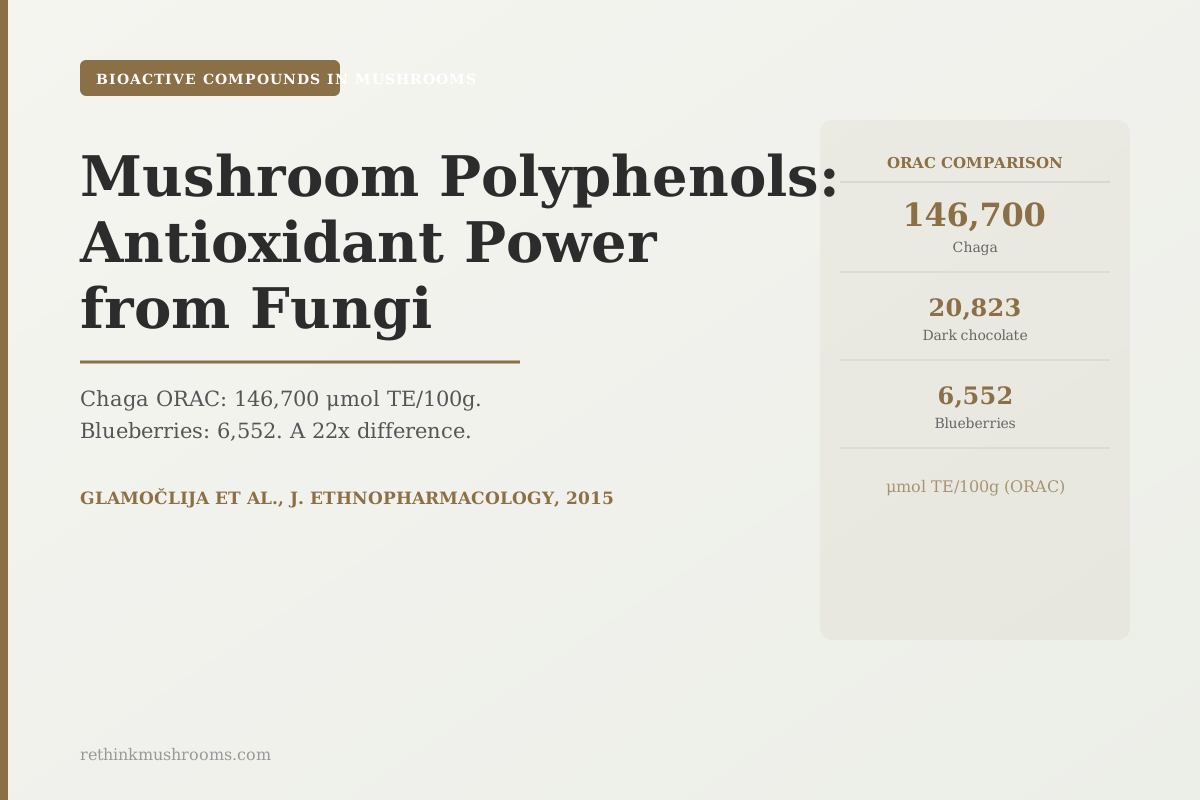
146,700 μmol TE/100g Chaga's ORAC antioxidant score
Chaga mushroom's ORAC antioxidant score of approximately 146,700 μmol TE per 100 grams is about 22 times higher than blueberries at 6,552. This figure comes from a 2015 peer-reviewed analysis, and it has never been properly contextualized in consumer health content.
Glamočlija et al., Journal of Ethnopharmacology, 2015
Phenolic acids
gallic, caffeic, p-coumaric, ferulic: the primary polyphenol class across most edible mushroom species
1–6 mg/g
total phenolic content range in dried edible mushrooms; significant species variation (Barros et al., 2008)
LDL oxidation
enoki mushroom polyphenols inhibited human LDL oxidation in vitro; a cardioprotective effect beyond simple radical scavenging (Rahman et al., 2015)
Glamočlija et al., Journal of Ethnopharmacology, 2015
 View as image ↗
When mushroom health benefits are discussed, beta-glucan gets the most attention and ergothioneine has been gaining ground. But mushrooms also contain polyphenols, the same broad class of plant-based antioxidants found in berries, tea, and red wine. And in some species, the antioxidant activity of these compounds dwarfs anything typically associated with mushrooms in the supplement conversation. Abdelshafy and colleagues published the most comprehensive review of phenolic compounds in edible mushrooms in 2022, cataloguing a wide range of phenolic acids, flavonoids, and mushroom-specific phenolic structures across species, while documenting antioxidant, anti-inflammatory, antitumor, and metabolic effects.[1] What the review and the broader literature make clear is that mushroom polyphenols are not just a minor component of a fungal food. In some species, they are the primary driver of antioxidant activity. This article is part of a broader look at bioactive compounds in medicinal mushrooms.
Key Takeaways
- Mushrooms contain three main phenolic compound categories: phenolic acids (gallic, caffeic, p-coumaric, ferulic, p-hydroxybenzoic), flavonoids (in at least some species), and mushroom-specific melanin-polyphenol complexes found in Chaga
- Total phenolic content in dried edible mushrooms ranges from 1 to 6 mg per gram depending on species, with strong correlation between phenolic content and antioxidant activity (Barros et al., 2008)
- Chaga's ORAC antioxidant score of approximately 146,700 μmol TE/100g is about 22 times higher than blueberries (6,552) and attributes primarily to its melanin-polyphenol complex, not standard plant-type phenolics (Glamočlija et al., 2015)
- Species vary significantly in antioxidant potency; choosing the right mushroom species matters for phenolic intake (Witkowska et al., 2011)
- Enoki mushroom polyphenols inhibited human LDL cholesterol oxidation in vitro, a cardioprotective mechanism beyond general antioxidant scoring (Rahman et al., 2015)
- Gallic acid is the predominant phenolic acid across most edible species, with cultivation substrate affecting polyphenol content (Mishra et al., 2013)
What Mushroom Polyphenols Are (and How They Differ From Plant Polyphenols)
Polyphenols are compounds with multiple phenol ring structures. In plants, the most familiar polyphenols are flavonoids (quercetin, rutin, catechin from berries and tea) and phenolic acids (caffeic acid, chlorogenic acid from coffee and vegetables). Plants produce polyphenols as defense chemicals, UV absorbers, and signaling molecules.
Mushrooms produce polyphenols for similar ecological reasons, but the specific compounds are different. The primary phenolic acids found across most edible mushroom species, documented in the Abdelshafy 2022 review, are gallic acid, caffeic acid, p-coumaric acid, ferulic acid, and p-hydroxybenzoic acid.[1] These are not unique to mushrooms. Gallic acid is found in tea, ferulic acid in cereal grains, caffeic acid in coffee. What makes mushroom polyphenols interesting is the combination of these compounds with fungal-specific structures not found in any plant.
The most dramatic example is Chaga (Inonotus obliquus), which grows as a parasite on birch trees. Chaga incorporates phenolic compounds from its birch host into its own biochemistry, producing a melanin-polyphenol complex that is structurally distinct from any plant polyphenol. This complex is the primary driver of Chaga's exceptional antioxidant activity. Glamočlija and colleagues characterized Chaga's bioactive profile in 2015 and attributed its ORAC score of approximately 146,700 μmol TE per 100 grams primarily to this melanin-phenol complex, which arises from Chaga's unique biology as a birch parasite rather than a free-living saprotrophic mushroom.[4]
For context: blueberries, which are frequently cited as a high-antioxidant food, have an ORAC score of approximately 6,552 μmol TE per 100 grams. Dark chocolate is approximately 20,823. Chaga's score is roughly 22 times higher than blueberries and seven times higher than dark chocolate.
How Species Compare: The Antioxidant Landscape Across Edible Mushrooms
Antioxidant potency varies substantially across mushroom species, and the variation is relevant for anyone selecting mushrooms specifically for their phenolic content.
Barros and colleagues conducted a comprehensive species-by-species phenolic profiling of wild edible mushrooms, quantifying total phenolic content and identifying specific compounds.[2] Total phenolics ranged from approximately 1 to 6 mg per gram of dried mushroom across the species studied. Flavonoid concentrations ranged from 0.9 to 3.0 mg per gram. The study found a strong correlation between total phenolic content and DPPH antioxidant activity: the more phenolics, the higher the antioxidant capacity. Myricetin and catechin were identified as the main flavonoids across species.
Witkowska and colleagues specifically compared wild edible mushrooms as antioxidant sources using multiple assay methods and documented significant inter-species variation in both polyphenol content and antioxidant activity.[3] Their conclusion: species choice matters. Selecting a mushroom for antioxidant intake is not a generic decision, because the variation between species is large enough to meaningfully affect what you're getting.
| Species | Primary phenolics | Notable antioxidant characteristic |
|---|---|---|
| Chaga (Inonotus obliquus) | Melanin-polyphenol complex, phelligridins | ORAC ~146,700; extraordinary antioxidant activity |
| Porcini (Boletus edulis) | Gallic acid, p-hydroxybenzoic acid | High DPPH activity; processing-sensitive |
| Chanterelle (Cantharellus cibarius) | Caffeic acid, protocatechuic acid | High total phenolics among culinary species |
| Enoki (Flammulina velutipes) | Gallic acid, protocatechuic acid | LDL oxidation inhibition (functional antioxidant) |
| King trumpet / Oyster (Pleurotus) | Gallic acid; cultivation substrate-dependent | Varies with growing conditions |
| Shiitake (Lentinus edodes) | Gallic acid, caffeic acid | Moderate; phenolics alongside lentinan and ergothioneine |
The table highlights that Chaga occupies a distinct tier from other mushrooms for raw antioxidant scoring, primarily due to its birch-parasitism chemistry. The culinary mushrooms (porcini, chanterelle, enoki, oyster) occupy a more moderate tier but still provide phenolic compounds with biological activity.
For readers interested in how Chaga's birch-derived chemistry distinguishes it from other fungi, how birch trees contribute to Chaga's unique chemistry covers the host-parasite biochemistry in depth. For a deeper look at Chaga's other primary bioactive class alongside polyphenols, inotodiol and Chaga's triterpenoid compounds provides the complementary analysis.
Beyond ORAC: What Mushroom Polyphenols Actually Do
ORAC scores measure antioxidant capacity in a test tube. Whether that capacity translates to biological effect in the human body is a different question, and one the research addresses more specifically than most antioxidant content discussions suggest.
Gallic acid, identified by Mishra and colleagues as the predominant phenolic acid across edible mushroom species, has documented anti-inflammatory activity alongside antioxidant activity.[6] This dual action makes it mechanistically different from vitamin C, which functions primarily as a reducing agent. Gallic acid works through multiple pathways including nuclear factor kappa-B inhibition, a key regulator of inflammatory gene expression. The mushroom species with the highest gallic acid content, including Pleurotus eryngii (king trumpet) and Pleurotus ostreatus (oyster mushroom), carry this anti-inflammatory potential alongside their antioxidant capacity.
Rahman and colleagues tested the functional antioxidant activity of Flammulina velutipes (enoki mushroom) polyphenols in a more clinically relevant context: human LDL cholesterol oxidation.[5] Oxidized LDL is a key driver of atherosclerosis, the buildup of plaques in arterial walls that underlies cardiovascular disease. Enoki polyphenols inhibited human LDL oxidation in vitro, demonstrating that mushroom phenolics can protect against a specific disease-relevant oxidative process, not just scavenge free radicals in a buffer solution.
The Abdelshafy 2022 systematic review documented the broader health activity landscape for mushroom phenolics: antioxidant activity (the most studied), anti-inflammatory, antitumor, antihyperglycemic (blood sugar regulation), antiosteoporotic (bone health), and anti-tyrosinase (relevant to skin hyperpigmentation).[1] This multi-target activity profile is consistent with how polyphenols from any source are understood to work: through simultaneous effects on multiple cellular pathways rather than a single drug-like mechanism.
Cultivation and Processing Effects on Phenolic Content
Mushroom polyphenol content is not fixed. Two things that change it significantly are cultivation substrate and cooking method.
Mishra and colleagues found that the substrate on which king trumpet mushrooms were grown affected their polyphenol content, suggesting that what mushrooms eat influences their phenolic profile.[6] This has practical implications for supplement quality: mushrooms grown on nutrient-poor substrates may have lower phenolic content than those grown on substrate designed to promote bioactive compound production.
Cooking effects are well-characterized across multiple studies. Boiling extracts water-soluble phenolics from the mushroom into cooking water and also degrades thermally sensitive compounds through heat. The phenolics that leach into cooking water are not lost if the broth is consumed. Microwaving, by contrast, applies heat with minimal water contact and preserves the majority of phenolic content within the mushroom tissue. The general finding across multiple cooking studies is that microwaving preserves more phenolics than boiling or frying.
For readers looking for the specific percentages across cooking methods with data from multiple studies, how processing affects mushroom phenolic content covers that in detail. For the full species-by-species breakdown of specific phenolic acid profiles, phenolic compounds in medicinal mushrooms provides the comprehensive reference. For the specific question of whether mushrooms contain flavonoids and why it's scientifically contested, mushroom flavonoids and health addresses that debate directly. And for how mushroom antioxidants compare specifically to vitamins C and E in mechanism and potency, mushroom antioxidants beyond vitamins addresses that question with data.
The Bottom Line
Mushrooms contain phenolic acids, flavonoids, and in the case of Chaga, a melanin-polyphenol complex with antioxidant activity approximately 22 times higher than blueberries by ORAC score. Species vary substantially in phenolic content, with Chaga occupying a distinct tier above most culinary mushrooms due to its birch-parasitism biochemistry. The primary phenolic acid across most edible species is gallic acid, which has anti-inflammatory properties beyond general antioxidant capacity. Enoki mushroom polyphenols have been shown to inhibit human LDL oxidation in vitro, demonstrating a cardioprotective functional effect. Cooking method affects phenolic retention, with microwaving preserving the most.
Frequently Asked Questions
Sources & References
- 1RTHM-01474·Abdelshafy, Asem Mahmoud et al. (2022). “A comprehensive review on phenolic compounds from edible mushrooms: Occurrence, biological activity, application and future prospective..” Critical reviews in food science and nutrition.Study breakdown →PubMed →↩
- 2RTHM-00126·Barros, Lillian et al. (2008). “Chemical composition and biological properties of portuguese wild mushrooms: a comprehensive study..” Journal of agricultural and food chemistry.Study breakdown →PubMed →↩
- 3RTHM-00238·Witkowska, Anna M et al. (2011). “Comparative study of wild edible mushrooms as sources of antioxidants..” International journal of medicinal mushrooms.Study breakdown →PubMed →↩
- 4RTHM-00373·Glamočlija, Jasmina et al. (2015). “Chemical characterization and biological activity of Chaga (Inonotus obliquus), a medicinal "mushroom"..” Journal of ethnopharmacology.Study breakdown →PubMed →↩
- 5RTHM-00729·Rahman, Mohammad Azizur et al. (2015). “Antioxidative Effects and Inhibition of Human Low Density Lipoprotein Oxidation In Vitro of Polyphenolic Compounds in Flammulina velutipes (Golden Needle Mushroom)..” Oxidative medicine and cellular longevity.Study breakdown →PubMed →↩
- 6RTHM-00544·Mishra, K K et al. (2013). “Antioxidant properties of different edible mushroom species and increased bioconversion efficiency of Pleurotus eryngii using locally available casing materials..” Food chemistry.Study breakdown →PubMed →↩