Bioactive Compounds in Mushrooms
48.7% less LDL lipid peroxidation
Polyphenols from enoki mushroom inhibited lipid peroxidation in isolated human LDL by 48.71% and extended the oxidation lag time to 125 minutes. That is a functional endpoint tied to artery disease — and it is a far better argument for mushroom antioxidants than any ORAC score.
Rahman et al., Oxidative Medicine and Cellular Longevity, 2015
inonoblins A–C
the genuinely novel chaga polyphenols isolated by Lee 2007 — not the phelligridins usually credited to that paper
ergothioneine
a non-phenolic mushroom antioxidant humans cannot make, which needs one specific transporter to enter a cell at all
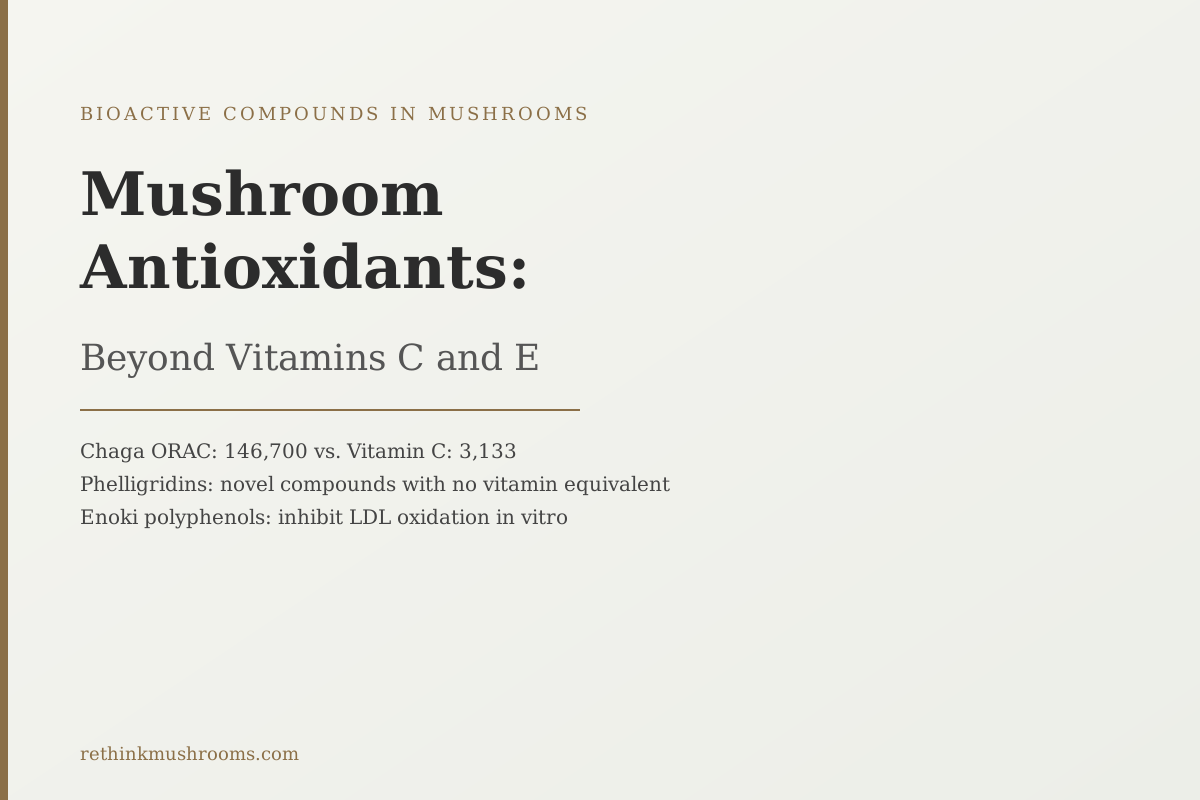
146,700
the chaga ORAC figure everyone cites — traceable to a commercial lab, not to the study it is attributed to
Rahman et al., Oxidative Medicine and Cellular Longevity, 2015
 View as image ↗
The claim that mushroom antioxidants go "beyond" vitamins C and E is usually made in two parts: magnitude and mechanism. The magnitude argument says mushrooms score enormously higher on antioxidant assays. The mechanism argument says mushrooms contain compounds that are structurally unlike anything in a vitamin, acting on targets vitamins never reach.
Only one of those two arguments survives a look at the primary literature. The magnitude case rests almost entirely on a chaga ORAC number that cannot be traced to the study it is credited to. The mechanism case is real, specific, and considerably more interesting — and it is the one almost nobody makes.
A 2022 comprehensive review by Abdelshafy and colleagues in Critical Reviews in Food Science and Nutrition surveyed the phenolic compounds found in edible mushrooms, their structural characteristics, and their reported biological activities.[1] Phenolic acids and flavonoids emerge as the most common phenolic classes in mushrooms, credited with antioxidant, anti-inflammatory, antitumor, antihyperglycaemic, antiosteoporotic, anti-tyrosinase and antimicrobial activities. That breadth is genuine. It also comes with a caveat the marketing never carries: nearly all of it is chemistry and cell work, and how much of any of it survives digestion has not been established. For the broader context of bioactive compounds in mushrooms, including beta-glucans and triterpenes, see What Are Beta-Glucans? The Most Important Compound in Medicinal Mushrooms.
Key Takeaways
- The most-cited mushroom antioxidant statistic — chaga at 146,700 μmol TE/100g ORAC — is not reported in Glamočlija 2015, the paper it is routinely attributed to; that study reports no ORAC value at all and states that quantitative conclusions about chaga require further purification
- The multiplier attached to it does not even close arithmetically: 146,700 ÷ 3,133 (vitamin C) is 46.8, not the "22 times" usually quoted. The 22× figure belongs to the blueberry comparator (146,700 ÷ 6,552 = 22.4) and was carried over to the wrong denominator
- The strongest real evidence is functional, not magnitude-based: enoki (Flammulina velutipes) polyphenols extended the oxidation lag time of isolated human LDL to 125 minutes and inhibited lipid peroxidation by 48.71% — though the two results are reported at concentrations a thousandfold apart, and all of it is in vitro (Rahman 2015)
- Lee 2007 isolated three genuinely new chaga polyphenols — inonoblins A, B and C — alongside the already-known phelligridins D, E and G. Popular accounts credit the paper with discovering the phelligridins, which is backwards. Their measured activity was significant against ABTS and DPPH but only moderate against superoxide
- Ergothioneine is the clearest structural difference from either vitamin, and it is not a phenolic at all: it is a histidine-derived thiol that humans cannot synthesise and that cannot cross a plasma membrane without the ETT transporter (Gründemann 2005, 2022)
- Antioxidant content varies several-fold between species and moves unpredictably with cooking — pressure cooking more than doubled radical scavenging in one oyster mushroom species, and Tan 2015 found no correlation at all between total phenolic content and antioxidant activity
Fact Check
Chaga's ORAC score and the 22× multiplier
The claim
“Chaga has an ORAC value of 146,700 μmol TE/100g — about 22 times the antioxidant power of vitamin C — as measured in the Journal of Ethnopharmacology.”
Supplement retail copy, repeated across health media and attributed to Glamočlija et al. 2015
What research shows
UnsupportedGlamočlija et al. 2015 reports no ORAC value. It identified organic acids and phenolic acids in chaga extracts and measured antioxidant activity by several assays, and its stated conclusion is that "further purification is necessary to draw quantitative conclusions." The 146,700 figure appears to originate in commercial testing of a single chaga product, not in the peer-reviewed literature.
The multiplier is separately wrong on its own terms. Dividing 146,700 by the quoted vitamin C value of 3,133 gives 46.8, not 22. The 22× ratio matches the blueberry comparator instead. Chaga's antioxidant chemistry is genuinely documented — the number, its attribution, and the comparison built on it are the parts that fail.
Glamočlija et al., Journal of Ethnopharmacology 162:323–32 (2015), PMID 25576897
How Antioxidant Activity Is Measured, and Why the Numbers Don't Tell the Whole Story
Before comparing mushroom phenolics to vitamins, it's worth understanding what the numbers actually measure.
The most commonly cited antioxidant score is ORAC (Oxygen Radical Absorbance Capacity), which measures how effectively a substance neutralizes free radicals in a test tube. The USDA officially discontinued publishing ORAC values for foods in 2012 specifically because the scores don't reliably predict what happens in the body after consumption. High-ORAC foods don't necessarily produce high antioxidant activity in the bloodstream, because absorption, metabolism, and bioavailability all intervene between the test tube and the cell.
DPPH and FRAP are two other common in vitro tests. DPPH measures how well a compound reduces a stable synthetic radical. FRAP measures ferric reducing antioxidant power. Both are useful laboratory tools for comparing compounds. None of them predict clinical efficacy.
This matters for interpreting chaga's much-quoted ORAC score, and for understanding why LDL oxidation inhibition data — which requires functional interaction with actual human lipoproteins — is a more biologically meaningful metric than any radical-scavenging assay. Where functional data exists, it deserves more weight than raw ORAC comparisons.
Where Chaga's 146,700 ORAC Number Actually Comes From
The figure of roughly 146,700 μmol TE per 100 grams is the most repeated antioxidant statistic in the mushroom category, and it is nearly always attributed to Glamočlija and colleagues' 2015 characterization of chaga in the Journal of Ethnopharmacology.[2] That attribution does not hold up.
What Glamočlija 2015 actually did was compare aqueous and ethanolic extracts of Inonotus obliquus collected in Finland, Russia and Thailand. It identified organic acids and phenolic compounds — oxalic acid was the dominant organic acid, and gallic, protocatechuic and p-hydroxybenzoic acids were detected in all samples — and it measured antioxidant activity by several different assays, alongside antimicrobial, anti-quorum-sensing and cytotoxicity testing. It did not report an ORAC value. It did not quantify melanin complexes, triterpenes or beta-glucans. And its own conclusion is a caution against exactly the sort of number it is being cited for: because the Inonotus obliquus content of chaga conks is limited, the authors write, further purification is necessary before quantitative conclusions can be drawn.[2]
Citation Chain Audit
Following “Chaga ORAC 146,700” Back to Its Source
This is the most-cited antioxidant number in the mushroom category, and it is almost always hung on one peer-reviewed paper. Reading that paper is enough to see that the attribution fails. Each step below is a link in the chain; the highlighted steps are where it breaks.
The claim as it circulates
Chaga has an ORAC score of 146,700 μmol TE/100 g — "roughly 22 times vitamin C."
The source it is attributed to
Glamočlija et al., Journal of Ethnopharmacology 162:323–32 (2015). PMID 25576897.
What that paper actually reports
Aqueous and ethanolic chaga extracts from Finland, Russia and Thailand. Organic acids and phenolic acids identified (oxalic acid dominant; gallic, protocatechuic and p-hydroxybenzoic acids in every sample). Antioxidant activity "measured by several different assays." No ORAC value appears anywhere in the abstract — and no melanin, triterpene or beta-glucan quantification.
What the paper says about quantifying chaga at all
"As the Inonotus obliquus presence in Chaga conks is limited, further purification is necessary to draw quantitative conclusions." The cited source explicitly declines to make the kind of quantitative claim it is being cited for.
Where the number appears to originate
A commercial ORAC assay of one chaga product, reported by Brunswick Laboratories and propagated through supplement retail copy. No peer-reviewed primary source reports 146,700.
The Arithmetic Does Not Close Either
Set the sourcing problem aside and just divide the numbers the claim supplies. The headline multiplier is attached to the wrong comparator.
What this does not mean: chaga's antioxidant chemistry is real and is documented in the peer-reviewed literature, including in the very paper above. What fails is the specific number, its attribution, and the multiplier built on top of it. A compound can have genuine measured activity and still be marketed with a statistic nobody can trace.
Chain steps 02–04 quote the published abstract of Glamočlija et al., J Ethnopharmacol 162:323–32 (2015), PMID 25576897. Step 05 reflects the absence of any peer-indexed primary source for the figure. Step 05 arithmetic is plain division on the comparator values the claim itself supplies; those comparator values derive from the USDA ORAC database withdrawn in 2012 and are not independently verified here.
None of this means chaga's antioxidant chemistry is fictional. Glamočlija 2015 found high antioxidant and antimicrobial activity in every extract it tested.[2] What fails is the specific number, the attribution it is hung on, and the vitamin comparison stacked on top. This is the same conclusion reached in more detail in Chaga ORAC Score: Marketing Hype vs. Actual Antioxidant Science.
Chaga's underlying biology is still unusual, and worth stating accurately. Unlike edible fruiting-body mushrooms such as shiitake, oyster or lion's mane, chaga is a sterile mycelial mass that grows parasitically on birch. The resulting conk is a dense, pigmented mass, and its polyphenol-melanin chemistry is the reason the material is interesting at all.
Lee and colleagues went into that chemistry directly in a 2007 paper in Bioorganic and Medicinal Chemistry Letters.[3] Here too the popular retelling has drifted from the record. The paper is usually credited with discovering the phelligridins; in fact it isolated three previously unknown compounds — inonoblins A, B and C — alongside phelligridins D, E and G, which were already known. The measured activity was likewise more modest than the retelling suggests: significant scavenging against the ABTS radical cation and the DPPH radical, but only moderate activity against the superoxide radical anion.
That is still a real finding, and it is the one that supports the mechanism argument. These are styrylpyranone-type pigments with no counterpart in vitamin C or vitamin E, which are single, well-defined molecules. But note what the evidence covers: three chemical assays in a tube.[3] The frequent leap to "chaga polyphenols hit molecular targets no vitamin can reach" is not something Lee 2007 tested. For a deeper look at chaga's other distinctive bioactive compound, see Inotodiol: Chaga's Other Important Bioactive Compound.
Enoki and LDL Oxidation: The More Clinically Relevant Endpoint
The most compelling mechanistic evidence for mushroom phenolics doing something vitamins-style scavenging scores can't capture comes not from chaga but from a less famous mushroom: enoki (Flammulina velutipes), also known as golden needle mushroom.
Rahman and colleagues published a 2015 study in Oxidative Medicine and Cellular Longevity testing five solvent fractions of enoki against isolated human LDL.[4] The methanol:dichloromethane fraction was the most active on every measure. It scavenged DPPH with an IC50 of 0.86 mg/mL and carried a total phenolic content of 56.36 gallic acid equivalents per gram. More importantly, it extended the lag time before conjugated diene formation to 125 minutes, and inhibited the formation of thiobarbituric acid reactive substances by 48.71%. LC-MS/MS identified protocatechuic acid, p-coumaric acid and ellagic acid in the active fraction — compounds the authors describe as chain-breaking polyphenolics.
What Was Actually Measured
Enoki Polyphenols Against Human LDL Oxidation
“Lag time” is the reason this experiment is more interesting than a scavenging score. Oxidising LDL does not degrade smoothly — it holds out while its own antioxidant reserve is consumed, then propagates rapidly. An added antioxidant extends the holding phase. That is a protective effect on a real lipoprotein, not a number from a buffer.
Chemical assay
DPPH radical scavenging
IC50 0.86 mg/mLMost potent of the five solvent fractions. Measures scavenging of a synthetic radical in solution.
Chemical assay
Total phenolic content
56.36 GAE/gGallic acid equivalents per gram of M:DCM fraction. A quantity of phenolics, not an activity.
Functional
Conjugated diene lag time
125 minAt 1 µg/mL. How long oxidation of isolated human LDL was held off before propagation began.
Functional
TBARS inhibition
48.71%At 1 mg/mL. Reduction in thiobarbituric acid reactive substances, a lipid peroxidation product.
Read the doses before the effect sizes: the two functional results are reported at concentrations a thousandfold apart — 125 minutes of lag at 1 µg/mL, 48.71% TBARS inhibition at 1 mg/mL — as printed in the paper's own abstract. Every measurement here is in vitro, on isolated human LDL in a tube. Nobody ate anything, and no blood level of these polyphenols was established.
All values from Rahman et al., Oxidative Medicine and Cellular Longevity 2015:403023, PMID 26180589. Curve shapes are schematic; the only measured quantity plotted is the 125 minute lag. The untreated trace illustrates what a shorter lag phase looks like — the abstract does not report a control lag time and none is asserted here.
Rahman et al. (2015) · Oxidative Medicine and Cellular Longevity
- Population
- Isolated human low-density lipoprotein, in vitro. No human subjects, no dosing, no absorption step.
- Intervention
- Five solvent fractions of Flammulina velutipes — methanol:dichloromethane (M:DCM), hexane, dichloromethane, ethyl acetate, and aqueous residue. M:DCM was the most potent throughout.
- Comparator
- Unfractionated and lower-activity solvent fractions; no vitamin C or vitamin E comparator arm was run
- Finding
- M:DCM fraction: DPPH IC50 0.86 mg/mL; total phenolic content 56.36 GAE/g. Conjugated diene lag time extended to 125 minutes at 1 µg/mL; TBARS formation inhibited 48.71% at 1 mg/mL. Protocatechuic, p-coumaric and ellagic acids identified by LC-MS/MS.
preliminary A functional endpoint on real human lipoproteins, which is a meaningful step above a scavenging score — but the two headline results are reported at concentrations a thousandfold apart, and nothing here establishes that eating enoki puts these compounds anywhere near LDL in a living person.
Rahman et al., Oxidative Medicine and Cellular Longevity, 2015 (ref 4)
The honest reading is that this places enoki polyphenols in the category of mechanistically interesting compounds with an endpoint worth following up, not in the category of demonstrated cardiovascular benefit. No human trial has tested it. For the ergothioneine angle on antioxidant protection, see Ergothioneine and Inflammation: Anti-Inflammatory Research.
Polyphenol Content Varies Substantially Across Species
Not all mushrooms are equivalent antioxidant sources, and the spread is wide enough to make "mushrooms are antioxidant-rich" a nearly meaningless statement on its own.
Witkowska and colleagues surveyed sixteen popular wild edible species in 2011 and found variation across every assay they ran.[5] Total polyphenol content exceeded 100 mg/100 g fresh mass in only five of the sixteen — Boletus chrysenteron, B. edulis, Leccinum scabrum, L. aurantiacum and Macrolepiota procera. TEAC values spanned 1.07 to 4.01 mmol/100 g fresh mass, and DPPH scavenging EC50 values ranged from 2.91 to 13.86 mg/mL, an almost fivefold spread from the most to the least active extract. Boletus edulis and B. chrysenteron scored high on polyphenol content and on all three of the FRAP, TEAC and DPPH assays.
Barros and colleagues found the same pattern in seven wild Portuguese species in 2008, measuring phenolics alongside tocopherols, ascorbic acid and carotenoids.[6] All seven showed antioxidant activity across four separate methods, but the activity was concentrated: Ramaria botrytis was the standout, with EC50 values below 1 mg/mL.
For practical purposes, this means the antioxidant potential of mushrooms as a category can't be reduced to a single number or a single comparison with vitamins. The head-to-head comparison with vitamins C and E is most defensible where the compound novelty is well documented — chaga's styrylpyranones, or mushroom ergothioneine. For common culinary species, the honest framing is that they contribute meaningful polyphenol content within a varied diet, not that they substitute for vitamin-containing fruits and vegetables.
How Cooking Affects What Antioxidants You Actually Get
Even knowing which species are richest in phenolics, what reaches you depends on preparation — and the research here is messier than the usual "don't boil your mushrooms" advice suggests.
Roncero-Ramos and colleagues tested boiling, microwaving, grilling and deep frying across four cultivated species — Agaricus bisporus, Lentinula edodes, Pleurotus ostreatus and Pleurotus eryngii — in 2017.[7] Antioxidant activity fell significantly after boiling and frying, while grilled and microwaved mushrooms retained higher values; the authors concluded that microwaving and grilling were the best processes for preserving the nutritional profile. Frying caused the heaviest losses of protein, ash and carbohydrate while raising fat and energy content. Boiling was not uniformly bad, though: it actually improved total glucan content by enhancing the beta-glucan fraction. Maillard reaction products, tracked by absorbance at 420 nm, appear to be partly responsible for the antioxidant shifts.
Then the picture complicates further. Tan and colleagues tested boiling, microwaving and pressure cooking across six oyster mushroom species in 2015 and found that cooking frequently increased measured antioxidant activity.[8] Pressure cooking improved radical scavenging in Pleurotus floridanus by more than 200%, in P. flabellatus by 117.6%, and in P. pulmonarius by 49.1% relative to uncooked samples. Microwaved P. eryngii showed a 17% higher TEAC value than raw.
Most usefully, Tan found no correlation between total phenolic content and antioxidant activity at all — which is a direct warning against reading a phenolic number as an activity number, and a reminder that heat can liberate or generate compounds the Folin-Ciocalteu assay never counted.
- Chemical & Cell Assayscompleted
Extensive. ORAC, DPPH, ABTS, FRAP and TEAC data across dozens of species; compound isolation and structural characterisation (Lee 2007, Witkowska 2011, Barros 2008)
- Animal Studiesmissing
Not covered by the sources in this article; no in vivo antioxidant outcome data is cited here for these specific compounds
- Case Reportsmissing
Not a meaningful tier for a dietary antioxidant question
- Small Human Trialsmissing
No human trial has tested mushroom phenolics against an oxidative-stress or cardiovascular endpoint in the evidence reviewed here
- Large Randomized Trialmissing
None
- Meta-Analysismissing
None; nothing to pool
Every finding in this article — the chaga polyphenols, the enoki LDL protection, the species rankings, the cooking effects — sits on the bottom rung. The functional endpoints (LDL oxidation) are more meaningful than the scavenging scores, but they are still in vitro. The distance between this evidence and a health claim is the entire ladder.
Assessment of the primary sources cited in this article, 2005–2022
Two practical implications survive all of this. First, method matters more than any blanket rule: microwaving and grilling preserved antioxidant activity in Roncero-Ramos, and pressure cooking raised it in Tan. Second, when mushrooms are boiled in soups or stews, water-soluble phenolics leach into the liquid — discarding the broth discards them. For the full picture on processing effects including supplement extraction, see How Processing Affects Mushroom Phenolic Content.
What Mushroom Antioxidants Have That Vitamins Don't
With the magnitude argument set aside, the mechanism argument can be stated precisely. It rests on two points, not three, and one of them is not about phenolics at all.
Structural diversity the vitamins don't have. Vitamins C and E are each a single defined molecule. Vitamin C is a water-phase reducing agent and enzyme co-factor; vitamin E is a lipid-soluble chain-breaking antioxidant that partitions into membranes and LDL particles. Mushroom phenolics are an array — phenolic acids, flavonoids, and in chaga the styrylpyranone pigments documented by Lee 2007, which have no vitamin counterpart.[3] This is a real difference in chemistry. It is not, by itself, evidence of a superior effect.
A genuinely non-phenolic antioxidant with a gated distribution. Ergothioneine is the clearest case, and it is worth being precise that it is not a phenolic compound — it is a histidine-derived thiol, which puts it outside the compound class this article is otherwise about. Gründemann and colleagues identified its dedicated transporter in 2005, showing that the protein previously called OCTN1 (gene SLC22A4) is in fact a highly efficient ergothioneine carrier, and proposing the functional name ETT.[9] Two findings from that work matter here: ergothioneine is entirely absorbed from food, since humans do not synthesise it, and cells lacking ETT do not accumulate it at all, because the plasma membrane is essentially impermeable to it.
Gründemann's 2022 inventory of ETT expression places it prominently in neutrophils, monocytes and macrophages, and developing erythrocytes, and notes that ETT remains the only well-defined biomarker of intracellular ergothioneine activity.[10] That review also treats the evidence for ETT expression in the brain critically rather than accepting it — a useful corrective to the wider claims made for ergothioneine's tissue reach.
Sorting the Toolkit
“Mushroom Antioxidants” Is Not One Chemical Class
The compounds usually bundled under that phrase belong to different families, are supported by different kinds of evidence, and do not all clear the same bar. Sorting them makes the real argument visible — and shows where the popular version of it goes wrong.
Phenolic acids
PHENOLICGlamočlija 2015Gallic, protocatechuic, p-hydroxybenzoic·Chaga (Inonotus obliquus)
Detected in every aqueous and ethanolic chaga extract tested across three countries.
Styrylpyranone pigments
PHENOLICLee 2007Inonoblins A–C (new); phelligridins D, E, G (known)·Chaga (Inonotus obliquus)
Significant ABTS and DPPH scavenging; only moderate activity against superoxide. Chemical assays only.
Phenolic acids
PHENOLICRahman 2015Protocatechuic, p-coumaric, ellagic·Enoki (Flammulina velutipes)
Extended oxidation lag time and cut lipid peroxidation in isolated human LDL — a functional endpoint, still in vitro.
Ergothioneine
NOT PHENOLICGründemann 2005, 2022Histidine-derived thiol / betaine·Mushrooms broadly; not synthesised by humans
Entirely diet-derived. Cells without the ETT transporter cannot take it up at all; prominent in neutrophils, monocytes/macrophages, developing erythrocytes.
The Other Side of the Comparison
Vitamin E (α-tocopherol)
PHENOLICA chromanol — structurally a phenolic antioxidant in its own right. "Mushroom phenolics vs vitamin E" is not a phenolic-vs-non-phenolic contrast.
Vitamin C (ascorbate)
NOT PHENOLICAn enediol lactone, not a phenol. Water-phase, and unlike ergothioneine it is not confined to one transporter for cellular entry.
The precise version of the claim: mushrooms supply phenolic structures that the two vitamins do not have, plus one genuinely non-phenolic antioxidant — ergothioneine — that humans cannot make and that only enters cells carrying a specific transporter. That is a real difference in chemistry and in distribution. It is not a claim that mushrooms out-perform vitamins, and it has not been tested as an outcome in people.
Compound identifications and activity descriptions from Glamočlija 2015 (PMID 25576897), Lee 2007 (PMID 17980585), Rahman 2015 (PMID 26180589), and Gründemann 2005 (PMID 15795384) / 2022 (PMID 34958679). The structural classification of α-tocopherol as a chromanol phenol and ascorbate as a non-phenolic enediol lactone is standard chemistry, stated here as background rather than sourced to any study above.
The conclusion that follows from the Abdelshafy 2022 review is a broad one: mushroom phenolics show antioxidant, anti-inflammatory, antitumor, antihyperglycaemic, antiosteoporotic, anti-tyrosinase and antimicrobial activities in published research.[1] What that body of work does not yet include is the step from characterised chemistry to demonstrated effect in people. Bioavailability from whole mushroom consumption, as opposed to isolated extracts at assay concentrations, remains the open question — and until it closes, mushroom antioxidants are best understood as complementing vitamins C and E through different chemistry, not as outperforming them.
How to use this article
LowThis is a chemistry and evidence review, not dietary or medical advice
Concern
The endpoints discussed here — LDL oxidation, oxidative stress, atherosclerosis — are disease-adjacent, and it is easy to read in vitro protection of isolated lipoproteins as evidence that eating a mushroom protects arteries. No study cited in this article tested that, or anything close to it, in a person.
What the research says
Treat every finding above as characterisation of what these compounds do in laboratory conditions. Mushrooms are a reasonable part of a varied diet on ordinary nutritional grounds; nothing here supports using them, or a concentrated extract of them, to prevent or treat cardiovascular or any other disease.
Particularly relevant for: Anyone managing cardiovascular risk, taking lipid-lowering or anticoagulant medication, or considering concentrated mushroom extracts rather than culinary amounts
What to do
Talk to a qualified healthcare provider before using mushroom supplements or extracts as part of managing a health condition, and don't substitute them for established treatment.
Scope assessment of the in vitro sources cited in this article
For related cluster articles see Mushroom Polyphenols: Antioxidant Power from Fungi and Phenolic Compounds in Medicinal Mushrooms: A Comprehensive Review. The flavonoid debate specific to mushrooms is explored in Mushroom Flavonoids and Health: What We Know.
The Bottom Line
Mushroom antioxidants do differ from vitamins C and E, but not in the way the popular claim says. The magnitude argument collapses under checking: chaga's famous 146,700 ORAC value is not reported in the study it is credited to, that study explicitly declines to make quantitative claims about chaga, and the "22 times vitamin C" multiplier is arithmetically the blueberry ratio attached to the wrong denominator. The mechanism argument holds up better. Enoki polyphenols extended the oxidation lag time of isolated human LDL to 125 minutes and cut lipid peroxidation by 48.71%, which is a functional endpoint rather than a scavenging score. Chaga contains styrylpyranone pigments with no vitamin counterpart, and ergothioneine — not a phenolic at all — is diet-derived, humanly un-synthesisable, and unable to enter a cell without the ETT transporter. All of it remains in vitro. The defensible claim is different chemistry with different distribution, complementing vitamins C and E rather than replacing or outperforming them.
Frequently Asked Questions
Sources & References
- 1RTHM-01474·Abdelshafy, Asem Mahmoud et al. (2022). “A comprehensive review on phenolic compounds from edible mushrooms: Occurrence, biological activity, application and future prospective..” Critical reviews in food science and nutrition.Study breakdown →PubMed →↩
- 2RTHM-00373·Glamočlija, Jasmina et al. (2015). “Chemical characterization and biological activity of Chaga (Inonotus obliquus), a medicinal "mushroom"..” Journal of ethnopharmacology.Study breakdown →PubMed →↩
- 3RTHM-00118·Lee, In-Kyoung et al. (2007). “New antioxidant polyphenols from the medicinal mushroom Inonotus obliquus..” Bioorganic & medicinal chemistry letters.Study breakdown →PubMed →↩
- 4RTHM-00729·Rahman, Mohammad Azizur et al. (2015). “Antioxidative Effects and Inhibition of Human Low Density Lipoprotein Oxidation In Vitro of Polyphenolic Compounds in Flammulina velutipes (Golden Needle Mushroom)..” Oxidative medicine and cellular longevity.Study breakdown →PubMed →↩
- 5RTHM-00238·Witkowska, Anna M et al. (2011). “Comparative study of wild edible mushrooms as sources of antioxidants..” International journal of medicinal mushrooms.Study breakdown →PubMed →↩
- 6RTHM-00126·Barros, Lillian et al. (2008). “Chemical composition and biological properties of portuguese wild mushrooms: a comprehensive study..” Journal of agricultural and food chemistry.Study breakdown →PubMed →↩
- 7RTHM-00488·Roncero-Ramos, Irene et al. (2017). “Effect of different cooking methods on nutritional value and antioxidant activity of cultivated mushrooms..” International journal of food sciences and nutrition.Study breakdown →PubMed →↩
- 8RTHM-00403·Tan, Yee-Shin et al. (2015). “Influence of customized cooking methods on the phenolic contents and antioxidant activities of selected species of oyster mushrooms (Pleurotus spp.)..” Journal of food science and technology.Study breakdown →PubMed →↩
- 9RTHM-00154·Gründemann, Dirk et al. (2005). “Discovery of the ergothioneine transporter..” Proceedings of the National Academy of Sciences of the United States of America.Study breakdown →PubMed →↩
- 10RTHM-01527·Gründemann, Dirk et al. (2022). “The ergothioneine transporter (ETT): substrates and locations, an inventory..” FEBS letters.Study breakdown →PubMed →↩