Mushroom Bioactive Compounds
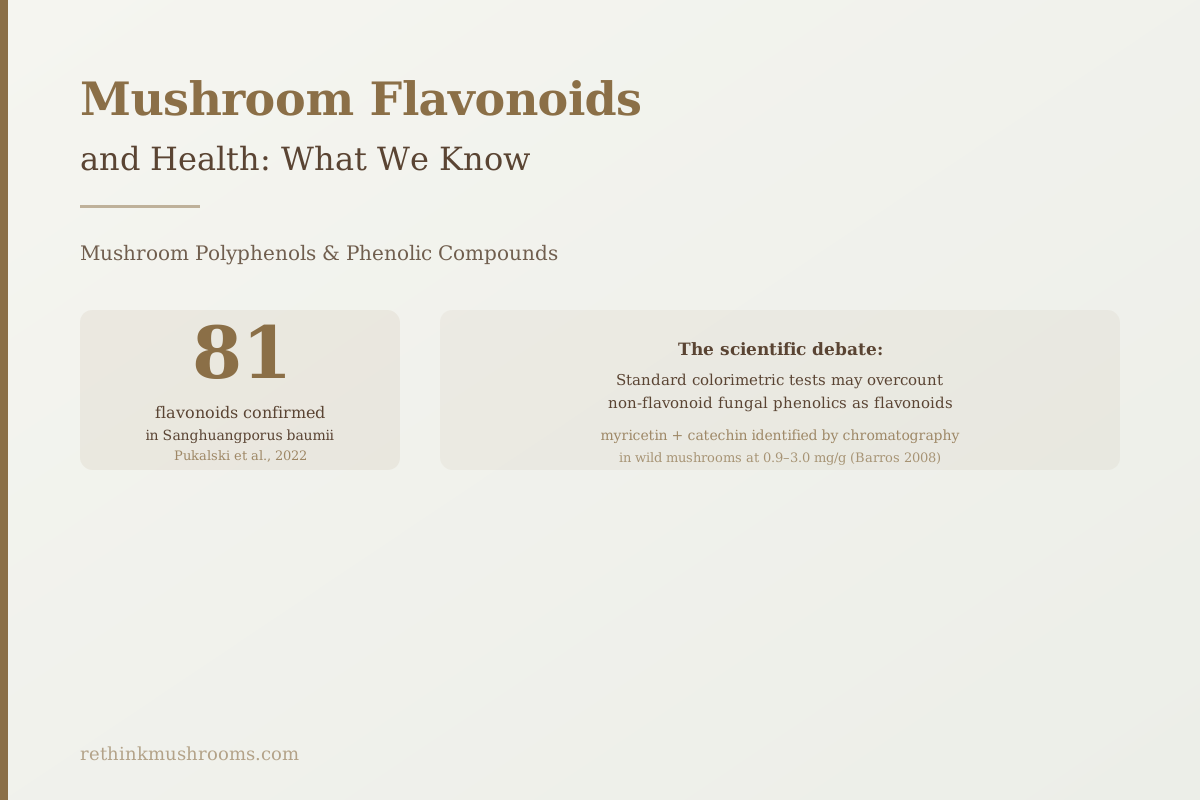
81 flavonoids confirmed
Pukalski et al. (2022) confirmed that Sanghuangporus baumii synthesizes 81 flavonoids on chemically defined medium, directly addressing a longstanding debate about whether mushrooms produce flavonoids at all.
Pukalski et al., Cells, 2022
4 of 16
classical plant flavonoid synthesis genes found in mushroom genomes (Pukalski 2022)
0.9–3.0 mg/g
flavonoid concentration range across wild Portuguese mushroom species (Barros 2008)
myricetin + catechin
the two main flavonoids identified in wild mushrooms, both also common in berries and tea
Pukalski et al., Cells, 2022
 View as image ↗
Mushrooms are regularly marketed for their antioxidant content. The polyphenols and flavonoids listed on supplement labels imply a straightforward fact: that mushrooms contain these health-relevant compounds in meaningful quantities. The reality is more interesting than the marketing suggests, and for flavonoids specifically, it has been more contested in the scientific literature than most people realize.
Whether mushrooms can synthesize flavonoids at all was disputed for years. Research using standard colorimetric tests reported flavonoids across many species. Later work questioned whether those tests, designed to detect plant flavonoids, could accurately identify the structurally different phenolic compounds that fungi produce. A 2022 paper by Pukalski and colleagues settled part of this question for one medicinal species: they confirmed that Sanghuangporus baumii, the mushroom known as Phellinus baumii, does synthesize flavonoids through a distinct biochemical pathway.[1] Whether this finding extends broadly across edible mushrooms is still being worked out. This article covers where the science stands and what it means for understanding mushrooms as sources of phenolic compounds. For the broader context of how mushroom bioactives are classified, see what are beta-glucans? The most important compound in medicinal mushrooms.
Key Takeaways
- Whether mushrooms produce flavonoids has been genuinely debated in food science; the standard colorimetric methods used in most studies were developed for plant phenolics and may overcount or misidentify fungal phenolic compounds
- Pukalski et al. (2022, Cells) confirmed that Sanghuangporus baumii (Phellinus baumii) synthesizes 81 flavonoids on chemically defined medium; only 4 of 16 classical plant flavonoid synthesis genes are present, and the key regulatory gene is PAL (phenylalanine ammonia lyase)
- Barros et al. (2008) identified myricetin and catechin as the main flavonoids in wild mushroom species, with concentrations of 0.9-3.0 mg per gram of dried mushroom
- The Abdelshafy 2022 systematic review confirms that mushroom phenolic compounds show antioxidant, anti-inflammatory, antitumor, antihyperglycemic, and anti-tyrosinase activities regardless of whether the specific compounds are classified as flavonoids or other phenolics
- Mushrooms may be better understood as a source of unique fungal phenolics (including melanin complexes, ergothioneine, and species-specific polyphenols) rather than as direct dietary substitutes for plant flavonoids from berries, citrus, or tea
- The honest answer to "do mushrooms contain flavonoids?" is: some do, confirmed by direct analytical evidence; most edible mushrooms likely contain phenolic compounds with flavonoid-like activity, but the exact classification depends on the measurement method used
What Flavonoids Are and Why the Mushroom Question Gets Complicated
Flavonoids are a large family of phenolic compounds produced by plants. They give fruits their colors (anthocyanins in blueberries), protect leaves from UV radiation, and deter herbivores. The family includes quercetin, kaempferol, rutin, catechin, myricetin, and several thousand other individual compounds, all sharing a core chemical structure of two aromatic rings connected by a three-carbon bridge.
In human health research, dietary flavonoids are associated with reduced cardiovascular risk, anti-inflammatory effects, antioxidant activity, and various cancer-protective properties in observational and experimental studies. They're abundant in berries, citrus fruit, tea, dark chocolate, red wine, and a range of vegetables. They're not typically associated with fungi in popular understanding.
The complication is that fungi are not plants. They evolved independently, use different biosynthetic pathways, and produce different secondary metabolites. The classical flavonoid synthesis pathway in plants uses a cascade of enzymes including chalcone synthase (CHS), chalcone isomerase (CHI), flavanone 3-hydroxylase (F3H), and others. Most of these enzymes are not found in fungal genomes.
This creates the measurement problem. Most studies measuring "flavonoid content" in mushrooms use colorimetric assays designed for plant tissue. These tests work by reacting sample extracts with aluminum nitrate or similar reagents, which form a colored complex with flavonoids. The problem is that some non-flavonoid fungal compounds also react with these reagents, potentially creating false positives. Research challenging mushroom flavonoid claims argued that reported flavonoid values in many edible mushrooms were largely measurement artifacts rather than actual flavonoid content.
The mushroom polyphenol cluster covers the broader phenolic compound picture in mushroom polyphenols: antioxidant power from fungi and phenolic compounds in medicinal mushrooms: a comprehensive review.
The 2022 Rebuttal: Sanghuangporus baumii Synthesizes 81 Flavonoids
Pukalski and colleagues approached the question differently. Rather than measuring what's in a mushroom extract with a colorimetric test, they grew Sanghuangporus baumii (commonly known as Phellinus baumii, a medicinal fungus used in East Asian traditional medicine) on a chemically defined medium and used high-resolution mass spectrometry to identify individual compounds.
Their finding: S. baumii synthesizes 81 flavonoids when grown under these controlled conditions.[1] These were not artifacts of a nonspecific colorimetric test. They were structurally identified compounds, distinguishable by molecular mass and fragmentation pattern.
The biochemistry is what makes this finding scientifically interesting. Pukalski's team found that S. baumii has only 4 of the 16 enzymes in the classical plant flavonoid pathway. The key regulatory gene is PAL, phenylalanine ammonia lyase, an enzyme that converts the amino acid phenylalanine into trans-cinnamic acid. This is the first step in both plant and fungal phenolic biosynthesis. From trans-cinnamic acid, the mushroom's own metabolic machinery proceeds differently from plants, using a smaller set of enzymes to produce structurally distinct flavonoids.
This means the answer to "do mushrooms contain flavonoids?" requires a more precise question: which species, measured how, under what conditions? The Pukalski finding establishes that at least one medicinal mushroom species genuinely synthesizes flavonoids through a simplified version of the plant pathway. Whether this characterizes most edible mushrooms broadly, or is specific to S. baumii and closely related species, remains under investigation.
Sanghuangporus baumii belongs to the Phellinus family of bracket fungi, which also includes species used as Sang Huang in traditional Chinese medicine. For context on another bioactive compound in this category of bracket fungi, see inotodiol: Chaga's other important bioactive compound.
What Barros Found: Myricetin and Catechin Measured in Wild Mushrooms
Before the detection methodology controversy became prominent, Barros and colleagues published a comprehensive chemical profiling study of wild Portuguese mushrooms in 2008. They used HPLC (high-performance liquid chromatography) to identify and quantify individual phenolic compounds rather than relying solely on colorimetric totals.
Their results: flavonoid concentrations across the species they analyzed ranged from 0.9 to 3.0 milligrams per gram of dried mushroom.[2] The main compounds they identified were myricetin and catechin.
Both myricetin and catechin are well-characterized plant flavonoids. Myricetin appears in grapes, berries, vegetables, and tea; it shows antioxidant, anti-inflammatory, and anticancer activity in cell and animal studies. Catechin is the primary flavonoid in tea leaves and is one of the most studied dietary polyphenols for cardiovascular protection.
Finding these compounds in wild mushrooms using chromatographic methods is a stronger result than colorimetric totals alone, because chromatography separates and identifies individual molecules by their specific retention times and absorption spectra. The concentration range they found (0.9-3.0 mg/g) is lower than in high-flavonoid plant sources like berries (blueberries contain around 4-8 mg/g fresh weight of flavonoids), but not negligible.
The Barros 2008 data also showed a strong correlation between phenolic content and antioxidant activity as measured by DPPH radical scavenging. The species with more phenolics consistently showed stronger antioxidant activity, which is what you'd expect if the measured compounds were real and biologically active rather than analytical artifacts.
The State of the Evidence: What the 2022 Systematic Review Concludes
Abdelshafy and colleagues published a systematic review in Critical Reviews in Food Science and Nutrition in 2022, covering phenolic compounds across edible mushrooms with 82 citations to primary research.[3]
Their classification of mushroom phenolics identifies two major groups: phenolic acids (gallic acid, caffeic acid, p-coumaric acid, ferulic acid, p-hydroxybenzoic acid) and flavonoids. The review maps biological activities associated with each compound class: antioxidant, anti-inflammatory, antitumor, antihyperglycemic, antiosteoporotic, and anti-tyrosinase (skin lightening) effects.
On the flavonoid question specifically, the Abdelshafy review acknowledges the measurement complexity without dismissing prior findings. The reported phenolic compounds in most edible mushroom studies likely include a mix of actual flavonoids (as confirmed for S. baumii) and other phenolic compounds that also show flavonoid-like biological activity, even if they're not structurally classified as flavonoids by strict chemical criteria.
This is arguably the most practically useful framing. A consumer asking "should I eat mushrooms for flavonoids?" might be asking the wrong question. The better question is: "do mushrooms contain phenolic compounds with the biological activities associated with flavonoids?" The answer to that question is more consistently yes across species, regardless of how precisely the specific compounds are classified.
Does It Matter? Mushrooms Have Their Own Phenolic Story
The flavonoid debate matters for scientific precision, but it obscures a more important point about mushrooms as a dietary source of phenolic compounds. Mushrooms produce phenolics through their own evolutionary pathways, under their own ecological selection pressures, resulting in compounds that don't have direct plant equivalents.
Chaga (Inonotus obliquus) produces a class of compounds called phelligridins that are structurally unique to Chaga and found nowhere in the plant kingdom. Chaga also concentrates melanin-polyphenol complexes derived from its parasitic relationship with birch trees. These compounds are real, structurally characterized, and show potent antioxidant activity in laboratory studies, but they're neither flavonoids nor any standard plant polyphenol class. For the connection between birch trees and Chaga's unique chemistry, see how birch trees contribute to Chaga's chemistry.
Enoki mushrooms (Flammulina velutipes) produce phenolic compounds that inhibit LDL cholesterol oxidation in laboratory models, a mechanism directly relevant to cardiovascular disease prevention. This is a more specific and mechanistically meaningful outcome than a general antioxidant score, and it comes from compounds unique to enoki's phenolic profile. The enoki phenolic story is in enoki phenolic compounds and oxidative stress protection.
The Abdelshafy 2022 review positions mushroom polyphenols within a broader context: they are one of three major bioactive compound classes in medicinal mushrooms, alongside polysaccharides (including beta-glucans) and triterpenes.[3] For the compound class that sits alongside polyphenols in the broader bioactive landscape, see how triterpenes differ from polysaccharides in mechanism.
The flavonoid question is worth answering honestly: some mushrooms do produce flavonoids, established now beyond the methodology controversy for at least one species. Most edible mushrooms likely contain smaller amounts of compounds that function like flavonoids. But the more distinctive story is the unique phenolic profile that fungi evolved independently, producing compounds unavailable from any plant source.
The Bottom Line
The question of whether mushrooms contain flavonoids is genuinely contested in the scientific literature. Standard colorimetric methods used in most studies may overcount fungal phenolics as flavonoids due to cross-reactivity. The 2022 Pukalski study established definitively that Sanghuangporus baumii synthesizes 81 flavonoids through a simplified version of the plant pathway, settling the question for that species. Barros 2008 identified myricetin and catechin in wild mushrooms at 0.9-3.0 mg/g using chromatographic methods. The Abdelshafy 2022 systematic review confirms that mushroom phenolic compounds, whether precisely classified as flavonoids or not, show consistent antioxidant, anti-inflammatory, and antitumor activity. Mushrooms may be better appreciated for their unique fungal phenolics than evaluated as flavonoid alternatives to plants.
Frequently Asked Questions
Sources & References
- 1RTHM-01601·Pukalski, Jan et al. (2022). “Secrets of Flavonoid Synthesis in Mushroom Cells..” Cells.Study breakdown →PubMed →↩
- 2RTHM-00126·Barros, Lillian et al. (2008). “Chemical composition and biological properties of portuguese wild mushrooms: a comprehensive study..” Journal of agricultural and food chemistry.Study breakdown →PubMed →↩
- 3RTHM-01474·Abdelshafy, Asem Mahmoud et al. (2022). “A comprehensive review on phenolic compounds from edible mushrooms: Occurrence, biological activity, application and future prospective..” Critical reviews in food science and nutrition.Study breakdown →PubMed →↩