Meshima & Cancer
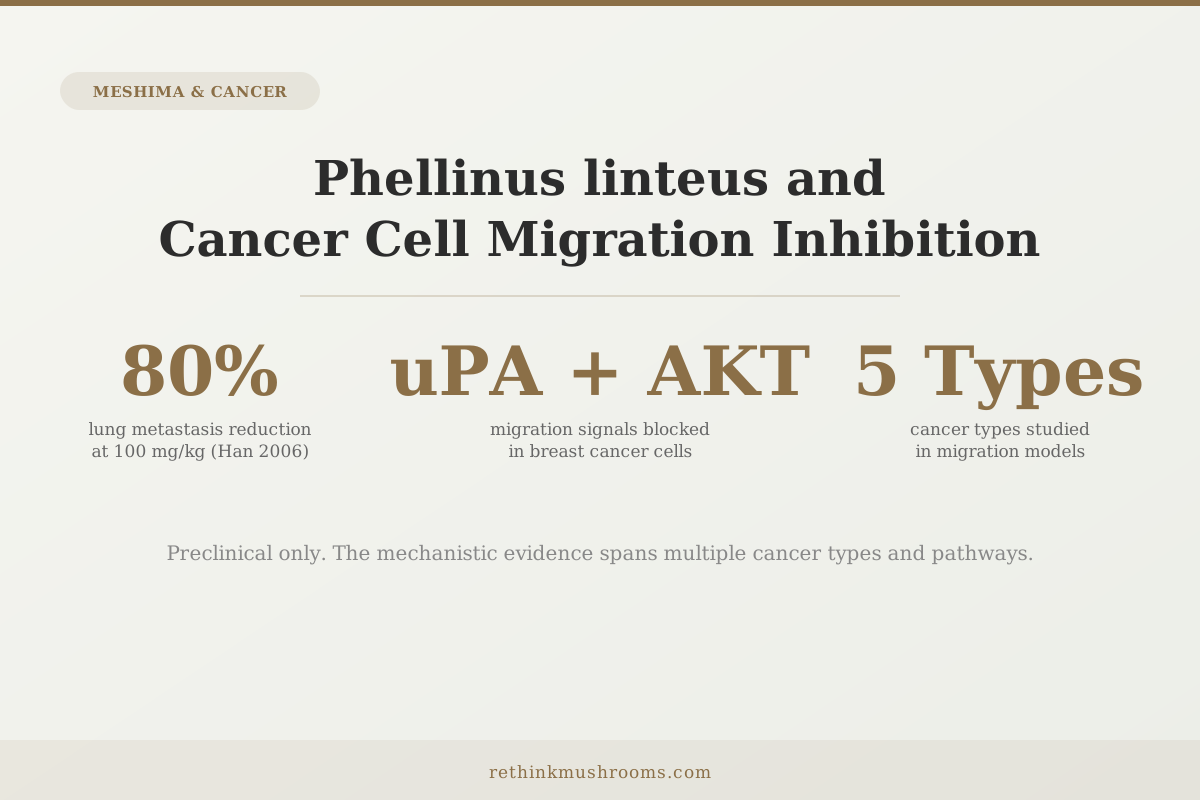
80% lung metastasis reduction at 100 mg/kg
In mice with melanoma, Phellinus linteus polysaccharide reduced lung metastasis frequency by 80% at the highest tested dose through dual action: blocking cancer cell adhesion to tissue and activating immune cells against circulating tumor cells.
Han et al., International Immunopharmacology, 2006
5 Cancer Types
breast, colon, hepatoma, thyroid, melanoma: all studied for migration inhibition
uPA + AKT
two key migration-enabling proteins suppressed by PL in breast cancer cells
No Clinical RCT
all evidence is preclinical; no human migration trial has been published
Han et al., International Immunopharmacology, 2006
 View as image ↗
Cancer kills primarily through metastasis. The original tumor, dangerous as it is, often stays manageable for years. What causes death in most solid cancers is when cells break away from that tumor, travel through the bloodstream or lymph system, and establish new colonies in distant organs. This process, called metastasis, requires cancer cells to migrate.
Phellinus linteus (meshima) has been studied across multiple cancer types specifically for its ability to inhibit this migration process. The research is mechanistically specific: several studies have identified exactly how PL compounds suppress the molecular machinery cancer cells use to move, invade surrounding tissue, and set up new tumors elsewhere.
All of this evidence is preclinical. No human randomized controlled trial has tested Phellinus linteus for cancer cell migration inhibition. What the research provides is a mechanistic picture of how the compounds work in laboratory and animal settings, which is how anti-metastatic drug candidates are typically evaluated before clinical investigation.
For a species overview, what is meshima mushroom covers the foundational biology and history of Phellinus linteus in Korean traditional medicine. This article focuses specifically on cancer cell migration and what the molecular research shows.
Key Takeaways
- Phellinus linteus extract suppressed adhesion, migration, and invasion of highly aggressive MDA-MB-231 breast cancer cells by inhibiting urokinase-plasminogen activator (uPA) and phosphorylation of AKT at two sites (Thr308 and Ser473) (Sliva 2008)
- In SW480 colon cancer cells, PL protein-bound polysaccharide inhibited MMP-9 activity, reduced cell motility, and disrupted Wnt/β-catenin signaling, a pathway that drives both proliferation and invasive behavior (Song 2011)
- Hispolon, a phenolic compound from PL, decreased MMP-2, MMP-9, and uPA expression in hepatoma cells via the FAK/PI3K/Akt/RhoA and ERK1/2 pathways (Huang 2010)
- In thyroid carcinoma cells, PL polysaccharide modulated EMT markers: increasing E-cadherin (which holds cells in place) and decreasing N-cadherin and Vimentin (which enable migration) (Yu 2022)
- Acidic polysaccharide from PL reduced lung metastasis frequency in melanoma-bearing mice by 30%, 77%, and 80% at doses of 10, 30, and 100 mg/kg respectively, through a dual mechanism of direct adhesion blocking AND immunopotentiation (Han 2006)
- PL grown on germinated brown rice restored sensitivity to cetuximab in KRAS-mutated colon cancer cells, which are normally resistant to this targeted therapy (Park 2017)
What Cancer Cells Actually Do When They Migrate
Understanding what migration means at the cellular level is necessary for interpreting what it means when a compound "inhibits cancer cell migration."
Cancer cells that have acquired metastatic capability go through a sequence of steps to spread. First, they must detach from the primary tumor, overcoming the molecular adhesives that normally hold cells together. Second, they must invade the surrounding extracellular matrix, the protein scaffold that fills the space between cells, by secreting enzymes called matrix metalloproteinases (MMPs) and proteases like urokinase-plasminogen activator (uPA). These enzymes dissolve the protein barrier so the cell can push through. Third, the invading cells must attach to new surfaces (blood vessel walls, lymph node tissue, distant organ tissue) to establish themselves in a new location.
Each of these steps is controlled by specific molecular signaling pathways. AKT is one of the central regulators: when AKT is active, it promotes cell survival, proliferation, and migration simultaneously. Wnt/β-catenin signaling activates genes that increase motility and reduce cell-to-cell adhesion. The epithelial-to-mesenchymal transition (EMT) is a broader cellular program where epithelial cells (which stay in place) convert to mesenchymal cells (which can move): this is controlled by a set of protein markers including E-cadherin (which maintains epithelial adhesion) and N-cadherin plus Vimentin (which enable mesenchymal migration).
Phellinus linteus compounds appear to interfere with multiple steps in this cascade, and the research has studied different compounds (polysaccharides, hispolon) and different pathways depending on the cancer type.
How Phellinus linteus Blocks Breast Cancer Cell Migration: uPA and AKT Suppression
The foundational study on Phellinus linteus and cancer cell migration is Sliva and colleagues' 2008 paper in the British Journal of Cancer, one of the most cited meshima research papers published.[1]
The researchers used MDA-MB-231 cells, a highly invasive human breast cancer line that represents one of the most difficult-to-treat breast cancer subtypes. In wound-healing migration assays and invasion assays, Phellinus linteus extract significantly reduced the cells' ability to migrate and invade.
The mechanism the study identified was suppression of uPA secretion. Urokinase-plasminogen activator is a serine protease that cancer cells secrete to dissolve the protein matrix around them, creating a path for invasion. High uPA levels in breast cancer tissue correlate with poor prognosis and higher metastasis risk. By suppressing uPA secretion, PL was removing one of the tools breast cancer cells use to cut through the tissue barrier.
The AKT finding was equally specific. The study showed PL suppressed phosphorylation of AKT at both Thr308 and Ser473, the two phosphorylation sites that activate AKT. Active AKT promotes cancer cell survival, drives migration signaling, and stimulates VEGF production (which supports the new blood vessels a metastatic colony needs). Suppressing AKT at both sites simultaneously had compound effects: less migration signaling, less survival advantage, and less capacity to build the vascular support a metastatic lesion needs.
The Sliva 2008 study also measured VEGF-mediated capillary formation and found PL inhibited this too, connecting the migration inhibition to angiogenesis inhibition in the same experimental system. For readers interested in the anti-angiogenesis angle, the article on how meshima starves tumors covers the VEGF suppression mechanism in detail.
Colon Cancer and the Wnt/β-catenin Pathway
Song and colleagues' 2011 study in BMC Cancer examined Phellinus linteus protein-bound polysaccharide in SW480 human colon cancer cells, finding a different but complementary set of migration inhibition mechanisms.[2]
SW480 is a colon cancer cell line with high invasive potential. At doses from 125 to 1000 µg/mL, PL polysaccharide significantly inhibited cell proliferation, reduced MMP-9 enzyme activity, and suppressed cell motility. MMP-9 is the specific matrix metalloproteinase most directly responsible for breaking down type IV collagen, the primary structural barrier of basement membranes that separates epithelial tissue from blood vessels. When MMP-9 is active, cancer cells can degrade this barrier and enter the circulation.
The pathway PL targeted in colon cells was Wnt/β-catenin signaling. In normal cells, β-catenin helps maintain tissue architecture and cell-to-cell adhesion. In colon cancer, β-catenin accumulates abnormally in the nucleus and drives expression of genes that promote both cell proliferation and invasive behavior, including cyclin D1 (which drives cell division) and MMP-9. PL treatment decreased β-catenin and cyclin D1 expression, with MMP-9 reduction as a downstream consequence.
This research included an animal component: when SW480 cells were implanted in nude mice and the mice were treated with PL, tumor growth was significantly decreased, the apoptotic index in tumor tissue was increased, and β-catenin expression was reduced in the actual tumor tissue, confirming that the in vitro findings translated to an animal model. The xenograft data makes this study more clinically relevant than pure cell culture work.
The MMP-9 inhibition mechanisms across multiple cancer types are covered in more detail in the companion article on meshima and matrix metalloproteinases.
EMT Reversal in Thyroid Cancer: Undoing the Migration Program
A 2022 study by Yu and colleagues in thyroid carcinoma cells introduced a different conceptual angle for understanding Phellinus linteus anti-migration effects.[4]
The epithelial-to-mesenchymal transition (EMT) is the cellular program by which cancer cells acquire migration capacity in the first place. Cells undergoing EMT change their protein expression profile: they downregulate E-cadherin (the adhesion molecule that keeps epithelial cells attached to each other) and upregulate N-cadherin and Vimentin (which are characteristic of mobile mesenchymal cells). Once cells have undergone EMT, they move and invade more aggressively.
The Yu 2022 study found that Phellinus linteus polysaccharide modulated EMT markers in thyroid carcinoma cells in the direction that reverses this program: E-cadherin expression increased, N-cadherin and Vimentin expression decreased. This means PL appeared to push cancer cells toward a less migratory, more epithelial-like state. The study also found decreased MMP expression and induced apoptosis via the NF-kB pathway, making this a multi-mechanism finding.
The EMT angle matters because it operates upstream of the specific proteases and signaling molecules targeted in the other studies. By modulating the EMT program itself, PL may be addressing the cellular identity that enables migration, not just individual tools cells use to migrate. Whether this effect on EMT markers translates to meaningful clinical anti-metastatic activity is not known, as no human data exists for this application.
Hispolon and Hepatoma Cells: A Specific Compound With Specific Numbers
The Huang 2010 study in Food and Chemical Toxicology is the most compound-specific migration study in the meshima research base.[3] It isolated hispolon, a polyphenol compound specifically from Phellinus linteus, and tested it against SK-Hep1 hepatoma (liver cancer) cells.
Hispolon decreased MMP-2, MMP-9, and uPA expression in hepatoma cells in a concentration-dependent manner. The mechanism was traced to the FAK signaling pathway: hispolon suppressed focal adhesion kinase (FAK) activity, which in turn reduced downstream PI3K/Akt, RhoA, and ERK1/2 activity. When the ERK1/2 inhibitor PD98256 was independently added to the cells, it also decreased MMP-2 and MMP-9, confirming that the ERK1/2 pathway is a direct route to MMP suppression.
FAK is particularly relevant in cancer metastasis because it integrates signals from the extracellular matrix (through integrins) and transmits them as motility signals inside the cell. When cancer cells touch a new surface (the wall of a blood vessel or the tissue of a distant organ), FAK activation is one of the first events in establishing adhesion and preparing to invade. Hispolon's suppression of FAK therefore disrupts the very first step of metastatic colonization.
The same hispolon findings are discussed in the article on Phellinus linteus bioactive compounds in the context of PL's full compound profile.
The Multi-Cancer Spectrum and One Unusual Drug Resistance Finding
The animal evidence from Han 2006 provides an important counterpart to the cell culture studies: it shows that the migration inhibition documented in cells translates to reduced actual metastasis in living organisms.[5] Melanoma-bearing mice given acidic polysaccharide from PL showed lung metastasis frequency reduced by 30%, 77%, and 80% at doses of 10, 30, and 100 mg/kg respectively. The dose-response relationship strengthens the biological plausibility. The mechanism in this study was dual: direct inhibition of cancer cell adhesion to extracellular matrix, and immunopotentiation (macrophage activation with increased NO production) that targets circulating tumor cells.
This dual mechanism, blocking migration directly AND activating the immune system against migrating cells simultaneously, is unique to the polysaccharide fraction and distinguishes it from compounds that only target one pathway.
For colon cancer specifically, Park and colleagues' 2010 study examined a germinated brown rice-grown form of Phellinus linteus extract (a cultivation format used in Korean anti-cancer supplements) in HT29 colon carcinoma cells, finding G0/G1 cell cycle arrest and apoptosis induction.[6] A 2017 follow-up by Park and colleagues introduced a clinically relevant surprise: PL grown on germinated brown rice increased sensitivity to cetuximab in KRAS-mutated colon cancer cells.[7]
KRAS mutation is present in roughly 40% of colorectal cancers and makes them resistant to cetuximab (an anti-EGFR targeted therapy that would otherwise be effective). Restoring cetuximab sensitivity in KRAS-mutated cells, even in a cell culture model, is a pharmacologically interesting finding because it suggests PL may affect not just migration but the drug resistance mechanisms that make certain colon cancers especially difficult to treat.
For the broader picture of meshima's potential as a primary tumor agent, the article on how meshima may help contain primary tumors covers the apoptosis, cell cycle arrest, and chemotherapy synergy evidence. For the metastasis overview specifically, the article on meshima and cancer metastasis provides the broader synthesis. For the MMP-9-specific mechanisms, meshima and MMP-9 inhibition covers that angle in dedicated detail.
The Bottom Line
Phellinus linteus compounds inhibit cancer cell migration through multiple documented mechanisms: suppression of uPA and AKT signaling in breast cancer cells (Sliva 2008), Wnt/β-catenin disruption and MMP-9 inhibition in colon cancer (Song 2011), hispolon-mediated FAK/PI3K/Akt/ERK suppression in hepatoma cells (Huang 2010), and EMT reversal in thyroid carcinoma (Yu 2022). Animal data confirms dose-dependent lung metastasis reduction of up to 80% in melanoma models. All evidence is preclinical; no human randomized trial has tested these mechanisms in patients.
Frequently Asked Questions
Sources & References
- 1RTHM-00271·Sliva, D et al. (2008). “Phellinus linteus Extract in Breast-Cancer Cell Models: What This 2008 Study Actually Found.” British journal of cancer.Study breakdown →PubMed →↩
- 2RTHM-00437·Song, Kyoung-Sub et al. (2011). “Protein-bound polysaccharide from Phellinus linteus inhibits tumor growth, invasion, and angiogenesis and alters Wnt/β-catenin in SW480 human colon cancer cells..” BMC cancer.Study breakdown →PubMed →↩
- 3RTHM-00344·Huang, Guan-Jhong et al. (2010). “Hispolon suppresses SK-Hep1 human hepatoma cell metastasis by inhibiting matrix metalloproteinase-2/9 and urokinase-plasminogen activator through the PI3K/Akt and ERK signaling pathways..” Journal of agricultural and food chemistry.Study breakdown →PubMed →↩
- 4RTHM-01643·Yu, Kun et al. (2022). “Systematic evaluation of the anti-tumor effect of Phellinus linteus polysaccharide in thyroid carcinoma in vitro..” Molecular biology reports.Study breakdown →PubMed →↩
- 5RTHM-00185·Han, Sang-Bae et al. (2006). “Acidic polysaccharide from Phellinus linteus inhibits melanoma cell metastasis by blocking cell adhesion and invasion..” International immunopharmacology.Study breakdown →PubMed →↩
- 6RTHM-00358·Park, Hye-Jin et al. (2010). “The ethyl acetate extract of Phellinus linteus grown on germinated brown rice induces G0/G1 cell cycle arrest and apoptosis in human colon carcinoma HT29 cells..” Phytotherapy research : PTR.Study breakdown →PubMed →↩
- 7RTHM-00904·Park, Hye-Jin et al. (2017). “Phellinus linteus Grown on Germinated Brown Rice Increases Cetuximab Sensitivity of KRAS-Mutated Colon Cancer..” International journal of molecular sciences.Study breakdown →PubMed →↩