Reishi (Ganoderma lucidum)
2 entry points in the NF-kB pathway
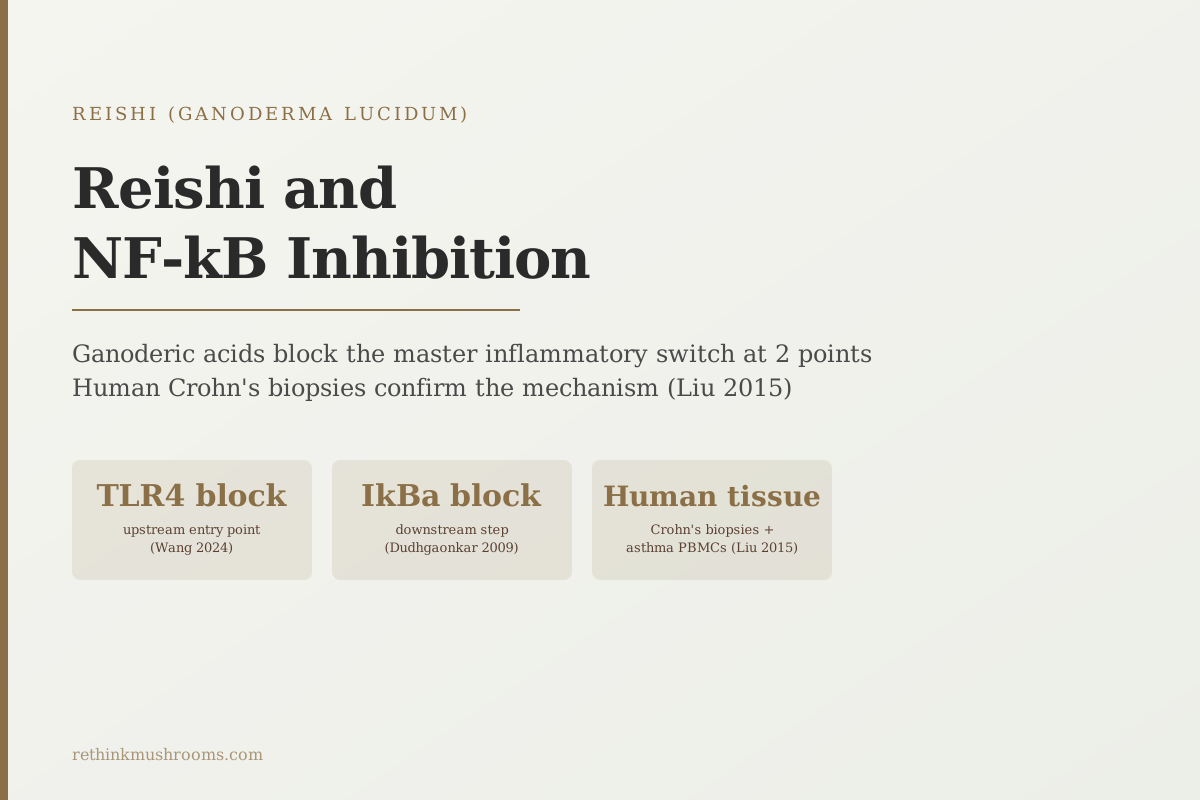
Reishi ganoderic acids interrupt NF-kB signaling at two independent locations: the TLR4 receptor upstream, and the IkBa phosphorylation step downstream. Most pharmaceutical anti-inflammatories target only one.
Wang et al., Life (Basel), 2024; Dudhgaonkar et al., Int Immunopharmacol, 2009
Human tissue
Liu et al. (2015) confirmed NF-kB downregulation using actual Crohn's disease mucosal biopsies — not a rodent model
TNF-α, IL-1β, IL-6, COX-2
all four major pro-inflammatory mediators are downstream targets of the NF-kB block (Dudhgaonkar 2009)
2026 meta-analysis
Pozzobon et al. (Pharmaceuticals, 2026) is the most current systematic review — confirmed consistent NF-kB inhibition across preclinical models
Wang et al., Life (Basel), 2024; Dudhgaonkar et al., Int Immunopharmacol, 2009
 View as image ↗
Most inflammatory diseases don't have one cause. They have one switch that's stuck in the on position.
NF-kB — formally, nuclear factor kappa B — is a protein that acts as the master inflammatory signaling switch inside cells. When NF-kB is activated, it moves into the cell's nucleus and turns on genes for dozens of inflammatory proteins: TNF-alpha (a cytokine that drives fever and tissue damage), IL-1beta and IL-6 (cytokines that escalate the inflammatory cascade), and COX-2 (the enzyme that produces prostaglandins — the molecules that cause pain and swelling and that are the target of ibuprofen and naproxen).
Chronic inflammatory conditions — rheumatoid arthritis, Crohn's disease, asthma, lupus, atherosclerosis — all involve NF-kB activation that has become dysregulated. The signal stays on when it should turn off. Many pharmaceutical anti-inflammatory drugs work by blocking specific outputs of NF-kB (ibuprofen blocks COX-2 enzyme, TNF blockers like adalimumab neutralize TNF-alpha). Reishi's ganoderic acids work further upstream: they prevent NF-kB from being activated in the first place.
And they do it at two independent points in the signaling chain.
For the broader anti-inflammatory landscape of reishi, see reishi and inflammation: how ganoderic acids fight chronic inflammation. For what this means for specific inflammatory conditions, see reishi for inflammatory conditions: research across diseases. For the Reishi pillar overview, see what is reishi mushroom: the science behind the mushroom of immortality.
Key Takeaways
- Reishi ganoderic acids block NF-kB through two independent mechanisms: inhibiting TLR4 receptor activation upstream (preventing the signal from starting) and blocking IkBa phosphorylation downstream (preventing NF-kB from entering the nucleus) — a dual-point blockade confirmed in the 5-year review by Wang et al. (Life, 2024)
- A 2009 foundational study (Dudhgaonkar et al., Int Immunopharmacol) identified triterpenes from Ganoderma lucidum as the primary anti-inflammatory fraction, suppressing NF-kB, COX-2, and TNF-alpha production in LPS-stimulated macrophages
- Liu et al. (Inflammatory Bowel Diseases, 2015) confirmed NF-kB downregulation using human Crohn's disease mucosal biopsies — not a rodent model — making this the strongest human tissue evidence for reishi's anti-inflammatory pathway
- Ganoderic acid C1 suppressed TNF-alpha in peripheral blood mononuclear cells taken from human asthma patients (Liu et al., Int Immunopharmacol, 2015) — a second human ex vivo data point confirming the effect translates to human immune cells
- Meng et al. (Molecules, 2023) found Ganoderma polysaccharides inhibit a second inflammatory pathway (JAK/STAT) alongside NF-kB in rheumatoid arthritis models — showing reishi targets parallel inflammatory cascades
- Pozzobon et al. (Pharmaceuticals, 2026) — the most current systematic review and meta-analysis — confirmed consistent NF-kB inhibition across preclinical models while identifying the absence of human RCTs as the key evidence gap
What NF-kB Is and Why It's the Target
NF-kB is not one protein — it is a family of transcription factors (proteins that switch genes on and off) that sit at the center of the inflammatory response. In a resting cell, NF-kB is held inactive by a security protein called IkBa (inhibitor of kappa B alpha). IkBa physically blocks NF-kB from entering the cell nucleus, where it would otherwise turn on inflammatory genes.
When cells receive an inflammatory signal — from bacteria, damaged tissue, cytokines, or other threats — a signaling cascade is triggered that phosphorylates IkBa (tags it with a chemical flag that marks it for destruction). Once IkBa is degraded, NF-kB is freed to enter the nucleus and activate its target genes.
The genes NF-kB activates include: TNF-alpha, IL-1beta, IL-6, COX-2, iNOS (nitric oxide synthase), and adhesion molecules that help inflammatory cells migrate to the site of injury. In acute inflammation, this is useful — the immune system deploys to fight infection or begin repair. In chronic inflammatory conditions, the cycle continues without appropriate resolution. NF-kB stays active. Inflammatory mediators remain elevated. Tissue damage accumulates.
This is why NF-kB is called the master inflammatory switch: it sits upstream of so many inflammatory endpoints that blocking it affects the entire cascade rather than just one output. It is also why NF-kB has been a pharmaceutical target for decades — though direct NF-kB inhibitors have proven difficult to develop without unacceptable immune suppression.
The Two Entry Points: How Ganoderic Acids Block NF-kB
The foundational study establishing reishi triterpenes as NF-kB inhibitors was published by Dudhgaonkar and colleagues in International Immunopharmacology in 2009.[1]
Dudhgaonkar's team isolated triterpenes from Ganoderma lucidum and tested them in macrophages — the immune cells primarily responsible for initiating and sustaining inflammatory responses. The macrophages were stimulated with LPS (lipopolysaccharide), a bacterial membrane fragment that triggers strong inflammatory activation through NF-kB. The Ganoderma triterpenes suppressed NF-kB activation, reduced COX-2 expression, and lowered TNF-alpha production compared to untreated cells.
This study also established an important distinction: it was the triterpenes — specifically the ganoderic acids — that drove anti-inflammatory activity, not the polysaccharides. Polysaccharide fractions tested separately showed minimal anti-inflammatory effect in this cell model.
A 2024 five-year review of ganoderic acid research by Wang and colleagues in Life (Basel) mapped the pathway in more detail.[3] Wang documented that ganoderic acids operate at two independent points in the NF-kB activation chain:
Point 1: TLR4 receptor (upstream). TLR4 — Toll-like receptor 4 — is a pattern recognition receptor on the surface of immune cells that detects bacterial signals and triggers the inflammatory cascade via an adapter protein called MyD88, which then activates TRAF6 (TNF receptor-associated factor 6), which ultimately phosphorylates IkBa to release NF-kB. Ganoderic acids bind to TLR4 and interrupt this chain at the entry point, before the cascade has even started.
Point 2: IkBa phosphorylation (downstream). Even if the TLR4 signal gets through, ganoderic acids also block the step where IkBa gets phosphorylated and degraded. By protecting IkBa from destruction, ganoderic acids keep NF-kB locked in its inactive complex even when the upstream signal is present.
This dual-entry blockade means reishi's effect is more comprehensive than drugs that target only one point in the cascade. Whether this translates to stronger anti-inflammatory effects in clinical settings — where multiple inflammatory pathways operate simultaneously — is not established from human trial data.
The NF-kB Activation Cascade
One Inflammatory Switch, Blocked at Two Independent Points
NF-kB is the master inflammatory switch. Reishi's ganoderic acids interrupt its activation twice: at the TLR4 receptor upstream, before the signal starts, and at the IkBa phosphorylation step downstream, even if the signal gets through. Most single-target anti-inflammatory drugs block only one point in this chain.
Ganoderic acids bind TLR4
Ganoderic acids interrupt the cascade at the receptor itself, before the MyD88 / TRAF6 relay can fire. The signal is stopped at the door.
Wang et al. 2024 (5-year GA review); Dudhgaonkar et al. 2009 (LPS-stimulated macrophages, in vitro)
Ganoderic acids protect IkBa
Even if the upstream signal gets through, ganoderic acids block IkBa phosphorylation and degradation — NF-kB stays locked in its inactive complex, out of the nucleus.
Wang et al. 2024 (mechanistic mapping, preclinical)
The dual-point blockade is documented in cell and tissue models, not human trials. Whether hitting two points translates to a stronger clinical anti-inflammatory effect is not established from human RCT data — none exist for reishi in inflammatory disease.
Mechanism synthesis; blockade points from Wang 2024 [3] & Dudhgaonkar 2009 [1]
The Most Compelling Evidence: Human Crohn's Disease Tissue
The most significant clinical-proximity evidence for reishi's NF-kB inhibition comes from a 2015 study published in Inflammatory Bowel Diseases by Liu and colleagues.[4]
The study used human Crohn's disease mucosal biopsies — tissue samples taken from the inflamed intestinal lining of patients with active Crohn's disease, not from rodents or cell lines. This is an important distinction. Rodent intestinal cells and human intestinal cells differ in receptor density, signaling pathway sensitivity, and inflammatory response characteristics. Results from human tissue have higher translational relevance than animal or cell culture results.
When Ganoderma triterpenoids were applied to these human intestinal biopsy samples, NF-kB signaling was significantly downregulated. Pro-inflammatory cytokine production was reduced in both the inflamed and non-inflamed tissue samples from the same patients. The effect occurred in tissues already showing active inflammatory disease — not just in tissue maintained in neutral conditions.
Crohn's disease is characterized by overactive NF-kB signaling in intestinal epithelial cells and immune cells of the gut wall. The Liu 2015 study directly addresses whether reishi triterpenoids can reduce that activation in human tissue from patients with the condition. No rodent experiment can answer that question equivalently.
This remains an in vitro study (the biopsies were treated in laboratory conditions, not given to patients). But the human tissue source makes it the strongest available evidence for biological plausibility in human inflammatory disease.
Human Ex Vivo Confirmation: Asthma Patient Immune Cells
A companion study from 2015 by the same lead author (Liu and colleagues, published in International Immunopharmacology) provided a second human data point from a different condition and a different compound.[5]
This study focused on ganoderic acid C1 — a specific individual ganoderic acid rather than a mixed extract — and tested it in peripheral blood mononuclear cells (PBMCs), which are the immune cells that can be drawn from a blood sample and include T cells, B cells, monocytes, and NK cells. The PBMCs came from asthma patients, not healthy donors.
Ganoderic acid C1 suppressed TNF-alpha production in both mouse macrophages and the human asthma patient PBMCs. The effect was dose-dependent. The mechanism included both NF-kB and MAPK/AP-1 pathway suppression — AP-1 (activator protein 1) is a second transcription factor that cooperates with NF-kB in driving inflammatory gene expression.
This study established two things. First, the anti-inflammatory effects of ganoderic acids are not limited to experimental cell lines — they occur in immune cells from patients with an actual inflammatory condition. Second, specific individual ganoderic acids have their own activity profiles, not just the mixed-extract effects seen in broader studies.
The asthma context is relevant because asthma is characterized by Th2-driven airway inflammation, and TNF-alpha blockade is a research target for asthma treatment. Ganoderic acid C1's effect on human asthma patient immune cells is a more precise finding than general anti-inflammatory activity.
For a deeper look at the specific compound profile, see ganoderic acid A, B, and beyond: individual compound research. For the compound class overview, see ganoderic acids: the unique triterpenes in reishi.
Extending to Rheumatoid Arthritis: The JAK/STAT Overlap
NF-kB is the primary target of reishi's anti-inflammatory compounds, but it is not the only inflammatory signaling pathway they affect.
A 2023 systematic review by Meng and colleagues in Molecules examined Ganoderma lucidum polysaccharides (note: polysaccharides, not triterpenes) specifically for rheumatoid arthritis mechanisms.[6]
The review found that GLP (Ganoderma lucidum polysaccharides) reduced synovial inflammation in collagen-induced arthritis mouse models through NF-kB pathway inhibition — consistent with the triterpene data — but also through a second inflammatory cascade called JAK/STAT. JAK/STAT (Janus kinase/signal transducer) is a parallel inflammatory signaling pathway that operates alongside NF-kB in autoimmune inflammation and is the specific target of newer RA drugs called JAK inhibitors (tofacitinib, baricitinib).
The Meng 2023 review also found that GLP suppressed Th17 cell differentiation — Th17 cells are T cells that produce IL-17, a cytokine particularly elevated in RA and involved in joint destruction. This adds a third mechanistic layer: not just NF-kB blockade, not just JAK/STAT inhibition, but also reduction of a specific inflammatory T cell type.
This evidence comes from polysaccharides rather than triterpenes — a different compound class with different mechanisms. It suggests reishi's anti-inflammatory effects involve multiple compound classes acting through multiple pathways simultaneously, rather than a single compound hitting a single target.
For a detailed explanation of the mechanistic difference between reishi's triterpenes and polysaccharides, see how reishi triterpenes differ from polysaccharides in mechanism.
What the 2026 Meta-Analysis Concluded
The most current synthesis of reishi's anti-inflammatory evidence comes from Pozzobon and colleagues, who published a systematic review and meta-analysis of Ganoderma lucidum triterpenes and anti-inflammation in Pharmaceuticals in 2026.[2]
The Pozzobon 2026 analysis found that Ganoderma lucidum triterpenes consistently reduced inflammatory markers across preclinical models, with NF-kB inhibition confirmed as the primary mechanism. The meta-analytic effect size was meaningful. But the review also identified two important limitations.
First, effect sizes varied significantly by extraction method and specific triterpene composition. Not all reishi extracts contain the same ganoderic acid profile. A product standardized to ganoderic acid A content will behave differently from one standardized only to total triterpenoids or one that is not standardized at all.
Second, no human randomized controlled trials of reishi for inflammatory conditions have been published. The entire evidence base — including the Liu 2015 human tissue studies, which are the closest to clinical evidence available — consists of in vitro and ex vivo work. The question of whether the NF-kB inhibition documented in laboratory settings produces meaningful anti-inflammatory benefit in patients with inflammatory disease is not yet answered by controlled trial data.
The Pozzobon 2026 meta-analysis provides the strongest case that the preclinical signal is real and consistent. It cannot tell us whether clinical trials will confirm or fail to confirm that signal.
Evidence Hierarchy
Reishi & NF-kB — Reaches Human Tissue, Stops Short of a Trial
The NF-kB case is unusually strong for a mushroom compound: it does not stop at cell lines but reaches human diseased tissue and human immune cells, tested outside the body. What is still missing is the tier that decides clinical use — a randomized controlled trial. Bar width reflects how much direct evidence sits at each tier.
Human randomized controlled trial
gapDoes not yet exist
No RCT has tested whether reishi reduces inflammation in patients with an inflammatory condition. This is the tier that would establish clinical benefit — and it is empty.
Human diseased tissue, ex vivo
humanLiu 2015 (Crohn’s) [4]
Ganoderma triterpenoids downregulated NF-kB in mucosal biopsies from patients with active Crohn’s disease — human inflamed tissue, not a rodent model. The closest evidence to the clinic.
Human immune cells, ex vivo
humanLiu 2015 (asthma PBMCs) [5]
Ganoderic acid C1 suppressed TNF-a in peripheral blood mononuclear cells drawn from asthma patients, dose-dependently, via NF-kB and MAPK/AP-1 — the effect reaches human immune cells.
Animal disease model
evidenceMeng 2023 (RA review) [6]
In collagen-induced arthritis mice, Ganoderma polysaccharides cut synovial inflammation through NF-kB plus the parallel JAK/STAT pathway and reduced Th17 differentiation.
Cell / macrophage mechanism
evidenceDudhgaonkar 2009 [1] · Wang 2024 [3]
The foundational and best-replicated tier: triterpenes suppress NF-kB, COX-2 and TNF-a in LPS-stimulated macrophages, with the TLR4-upstream / IkBa-downstream dual block mapped in detail.
How to read it: the base is wide and solid because the cell-level mechanism is well replicated and the two human ex-vivo tiers are what set reishi apart — an effect confirmed in tissue and cells from actual patients. The 2026 meta-analysis synthesizes the preclinical layers but adds no clinical tier. The top rung — a human RCT — has never been built. That gap, not the quality of the mechanism, is the honest limit of the claim.
Sources: Dudhgaonkar 2009 [1]; Wang 2024 [3]; Meng 2023 [6]; Liu 2015 asthma PBMCs [5]; Liu 2015 Crohn's [4]; Pozzobon 2026 meta-analysis [2]. Bar widths are illustrative of evidence depth per tier, not effect sizes.
The Bottom Line
Reishi ganoderic acids inhibit NF-kB — the master inflammatory signaling switch — at two independent points: blocking the TLR4 receptor upstream and the IkBa phosphorylation step downstream. A 2009 study established triterpenes as the anti-inflammatory fraction; a 2015 study using human Crohn's disease mucosal biopsies confirmed NF-kB downregulation in actual human inflamed tissue; a second 2015 study showed the effect in immune cells from asthma patients. A 2026 systematic review and meta-analysis confirmed consistent preclinical NF-kB inhibition. No human randomized controlled trials have tested reishi for inflammatory conditions.
Frequently Asked Questions
Sources & References
- 1RTHM-00152·Dudhgaonkar, Shailesh et al. (2009). “Suppression of the inflammatory response by triterpenes isolated from the mushroom Ganoderma lucidum..” International immunopharmacology.Study breakdown →PubMed →↩
- 2RTHM-02241·Pozzobon, Rafaela Guedes et al. (2026). “Anti-Inflammatory Potential of Ganoderma lucidum Triterpenes: A Systematic Review and Meta-Analysis of Preclinical Evidence..” Pharmaceuticals (Basel.Study breakdown →PubMed →↩
- 3RTHM-02014·Wang, Siyi et al. (2024). “Research Progress on the Biological Activity of Ganoderic Acids in Ganoderma lucidum over the Last Five Years..” Life (Basel.Study breakdown →PubMed →↩
- 4RTHM-00719·Liu, Changda et al. (2015). “Anti-inflammatory Effects of Ganoderma lucidum Triterpenoid in Human Crohn's Disease Associated with Downregulation of NF-κB Signaling..” Inflammatory bowel diseases.Study breakdown →PubMed →↩
- 5RTHM-00720·Liu, Changda et al. (2015). “Ganoderic acid C1 isolated from the anti-asthma formula, ASHMI™ suppresses TNF-α production by mouse macrophages and peripheral blood mononuclear cells from asthma patients..” International immunopharmacology.Study breakdown →PubMed →↩
- 6RTHM-01750·Meng, Meng et al. (2023). “Potential Anti-Rheumatoid Arthritis Activities and Mechanisms of Ganoderma lucidum Polysaccharides..” Molecules (Basel.Study breakdown →PubMed →↩