Reishi and Inflammation
5 key inflammatory markers reduced
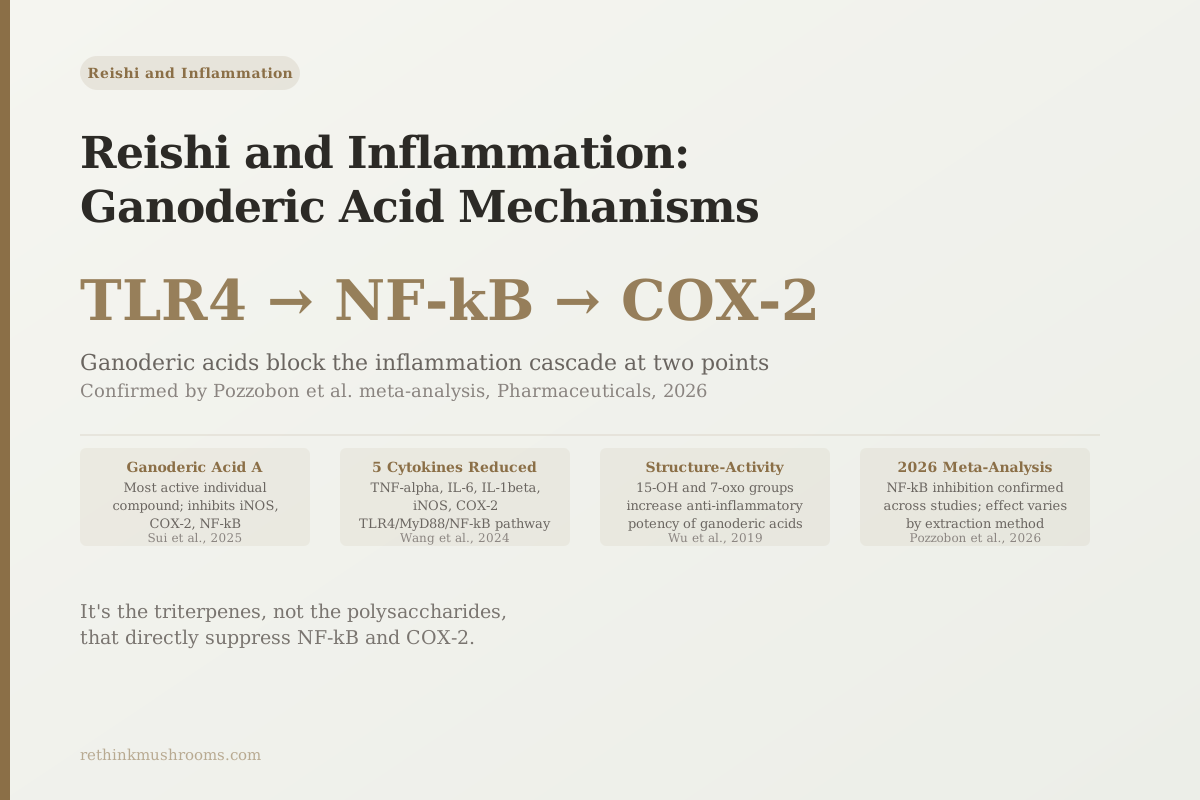
Ganoderic acids from reishi consistently reduce five inflammatory signaling molecules in preclinical research: TNF-alpha, IL-6, IL-1beta, iNOS, and COX-2 — all downstream targets of the NF-kB pathway that drives chronic inflammatory conditions.
Wang et al., Life (Basel), 2024
NF-kB
the master regulator of inflammation gene expression; primary target of ganoderic acids confirmed by 2026 Pozzobon meta-analysis
GA-A
ganoderic acid A identified as the most pharmacologically active individual ganoderic acid for inflammation (Sui 2025)
15-OH / 7-oxo
structural features on the ganoderic acid skeleton that determine anti-inflammatory potency (Wu 2019)
Wang et al., Life (Basel), 2024
 View as image ↗
Most summaries of reishi's anti-inflammatory properties stop at "it contains triterpenes that reduce inflammation" without explaining which ones, how they work, or how potent the effect actually is. That level of vagueness makes it impossible to evaluate what the evidence actually supports.
The precision matters. Reishi contains two major compound classes: polysaccharides (the beta-glucan chains that activate immune cells) and triterpenes (the lanostane-type molecules called ganoderic acids). Both have documented biological activity, but they work through completely different pathways. The anti-inflammatory story — specifically, the suppression of chronic inflammation at the molecular level — belongs primarily to the triterpenes.
A 2026 systematic review and meta-analysis by Pozzobon and colleagues is the most current comprehensive synthesis of this evidence, confirming NF-kB inhibition as the primary mechanism across preclinical studies and noting significant variation in effect size by extraction method and triterpene composition.[2]
This article covers the specific mechanisms by which ganoderic acids fight chronic inflammation, which individual ganoderic acids are most potent and why, what the current evidence base looks like, and what product implications follow from the mechanism. For an introduction to reishi and its compound profile, see the reishi overview. For the specific NF-kB pathway in more depth, see Reishi and NF-kB Inhibition.
Key Takeaways
- Reishi's anti-inflammatory activity is driven primarily by its triterpene fraction (ganoderic acids), not polysaccharides; for NF-kB and COX-2 inhibition, the triterpene-rich ethanol extract is the relevant preparation (Dudhgaonkar 2009)
- Ganoderic acids reduce five key inflammatory markers: TNF-alpha (tumor necrosis factor), IL-6, IL-1beta (interleukins), iNOS (nitric oxide synthase), and COX-2 (cyclooxygenase-2), primarily via TLR4/MyD88/NF-kB pathway inhibition (Wang 2024)
- The 2026 Pozzobon meta-analysis confirmed NF-kB inhibition as the primary mechanism across preclinical studies; effect sizes vary significantly by extraction method and specific triterpene composition
- Ganoderic acid A is the most pharmacologically active individual ganoderic acid; a 2025 comprehensive review with molecular docking analysis confirmed it inhibits iNOS, COX-2, and NF-kB and identified specific binding interactions with inflammatory targets (Sui 2025)
- Structural features of the ganoderic acid molecule determine potency: the 15-OH and 7-oxo substitutions on the lanostane skeleton are associated with stronger anti-inflammatory activity (Wu 2019)
- Human clinical trial evidence for reishi as a chronic inflammatory disease treatment is lacking; the evidence base is preclinical, with some human ex vivo tissue data for specific conditions
Triterpenes vs. Polysaccharides: The Anti-Inflammatory Fraction
Reishi's general anti-inflammatory reputation doesn't distinguish between compound classes. This distinction matters for understanding mechanism and for product selection.
Polysaccharides — specifically beta-glucans — bind to immune cell receptors called dectin-1 and TLR4 on macrophages and natural killer cells. They activate these cells, increasing cytokine production and immune surveillance. In some contexts, this immune activation is anti-inflammatory (suppressing chronic low-grade inflammation driven by dysregulated immune cells). In other contexts, activating immune cells can increase certain inflammatory signals.
Ganoderic acids — the triterpene fraction — work differently. They directly suppress the master inflammation gene-expression switch in the cell, reducing the production of inflammatory cytokines, prostaglandins, and enzymes before they are made.
Dudhgaonkar and colleagues demonstrated this distinction in 2009 in a foundational study isolating the triterpene fraction of Ganoderma lucidum and testing it in LPS-stimulated macrophages — cells that had been artificially triggered to produce a strong inflammatory response.[1] The isolated triterpenes suppressed NF-kB activation, COX-2 expression, and TNF-alpha production significantly. This established that the triterpene fraction, not polysaccharides, is the primary anti-inflammatory agent in reishi for direct cytokine suppression.
This has a practical implication: water extracts, which concentrate polysaccharides, will have different (and likely weaker) direct anti-inflammatory effects than ethanol extracts, which concentrate the ganoderic acid fraction. Dual extracts that combine both methods are increasingly standard for this reason.
What Ganoderic Acids Actually Target: The NF-kB Pathway
NF-kB stands for nuclear factor kappa B. The name describes its structure, but what matters is its function: it is the master regulator of inflammation gene expression. When a cell detects a threat — bacterial products, tissue damage, stress signals — NF-kB is the switch that turns on the production of dozens of inflammatory molecules: TNF-alpha, IL-6, IL-1beta, COX-2, and iNOS, among others.
The pathway works as follows: Threat signals (such as bacterial components like LPS) bind to TLR4 on the cell surface. TLR4 activates MyD88, an adapter protein that relays the alarm signal into the cell. MyD88 activates IKK, an enzyme that phosphorylates (chemically modifies) the inhibitor protein IkBa. IkBa normally holds NF-kB inactive in the cytoplasm. When IkBa is phosphorylated, it is degraded, releasing NF-kB to enter the cell nucleus and activate inflammation genes.
Ganoderic acids block this pathway at two points. The 2024 Wang review of five years of ganoderic acid research found that TLR4/MyD88/NF-kB inhibition is the primary documented mechanism for their anti-inflammatory effects across multiple studies.[4] Some ganoderic acids block the upstream TLR4 signal from reaching MyD88. Others prevent IkBa from being phosphorylated, keeping NF-kB trapped in the cytoplasm.
The downstream consequences: less TNF-alpha (a signaling molecule that coordinates acute inflammation and tissue damage), less IL-6 and IL-1beta (interleukins that amplify the inflammatory cascade and drive fever and pain), less COX-2 (the enzyme that makes prostaglandins, the molecules directly responsible for local pain and swelling), and less iNOS (the enzyme that produces high levels of nitric oxide during inflammation, contributing to tissue damage when chronically elevated).
A 2014 comprehensive review by Bhardwaj and colleagues described Ganoderma lucidum as "pharmacologically potent" in anti-inflammatory and anti-allergic activity, noting mechanistic overlap with pharmaceutical anti-inflammatories while also identifying the critical gap: there are no human clinical trials comparing GL to NSAIDs or providing dose-response data for pain relief.[6] For the direct comparison with pharmaceutical COX-2 inhibitors, see Reishi and COX-2 Inhibition: How It Compares to Pharmaceutical Anti-Inflammatories.
Ganoderic Acid A: The Most Studied Individual Compound
Among the dozens of ganoderic acids identified in Ganoderma lucidum, ganoderic acid A (GA-A) has been the most thoroughly characterized for anti-inflammatory activity.
A 2025 comprehensive review by Sui and colleagues synthesized all available research on GA-A specifically, including molecular docking analysis.[3] Molecular docking is a computational method that models how a compound physically fits into a target protein — like testing whether a key fits a lock. The analysis confirmed that GA-A inhibits iNOS, COX-2, and NF-kB activation, and identified the specific binding interactions at inflammatory target sites.
The review also documented GA-A's range beyond anti-inflammation: anti-cancer activity, hepatoprotective (liver-protective) effects, and anti-aging properties. This multi-target pharmacological profile is consistent with why reishi has been studied across such a range of conditions — the compound doesn't specialize narrowly.
GA-A was identified as the most pharmacologically active individual ganoderic acid based on the breadth and consistency of its documented mechanisms, though several other ganoderic acids (GA-B, GA-C1, GA-D, GA-DM) also show meaningful anti-inflammatory activity with varying compound-specific mechanisms.
For the complete compound-by-compound breakdown of ganoderic acid research, see Ganoderic Acid A, B, and Beyond: Individual Compound Research.
Which Structural Features Make Ganoderic Acids More Potent?
Not all ganoderic acids are equally anti-inflammatory. The chemical structure of the molecule determines how well it interacts with inflammatory targets.
A 2019 study by Wu and colleagues analyzed the structure-activity relationships of triterpenoid compounds from Ganoderma lucidum, including ganoderic acids, to determine which structural features confer greater anti-inflammatory potency.[5]
Ganoderic acids are lanostane-type triterpenes, meaning they share a four-ring carbon skeleton called the lanostane scaffold. The anti-inflammatory potency varies based on what chemical groups are attached to this skeleton. The key finding from the Wu analysis: the presence of a 15-OH (hydroxyl group at position 15) and a 7-oxo (ketone group at position 7) on the lanostane skeleton are associated with greater anti-inflammatory activity.
This structural precision explains why two supplements labeled "ganoderic acids" can have dramatically different biological effects depending on which specific ganoderic acid species are present in the extract, and in what proportions. It also explains why extraction method, solvent choice, and mushroom processing conditions all affect the anti-inflammatory profile of the final product.
For readers interested in how extraction processes affect the ganoderic acid content of commercial products, see Ganoderic Acids: The Unique Triterpenes in Reishi.
The 2026 Meta-Analysis: What the Evidence Currently Shows
The Pozzobon 2026 systematic review and meta-analysis is the most current comprehensive synthesis of the preclinical evidence on Ganoderma lucidum triterpenes as anti-inflammatory agents.[2] It is also the study that is least likely to have been incorporated into any currently indexed consumer-facing content, given its 2026 publication date.
The key findings: Ganoderma lucidum triterpenes consistently reduced inflammatory markers across preclinical models, with NF-kB inhibition confirmed as the primary mechanism across included studies. Effect sizes varied significantly — and this variation correlated with extraction method and specific triterpene composition, supporting the structure-activity findings discussed above. High-quality triterpene extracts with specific ganoderic acid profiles showed stronger effects; crude preparations with less-characterized profiles showed more variable results.
The meta-analysis also identified the primary research gap: human randomized controlled trials for specific chronic inflammatory conditions are lacking. The preclinical evidence is broad and mechanistically coherent, but the translational step from cell culture and animal models to human clinical outcomes remains largely unmade for inflammation specifically.
This is the honest state of the evidence: strong mechanistic foundation, consistent preclinical signal, and a missing layer of human clinical trial validation for most inflammatory conditions. The one area with the most direct human evidence — Crohn's disease and asthma, using human tissue and human immune cell data rather than animal models — is covered in Reishi for Inflammatory Conditions: Research Across Diseases.
Polysaccharides' Role: The Complementary Mechanism
Having established that triterpenes are the primary anti-inflammatory fraction for direct NF-kB/COX-2 inhibition, it's worth noting what polysaccharides do contribute.
Ganoderma lucidum polysaccharides activate immune surveillance cells — macrophages, dendritic cells, NK cells — via pattern recognition receptors. In a chronic inflammatory context where immune dysregulation is causing persistent inflammation, this immune normalization activity can indirectly reduce inflammatory output. Polysaccharides also appear to modulate gut microbiota in ways that reduce systemic inflammatory burden, as demonstrated in colitis animal models.
The two compound classes are complementary rather than redundant. For whole-body anti-inflammatory benefit, dual-extract preparations that capture both the triterpene and polysaccharide fractions are the logical choice. For specifically targeting NF-kB and COX-2 — the pathways most analogous to pharmaceutical anti-inflammatory action — the triterpene fraction is the primary agent.
For the mechanistic comparison between the two compound classes in detail, see How Reishi Triterpenes Differ from Polysaccharides in Mechanism.
The Bottom Line
Reishi's anti-inflammatory activity is driven by its ganoderic acid (triterpene) fraction, which inhibits the NF-kB pathway at two points — blocking upstream TLR4 activation and preventing IkBa phosphorylation — reducing downstream production of TNF-alpha, IL-6, IL-1beta, COX-2, and iNOS. The 2026 Pozzobon meta-analysis confirmed NF-kB inhibition as the consistent primary mechanism across preclinical studies. Ganoderic acid A is the most pharmacologically active individual compound, with molecular docking confirming specific binding to inflammatory targets. The 15-OH and 7-oxo structural features confer the strongest potency. Human clinical trial evidence for specific inflammatory conditions is limited; the preclinical evidence base is mechanistically strong and consistent.
Frequently Asked Questions
Sources & References
- 1RTHM-00152·Dudhgaonkar, Shailesh et al. (2009). “Suppression of the inflammatory response by triterpenes isolated from the mushroom Ganoderma lucidum..” International immunopharmacology.Study breakdown →PubMed →↩
- 2RTHM-02241·Pozzobon, Rafaela Guedes et al. (2026). “Anti-Inflammatory Potential of Ganoderma lucidum Triterpenes: A Systematic Review and Meta-Analysis of Preclinical Evidence..” Pharmaceuticals (Basel.Study breakdown →PubMed →↩
- 3RTHM-02188·Sui, Qi et al. (2025). “Ganoderic acid A: an in-depth review of pharmacological effects and molecular docking analysis..” Journal of ethnopharmacology.Study breakdown →PubMed →↩
- 4RTHM-02014·Wang, Siyi et al. (2024). “Research Progress on the Biological Activity of Ganoderic Acids in Ganoderma lucidum over the Last Five Years..” Life (Basel.Study breakdown →PubMed →↩
- 5RTHM-01138·Wu, Yan-Li et al. (2019). “Triterpenoids from Ganoderma lucidum and Their Potential Anti-inflammatory Effects..” Journal of agricultural and food chemistry.Study breakdown →PubMed →↩
- 6RTHM-00578·Bhardwaj, Neha et al. (2014). “Suppression of inflammatory and allergic responses by pharmacologically potent fungus Ganoderma lucidum..” Recent patents on inflammation & allergy drug discovery.Study breakdown →PubMed →↩