Reishi & Inflammation
5 inflammatory conditions with published reishi research
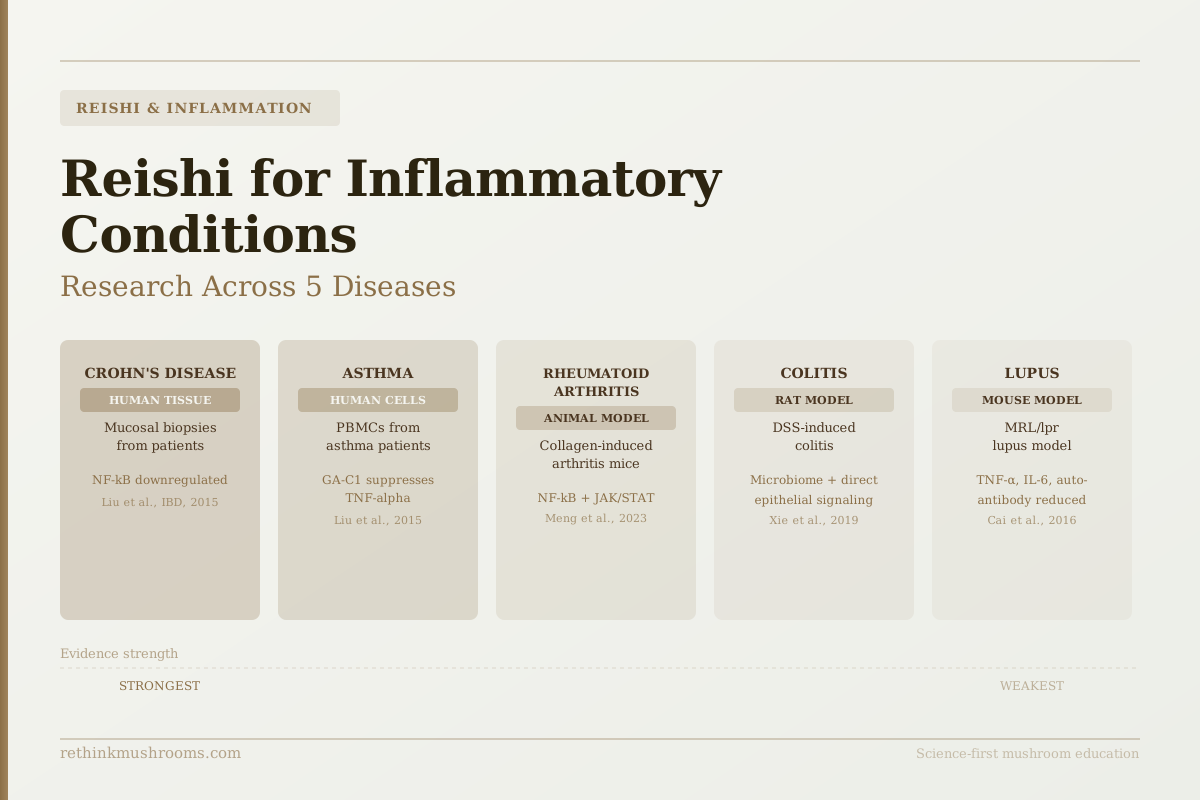
From Crohn's disease mucosal biopsies to rheumatoid arthritis animal models, reishi compounds have been studied across multiple inflammatory diseases. Evidence strength varies significantly by condition.
Pozzobon et al., Pharmaceuticals, 2026
Human tissue
evidence for Crohn's disease: mucosal biopsies from patients, not rodent models (Liu et al., 2015)
JAK/STAT
pathway targeted by polysaccharides in rheumatoid arthritis, distinct from the NF-kB triterpene pathway
0
human clinical trials completed for most of these conditions; all data is preclinical or ex vivo
Pozzobon et al., Pharmaceuticals, 2026
 View as image ↗
Most coverage of reishi as an anti-inflammatory stops at the mechanism level: it inhibits NF-kB, it reduces COX-2 expression, it lowers TNF-alpha. These are real findings. But readers who have a specific inflammatory condition want a different answer: has reishi been studied for the thing I have?
The honest answer is that it has been studied for several conditions, but the evidence is uneven. For some conditions, researchers worked with human tissue. For others, the data is animal models. For most, human clinical trials have not been done. This article covers five conditions with published reishi research, ordered by the strength of the translational evidence: from the closest to human clinical relevance down to animal-model-only data.
For context on how reishi's anti-inflammatory compounds work at the molecular level, see Reishi and Inflammation: How Ganoderic Acids Fight Chronic Inflammation. For the overarching reishi evidence base, see What Is Reishi Mushroom? The Science Behind the Mushroom of Immortality.
Key Takeaways
- Crohn's disease has the strongest translational evidence: Liu and colleagues (Inflammatory Bowel Diseases, 2015) used actual human Crohn's disease mucosal biopsies (not rodent tissue) and found significant NF-kB downregulation by Ganoderma triterpenoids[1]
- Asthma evidence comes from human peripheral blood mononuclear cells from asthma patients: ganoderic acid C1 suppressed TNF-alpha via NF-kB and MAPK/AP-1 inhibition (Liu et al., 2015)[2]
- Rheumatoid arthritis evidence comes from animal models and a 2023 review: Ganoderma polysaccharides reduce synovial inflammation via NF-kB and JAK/STAT pathways, a distinct mechanism from the triterpenes (Meng et al., Molecules, 2023)[3]
- Colitis evidence is rodent-model only: reishi polysaccharides reduced DSS-induced colitis partly by reshaping gut microbiota, not just through direct anti-inflammatory signaling (Xie et al., 2019)[4]
- Lupus evidence is mouse model: reishi reduced kidney inflammation and auto-antibody production in an MRL/lpr lupus mouse model (Cai et al., Chinese Medicine, 2016)[5]
- A 2026 systematic review and meta-analysis confirms NF-kB inhibition as the consistent primary mechanism across conditions, but identifies human RCTs as the critical evidence gap (Pozzobon et al., Pharmaceuticals, 2026)[6]
Conditions Covered and Evidence Levels at a Glance
| Condition | Best Available Evidence | Study Type | Primary Mechanism |
|---|---|---|---|
| Crohn's disease | Human mucosal biopsies from patients | Ex vivo (human tissue) | NF-kB downregulation by triterpenoids |
| Asthma | Human PBMCs from asthma patients | Ex vivo (human cells) | NF-kB and MAPK/AP-1 inhibition by ganoderic acid C1 |
| Rheumatoid arthritis | Collagen-induced arthritis mouse model | Animal + 2023 review | NF-kB and JAK/STAT pathway inhibition by polysaccharides |
| Colitis | DSS-induced colitis rat model | Animal | Microbiome reshaping + direct epithelial signaling by polysaccharides |
| Lupus | MRL/lpr transgenic mouse model | Animal | TNF-alpha, IL-6 reduction; anti-antibody suppression |
Crohn's Disease: The Strongest Human-Relevant Evidence
The Liu 2015 study in Inflammatory Bowel Diseases is the most human-relevant piece of anti-inflammatory reishi research available for any inflammatory condition.[1]
Most preclinical research uses cell lines derived from cancer tissue, or tissues from rodents, or tissues from healthy human donors. Liu and colleagues used intestinal mucosal biopsies from people with active Crohn's disease, a substantially higher bar. The biopsies came from inflamed intestinal tissue of Crohn's patients. The researchers then applied Ganoderma lucidum triterpenoids and measured NF-kB signaling and pro-inflammatory cytokine levels.
The result: Ganoderma triterpenoids significantly downregulated NF-kB signaling and reduced inflammatory cytokines in the intestinal epithelial cells from Crohn's patients. The effect appeared in both inflamed and non-inflamed tissue samples from the same patients. This is not proof that reishi treats Crohn's disease in humans; no clinical trial has tested that. But it establishes that the compound works on the relevant tissue from the relevant disease population, which is a more meaningful step toward clinical relevance than a rodent model.
NF-kB is particularly central to Crohn's pathology. The NF-kB transcription factor drives expression of the cytokines (TNF-alpha, IL-6, IL-1beta) that maintain the chronic intestinal inflammation in Crohn's disease. The fact that reishi triterpenoids suppress NF-kB in Crohn's disease tissue specifically provides a mechanistic basis for potential therapeutic relevance that goes beyond general anti-inflammatory activity.
For the full explanation of how the NF-kB pathway works and why reishi's dual-entry inhibition is significant, see Reishi and NF-kB Inhibition: The Anti-Inflammatory Pathway.
Asthma: Human Immune Cell Data
Asthma is the second condition with human-derived cellular evidence for reishi.
Liu and colleagues (2015, International Immunopharmacology) isolated a specific ganoderic acid, ganoderic acid C1, from the herbal formula ASHMI and tested it against TNF-alpha production in both mouse macrophages and peripheral blood mononuclear cells from human asthma patients.[2]
Peripheral blood mononuclear cells (immune cells circulating in the bloodstream) are not as specific to the disease site as intestinal biopsies are for Crohn's. But they are still cells taken from asthma patients, not from unrelated healthy donors or from mice. The study found that ganoderic acid C1 suppressed TNF-alpha production in both cell types, through NF-kB inhibition and MAPK/AP-1 pathway suppression. The effect was dose-dependent.
TNF-alpha is a key driver of airway inflammation in asthma. Its production by activated immune cells contributes to the bronchoconstriction and mucosal swelling that define asthma exacerbations. The suppression of TNF-alpha in immune cells from asthma patients is a meaningful finding; it suggests the compound exerts its effect in the relevant immune cell population.
As with the Crohn's data, this is not clinical trial evidence. There is no randomized controlled trial of reishi for asthma. The mechanistic plausibility is established; clinical validation has not been done. For a deeper look at reishi and asthma specifically, see Ganoderma lucidum and Asthma: Can Reishi Help?.
Rheumatoid Arthritis: Animal Models and Two Separate Pathways
Rheumatoid arthritis evidence for reishi is based on animal models and systematic reviews, not human tissue data, a step down in translational strength.
Meng and colleagues published a 2023 review in Molecules examining Ganoderma lucidum polysaccharides specifically for rheumatoid arthritis.[3] The review covered collagen-induced arthritis mouse models and identified two separate inflammatory pathways that polysaccharides appear to target: NF-kB (also relevant in Crohn's and asthma) and JAK/STAT, a signaling pathway that regulates Th17 cell differentiation, a subset of inflammatory immune cells particularly involved in autoimmune joint destruction.
This JAK/STAT angle is important because it provides a mechanistic basis distinct from NF-kB inhibition. Many existing RA drugs (including tofacitinib) target JAK pathways. The fact that reishi polysaccharides also show activity at this pathway in animal models suggests a different mechanism than the triterpenes' NF-kB inhibition, and opens a different rationale for their use.
One important distinction: the evidence for RA comes from polysaccharides, not the triterpenes. Most reishi anti-inflammatory content focuses on triterpenes and ganoderic acids. In the RA context, it is the polysaccharide fraction that has been studied. Different compounds, different pathways, different evidence base.
The limitation is clear: collagen-induced arthritis mouse models are useful for understanding mechanisms but are not reliable predictors of clinical outcomes in human RA. Human trials for reishi and RA have not been published.
Colitis: Rodent Evidence With a Microbiome Mechanism
Xie and colleagues (Food & Nutrition Research, 2019) tested Ganoderma lucidum polysaccharide in a rat model of colitis induced by dextran sulfate sodium (DSS).[4]
DSS colitis is a well-established rodent model of inflammatory bowel disease that produces colon inflammation resembling ulcerative colitis in humans. The study found that polysaccharide treatment reduced disease severity, measured by weight loss, stool consistency, and colon tissue inflammation scores.
What makes the Xie 2019 finding mechanistically distinctive is the microbiome component. The polysaccharides appeared to reduce inflammation not only through direct signaling in colonic epithelial cells but also by reshaping the intestinal microbiota: increasing Lactobacillus abundance and reducing Proteobacteria (a phylum associated with intestinal inflammation). This gut microbiome mechanism is separate from the direct NF-kB and COX-2 inhibition driven by triterpenes. It suggests that the polysaccharide fraction of reishi may be contributing to gut-specific anti-inflammatory effects through a prebiotic pathway.
This is rodent data. Whether it translates to human colitis or ulcerative colitis has not been tested in a clinical trial.
Lupus: Autoimmune Evidence in Mice
Cai and colleagues (Chinese Medicine, 2016) used the MRL/lpr mouse model (a transgenic mouse line that spontaneously develops a syndrome resembling human systemic lupus erythematosus) to test Ganoderma lucidum extract and a combination formula.[5]
The findings: reishi extract reduced kidney inflammation (nephritis is a major complication in lupus), lowered serum TNF-alpha and IL-6 levels, and reduced anti-double-stranded DNA antibody production, one of the hallmark autoantibodies in lupus. The combination formula (reishi plus San-Miao-San, a traditional Chinese medicine preparation) showed a greater effect than reishi alone.
The MRL/lpr model is considered a reasonable model for autoimmune dysregulation, but lupus in humans is a complex, heterogeneous disease that the mouse model captures imperfectly. The evidence is interesting mechanistically (reishi suppressing both pro-inflammatory cytokines and auto-antibody production suggests effects at multiple levels of lupus pathology), but it remains animal data without human clinical validation.
For a deeper look at reishi and autoimmune disease more broadly, see Reishi and Autoimmune Disease: Immune Regulation Research.
What the 2026 Systematic Review Found Across All Models
The most current and comprehensive synthesis of reishi's anti-inflammatory evidence is Pozzobon and colleagues' 2026 systematic review and meta-analysis in Pharmaceuticals.[6]
The review focused on Ganoderma lucidum triterpenes specifically (not polysaccharides) and found consistent reduction of inflammatory markers across preclinical models. NF-kB inhibition was identified as the primary mechanism. Importantly, the review noted that effect sizes varied significantly depending on extraction method and the specific triterpene composition of the preparation tested, suggesting that the source and quality of reishi extract affects anti-inflammatory activity in ways that matter for interpreting results across studies.
The conclusion Pozzobon and colleagues reached about the evidence gaps is the most useful single summary of where this field stands: the preclinical evidence for reishi triterpenes as anti-inflammatory agents is consistent and supports NF-kB as the primary target. Human randomized controlled trials are lacking for all the conditions covered in this article. The field's next step is clinical translation, and it has not happened yet for most of these conditions.
This honest conclusion is what most competitors fail to provide. The preclinical evidence for reishi's anti-inflammatory activity in multiple conditions is real and mechanistically specific. The clinical validation needed to recommend it for any of these conditions specifically has not been completed. For a direct look at how reishi compares to pharmaceutical anti-inflammatory drugs on these mechanisms, see Reishi vs. NSAIDs: Can a Mushroom Replace Anti-Inflammatory Drugs?. For the COX-2 comparison specifically, see Reishi and COX-2 Inhibition: How It Compares to Pharmaceutical Anti-Inflammatories.
For readers wanting to understand the compound-level detail, see Ganoderic Acids: The Unique Triterpenes in Reishi and Ergothioneine and Chronic Inflammatory Conditions for a comparison with a different mushroom-derived anti-inflammatory compound.
The Bottom Line
Five inflammatory conditions have published reishi research: Crohn's disease (human mucosal biopsies), asthma (human PBMCs from patients), rheumatoid arthritis (animal models + 2023 review), colitis (rat model with microbiome mechanism), and lupus (mouse model). Evidence strength is highest for Crohn's disease and asthma, where researchers used tissue and cells from actual patients. All other evidence is animal model or in vitro. No human clinical trials have tested reishi for any of these conditions specifically. The 2026 Pozzobon systematic review confirms consistent NF-kB inhibition across preclinical models but identifies human trials as the critical missing step.
Frequently Asked Questions
Sources & References
- 1RTHM-00719·Liu, Changda et al. (2015). “Anti-inflammatory Effects of Ganoderma lucidum Triterpenoid in Human Crohn's Disease Associated with Downregulation of NF-κB Signaling..” Inflammatory bowel diseases.Study breakdown →PubMed →↩
- 2RTHM-00720·Liu, Changda et al. (2015). “Ganoderic acid C1 isolated from the anti-asthma formula, ASHMI™ suppresses TNF-α production by mouse macrophages and peripheral blood mononuclear cells from asthma patients..” International immunopharmacology.Study breakdown →PubMed →↩
- 3RTHM-01750·Meng, Meng et al. (2023). “Potential Anti-Rheumatoid Arthritis Activities and Mechanisms of Ganoderma lucidum Polysaccharides..” Molecules (Basel.Study breakdown →PubMed →↩
- 4RTHM-00598·Xie, Jinli et al. (2019). “Ganoderma lucidum polysaccharide improves rat DSS-induced colitis by altering cecal microbiota and gene expression of colonic epithelial cells..” Food & nutrition research.Study breakdown →PubMed →↩
- 5RTHM-00766·Cai, Zhe et al. (2016). “Anti-inflammatory activities of Ganoderma lucidum (Lingzhi) and San-Miao-San supplements in MRL/lpr mice for the treatment of systemic lupus erythematosus..” Chinese medicine.Study breakdown →PubMed →↩
- 6RTHM-02241·Pozzobon, Rafaela Guedes et al. (2026). “Anti-Inflammatory Potential of Ganoderma lucidum Triterpenes: A Systematic Review and Meta-Analysis of Preclinical Evidence..” Pharmaceuticals (Basel.Study breakdown →PubMed →↩