Reishi & Inflammation
Same target, different mechanism
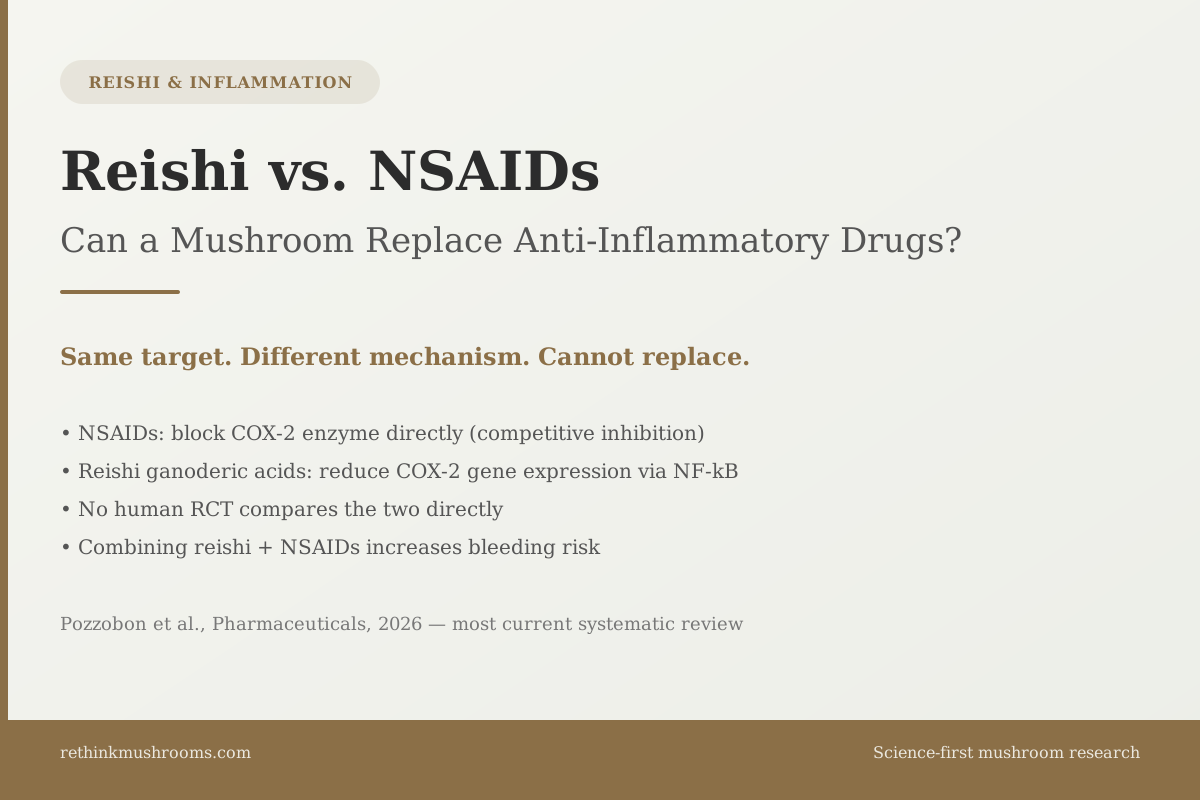
Reishi ganoderic acids and NSAIDs both inhibit COX-2, the enzyme that drives inflammation and pain. But they reach the same target in opposite ways, and combining them increases bleeding risk.
Dudhgaonkar et al., International Immunopharmacology, 2009
COX-2
inhibited by both reishi ganoderic acids and NSAIDs like ibuprofen and celecoxib
No human RCT
has compared reishi to ibuprofen for pain or acute inflammation; the comparison is preclinical only
Bleeding risk
combining reishi with NSAIDs is documented as increasing bleeding risk through additive platelet effects
Dudhgaonkar et al., International Immunopharmacology, 2009
 View as image ↗
The answer to "can reishi replace NSAIDs?" is no. But the reason why is more interesting than the no.
Reishi ganoderic acids and ibuprofen share the same molecular endpoint: both reduce COX-2 activity, and COX-2 is the enzyme most responsible for producing the prostaglandins that trigger inflammation and pain. In this narrow sense, reishi and NSAIDs are doing chemically similar things. The competitive edge competitor articles have here is simply that no one has explained this shared target clearly to a general audience, or been honest about what it implies.
What it implies: the same target doesn't mean the same effect or the same safety profile. NSAIDs block the COX-2 enzyme directly, rapidly, and at concentrations proven to work in humans. Reishi's ganoderic acids reduce COX-2 gene expression through an upstream mechanism, more slowly, at concentrations established only in cell culture. No head-to-head human pain trial exists. And combining both carries a documented interaction risk.
This article covers the reishi vs. NSAIDs comparison using the available evidence, including the most current systematic review (Pozzobon 2026), and addresses the bleeding interaction question honestly. For the broader reishi context, the complete reishi guide provides the foundation.
Key Takeaways
- Reishi ganoderic acids and NSAIDs both inhibit COX-2, the enzyme at the center of the prostaglandin-driven inflammation cascade, confirmed by multiple in vitro studies including the foundational Dudhgaonkar 2009 study[1]
- The mechanism differs: NSAIDs directly block the COX-2 enzyme's active site (competitive inhibition); reishi ganoderic acids block upstream NF-kB signaling, reducing how much COX-2 the cell produces (transcriptional inhibition)[3]
- The 2026 Pozzobon systematic review and meta-analysis confirms consistent anti-inflammatory marker reduction across preclinical studies of Ganoderma lucidum triterpenes, and explicitly identifies human RCTs as the missing evidence needed to establish clinical equivalence[2]
- Bhardwaj 2014's review of reishi's anti-inflammatory and antiallergic mechanisms documented meaningful immune-modulating activity, but built its case on mechanistic and preclinical evidence rather than human clinical trials, and the potent concentrations used in cell studies often exceed what supplement doses achieve in human blood[4]
- Combining reishi with NSAIDs is not recommended: both compounds affect platelet aggregation, and their combination may compound bleeding risk, particularly for people on anticoagulants or pre-surgery
- Reishi may have a role alongside (not instead of) NSAIDs in managing chronic low-level inflammation, but this potential role hasn't been tested in human clinical trials comparing the two treatments
Fact Check — reishi vs. NSAIDs
Can reishi replace ibuprofen as an anti-inflammatory?
The claim
“Reishi hits the same COX-2 target as ibuprofen, so it can be used as a natural substitute for anti-inflammatory drugs.”
Grows out of the real finding that reishi triterpenes down-regulate COX-2, which gets flattened into 'reishi = natural ibuprofen' in supplement marketing.
What research shows
OverstatedReishi ganoderic acids and NSAIDs do converge on COX-2, but they reach it differently: NSAIDs block the enzyme directly and fast at doses proven in humans, while reishi lowers COX-2 gene expression upstream via NF-kB, more slowly, at concentrations demonstrated mainly in cell and animal models.
No human trial has compared reishi to ibuprofen for pain or acute inflammation, and combining the two raises bleeding risk. Reishi's plausible role is as a complement for chronic low-grade inflammation, not a swap-in for acute pain relief.
Dudhgaonkar et al. 2009; Pozzobon et al. 2026 systematic review
Reishi vs. NSAIDs: How They Reach the Same Molecular Target
COX-2 (cyclooxygenase-2) is an enzyme that produces prostaglandins from arachidonic acid. Prostaglandins are signaling molecules that trigger and amplify inflammation, pain signals, and fever. Drugs that block COX-2 reduce prostaglandin production, which is why they reduce pain and inflammation. NSAIDs (ibuprofen, naproxen, celecoxib) are the dominant class of pharmaceutical COX-2 inhibitors.
Reishi's ganoderic acids reach the same endpoint through a different entry point.
NSAIDs physically block the COX-2 enzyme's active site. They occupy the pocket where arachidonic acid normally sits, preventing the enzyme from converting it into prostaglandins. This is called competitive inhibition. The effect is rapid (peak plasma levels in 1-2 hours for ibuprofen) and well-characterized in humans at specific doses.
Reishi ganoderic acids work earlier in the process. Rather than blocking an already-produced COX-2 enzyme from working, they block the transcription factor (NF-kB) that tells the cell to produce COX-2 in the first place. When NF-kB can't enter the cell nucleus to switch on the COX-2 gene, less COX-2 is made, and therefore less prostaglandin is produced. This is transcriptional inhibition, not competitive inhibition. It works upstream of where NSAIDs act.
Dudhgaonkar and colleagues demonstrated this mechanism in the foundational 2009 study of Ganoderma lucidum triterpenes: exposing LPS-stimulated macrophages to reishi's isolated triterpene fraction suppressed NF-kB activation, reduced iNOS and COX-2 expression, and lowered the output of TNF-alpha, interleukin-6, nitric oxide, and prostaglandin E2. Because the study used the triterpene fraction on its own, it established that reishi's triterpenes carry this anti-inflammatory activity, and the same suppression of TNF-alpha and IL-6 held up in living mice, not only in cell culture.[1]
Wu and colleagues' 2019 study built on this by isolating and testing dozens of individual triterpenoids from reishi fruiting bodies. One compound stood out as the most potent: it dose-dependently reduced nitric oxide production, lowered interleukin-6 and interleukin-1-beta, cut the expression of iNOS, COX-2, and NF-kB, and blocked the phosphorylation steps that normally switch NF-kB on. The finding matters because it shows the anti-inflammatory activity is not uniform across reishi's triterpenes; specific compounds are substantially more potent than others.[3]
For more on how the ganoderic acid mechanism differs from the polysaccharide pathway, the how reishi triterpenes differ from polysaccharides article covers this distinction in depth.
What Ganoderic Acid A Shows About Specific Compound Potency
Among the many identified ganoderic acids, ganoderic acid A has received some of the most targeted pharmacological investigation. Sui and colleagues' 2025 comprehensive review describes ganoderic acid A as one of the most abundant and active of reishi's ganoderic acids, with anti-inflammatory effects that run through NF-kB and MAPK signaling among several other pathways. Network pharmacology and molecular docking analyses in the review mapped ganoderic acid A's interactions to targets including MAPK3, tumor necrosis factor (TNF), and caspase-3, giving a computational picture of how the compound engages inflammatory signaling.[5]
Molecular docking is a computational technique that maps how a compound interacts with a protein's 3D structure. For ganoderic acid A, this analysis identified binding interactions at inflammatory-pathway proteins such as MAPK3 and TNF, giving pharmacologists a structural map of how the compound engages inflammatory signaling at the molecular level.
This is useful mechanistic data. Ganoderic acid A is not hypothetically anti-inflammatory based on traditional use or vague biological activity; its interactions with inflammatory-pathway proteins have been mapped computationally. But this is still computational and preclinical data. Whether orally administered ganoderic acid A reaches sufficient blood concentrations in humans to produce these interactions remains unanswered, and the review itself notes ganoderic acid A's low oral bioavailability. Detailed human pharmacokinetic data on individual ganoderic acids is sparse.
For a deeper look at the research on specific ganoderic acid variants, the ganoderic acid A, B, and beyond article covers the individual compound profiles.
What the 2026 Systematic Review Shows About the Evidence
The most current comprehensive synthesis of reishi's anti-inflammatory evidence is the 2026 systematic review and meta-analysis by Pozzobon and colleagues, covering Ganoderma lucidum triterpenes across preclinical studies.[2]
The findings:
- Ganoderma lucidum triterpenes consistently reduced inflammatory markers across preclinical models
- NF-kB inhibition was the primary mechanism across studies
- Effect sizes varied substantially by extraction method and specific triterpene composition (reinforcing the importance of product quality)
- Human RCTs are identified as the critical missing evidence
This last point is the most important for the reishi vs. NSAIDs question. A meta-analysis of preclinical evidence can confirm consistent biological activity across laboratory models. It cannot establish whether that activity translates to clinically meaningful effect in people, at supplement doses, with typical pharmacokinetics, in populations with real inflammatory conditions. Pozzobon's conclusion that human RCTs are needed is the accurate current state of knowledge.
Bhardwaj and colleagues' 2014 review reached the same bottom line from the mechanistic side. It documented reishi's anti-inflammatory and antiallergic activity in detail, cataloguing the immune-modulating pathways involved, while resting entirely on cell, animal, and mechanistic evidence rather than human clinical trials.[4] More than a decade later, the human-trial gap that review worked around is still open.
- Cell & Lab Studiescompleted
Reishi triterpenes suppress NF-kB, iNOS, and COX-2 and lower TNF-alpha, IL-6, NO, and PGE2 in LPS-stimulated macrophages; individual triterpenoids differ in potency (Dudhgaonkar 2009; Wu 2019)
- Animal Studiescompleted
Triterpene extract reduced TNF-alpha and IL-6 in endotoxemic mice; anti-inflammatory activity confirmed across diverse animal models in the 2026 meta-analysis (Dudhgaonkar 2009; Pozzobon 2026)
- Case Reports & Early Seriesmissing
No human case series measuring reishi's anti-inflammatory effect against a defined inflammatory condition
- Small Human Trialsmissing
No RCT has tested reishi as an anti-inflammatory or compared it head-to-head with an NSAID for pain or inflammation
- Large Randomized Trialsmissing
None
- Meta-Analyses & Systematic Reviewscurrent
Pozzobon 2026 pooled 23 preclinical studies and confirmed consistent anti-inflammatory activity, but explicitly of preclinical data only — it identifies human RCTs as the missing evidence
The mechanism is well-characterized in cells and animals, and a 2026 systematic review confirms the preclinical signal is consistent. But the human rungs of the ladder are empty: there are no human trials, and no head-to-head comparison with NSAIDs. 'Reishi is anti-inflammatory in the lab' is well supported; 'reishi works as an anti-inflammatory in people' is not yet established.
Dudhgaonkar 2009; Wu 2019; Pozzobon 2026 systematic review
The Potency Gap: What In Vitro Data Cannot Tell You
The most consistent limitation in reishi inflammation research is the jump from in vitro to in vivo at supplement doses.
In vitro studies use pure compound or concentrated extract at specific concentrations. The question is whether those concentrations are achievable and maintained in human plasma after oral supplementation. Many natural compounds show excellent in vitro activity at concentrations that vastly exceed anything achievable from a capsule.
For reishi, the pharmacokinetics of individual ganoderic acids are poorly characterized. Oral bioavailability data for specific ganoderic acids in humans is limited. Without knowing what blood concentration a given supplement dose achieves, the in vitro IC50 values (the concentration needed to inhibit 50% of an enzyme's activity) cannot be translated into a dose prediction.
This gap matters specifically for the NSAIDs comparison. Ibuprofen at 400mg achieves plasma concentrations well-characterized in humans and shows dose-proportional COX-2 inhibition at those concentrations, which is why the dose-effect relationship is predictable in clinical practice. For reishi ganoderic acids, the equivalent pharmacokinetic characterization doesn't exist at the individual compound level.
The absence of human pain trials comparing reishi to NSAIDs isn't an oversight; it's a reflection of this pharmacokinetic uncertainty. A fair head-to-head comparison requires established dose equivalence, which requires human PK data, which largely doesn't exist for reishi's active compounds.
The Interaction Risk: Why Combining Reishi with NSAIDs Raises Bleeding Risk
This is the section most relevant to people who are already taking NSAIDs and considering adding reishi.
Both NSAIDs and reishi affect platelet function and coagulation through different pathways, and the combination can compound bleeding risk.
NSAIDs inhibit COX-1 (the constitutively expressed cyclooxygenase, distinct from the inducible COX-2) in platelets. COX-1 produces thromboxane A2, a potent platelet activator. When NSAIDs block COX-1, platelets produce less thromboxane A2, aggregate more slowly, and the blood's natural tendency to form clots is reduced. This is why ibuprofen and aspirin are associated with GI bleeding and increased bruising.
Reishi ganoderic acids independently affect platelet aggregation through NF-kB and other pathways, adding an additional antiplatelet effect on top of NSAIDs' COX-1 inhibition. The combination has been documented as increasing bleeding risk in the reishi drug interactions literature. For anyone taking warfarin, clopidogrel, or aspirin in addition to NSAIDs, the compounding effect is relevant at a clinical level, not just a theoretical one.
The practical guidance: reishi and NSAIDs share a molecular target and share a risk when combined. People taking prescription NSAIDs long-term, aspirin therapy, or anticoagulants should not add reishi supplementation without reviewing the interaction with a prescriber. Pre-surgical patients specifically should avoid reishi for the same reason.
The full drug interaction profile, including the CYP450 pathway interactions that affect warfarin and statin metabolism specifically, is covered in the reishi side effects and drug interactions review.
Safety — bleeding and platelet risk
ModerateDo not combine reishi with NSAIDs, aspirin, or anticoagulants without medical supervision
Concern
NSAIDs slow platelet aggregation by inhibiting COX-1 and thromboxane A2, and reishi independently affects platelet function through separate pathways. Layering the two adds antiplatelet effects on top of each other, which can compound bleeding risk. The risk rises further for people also taking aspirin, warfarin, or clopidogrel, and around surgery.
What the research says
Keep reishi and prescription or over-the-counter NSAIDs separate unless a prescriber has reviewed the combination. Reishi is not a demonstrated substitute for NSAIDs, so there is no established benefit to justify taking the combined bleeding risk on your own.
Particularly relevant for: People taking NSAIDs long-term, on aspirin therapy or anticoagulants, or scheduled for surgery
What to do
Review reishi use with a physician or pharmacist before combining it with any anti-inflammatory or blood-thinning medication, and stop reishi ahead of surgery. This article is educational and is not medical advice.
Reishi antiplatelet activity and NSAID COX-1/thromboxane pharmacology; interaction summarized in the reishi drug-interaction literature
Where Reishi May Fit: Complement, Not Replacement
The honest picture is this: reishi's ganoderic acids are genuinely anti-inflammatory through a mechanism that overlaps with NSAIDs, but at lower potency in acute settings, without human pain trial data, and with a documented interaction risk that makes combining them unwise.
Where reishi may have a role that NSAIDs don't fill well: chronic, low-level systemic inflammation where continuous NSAID use isn't appropriate (due to GI, renal, or cardiovascular risk) and where a modest, sustained reduction in inflammatory markers might be relevant. The conditions studied (rheumatoid arthritis animal models, Crohn's disease human tissue, colitis rodent models) suggest this is the type of inflammation where reishi's mechanism is most active.
The key difference is the inflammatory context. NSAIDs are most effective for acute, high-level inflammation and pain (injury, fever, acute flare). Reishi's transcriptional inhibition mechanism works better when there's sustained inflammatory signaling driving continuous COX-2 production, as in chronic conditions. Whether this translates to meaningful clinical benefit in people has not been tested.
For the broader landscape of inflammatory conditions where reishi has been studied, the reishi for inflammatory conditions article covers the condition-specific research with differentiated evidence levels. The reishi and NF-kB inhibition article covers the specific pathway in detail.
The Bottom Line
Reishi and NSAIDs share the COX-2 inflammatory target but work through different mechanisms: NSAIDs block the enzyme competitively; reishi ganoderic acids reduce COX-2 gene expression via NF-kB inhibition. The Pozzobon 2026 systematic review confirms consistent anti-inflammatory activity in preclinical models with NF-kB as the primary mechanism, but explicitly identifies human RCTs as the missing evidence. Combining reishi with NSAIDs is not advisable due to additive platelet inhibition and increased bleeding risk. The two are chemically related but not clinically interchangeable.
Frequently Asked Questions
Sources & References
- 1RTHM-00152·Dudhgaonkar, Shailesh et al. (2009). “Suppression of the inflammatory response by triterpenes isolated from the mushroom Ganoderma lucidum..” International immunopharmacology.Study breakdown →PubMed →↩
- 2RTHM-02241·Pozzobon, Rafaela Guedes et al. (2026). “Anti-Inflammatory Potential of Ganoderma lucidum Triterpenes: A Systematic Review and Meta-Analysis of Preclinical Evidence..” Pharmaceuticals (Basel.Study breakdown →PubMed →↩
- 3RTHM-01138·Wu, Yan-Li et al. (2019). “Triterpenoids from Ganoderma lucidum and Their Potential Anti-inflammatory Effects..” Journal of agricultural and food chemistry.Study breakdown →PubMed →↩
- 4RTHM-00578·Bhardwaj, Neha et al. (2014). “Suppression of inflammatory and allergic responses by pharmacologically potent fungus Ganoderma lucidum..” Recent patents on inflammation & allergy drug discovery.Study breakdown →PubMed →↩
- 5RTHM-02188·Sui, Qi et al. (2025). “Ganoderic acid A: an in-depth review of pharmacological effects and molecular docking analysis..” Journal of ethnopharmacology.Study breakdown →PubMed →↩