Mushroom Taxonomy
2 divisions
Basidiomycota and Ascomycota together form the subkingdom Dikarya, containing virtually all species studied for medicinal properties, yet they diverged approximately 400 million years ago.
Lysakowska et al., Molecules, 2023
~30,000
Basidiomycota species
~64,000
Ascomycota species
400 million years
divergence time
Lysakowska et al., Molecules, 2023
 View as image ↗
Every medicinal mushroom studied in modern research belongs to one of two fungal divisions: Basidiomycota or Ascomycota. Together they form the subkingdom Dikarya, the "higher fungi," and between them contain over 94,000 described species. Reishi, lion's mane, turkey tail, chaga, and shiitake are all Basidiomycota. Cordyceps, the genus Psilocybe (which is taxonomically placed in Basidiomycota despite early confusion), and the yeast Saccharomyces are classified differently. Understanding which group a mushroom belongs to explains why its bioactive compound profile looks the way it does, why certain species produce beta-glucans while others produce cordycepin, and why extraction methods that work for one group may be irrelevant for another. For a broader introduction to how scientists classify medicinal fungi, see our taxonomy primer.
Key Takeaways
- Basidiomycota produce spores on external club-shaped structures (basidia), while Ascomycota produce spores inside sac-like structures (asci); this reproductive difference defines the two divisions
- Most medicinal mushrooms studied for beta-glucans, triterpenes, and polysaccharides are Basidiomycota, including reishi, lion's mane, turkey tail, maitake, and chaga
- The primary medicinal Ascomycota is Cordyceps (Ophiocordyceps sinensis and Cordyceps militaris), which produces unique compounds like cordycepin and adenosine
- Basidiomycota genomes contain fewer polyketide synthase (PKS) and nonribosomal peptide synthetase (NRPS) genes than Ascomycota but produce hundreds of terpenoids with unique structures
- Genome-scale DNA sequencing continues to reshape fungal phylogeny, resolving evolutionary relationships and gene-cluster origins within key medicinal genera such as Psilocybe (Bradshaw et al., 2024)
- Commercial supplement quality varies within both divisions; DNA barcoding found reishi products labeled Ganoderma lucidum actually contained the closely related G. lingzhi (Gunnels et al., 2020)
What defines each division
The split between Basidiomycota and Ascomycota occurred approximately 400 million years ago, around the time plants first colonized land. Despite this ancient divergence, both divisions share a key feature: dikaryotic cells containing two genetically distinct nuclei. This shared trait is why they are grouped together as Dikarya. The differences lie in how they produce sexual spores.
Basidiomycota form specialized club-shaped structures called basidia, typically located on the gills, pores, or teeth of the fruiting body. Each basidium usually produces four haploid basidiospores on external projections called sterigmata. The visible mushroom cap, stem, and gills familiar to most people is the reproductive structure of a Basidiomycota species. Approximately 30,000 species have been described across three subphyla: Agaricomycotina (the mushroom-formers), Pucciniomycotina (rusts), and Ustilaginomycotina (smuts).
Ascomycota form sac-like structures called asci, each typically containing eight haploid ascospores produced internally. Many Ascomycota do not produce the large, visible fruiting bodies associated with the word "mushroom." The division contains approximately 64,000 described species, making it the largest fungal phylum. It includes morels (Morchella), truffles (Tuber), and the medicinal genus Cordyceps.
Both divisions also reproduce asexually through conidia (spores produced without meiosis), which complicates taxonomy because the asexual and sexual forms of the same species were historically given different names. For more on why mushroom names keep changing, see our dedicated article.
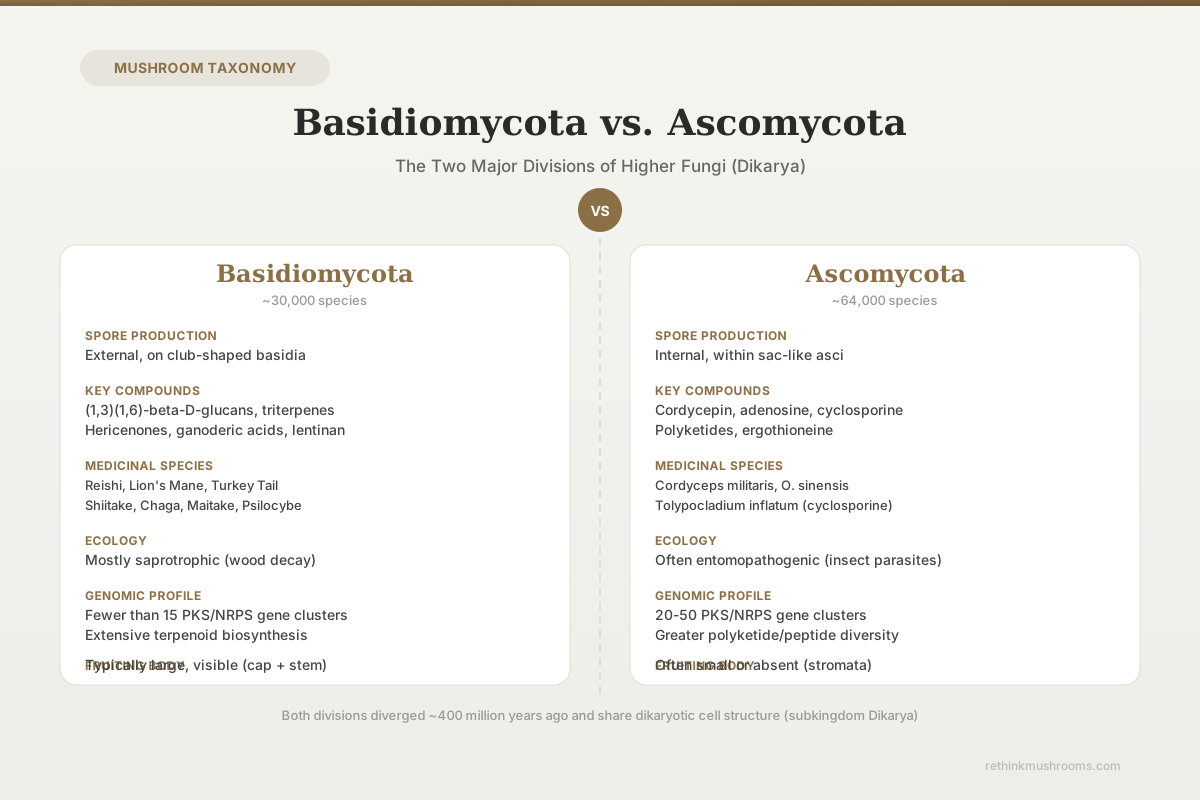
Division Contrast
Two Branches of Dikarya, Two Chemical Toolkits
Basidiomycota
Ascomycota
Sexual spores
External, on club-shaped basidia (4 spores each)
Internal, inside sac-like asci (8 spores each)
Described species
~30,000
~64,000
PKS / NRPS gene clusters
Fewer than 15 (avg)
20-50 (avg)
Chemical strength
Terpenoids & (1,3)(1,6)-beta-D-glucans
Polyketides & nucleosides (cordycepin, adenosine)
Flagship medicinal taxa
Reishi, lion’s mane, turkey tail, shiitake, chaga
Cordyceps (Ophiocordyceps sinensis, C. militaris)
Ecological strategy
Saprotrophic — wood & litter decay
Often entomopathogenic — insect parasitism
The reproductive split — spores made outside on basidia versus inside asci — is the defining difference, but the practical consequence is chemical: Basidiomycota genomes lean toward terpenoid and beta-glucan diversity, while Ascomycota carry more polyketide and peptide machinery, yielding nucleosides such as cordycepin.
Sources: Lysakowska et al. (2023) [ref 1]; Zheng et al. (2015) [ref 4].
Medicinal Basidiomycota: the beta-glucan producers
The majority of species studied as medicinal mushrooms are Basidiomycota. This is not coincidental; Basidiomycota cell walls are rich in (1,3)(1,6)-beta-D-glucans, the polysaccharide class most extensively studied for immunomodulatory and anti-tumor properties.[1]
Key medicinal Basidiomycota include:
- Ganoderma lucidum (reishi/lingzhi): produces over 400 identified bioactive compounds including ganoderic acids (triterpenes) and polysaccharides. Classified in the order Polyporales, family Ganodermataceae.
- Hericium erinaceus (lion's mane): notable for hericenones and erinacines, compounds that stimulate nerve growth factor synthesis. Order Russulales, family Hericiaceae.
- Trametes versicolor (turkey tail): source of polysaccharide-K (PSK) and polysaccharopeptide (PSP), both studied as cancer immunotherapy adjuvants. Order Polyporales, family Polyporaceae.
- Lentinula edodes (shiitake): produces lentinan, a beta-glucan approved as an adjuvant cancer therapy in Japan. Order Agaricales, family Omphalotaceae.
- Inonotus obliquus (chaga): accumulates betulinic acid and melanin complex. Order Hymenochaetales, family Hymenochaetaceae.
- Antrodia camphorata: endemic to Taiwan, produces unique triterpenoids (antcins, zhankuic acids) and antroquinonol.[2] For details on its bioactive compound profile, see our dedicated article.
- Auricularia auricula-judae (wood ear): water-soluble beta-glucans with anti-tumor activity against Sarcoma 180 in mice.[3] See our article on Auricularia polysaccharides and cancer cell inhibition for the full evidence base.
- Agaricus blazei (royal sun mushroom): beta-glucan complex with documented Toll-like receptor activation. See our review of Agaricus blazei bioactive compounds.
Basidiomycota genomes contain comparatively few polyketide synthase (PKS) and nonribosomal peptide synthetase (NRPS) genes relative to Ascomycota, with most species carrying fewer than 15 of these biosynthetic gene clusters. However, they compensate with extensive terpenoid production; hundreds of terpenoids have been isolated from Basidiomycota, many with hydrocarbon skeletons not found in any other organisms.[1]
Medicinal Ascomycota: cordycepin and beyond
Ascomycota contribute fewer species to the medicinal mushroom field, but those species produce compounds with unique pharmacological profiles.
Ophiocordyceps sinensis (caterpillar fungus) and Cordyceps militaris are the primary medicinal Ascomycota. Both produce cordycepin (3'-deoxyadenosine), a nucleoside analog with documented anti-inflammatory, anti-tumor, and anti-fatigue properties. Zheng et al. (2015) identified the specific genes involved in cordycepin biosynthesis in C. militaris, revealing that this secondary metabolite is produced through a dedicated enzymatic pathway rather than being a byproduct of primary metabolism.[4]
Hirsch et al. (2017), in a randomized, double-blind, placebo-controlled trial of 28 participants, found that supplementation with a Cordyceps militaris-containing mushroom blend improved tolerance to high-intensity exercise, with three weeks of supplementation raising maximal oxygen consumption (VO2max) and time to exhaustion.[5] This ergogenic application is specific to Cordyceps; few Basidiomycota species have shown comparable effects in controlled human trials.
Other notable Ascomycota with medicinal or nutritional relevance include:
- Morchella species (morels): edible fungi prized culinarily, with documented antioxidant and immunomodulatory polysaccharides, though less studied than Basidiomycota medicinal species.
- Tuber species (truffles): produce volatile organic compounds and polysaccharides with emerging evidence for antioxidant activity. Primarily valued as culinary ingredients rather than medicinal sources.
- Tolypocladium inflatum: the source of cyclosporine, one of the most important immunosuppressant drugs in organ transplant medicine. This single Ascomycota species has had arguably greater pharmaceutical impact than any individual Basidiomycota species.
Ascomycota genomes generally contain more PKS and NRPS gene clusters (20-50 per genome) than Basidiomycota, giving them greater capacity for producing polyketide and peptide-based secondary metabolites. This genomic difference explains why Cordyceps species produce nucleoside analogs like cordycepin that are structurally unrelated to the triterpenes and polysaccharides dominant in Basidiomycota. The clinical success of cyclosporine from Tolypocladium demonstrates that Ascomycota secondary metabolites, while fewer in the "medicinal mushroom" category, can have transformative pharmaceutical applications.
The Psilocybe question: Basidiomycota, not Ascomycota
A common misconception places psilocybin-producing mushrooms in Ascomycota. In fact, the genus Psilocybe belongs firmly within Basidiomycota (order Agaricales, family Hymenogastraceae). Bradshaw et al. (2024) published a comprehensive phylogenomic analysis of the genus Psilocybe, shotgun-sequencing 71 fungarium specimens (drawn from a genus of roughly 165 recognized species) and analyzing 2,983 single-copy gene families to resolve evolutionary relationships and trace the evolution of the psilocybin biosynthetic gene cluster.[6]
Their analysis indicated that psilocybin biosynthesis first arose within Psilocybe and was then followed by an estimated four to five horizontal transfers of the gene cluster to other mushroom lineages between roughly 40 and 9 million years ago, which is why psilocybin production appears in distantly related Basidiomycota genera (Gymnopilus, Panaeolus, Pluteus) beyond Psilocybe itself, but not in Ascomycota. The biosynthetic pathway involves four key enzymes: tryptophan decarboxylase, a cytochrome P450 monooxygenase, a kinase, and a methyltransferase. All four genes cluster together in the genome, facilitating their transfer as a unit between species.[6] For historical context, see our article on Albert Hofmann and the isolation of psilocybin.
Ecological roles: decomposers vs. parasites
The two divisions also differ in their primary ecological strategies, which influences how they produce bioactive compounds.
Most medicinal Basidiomycota are saprotrophic, decomposing dead wood and leaf litter. Their extensive enzymatic toolkit for breaking down lignin and cellulose is directly connected to their terpenoid production; the same metabolic pathways that process complex plant polymers generate precursors for triterpene biosynthesis. White-rot fungi like Trametes versicolor and Ganoderma lucidum are particularly efficient lignin degraders, and their medicinal compound diversity correlates with this degradative capacity.
Medicinal Ascomycota occupy different niches. Cordyceps species are entomopathogenic fungi, parasitizing insects as part of their life cycle. The bioactive compounds they produce, including cordycepin, likely evolved as virulence factors or as defenses against competing microorganisms in the insect host environment. This parasitic strategy shapes a fundamentally different secondary metabolite profile than saprotrophic decomposition does.
Compound profiles: why the division matters
The Basidiomycota-Ascomycota distinction has practical implications for what bioactive compounds a species can produce:
| Feature | Basidiomycota | Ascomycota |
|---|---|---|
| Primary polysaccharides | (1,3)(1,6)-beta-D-glucans | (1,3)-beta-D-glucans, galactomannans |
| Signature terpenoids | Ganoderic acids, antcins, betulinic acid | Fewer terpenoid classes |
| Unique compound classes | Hericenones, erinacines, lentinan | Cordycepin, adenosine, ergothioneine |
| PKS/NRPS gene clusters | Fewer than 15 (avg) | 20-50 (avg) |
| Spore production | External (basidia) | Internal (asci) |
| Fruiting body | Typically large, visible | Often small or absent |
| Beta-glucan content | Generally higher | Variable |
| Medicinal species count | Majority of studied species | Primarily Cordyceps |
This is not a ranking of one division over the other. Each division's genomic architecture produces a different chemical toolkit. Basidiomycota excel at terpenoid and polysaccharide diversity; Ascomycota excel at polyketide and nucleoside chemistry. The medicinal properties attributed to each species are direct consequences of these evolutionary divergences.
Why accurate classification matters for supplements
Species identification within these divisions has direct consequences for supplement quality and authenticity. Gunnels et al. (2020) used ITS DNA barcoding to authenticate seven commercial reishi supplements (six powdered, one dried) sold as Ganoderma lucidum, and found that every sample actually contained G. lingzhi, the Asian reishi species routinely conflated with the European G. lucidum.[7] Because different Ganoderma species carry different triterpene profiles, this label-versus-DNA mismatch directly affects the bioactive compound content consumers receive.
Within Basidiomycota, the same species can have dramatically different triterpene profiles depending on growing conditions. Reishi cultivated on different substrates produces measurably different ganoderic acid ratios. A 2023 review of medicinal mushroom bioactive components noted that cultivation method, substrate, and harvest timing all influence the final compound profile regardless of correct species identification.[1]
The classification challenge extends to Cordyceps. Wild-harvested Ophiocordyceps sinensis (the high-altitude caterpillar fungus from the Tibetan Plateau) has a fundamentally different chemical profile from commercially cultivated Cordyceps militaris, yet both are sold under the "cordyceps" label. These are not merely different strains of the same organism; they belong to different genera, with O. sinensis producing a broader range of nucleosides and C. militaris producing higher concentrations of cordycepin specifically. Knowing whether a product derives from a Basidiomycota or Ascomycota source, and which species within that division, determines what the consumer is actually getting.
For how DNA sequencing is rewriting mushroom classification, including reclassifications that have moved species between genera or revealed cryptic species complexes, see our dedicated article.
The practical takeaway for consumers and researchers: when evaluating a medicinal mushroom product, the first question is which division the species belongs to. This immediately narrows the expected bioactive compound profile. A Basidiomycota product (reishi, lion's mane, turkey tail) should be evaluated for beta-glucan content and triterpene profiles. An Ascomycota product (cordyceps) should be evaluated for cordycepin and adenosine content. Applying Basidiomycota quality metrics to an Ascomycota product, or vice versa, produces misleading assessments.
For more on how DNA sequencing is reshaping mushroom classification and the practical impact on species identification, see our dedicated article. Understanding why mushroom names keep changing provides additional context for navigating the evolving taxonomy.
The Bottom Line
Basidiomycota and Ascomycota represent two fundamentally different evolutionary strategies for producing bioactive compounds. Basidiomycota dominate the medicinal mushroom field with beta-glucan-rich species like reishi, turkey tail, and lion's mane, while Ascomycota contribute Cordyceps species with unique nucleoside chemistry. The genomic differences between the divisions, particularly in terpenoid versus polyketide biosynthetic capacity, directly determine the compound profiles that make each species medically interesting. Accurate species identification within both divisions remains essential for supplement quality, as the bioactive differences between closely related species can be substantial.
Frequently Asked Questions
Sources & References
- 1RTHM-00843·Łysakowska, Paulina et al. (2023). “Medicinal Mushrooms: Their Bioactive Components, Nutritional Value and Application in Functional Food Production-A Review..” Molecules (Basel.Study breakdown →PubMed →↩
- 2RTHM-00274·Yue, Patrick Ying-Kit et al. (2012). “Review of biological and pharmacological activities of the endemic Taiwanese bitter medicinal mushroom, Antrodia camphorata (M. Zang et C. H. Su) Sh. H. Wu et al. (higher Basidiomycetes)..” International journal of medicinal mushrooms.Study breakdown →PubMed →↩
- 3RTHM-00001·Misaki, A et al. (1981). “Studies on interrelation of structure and antitumor effects of polysaccharides: antitumor action of periodate-modified, branched (1 goes to 3)-beta-D-glucan of Auricularia auricula-judae, and other polysaccharides containing (1 goes to 3)-glycosidic linkages..” Carbohydrate research.Study breakdown →PubMed →↩
- 4RTHM-00413·Zheng, Zhuang-Li et al. (2015). “Identification of the Genes Involved in the Fruiting Body Production and Cordycepin Formation of Cordyceps militaris Fungus..” Mycobiology.Study breakdown →PubMed →↩
- 5RTHM-00473·Hirsch, Katie R et al. (2017). “Cordyceps militaris Improves Tolerance to High-Intensity Exercise After Acute and Chronic Supplementation..” Journal of dietary supplements.Study breakdown →PubMed →↩
- 6RTHM-00865·Bradshaw, Alexander J et al. (2024). “Phylogenomics of the psychoactive mushroom genus Psilocybe and evolution of the psilocybin biosynthetic gene cluster..” Proceedings of the National Academy of Sciences of the United States of America.Study breakdown →PubMed →↩
- 7RTHM-00615·Gunnels, Tess et al. (2020). “The ITS region provides a reliable DNA barcode for identifying reishi/lingzhi (Ganoderma) from herbal supplements..” PloS one.Study breakdown →PubMed →↩