Mushroom Taxonomy
93% of commercial reishi is the wrong species
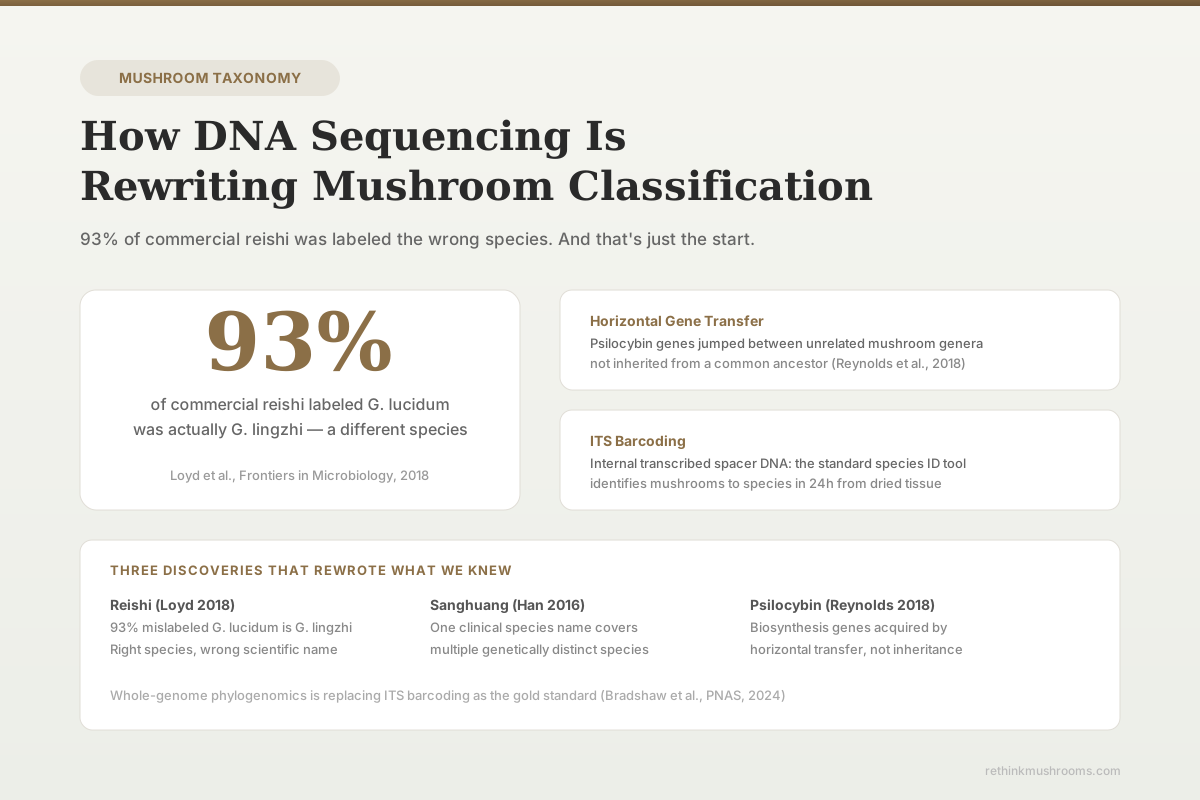
DNA barcoding of commercial reishi products found 93% labeled 'Ganoderma lucidum' contained a different species, G. lingzhi. Not a single tested manufactured product contained authentic G. lucidum sensu stricto.
Loyd et al., Frontiers in Microbiology, 2018
~90% renamed
approximately 90% of described fungal species renamed at least once due to revised taxonomy
Horizontal transfer
psilocybin genes jumped across unrelated mushroom genera, not inherited from one ancestor
ITS barcoding
the DNA identification method now used by scientists and supplement authentication labs
Loyd et al., Frontiers in Microbiology, 2018
 View as image ↗
In 2018, researchers purchased commercial reishi products from across the United States and sequenced their DNA. The results were striking: 93% of products labeled "Ganoderma lucidum" (the official scientific name printed on millions of supplement labels, cited in thousands of research papers, and used in marketing across the industry) were actually a different species, Ganoderma lingzhi.[1] Not a contaminant. Not a mistake in one batch. A systematic mislabeling that affected nearly the entire commercial category, sustained for decades because visual identification could not distinguish the two species reliably.
This is what DNA sequencing is revealing about medicinal mushrooms. It is not refining what we already knew: it is showing that what we thought we knew was frequently wrong. The morphological classification system that mycologists built over centuries, based on what fungi look like under a microscope and to the naked eye, turns out to have misidentified species at rates that are difficult to overstate.
For context on the broader classification system and why species identity matters for supplement buyers, see the pillar article on fruiting body vs. mycelium.
Key Takeaways
- DNA barcoding of commercial reishi found 93% labeled 'Ganoderma lucidum' were actually G. lingzhi; zero tested manufactured products contained authentic G. lucidum sensu stricto, the European species the name refers to (Loyd et al., 2018)
- DNA authentication of Psilocybe specimens in scientific museum collections revealed widespread misdetermination; metabolite profiles differed significantly between morphologically similar but genetically distinct species, meaning taxonomic errors directly propagate into research errors (Bradshaw et al., 2022)
- The ITS (internal transcribed spacer) region of ribosomal DNA is the standard molecular barcode for fungal species identification; PCR amplification and sequencing of this region can identify a mushroom to species from a piece of dried tissue in 24 hours (Gunnels et al., 2020)
- Psilocybin biosynthesis genes were acquired via horizontal gene cluster transfer, not inherited from a common ancestor; this explains why distantly related mushroom genera independently produce psilocybin, and reveals that morphology-based groupings of "psychedelic mushrooms" were taxonomically misleading (Reynolds et al., 2018)
- Whole-genome phylogenomics (using hundreds to thousands of genes simultaneously) is replacing single-gene ITS barcoding as the gold standard, revealing evolutionary relationships invisible to prior methods (Bradshaw et al., PNAS, 2024)
The Reishi Problem: What DNA Found in Commercial Supplements
The name Ganoderma lucidum comes from Europe. The European reishi, growing wild on oaks in temperate forests, was the species given that name by the botanist William Curtis in 1781. Asian reishi (the fungus at the center of thousands of years of Chinese medicine) looks similar. For most of mycology's history, it was assumed to be the same species.
It is not. DNA analysis established this unambiguously over the past decade. The Asian medicinal species that all commercial reishi cultivation and all clinical reishi research draws on is Ganoderma lingzhi. The European species G. lucidum is a different organism with a different bioactive compound profile.
Loyd and colleagues' 2018 study confronted the practical implication directly. They collected commercial reishi products from across the US market, extracted DNA, and sequenced the ITS region (the standard molecular barcode). The result: 93% of products were G. lingzhi, not G. lucidum. No manufactured reishi product tested contained the European species that the label name technically refers to.[1]
This is not a scandal. Asian reishi has the clinical research base, and G. lingzhi is the legitimate medicinal species. The correct name for what is sold as reishi in virtually all products worldwide is G. lingzhi, not G. lucidum. The commercial market is essentially selling the right species under the wrong scientific name.
What the Loyd finding illustrates is how deeply morphological misidentification can penetrate a commercial category, and how molecular tools expose it. An independent quality analysis of US Ganoderma supplements by Wu and colleagues the following year found major inconsistencies in chemical composition across products, partially attributable to this species identity confusion.[2]
Even the Scientists Had It Wrong: Museum Specimens and Research Errors
The reishi mislabeling might be explained by commercial corners being cut. The Bradshaw 2022 finding is harder to dismiss.
Bradshaw and colleagues examined Psilocybe specimens held in scientific herbaria: the fungal equivalent of a natural history museum, where type specimens and reference collections are kept for scientific use. These are the materials researchers use to confirm species identity, publish taxonomic descriptions, and calibrate field identification guides. If the museum specimens are correct, everything built from them is correct. If they are not, the error propagates everywhere.
The findings were uncomfortable. DNA authentication of herbarium Psilocybe specimens revealed widespread misdetermination throughout the collections.[3] Morphologically similar species (those that look nearly identical under light microscopy) were mixed together in ways that the original taxonomists had not detected. And critically, metabolite profiles varied significantly between what turned out to be genetically distinct species. A specimen filed as Psilocybe cubensis might be something else. The psilocybin content, and the ratios of associated compounds, differed between the confused species.
The practical consequence: any study that identifies mushrooms from morphology alone and reports clinical or biochemical findings is building on a foundation that may not be reliable at the species level. This applies to herbarium specimens, to commercial products, and to research samples.
ITS Barcoding: How DNA Actually Identifies a Mushroom Species
The ITS region is a section of ribosomal DNA: the genetic instructions for building ribosomes, the cellular machines that assemble proteins. All fungi have ribosomal DNA. The ITS region, which sits between the more conserved ribosomal RNA genes, evolves at a useful rate: fast enough to distinguish closely related species, but slow enough to be stable within a species.
When scientists want to identify a fungal sample, they extract DNA, amplify the ITS region using PCR (a method that copies specific DNA sequences millions of times to make them detectable), sequence the amplified fragment, and compare the sequence to reference databases such as UNITE or GenBank. This process takes 24-48 hours in a standard laboratory.
Gunnels and colleagues validated this approach specifically for Ganoderma species in commercial supplements.[4] Their 2020 study confirmed that ITS barcoding correctly distinguishes Ganoderma species even from processed supplement materials, establishing it as the reliable authentication tool for the category. This is the method that generated the 93% mislabeling finding in Loyd 2018.
The same ITS approach is now being used by supplement companies for quality control and by regulatory bodies for label verification. A 2024 review by You and colleagues examined approaches to botanical supplement authentication and identified DNA barcoding as the most reliable method for species-level ingredient verification, more accurate than chemical fingerprinting or microscopy alone for distinguishing closely related species.[5]
For more on how scientists classify fungi using multiple methods, see mushroom taxonomy 101: how scientists classify medicinal fungi. And for why names change so often as a result of these findings, see why mushroom names keep changing: the taxonomy problem.
Three Discoveries That Changed What We Thought We Knew
Chicken-of-the-woods is not one mushroom (Lindner 2008). Laetiporus sulphureus (the bright orange bracket fungus known as chicken-of-the-woods) was treated as one widespread North American species for most of the 20th century. Lindner and Banik's 2008 molecular phylogeny showed it is actually a group of distinct species with different geographic distributions and probably different chemical profiles.[6] What foragers in California and foragers in New England think is the same mushroom is not. Species-level identity matters even for familiar species.
Sanghuang is not one species (Han 2016). In Korean traditional medicine, Phellinus linteus is sanghuang: a polypore mushroom prized for its immune-modulating and anti-tumor properties, the subject of significant clinical research. Han and colleagues' 2016 DNA analysis found that the single clinical designation covers multiple distinct species with different genetic profiles.[7] Clinical research conducted on "sanghuang" may have used different species in different studies, which may partly explain inconsistencies in the literature.
Psilocybin genes jumped across unrelated genera (Reynolds 2018). The most surprising finding: psilocybin-producing ability was not inherited by the genera that have it. Reynolds and colleagues showed in 2018 that the cluster of genes responsible for psilocybin biosynthesis was acquired via horizontal gene transfer: a process where gene clusters jump between organisms, common in bacteria but rarer and more recently documented in fungi.[8]
This means Psilocybe, Panaeolus, Pluteus, and other psilocybin-producing genera are not closely related on the fungal family tree. They independently acquired the same biosynthetic gene cluster. Morphology-based groupings of "magic mushrooms" into a single lineage were taxonomically wrong. The ability to produce psilocybin is a shared acquisition, not shared ancestry.
The Frontier: From Single-Gene Barcoding to Whole-Genome Phylogenomics
ITS barcoding works well for species-level identification but has limits. It uses one short DNA region, which means closely related species that diverged recently may have identical or nearly identical ITS sequences. For complex genera like Ganoderma (which contains hundreds of species worldwide) or Psilocybe (which contains over 100 species), ITS barcoding can misclassify.
Phylogenomics, which uses hundreds or thousands of genes simultaneously rather than a single marker, is the successor approach. By comparing large portions of the genome across species, phylogenomics generates more stable and resolved evolutionary trees.
Bradshaw and colleagues' 2024 PNAS study applied phylogenomics to the Psilocybe genus, analyzing relationships using whole-genome approaches.[9] The results established evolutionary relationships and confirmed species boundaries that ITS barcoding had left ambiguous. Phylogenomics also allowed reconstruction of the psilocybin biosynthesis gene cluster's evolutionary history within Psilocybe: building on Reynolds 2018's horizontal transfer finding with finer resolution.
For what genomic tools can do beyond classification, including their applications to breeding and bioactive compound optimization, see genomic tools in mushroom science: CRISPR and beyond. For how genetic variation within and between species affects bioactive compound profiles, see mushroom genetics and bioactive variation: why strain selection matters.
The reclassification effort is ongoing. Only about 5% of an estimated 2.2-3.8 million fungal species are currently known to science: the 93% mislabeled reishi statistic, striking as it is, reflects only the portion of fungal diversity that taxonomists have examined so far.
The Bottom Line
DNA sequencing has revealed that mushroom taxonomy built on morphological features was wrong in ways that affect commercial products, scientific research, and clinical studies. The most concrete example: 93% of commercial reishi labeled Ganoderma lucidum is actually G. lingzhi. Museum specimens of Psilocybe species were widely misdetermined, with metabolite profiles differing between genetically distinct but morphologically similar species. ITS barcoding of the ribosomal DNA marker is now the standard identification tool, validated for supplement authentication. Three landmark discoveries (cryptic species in chicken-of-the-woods, multiple species within commercial sanghuang, and horizontal gene transfer of psilocybin genes) changed what we understand about familiar medicinal fungi. Whole-genome phylogenomics is the next standard, already applied to Psilocybe with more resolved results.
Frequently Asked Questions
Sources & References
- 1RTHM-00981·Loyd, Andrew L et al. (2018). “Identifying the "Mushroom of Immortality": Assessing the Ganoderma Species Composition in Commercial Reishi Products..” Frontiers in microbiology.Study breakdown →PubMed →↩
- 2RTHM-00499·Wu, Ding-Tao et al. (2017). “Evaluation on quality consistency of Ganoderma lucidum dietary supplements collected in the United States..” Scientific reports.Study breakdown →PubMed →↩
- 3RTHM-01490·Bradshaw, Alexander J et al. (2022). “DNA Authentication and Chemical Analysis of Psilocybe Mushrooms Reveal Widespread Misdeterminations in Fungaria and Inconsistencies in Metabolites..” Applied and environmental microbiology.Study breakdown →PubMed →↩
- 4RTHM-00615·Gunnels, Tess et al. (2020). “The ITS region provides a reliable DNA barcode for identifying reishi/lingzhi (Ganoderma) from herbal supplements..” PloS one.Study breakdown →PubMed →↩
- 5RTHM-02031·You, Hong et al. (2024). “Label compliance for ingredient verification: regulations, approaches, and trends for testing botanical products marketed for "immune health" in the United States..” Critical reviews in food science and nutrition.Study breakdown →PubMed →↩
- 6RTHM-00142·Lindner, Daniel L et al. (2008). “Molecular phylogeny of Laetiporus and other brown rot polypore genera in North America..” Mycologia.Study breakdown →PubMed →↩
- 7RTHM-00783·Han, Jae-Gu et al. (2016). “Species identity of Phellinus linteus (sanghuang) extensively used as a medicinal mushroom in Korea..” Journal of microbiology (Seoul.Study breakdown →PubMed →↩
- 8RTHM-01000·Reynolds, Hannah T et al. (2018). “Horizontal gene cluster transfer increased hallucinogenic mushroom diversity..” Evolution letters.Study breakdown →PubMed →↩
- 9RTHM-00865·Bradshaw, Alexander J et al. (2024). “Phylogenomics of the psychoactive mushroom genus Psilocybe and evolution of the psilocybin biosynthetic gene cluster..” Proceedings of the National Academy of Sciences of the United States of America.Study breakdown →PubMed →↩