Mushroom Taxonomy
93% mislabeled
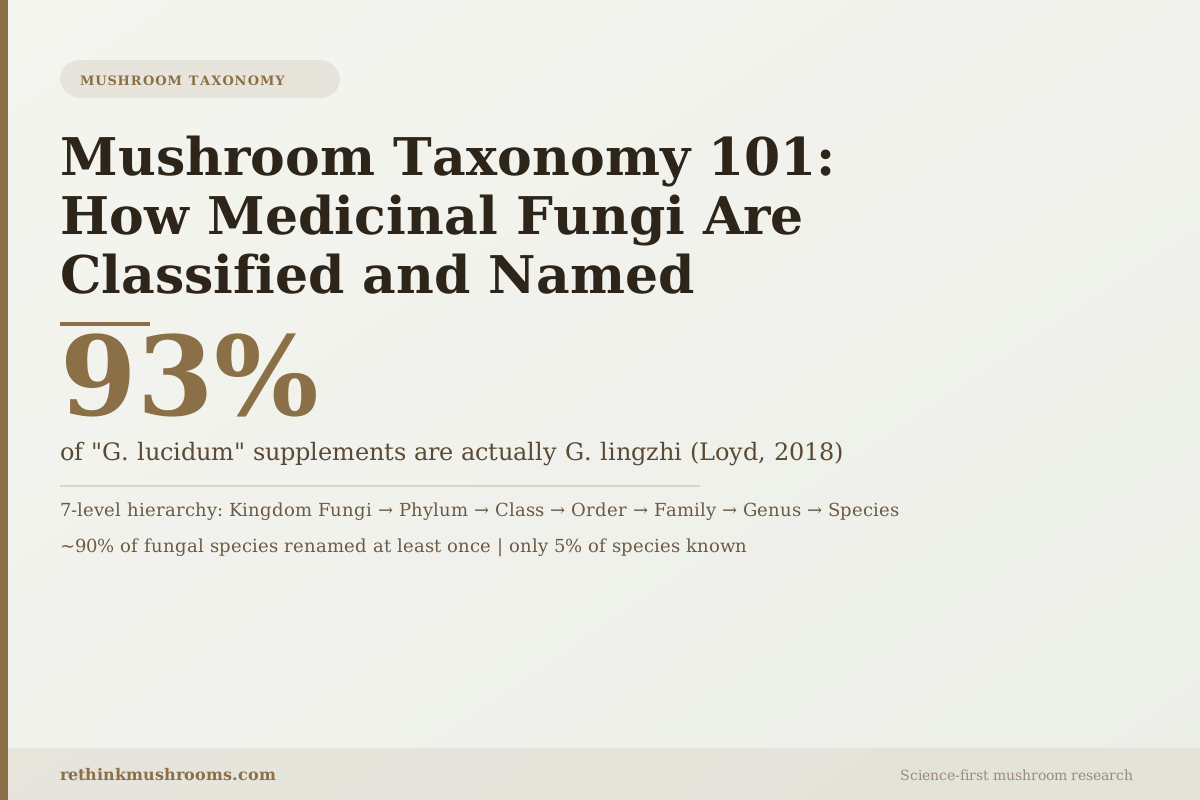
A 2018 DNA analysis found that 93% of commercially sold reishi supplements labeled 'Ganoderma lucidum' were actually a different species, G. lingzhi. This is not fraud; it is a taxonomy problem that took decades of DNA science to resolve.
Loyd et al., Frontiers in Microbiology, 2018
~90%
of described fungal species have been renamed at least once (Naranjo-Ortiz, 2019)
5%
of estimated 2.2–3.8 million fungal species are currently known (Zhou, 2023)
7 levels
in the classification hierarchy from Kingdom Fungi to individual species
Loyd et al., Frontiers in Microbiology, 2018
 View as image ↗
Pick up any reishi supplement and read the label. In almost every case, it says "Ganoderma lucidum." That name appears in thousands of supplement descriptions, health articles, and research citations. It is almost certainly wrong.
A 2018 analysis by Loyd and colleagues applied DNA barcoding to commercial reishi products and found that 93% of those labeled "Ganoderma lucidum" were actually Ganoderma lingzhi, an Asian species that is distinct from the European G. lucidum sensu stricto. Genuine G. lucidum was found in zero of the manufactured reishi products tested.[3]
This is not a story about supplement fraud. It is a story about how taxonomic classification works, why it is difficult, and why it matters. For decades, mycologists classified mushrooms based on physical appearance, and morphologically similar species ended up sharing names. DNA has been resolving those errors since the early 2000s, and the reishi labeling situation is one of the most visible examples of classification catching up to reality.
Understanding how fungi are classified and named, and why those classifications change, is foundational to reading mushroom supplement research accurately. For the broader context on mushroom supplement quality, see the complete mushroom supplement buyer's guide.
Key Takeaways
- 93% of commercially sold reishi supplements labeled "Ganoderma lucidum" are actually G. lingzhi, a different Asian species that looks nearly identical but is taxonomically distinct
- Approximately 90% of described fungal species have been renamed at least once, because morphological classification frequently grouped distinct species together
- Scientific consensus estimates only about 5% of the 2.2 to 3.8 million fungal species on Earth are currently known and named
- Mushroom classification follows seven hierarchical levels: Kingdom, Phylum, Class, Order, Family, Genus, Species
- Misidentification of mushroom species is the leading cause of serious mushroom poisoning in the US, establishing the literal life-safety stakes of accurate taxonomy
- European mushroom supplement markets show the same species identification problems as the US market, suggesting this is a global supply chain issue
The Ganoderma Problem: Why the Most Famous Medicinal Mushroom Has Been Mislabeled for Decades
Ganoderma lucidum is the Latin name most people know for reishi, the varnished shelf fungus used in traditional East Asian medicine for centuries. It appears in research papers, clinical trials, label claims, and marketing copy.
The problem is that Ganoderma lucidum strictly speaking refers to a European species, first described in 1778 from a European specimen. The Asian species used in virtually all Chinese and Japanese medicine, and virtually all commercial cultivation, is Ganoderma lingzhi, which was formally recognized as a separate species in 2012 following DNA analysis. The two species look nearly identical to the naked eye and were classified as the same thing for most of mushroom science's history.
Loyd and colleagues confirmed the scale of this error in 2018: DNA barcoding of commercial reishi products found G. lucidum sensu stricto (the actual European species) in none of the manufactured products. Everything labeled G. lucidum was G. lingzhi or related Asian species.[3]
This matters for supplement buyers because all the clinical trials cited for "G. lucidum" effects (on immune function, cholesterol, blood sugar, sleep quality) were conducted using what is now known to be G. lingzhi. The underlying research findings remain valid, but the species name in the research and the species name on the supplement label are both referring to the same Asian species, even though both are calling it by the European species name. When the literature eventually fully transitions to using G. lingzhi, the citation chain becomes clearer. Until then, the name confusion persists.
A 2024 review of Ganoderma lucidum morphology, cultivation, and market context noted this ongoing nomenclature issue as a significant challenge for quality control and research reproducibility across the industry.[6]
Label Fact Check
Does 'Ganoderma lucidum' on the label mean you're getting Ganoderma lucidum?
The claim
“A reishi supplement labeled 'Ganoderma lucidum' contains Ganoderma lucidum.”
Standard industry labeling, carried forward from pre-2012 taxonomy.
What research shows
MisleadingDNA barcoding of commercial reishi products found the European species G. lucidum sensu stricto in none of them. 93% were the distinct Asian species G. lingzhi.
The raw material is usually the correct, clinically studied species. The label name is scientifically outdated, not evidence that the product is counterfeit.
Loyd et al., Frontiers in Microbiology, 2018
How the Classification System Works: Seven Levels from Kingdom to Species
Biological classification places every living organism in a hierarchy of seven levels. For mushrooms:
Kingdom: Fungi Fungi are their own kingdom, separate from plants, animals, and bacteria. They do not photosynthesize (unlike plants), they do not ingest food (unlike animals), and they absorb nutrients through their cell walls. Their cell walls contain chitin, not the cellulose found in plant cell walls.
Phylum Most medicinal mushrooms belong to either Basidiomycota (which includes reishi, lion's mane, turkey tail, chaga, maitake, and shiitake) or Ascomycota (which includes Cordyceps militaris and truffles). The two phyla differ in how they produce and release spores. For a full comparison, see Basidiomycota vs. Ascomycota: The Two Major Mushroom Groups.
Class, Order, Family These intermediate levels group species by progressively finer shared characteristics. Reishi belongs to Class Agaricomycetes, Order Polyporales, Family Ganodermataceae.
Genus The genus is the first word in the binomial species name. Ganoderma is a genus containing dozens of species with similar shelf-like growth forms and varnished surfaces. Species within the same genus share a common ancestor and fundamental biological characteristics.
Species The species is the second word in the binomial name. The species designation should uniquely identify a single reproductively isolated population with consistent characteristics. Ganoderma lingzhi refers to the Asian reishi species. Ganoderma tsugae refers to the hemlock varnish shelf. They look similar but are distinct organisms.
The complete classification for Asian reishi (what is sold as reishi in most supplements):
- Kingdom: Fungi
- Phylum: Basidiomycota
- Class: Agaricomycetes
- Order: Polyporales
- Family: Ganodermataceae
- Genus: Ganoderma
- Species: lingzhi
Seven Levels, One Species
How Asian Reishi Is Classified, Kingdom to Species
Each level narrows the group. The bar shortens as the classification filters from the whole Kingdom Fungi down to a single species. The last two rungs — Genus and Species — combine to form the binomial name.
The binomial name
Ganoderma lingzhi
Genus + Species. The name on most supplement labels — Ganoderma lucidum — is the European species; DNA analysis separated the Asian reishi as G. lingzhi in 2012.
Classification per standard mycological taxonomy; species assignment consistent with Loyd et al. (2018) and Thakur et al. (2024). Bar length is illustrative of successive narrowing, not a count of species.
Why Classification Is Genuinely Difficult
The classification system described above sounds straightforward. In practice, applying it to fungi presents serious challenges.
The most fundamental challenge is that many unrelated fungi evolve similar physical features independently. A shelf-shaped fruiting body, a brown cap, white gills, or a specific size can appear in species that are not closely related to each other. Mycologists classifying mushrooms based solely on physical appearance frequently placed similar-looking but genetically distinct species into the same group, and conversely sometimes split closely related species because of superficial visual differences.
Naranjo-Ortiz and Gabaldón's 2019 comprehensive review of fungal diversity and phylogeny noted a striking consequence of this: approximately 90% of described fungal species have been renamed at least once due to revised taxonomy.[1] Most fungal names are not stable. They are subject to revision as DNA data reveals that the original classification was based on misleading physical characteristics.
The second challenge is scale. Zhou and colleagues' 2023 review of the current status of fungal taxonomy estimated that only about 5% of an estimated 2.2 to 3.8 million fungal species on Earth are currently known and formally named.[2] The vast majority of fungal diversity is uncharacterized. This means that many medicinal mushroom species currently considered well-understood are sitting within a much larger genus whose species boundaries are likely to be revised as the rest of the genus becomes better known.
The third challenge is convergent chemistry. Some fungi have evolved the same chemical compounds independently, not because they are closely related but because the compounds provide survival advantages. This means chemical profiles alone cannot reliably determine species relationships or identify unknown samples.
The Stakes: When Taxonomy Goes Wrong
Taxonomic errors have consequences beyond label accuracy on supplement bottles.
Brandenburg and Ward's 2018 epidemiological analysis of US mushroom poisoning cases identified misidentification as the leading cause of serious poisoning events.[4] When a forager mistakes a deadly Amanita species for an edible look-alike, the taxonomic error results in a medical emergency. Accurate species identification is not merely an academic exercise; it is a safety requirement for anyone harvesting or consuming wild fungi.
For supplement users, the stakes are different but real. A 2023 review of the Italian mushroom supplement market found extensive inconsistencies in species identification, labeling accuracy, and active compound content across products that reached market.[5] The "Pandora's Box" framing the authors used reflected the scope of the problem: even in the European Union, which has more stringent supplement regulation than the United States, species identity problems are widespread.
The clinical significance follows directly: if the species in a supplement is not what the label says it is, any efficacy claims derived from research on a different species are not directly applicable. The reishi example illustrates this: whether G. lingzhi and G. lucidum sensu stricto have identical bioactive profiles has not been definitively established, because most research was conducted before the species split was formalized and the distinction was well-recognized.
Why Common Names Fail and Scientific Names Help
Most people encounter medicinal mushrooms through common names: reishi, lion's mane, turkey tail, chaga, maitake. These names are familiar, easier to pronounce, and effectively serve as marketing shorthand.
Common names have no official standardization. "Turkey tail" refers to Trametes versicolor in most contexts, but multiple other shelf fungi have been called turkey tail informally. "Chaga" almost universally refers to Inonotus obliquus, but the common name carries no regulatory or scientific weight. In different countries, the same common name may refer to different species.
Scientific binomial names are supposed to solve this problem by providing a universal, standardized identifier. "Ganoderma lingzhi" should unambiguously refer to one species globally, regardless of language or country.
The system works when the taxonomy is stable and well-established. It breaks down when classification is in flux, which, as the 90% rename rate suggests, is much of the time in mycology. The Ganoderma situation is not unique: it is one of many cases where a name that appears on labels and in research papers is scientifically outdated or ambiguous.
For a practical guide to common name changes and how to map old names to current scientific names, see Why Mushroom Names Keep Changing: The Taxonomy Problem.
How Taxonomy Is Improving: What to Look for on Labels
DNA-based species verification is now the practical solution to the classification accuracy problem. The ITS (internal transcribed spacer) region of ribosomal DNA serves as a reliable barcode for fungal species identification. A supplement manufacturer that applies DNA barcoding to incoming raw materials can verify species identity against a reference database before the product is manufactured.
Quality manufacturers now include this information in their Certificates of Analysis. A COA that specifies "DNA verified: Ganoderma lingzhi (ITS sequencing)" tells a buyer more than any certification logo, because it identifies not just that testing was done but what method was used and what the result showed.
This level of transparency is not yet standard in the industry. Most supplement labels still carry the outdated G. lucidum name, reflecting supply chains that have not updated to the post-2012 taxonomy. The product quality is often fine. The underlying raw material is G. lingzhi, which is the clinically studied species, but the label is scientifically inaccurate.
For a deeper look at how DNA sequencing is changing the classification of all medicinal mushrooms, not just Ganoderma, see How DNA Sequencing Is Rewriting Mushroom Classification. For context on why species variation within a genus matters for bioactive content, see Mushroom Genetics and Bioactive Variation: Why Strain Selection Matters and The Genetic Diversity of Medicinal Mushroom Species.
For the question of how classification connects to supplement form, see Mushroom Taxonomy 101: How Scientists Classify Medicinal Fungi, which covers the methodological arc from morphological to DNA-based classification in detail.
The Bottom Line
Mushroom taxonomy organizes fungi into a seven-level hierarchy, with species as the fundamental unit. The system is designed to give each organism a unique, stable identifier. In practice, approximately 90% of described fungal species have been renamed at least once, because morphological classification regularly misidentified similar-looking species as the same thing. The reishi situation is the most commercially visible example: 93% of supplements labeled "Ganoderma lucidum" contain the distinct Asian species G. lingzhi, which was only formally separated by DNA analysis in 2012. Getting taxonomy right matters for supplement label accuracy, clinical research reproducibility, and, in the case of wild foraging, basic safety.
Frequently Asked Questions
Sources & References
- 1RTHM-01109·Naranjo-Ortiz, Miguel A et al. (2019). “Fungal evolution: diversity, taxonomy and phylogeny of the Fungi..” Biological reviews of the Cambridge Philosophical Society.Study breakdown →PubMed →↩
- 2RTHM-01839·Zhou, Li-Wei et al. (2023). “Fungal taxonomy: current status and research agendas for the interdisciplinary and globalisation era..” Mycology.Study breakdown →PubMed →↩
- 3RTHM-00981·Loyd, Andrew L et al. (2018). “Identifying the "Mushroom of Immortality": Assessing the Ganoderma Species Composition in Commercial Reishi Products..” Frontiers in microbiology.Study breakdown →PubMed →↩
- 4RTHM-00942·Brandenburg, William E et al. (2018). “Mushroom poisoning epidemiology in the United States..” Mycologia.Study breakdown →PubMed →↩
- 5RTHM-01778·Risoli, Samuele et al. (2023). “Mushroom-Based Supplements in Italy: Let's Open Pandora's Box..” Nutrients.Study breakdown →PubMed →↩
- 6RTHM-02005·Thakur, Pratibha et al. (2024). “Exploring Ganoderma lucidum: morphology, cultivation and market potential..” World journal of microbiology & biotechnology.Study breakdown →PubMed →↩