Chaga Diabetes Research
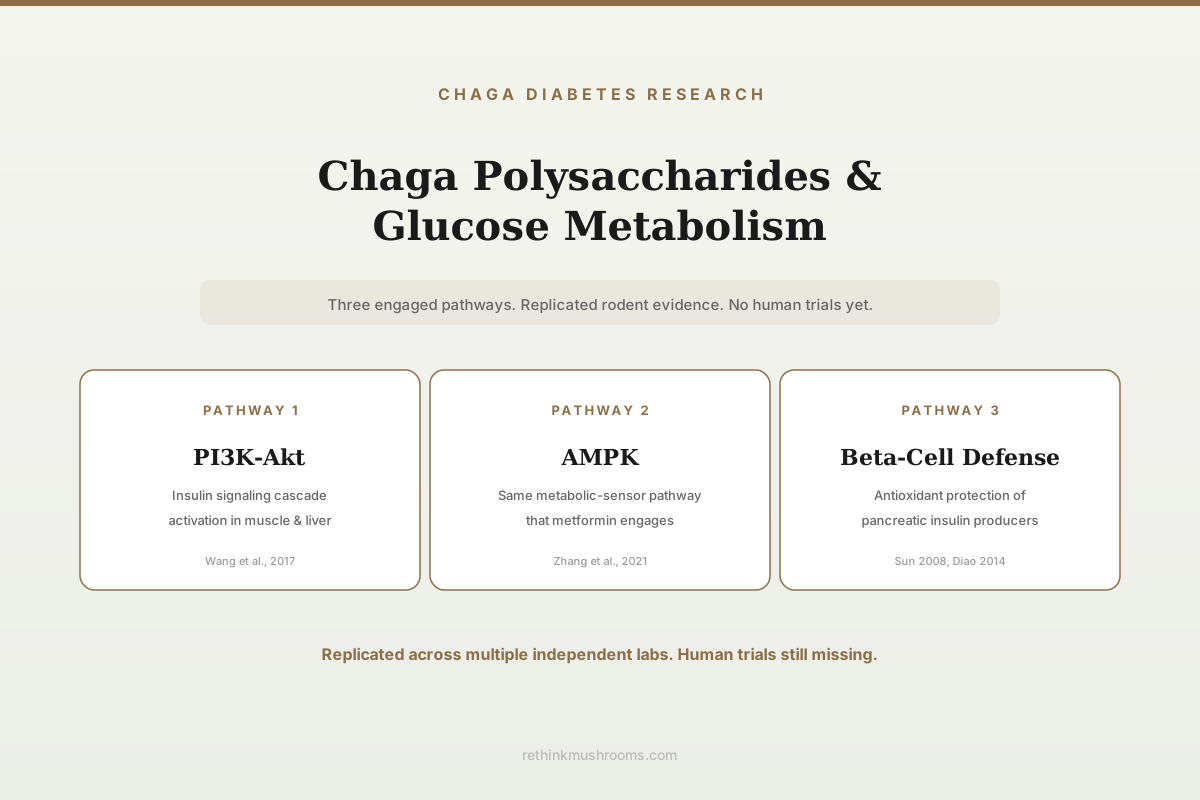
3 mechanism pathways
Chaga polysaccharides converge on glucose metabolism through three mapped mechanisms: PI3K-Akt insulin signaling activation, AMPK pathway stimulation, and protection of pancreatic beta cells from oxidative damage.
Wang et al., Carbohydrate Polymers, 2017
PI3K-Akt Pathway
the canonical insulin signaling cascade
AMPK Activation
metformin works through this pathway too
Beta-Cell Protection
antioxidant defense of insulin producers
Wang et al., Carbohydrate Polymers, 2017
 View as image ↗
The chaga polysaccharide diabetes literature is unusually consistent for a natural product. Across more than a dozen rodent studies in different laboratories, purified I. obliquus polysaccharide preparations have consistently lowered fasting blood glucose, improved oral glucose tolerance, and engaged a small set of well-characterized molecular pathways. The effect sizes are large enough to be biologically meaningful, the mechanisms map onto the same pathways targeted by approved diabetes drugs, and the replication across independent groups is stronger than for almost any other chaga indication. What is missing is the same thing missing across the chaga literature: human clinical trial data. Wang et al. (2017) is one of the most thoroughly mechanism-mapped studies in this body of work, and it provides the clearest illustration of the pathway logic.[1]
For the broader cluster context, see chaga and blood sugar: hypoglycemic research and chaga for type 2 diabetes: evidence and mechanisms.
Key Takeaways
- I. obliquus polysaccharides activate PI3K-Akt insulin signaling in skeletal muscle and liver, the canonical insulin signal-transduction pathway downstream of the insulin receptor (Wang et al., 2017)
- Chaga polysaccharide also activates AMPK in skeletal muscle and liver, the same metabolic-sensor pathway through which metformin produces a substantial portion of its antidiabetic effect (Zhang et al., 2021)
- Sun et al. (2008) showed I. obliquus culture broth lowered blood glucose and reduced lipid peroxidation in alloxan-diabetic mice, an early demonstration of pancreatic beta-cell protection
- Diao et al. (2014) administered purified polysaccharides to streptozotocin-diabetic rats and documented reductions in fasting glucose, improvements in oral glucose tolerance, and partial restoration of pancreatic islet morphology
- Liu et al. (2018) structurally characterized two distinct chaga polysaccharides and tied hypoglycemic activity to specific molecular weights and beta-glucan linkage patterns
- Randeni et al. (2025) used integrated LC-MS, network pharmacology, and molecular docking to map a multi-target antidiabetic mechanism for chaga across glucose, lipid, and insulin signaling networks
How Glucose Metabolism Goes Wrong
Type 2 diabetes is fundamentally a disorder of insulin signaling. The body produces insulin, but skeletal muscle and liver cells do not respond to it normally. Glucose accumulates in the blood. Pancreatic beta cells overproduce insulin to compensate, then exhaust themselves and fail. The downstream complications follow.
The molecular pathways that drive this failure are well-mapped. Insulin binds its receptor; the receptor phosphorylates IRS-1; IRS-1 activates PI3K; PI3K activates Akt; Akt translocates GLUT4 to the cell membrane; glucose enters the cell. Every step in this cascade is a potential point of failure, and every step is a potential drug target.
A second pathway runs in parallel. AMPK is a metabolic sensor that responds to low cellular energy by activating glucose uptake and fatty acid oxidation. Metformin, the most-prescribed type 2 diabetes drug in the world, works substantially through AMPK activation. Compounds that activate AMPK are mechanistically interesting for diabetes regardless of their effect on insulin signaling.
Chaga polysaccharides engage both of these pathways in preclinical models, plus a third arm involving direct protection of pancreatic beta cells from oxidative damage.
The PI3K-Akt Insulin Signaling Evidence
Wang et al. (2017) is the most thoroughly mechanism-mapped chaga diabetes study.[1] The group administered purified I. obliquus polysaccharide to streptozotocin-induced type 2 diabetic mice and characterized the molecular response in detail.
The findings:
- Fasting blood glucose was reduced significantly in chaga-treated animals
- Oral glucose tolerance test response was improved
- Phosphorylation of IRS-1, PI3K, and Akt in liver and muscle tissue was increased
- GLUT4 translocation to cell membranes was enhanced
- Hepatic glucose production markers were reduced
The mechanism logic is clean. Chaga polysaccharide engages a pathway upstream of or parallel to the insulin receptor, with downstream effects propagating through the canonical insulin signaling cascade. This is mechanistically the same cascade that insulin sensitizers like thiazolidinediones target through different upstream receptors.
A second 2017 Wang study used a different I. obliquus polysaccharide preparation in streptozotocin-induced diabetic mice and reported parallel findings, with the additional observation that the effect was associated with reduced oxidative stress markers in pancreatic tissue.[2]
AMPK Activation: the Metformin Parallel
Zhang et al. (2021) tested I. obliquus extract in mice and characterized effects on the regulation of glycolipid metabolism through both PI3K-Akt and AMPK-ACC pathways.[3] The dual-pathway engagement is particularly interesting because it parallels the mechanism of metformin, which works substantially through AMPK activation while also having effects on insulin signaling.
AMPK is activated by cellular energy stress. When AMPK turns on, it shifts the cell from anabolic to catabolic metabolism: glucose uptake increases, fatty acid oxidation increases, gluconeogenesis decreases, and lipid storage decreases. These are exactly the metabolic shifts that benefit a person with type 2 diabetes.
The chaga polysaccharide AMPK signal is reproducible across multiple studies in this cluster, which puts the pathway engagement in a different evidence category than a single unreplicated finding. For the AMPK-specific story, see chaga AMPK activation and insulin sensitivity.
Pancreatic Beta-Cell Protection
The third arm of the chaga diabetes mechanism involves direct protection of pancreatic beta cells from oxidative damage. Beta cells are unusually vulnerable to oxidative stress because they have low constitutive expression of antioxidant enzymes; this is one reason streptozotocin-induced diabetes (which works by killing beta cells through oxidative damage) is the standard preclinical type 1 and severe type 2 model.
Sun et al. (2008) was the early demonstration. I. obliquus culture broth reduced lipid peroxidation in pancreatic tissue from alloxan-diabetic mice and was associated with restoration of insulin-producing capacity.[4]
Diao et al. (2014) extended this work with purified polysaccharides in streptozotocin-diabetic rats.[5] The findings included reductions in fasting glucose, improvements in oral glucose tolerance, and histological evidence of partial restoration of pancreatic islet morphology after chaga polysaccharide administration. The implication is that chaga's antioxidant activity in pancreatic tissue is contributing to the antidiabetic effect, not just the insulin signaling and AMPK arms.
Chen et al. (2022) tested chaga extract in a high-fat-diet plus streptozotocin model of type 2 diabetes (which is closer to human type 2 diabetes than streptozotocin alone) and reported parallel improvements in glucose tolerance, insulin sensitivity, and pancreatic islet integrity.[6]
Structure-Activity Relationship
Liu et al. (2018) structurally characterized two distinct polysaccharides isolated from chaga and tied hypoglycemic activity to specific molecular features.[7] The two polysaccharides differed in molecular weight, monosaccharide composition, and glycosidic linkage patterns, and the antidiabetic activity tracked with these structural differences.
The implication is practically important. "Chaga polysaccharide" is not a single molecule. The hypoglycemic activity in any given preparation depends on the structural profile of the polysaccharides extracted, which depends on the source material, extraction method, and downstream processing. Wang et al. (2018) added another layer by demonstrating that polysaccharides from chaga (and a chromium III complex of those polysaccharides) had distinct effects on advanced glycation end-product formation and on alpha-amylase and alpha-glucosidase enzyme activities, which control postprandial glucose absorption from the gut.[8]
For the alpha-amylase mechanism in detail, see chaga polysaccharides and pancreatic alpha-amylase inhibition. For the broader compound chemistry, see chaga bioactive compounds: betulinic acid, melanin, and polysaccharides.
A Network View: the Randeni 2025 Synthesis
Randeni et al. (2025) integrated LC-MS chemical profiling, network pharmacology, molecular docking, and bioinformatics to construct a multi-target view of chaga's antidiabetic activity.[9] This kind of integrated analysis is increasingly common in natural-product pharmacology and provides a higher-resolution picture than single-mechanism studies.
The findings support a polypharmacology model in which chaga simultaneously engages multiple targets in glucose, lipid, and insulin signaling networks. The dominant predicted targets included components of the PI3K-Akt and AMPK pathways already identified by mechanism studies, plus additional targets in lipid metabolism and inflammatory signaling that may contribute to the observed antidiabetic effects.
This view is mechanistically consistent with the cumulative experimental literature and provides one explanation for why chaga polysaccharide preparations produce broader metabolic effects than what would be predicted from a single-target compound.
Diabetic Complications: Kidney Evidence
The chaga diabetes evidence extends beyond glucose control to the protective effects on diabetic complications. Chou et al. (2016) tested low molecular weight I. obliquus polysaccharide on diabetic nephropathy in HFD/STZ-induced mice and documented renal protection.[10] Chiang et al. (2023) extended this with an ethanol-ethyl acetate extract in a more aggressive nephrectomy-plus-streptozotocin diabetic nephropathy model.[11] Xu et al. (2021) characterized serum metabolomic profiles in streptozotocin-diabetic mice receiving chaga polysaccharide, providing a systems-level view of the metabolic shifts induced by the intervention.[12]
For the diabetic complication evidence in detail, see chaga and diabetic complications: kidney and eye protection.
Why Human Translation Has Lagged
Given the consistency and replication of the rodent evidence, the absence of human trials is itself worth examining. Several structural reasons explain the gap.
Chaga is not a single compound. It is a complex extract whose composition varies by source, extraction method, and preparation. Designing a clinical trial requires standardizing the intervention, and standardizing chaga across the variability documented by Windsor et al. (2025) and Lazic et al. (2024) is a non-trivial regulatory and manufacturing problem.
The sponsorship structure for natural-product clinical trials is weaker than for synthetic drugs. A patentable pharmaceutical attracts venture and pharmaceutical company funding for clinical development. A non-patentable mushroom extract does not, even when the preclinical signal is strong. This is a known structural issue in natural-product research and is not specific to chaga.
The dosing question is unresolved. The rodent studies use polysaccharide doses that, when scaled by body surface area or simple weight conversion, would correspond to large amounts of consumed chaga in humans. Whether the equivalent biological exposure can be achieved at culturally typical chaga consumption (a few cups of tea per day, or modest supplement doses) has not been established.
These are tractable problems. None of them is a reason the field will not eventually generate human trial data. They are reasons the data does not exist yet despite the strong preclinical signal.
What This Evidence Justifies and What It Does Not
A precise statement of the chaga polysaccharide glucose evidence as of 2026:
- Replicated rodent evidence across multiple laboratories shows hypoglycemic activity in streptozotocin and high-fat-diet plus streptozotocin diabetes models
- The mechanism involves at least three engaged pathways: PI3K-Akt insulin signaling, AMPK metabolic sensing, and pancreatic beta-cell antioxidant protection
- The structure-activity relationship is non-trivial; specific polysaccharide structures matter
- A multi-target polypharmacology view is supported by integrated LC-MS and network pharmacology analysis
- Diabetic complication evidence (kidney protection) parallels the glucose control evidence
What is not yet supported:
- Demonstrated effect in human type 2 diabetes
- Defined dose, formulation, or duration for any human diabetic indication
- Pharmacokinetic data establishing that any polysaccharide structure reaches active concentrations in human tissue
- Comparative efficacy versus established diabetes interventions
Szychowski et al. (2021) summarized the broader chaga clinical-translation gap, and the diabetes indication is one where the gap is particularly striking given the strength and consistency of the preclinical evidence base.[13]
The Bottom Line
Chaga polysaccharides engage three mechanistically validated pathways relevant to glucose metabolism: PI3K-Akt insulin signaling activation, AMPK metabolic-sensor stimulation, and antioxidant protection of pancreatic beta cells. The preclinical evidence is unusually consistent and replicated across multiple independent laboratories. Human clinical trial data does not yet exist. The indication is a textbook case of strong preclinical signal awaiting clinical translation.
Frequently Asked Questions
Sources & References
- 1RTHM-00495·Wang, Jia et al. (2017). “Anti-diabetic effects of Inonotus obliquus polysaccharides in streptozotocin-induced type 2 diabetic mice and potential mechanism via PI3K-Akt signal pathway..” Biomedicine & pharmacotherapy = Biomedecine & pharmacotherapie.Study breakdown →PubMed →↩
- 2RTHM-00498·Wang, Juan et al. (2017). “Antidiabetic activities of polysaccharides separated from Inonotus obliquus via the modulation of oxidative stress in mice with streptozotocin-induced diabetes..” PloS one.Study breakdown →PubMed →↩
- 3RTHM-00736·Zhang, Zhe et al. (2021). “Effect of Inonotus obliquus (Fr.) Pilat extract on the regulation of glycolipid metabolism via PI3K/Akt and AMPK/ACC pathways in mice..” Journal of ethnopharmacology.Study breakdown →PubMed →↩
- 4RTHM-00145·Sun, Jun-En et al. (2008). “Antihyperglycemic and antilipidperoxidative effects of dry matter of culture broth of Inonotus obliquus in submerged culture on normal and alloxan-diabetes mice..” Journal of ethnopharmacology.Study breakdown →PubMed →↩
- 5RTHM-00319·Diao, Bao-Zhong et al. (2014). “Protective Effect of Polysaccharides from Inonotus obliquus on Streptozotocin-Induced Diabetic Symptoms and Their Potential Mechanisms in Rats..” Evidence-based complementary and alternative medicine : eCAM.Study breakdown →PubMed →↩
- 6RTHM-00750·Chen, Shanshan et al. (2022). “Anti-diabetic effects of Inonotus obliquus extract in high fat diet combined streptozotocin-induced type 2 diabetic mice..” Nutricion hospitalaria.Study breakdown →PubMed →↩
- 7RTHM-00520·Liu, Ping et al. (2018). “Structure Characterization and Hypoglycaemic Activities of Two Polysaccharides from Inonotus obliquus..” Molecules (Basel.Study breakdown →PubMed →↩
- 8RTHM-00533·Wang, Cong et al. (2018). “Effects of polysaccharides from Inonotus obliquus and its chromium (III) complex on advanced glycation end-products formation, α-amylase, α-glucosidase activity and H2O2-induced oxidative damage in hepatic L02 cells..” Food and chemical toxicology : an international journal published for the British Industrial Biological Research Association.Study breakdown →PubMed →↩
- 9RTHM-00948·Randeni, Nidesha et al. (2025). “Elucidating the Anti-Diabetic Mechanisms of Mushroom Chaga (Inonotus obliquus) by Integrating LC-MS, Network Pharmacology, Molecular Docking, and Bioinformatics..” International journal of molecular sciences.Study breakdown →PubMed →↩
- 10RTHM-00423·Chou, Yen-Jung et al. (2016). “Renal Protective Effects of Low Molecular Weight of Inonotus obliquus Polysaccharide (LIOP) on HFD/STZ-Induced Nephropathy in Mice..” International journal of molecular sciences.Study breakdown →PubMed →↩
- 11RTHM-00819·Chiang, Kuang-Hsing et al. (2023). “Renoprotective Impacts of Inonotus obliquus Ethanol-Ethyl Acetate Extract on Combined Streptozotocin and Unilateral Nephrectomy-Induced Diabetic Nephropathy in Mice..” International journal of molecular sciences.Study breakdown →PubMed →↩
- 12RTHM-00729·Xu, Tanye et al. (2021). “Inonotus obliquus polysaccharide ameliorates serum profiling in STZ-induced diabetic mice model..” BMC chemistry.Study breakdown →PubMed →↩
- 13RTHM-00722·Szychowski, Konrad A et al. (2021). “Inonotus obliquus - from folk medicine to clinical use..” Journal of traditional and complementary medicine.Study breakdown →PubMed →↩