Growing Reishi Mushrooms at Home
30–90 days to harvest
Reishi takes 30–90 days from pinning to peak harvest depending on form and conditions. Research shows the cap (pileus) accumulates significantly more ganoderic acid than the stipe at all growth stages, making harvest technique a medicinal decision.
Ren et al., International Journal of Medicinal Mushrooms, 2020
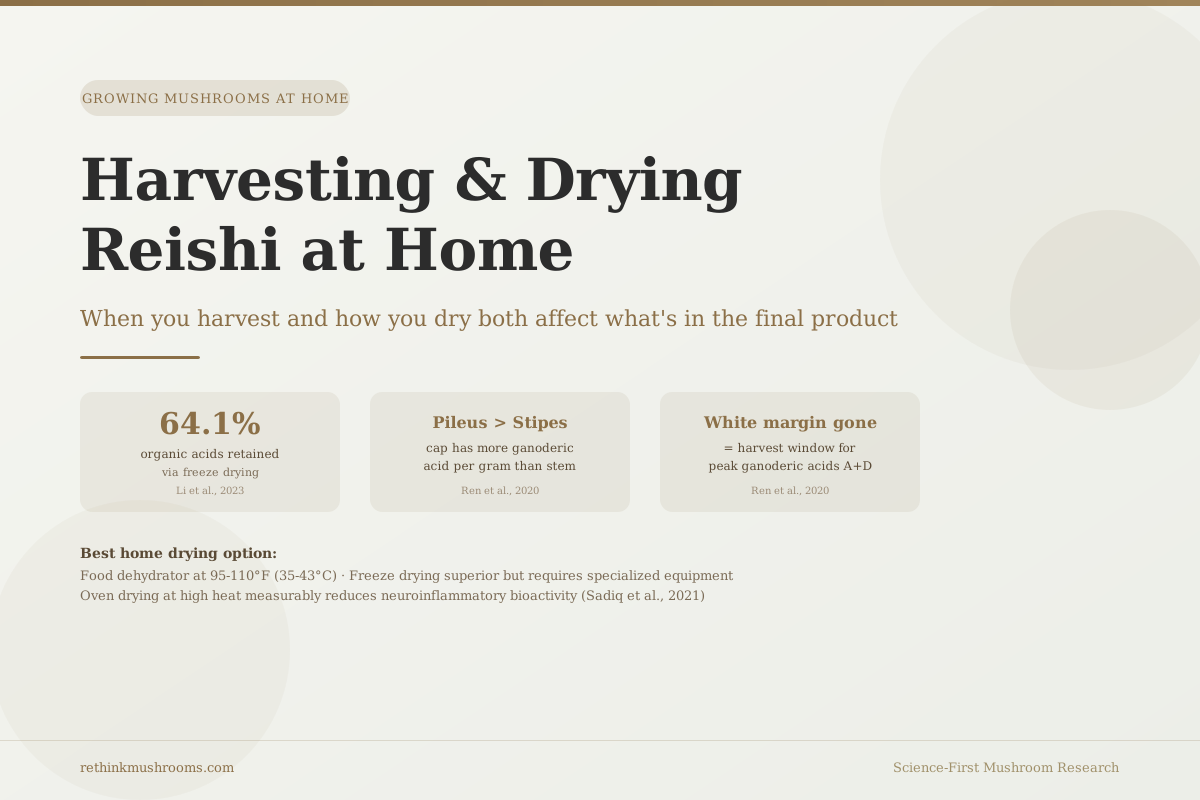
Pileus > stipes
cap contains significantly more ganoderic acid than the stem at all growth stages (Ren 2020)
Freeze drying
retains 64.1% organic acids vs. lower retention with heat drying methods (Li 2023)
White margin
harvest signal: when the white growing edge disappears, active growth has stopped
Ren et al., International Journal of Medicinal Mushrooms, 2020
 View as image ↗
Most guides on harvesting reishi tell you to "harvest when the white rim disappears" and "dry at 110°F." Both pieces of advice are correct, but neither one explains the research behind them. That research turns out to be worth knowing, because the choices you make at harvest and during drying have measurable effects on what ends up in the dried mushroom.
This article covers growing mushrooms at home with focus on what happens after the mushroom develops: when to pick it, how the cap and stem differ in compound content, and what drying method does to the bioactive profile.
Key Takeaways
- Harvest reishi when the white growing margin at the cap edge disappears and growth has stopped; this typically occurs 30–90 days after pinning, varying by temperature, form (antler vs. conk), and strain
- The cap (pileus) contains significantly more ganoderic acid than the stipe (stem) at all growth stages; prioritizing cap material during harvest and processing maximizes ganoderic acid content per gram of dried product (Ren et al., 2020)
- Different ganoderic acids peak at different stages: GA-A and GA-D peak at the mature fruiting body stage, while GA-B, GA-C2, and GA-G peak earlier at the bud-elongation stage (Ren 2020)
- A 2021 study (Sadiq et al., Molecules) directly measured neuroinflammatory bioactivity of reishi dried by different methods and found measurable differences; freeze drying and vacuum drying preserved the most activity
- Li et al. (2023) found freeze drying retains the highest organic acid content (64.1%); heat-based methods shift the bioactive profile toward amino acids and monosaccharides and away from heat-sensitive triterpenoids
- For home growers, a food dehydrator at 40–50°C (104–122°F) is the most accessible method that approximates freeze drying outcomes; oven drying at typical low-heat settings exceeds this range and causes greater compound degradation
When to Harvest: Reading the White Margin Signal
Reishi does not behave like oyster mushrooms or lion's mane, where the harvest window is measured in days and urgency is high. Reishi grows slowly, sometimes taking 30–90 days from visible pin formation to the mature harvest stage depending on temperature, humidity, and the form being cultivated (antler vs. conk). The slow growth pace gives growers more time, but it also means many beginners harvest too early.
The primary visual harvest signal for reishi is the disappearance of the white growing margin.
The white rim is a band of actively growing tissue at the outer edge of the fruiting body. As long as this rim is visible, the mushroom is still adding new material. The tissue is lighter in color because newly formed cells have not yet developed the characteristic red-brown varnished coating, which is deposited progressively from the center outward as the tissue matures.
When the white rim disappears and the entire surface has transitioned to the uniform red-brown varnished finish, active growth has essentially stopped. This is the mature stage, and research by Ren and colleagues demonstrates that this stage corresponds to peak accumulation of specific ganoderic acids in the pileus.[1]
A secondary harvest signal is spore release. Mature reishi mushrooms release a fine rust-brown powder that settles on surfaces below and around the growing area. Spore release typically begins at or shortly after the white margin disappears. At this point, harvest is appropriate; waiting much longer accumulates spore mass rather than additional medicinal compounds.
Antler vs. conk harvest timing
Antler-form reishi, which grows as elongated branches when CO2 stays high inside a sealed bag, typically reaches maturity faster than conk-form reishi because the branching structure has less total mass to develop. Harvest signals apply equally: when branch tips lose their white growing tips and the entire surface has darkened, the antlers are at peak maturity. For more on the relationship between form and compound content, see How to Grow Reishi at Home: Antler vs. Conk Form and Growing Reishi Antlers and Conks: Manipulating CO2 for Different Forms.
The Cap vs. Stem Difference: Where Ganoderic Acid Concentrates
Most growers dry and process the entire harvested mushroom. This is sensible for general use, but research by Ren and colleagues suggests that when the goal is ganoderic acid content, the cap and stem are not equivalent.[1]
Ren's study measured ganoderic acid content separately in the pileus (cap) and stipes (stem) of Ganoderma lucidum at multiple developmental stages. The finding: the pileus contained significantly more ganoderic acid than the stipes across all stages measured.
The reason behind this distribution relates to where the mushroom concentrates secondary metabolite synthesis. Ganoderic acids are triterpenoid compounds biosynthesized in the cellular tissue of the developing fruiting body. The cap, with its higher density of spore-producing cells and greater metabolic activity, accumulates more of these compounds than the comparatively fibrous stipe tissue.
The practical implication: when slicing dried reishi for extraction, tea, or powder preparation, prioritizing cap material over stem material produces a more ganoderic-acid-rich product per gram of dried mushroom. The stem is not worthless; it contains polysaccharides and other bioactive compounds. But if ganoderic acid content is the priority, the cap-to-stem ratio matters.
Which Ganoderic Acids Peak When: The Timing Nuance
Ren 2020 adds another layer of useful detail: not all ganoderic acids peak at the same developmental stage.[1]
Ganoderic acids A and D, two of the most extensively studied compounds for their liver-protective and anti-tumor properties, reach peak concentration at the mature fruiting body stage. Waiting for the white margin to disappear fully is the right call if GA-A and GA-D are the target.
Ganoderic acids B, C2, and G peak at an earlier stage, during the bud-elongation phase before the fruiting body has fully matured. For someone primarily interested in these specific compounds, an earlier harvest would capture their peak concentration.
For most home growers who are not targeting a specific ganoderic acid fraction, the late-harvest (mature stage) approach makes the most practical sense: GA-A and GA-D are the most studied compounds, and late-stage material also represents the largest total yield. But this staging data is the reason cultivation researchers increasingly discuss "harvest timing" as a compound-specific optimization variable rather than a single binary decision.
For deeper reading on individual ganoderic acids and what research shows about each, see Ganoderic Acid A, B, and Beyond: Individual Compound Research.
Drying Reishi: Why This Step Is a Medicinal Decision, Not Just Food Preservation
Every guide on drying reishi mentions temperature. Most say "use a dehydrator at 110°F" or "air dry in a warm room." Almost none explain why, or cite any research comparing outcomes between methods.
In 2021, Sadiq and colleagues published a study in Molecules that directly addressed this gap.[2] They dried identically-grown Ganoderma lucidum using multiple methods and then measured not just compound retention but actual neuroinflammatory bioactivity, the ability of the dried product to reduce inflammation in a neural cell model.
The result: drying method produced measurable differences in anti-neuroinflammatory activity. Freeze drying and vacuum drying preserved the highest bioactivity. Hot-air oven drying at higher temperatures reduced both triterpenoid retention and the associated biological activity.
This is not a theoretical compound measurement. Sadiq's team measured whether the dried mushroom could actually do something biologically meaningful and found the method used to dry it changed the answer. That reframes the drying decision from "how do I preserve my harvest" to "what kind of product am I making."
The reason for the difference: ganoderic acids are heat-sensitive compounds. Exposure to elevated temperatures causes oxidative degradation of the triterpene molecular structure. Freeze drying and vacuum drying remove moisture at low temperatures through sublimation and reduced pressure, avoiding the thermal degradation that occurs in any heat-based method. These industrial methods produce the best results but require specialized equipment unavailable in most homes.
The Method Comparison: Research Findings on Bioactive Retention
Sadiq 2021 establishes that method matters. Li and colleagues' 2023 study in Food Research International provides the compound-level specificity.[3]
Li's team dried Ganoderma-fermented material using different methods and measured the resulting bioactive profiles:
Freeze drying retained the highest concentration of organic acids, measuring 64.1% organic acid retention in the dried product. Organic acids in reishi include compounds with antioxidant and anti-inflammatory activity.
Heat-based drying methods retained more amino acids (17.4%) and monosaccharides (8.8%) than freeze drying. Amino acids and monosaccharides are generally more heat-stable than triterpenoids and organic acids, which explains why they fare relatively better under thermal conditions.
The pattern: freeze drying preserves the heat-sensitive secondary metabolite fraction (triterpenoids, organic acids) at the cost of some water-soluble compounds. Heat drying shifts the profile toward a more stable but different bioactive composition.
For a deeper look at how triterpenes and polysaccharides from reishi differ in their mechanisms, see How Reishi Triterpenes Differ from Polysaccharides in Mechanism. For the downstream step of extracting bioactive compounds from dried reishi, see Ganoderic Acid Extraction Methods: How Processing Affects Potency.
Practical Guide: Which Method to Use at Home
Freeze drying produces the best compound preservation but is not home-accessible for most growers. Home freeze dryers exist but are expensive (typically $500–2,000+). If you grow reishi in quantity and prioritize ganoderic acid retention, freeze drying produces the best-preserved product. Some small-batch specialty processors offer freeze-drying services.
Dehydrator at 40–50°C (104–122°F) is the best accessible home method. This temperature range is low enough to minimize thermal triterpenoid degradation while removing moisture reliably. The process typically takes 8–16 hours for sliced mushroom material and 24–48 hours for thicker sections. Use a dehydrator with a temperature setting, not just a timer-only model, to maintain the lower range consistently.
Slice reishi thinly (3–5mm) before dehydrating. This dramatically reduces drying time and ensures even moisture removal throughout the tissue. Prioritize cap slices over stipe sections when ganoderic acid content is the goal.
Oven at lowest setting is acceptable but suboptimal. Most conventional ovens have a minimum of 60–70°C (140–158°F), which exceeds the optimal range and will produce measurably more triterpenoid degradation than a low-temperature dehydrator. If the oven is the only option, use the lowest temperature available, prop the door open slightly to reduce effective temperature and allow moisture escape, and accept that some compound loss will occur.
Air drying at room temperature is the traditional approach but highly variable. In dry climates, room-temperature air drying can work reasonably well. In humid climates, it risks mold growth before adequate moisture removal is achieved. This method is not recommended where humidity control is limited.
Whole vs. sliced before drying
Drying whole reishi conks produces uneven results: the outer layers dry before the interior, and the center may retain enough moisture to support mold. Slicing before drying is almost always preferable. For antler-form reishi, the narrow branching structure often dries more uniformly than conk slices.
Storage After Drying
Properly dried reishi should be brittle throughout with no pliable areas, which indicate residual moisture. Any section that remains flexible after drying should go back into the dehydrator before storage.
Store dried reishi in airtight glass containers away from light, heat, and moisture. A cool, dark pantry is suitable. Refrigerator storage extends shelf life but requires care to prevent condensation when removing containers.
Shelf life for properly dried and stored reishi is typically 1–2 years with minimal bioactive degradation. Beyond 2 years, compound oxidation accelerates progressively. Powdered reishi degrades faster than whole dried pieces because the increased surface area accelerates oxidation.
For the growing conditions that affect bioactive content before harvest, see Reishi Growing Conditions: What This Mushroom Needs.
The Bottom Line
Harvest reishi when the white growing margin disappears, which corresponds to the mature stage when ganoderic acids A and D reach peak concentration in the cap. The cap (pileus) contains significantly more ganoderic acid than the stem (stipes) at all stages. Drying method measurably affects the resulting bioactive profile: freeze drying preserves the most triterpenoids and organic acids (64.1% retention per Li 2023); a food dehydrator at 40–50°C is the best practical home equivalent. Sadiq 2021 confirmed via neuroinflammatory bioactivity testing that heat-based oven drying reduces the functional potency of the dried product compared to low-temperature methods.
Frequently Asked Questions
Sources & References
- 1. Source details for this reference are not yet available.
- 2. Source details for this reference are not yet available.
- 3. Source details for this reference are not yet available.