Growing Mushrooms at Home
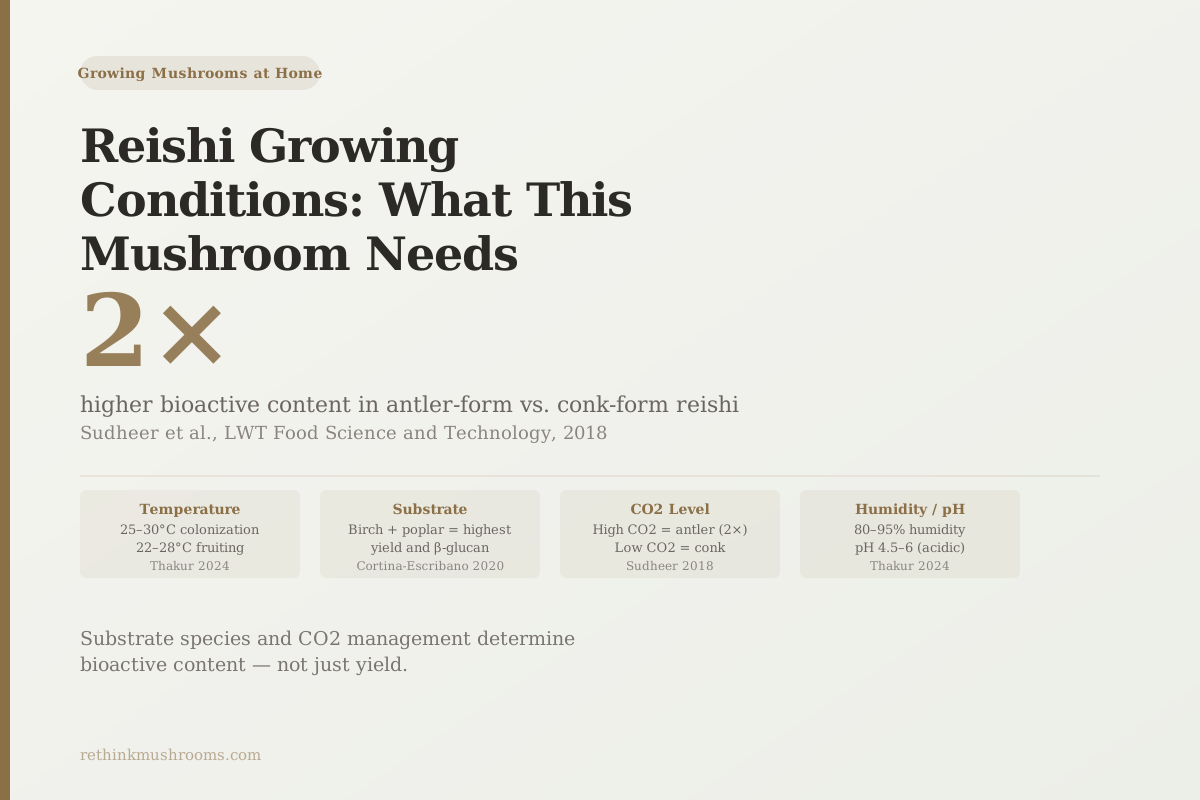
2× higher bioactive content
Research found antler-form reishi fruiting bodies contain approximately twice the polysaccharides, phenolics, flavonoids, and ganoderic acid of conk-form reishi — a difference determined by a single variable: CO2 management during cultivation.
Sudheer et al., LWT Food Science and Technology, 2018
25–30°C
optimal temperature for reishi colonization and fruiting, with 80–90% humidity (Thakur 2024 comprehensive cultivation review)
Substrate
birch and poplar produced highest yields and β-glucan content varied significantly by strain and wood species (Cortina-Escribano 2020)
CO2 level
controls form: high CO2 produces antler form, low CO2 produces conk — and antler has the higher bioactive content (Sudheer 2018)
Sudheer et al., LWT Food Science and Technology, 2018
 View as image ↗
Most growing guides for reishi list temperature, humidity, and substrate — then stop. Those parameters determine whether your mushroom fruits. They don't tell you that the wood species you use for substrate affects beta-glucan content independently of yield, or that CO2 management controls not just the shape of the mushroom but its bioactive concentration.
Reishi (Ganoderma lucidum) is a slow-growing, wood-rotting fungus that is significantly more demanding than oyster or shiitake mushrooms. It rewards patience and precise environmental control with a fruiting body that no other commonly cultivated mushroom matches for documented bioactive content. This article covers the specific conditions reishi needs, what the research shows about how those choices affect medicinal quality, and how to troubleshoot the most common problems. For the broader growing context, see How to Grow Mushrooms at Home.
Key Takeaways
- Reishi colonizes best at 25–30°C (77–86°F) with high humidity (85–95%); fruiting is triggered by a slight temperature drop, increased humidity, and fresh air exchange
- pH 4.5–6 (mildly acidic) is optimal; hardwood sawdust naturally falls in this range when properly moistened
- Substrate wood species affects both yield and beta-glucan content independently — birch and poplar outperformed other species on both metrics in controlled research (Cortina-Escribano 2020)
- CO2 level determines fruiting body form: high CO2 (restricted ventilation) produces antler form; low CO2 (regular fresh air exchange) produces conk form
- Antler-form reishi contains approximately twice the polysaccharides, phenolics, flavonoids, and ganoderic acid of conk-form material grown under identical conditions (Sudheer 2018) — CO2 management is a potency lever
- Sterilization (not pasteurization) is required for sawdust substrate — reishi's slow growth rate makes it more vulnerable to contamination than faster-colonizing species
Reishi Growing Conditions: Quick Reference
| Parameter | Optimal Range | Notes |
|---|---|---|
| Colonization temperature | 25–30°C (77–86°F) | Consistent warmth; avoid fluctuations |
| Fruiting temperature | 22–28°C (72–82°F) | Slight drop from colonization triggers fruiting |
| Humidity | 80–95% | Higher during pinning and early growth |
| Substrate | Hardwood sawdust (oak, birch, poplar, beech) | Birch and poplar showed highest yield and β-glucan in research |
| pH | 4.5–6 | Mildly acidic; most hardwood sawdust achieves this naturally |
| CO2 | High: antler form; Low: conk form | Deliberate variable — affects bioactive content |
| Light | Indirect, 12-hour cycle | Directional light shapes growth orientation |
| Colonization time | 4–8 weeks | Slower than oyster or shiitake; sterilization required |
Sources: Thakur et al. 2024[1]; Cortina-Escribano et al. 2020[2]; Sudheer et al. 2018[3]
Temperature and Humidity: The Foundation
A 2024 comprehensive review of Ganoderma lucidum cultivation by Thakur and colleagues, drawing on cultivation data across multiple studies, identified 25–30°C as the optimal colonization temperature range and 4.5–6 as the optimal pH.[1]
During colonization — the phase when mycelium (the thread-like root network) grows through the substrate — consistent warmth matters more than exact numbers. Temperature fluctuations slow colonization and open windows for contamination. A stable 26–28°C is preferable to temperatures that drift between 22°C and 32°C even if the average is in range.
Fruiting is triggered by a combination of temperature drop, humidity increase, and fresh air exchange. Most growers achieve this by moving colonized blocks from an incubation space (warmer, low airflow) to a fruiting chamber (slightly cooler, higher humidity, regular fresh air exchange). Humidity should reach 85–95% during the pinning and early growth phase. Dropping below 80% causes surface drying and cracking of developing fruiting bodies.
Reishi is not sensitive to temperature in the way that lion's mane or oyster mushrooms are — it tolerates somewhat warmer conditions without the quality drops those species show. But it shares with all wood-decomposing fungi a vulnerability to sustained temperatures above 32°C, which slow mycelium growth and can cause culture die-off at the surface.
Substrate: Why Wood Species Is Not Just a Supply Choice
The standard advice for reishi substrate is "hardwood sawdust" — and that's correct as far as it goes. Reishi is a tree pathogen and wood decomposer that requires the lignin and cellulose structure of hardwood to complete its life cycle. It will not perform on straw (which suits oyster mushrooms) or supplemented grain blocks (which suit lion's mane).
What most guides miss is that the choice of hardwood species within that category affects both yield and beta-glucan content — the primary immune-modulating polysaccharide in medicinal mushrooms.
Cortina-Escribano and colleagues tested multiple wood substrates (Betula spp./birch, Populus tremula/aspen-poplar, oak, beech, and mixed formulations) across multiple Ganoderma lucidum strains, also testing cold treatment protocols.[2] Birch and poplar substrates produced the highest yields — with poplar-based substrate achieving up to 90.2g fresh weight and 9% biological efficiency (biological efficiency is the weight of harvested mushrooms as a percentage of dry substrate weight). Beta-glucan content varied significantly by the interaction of strain and substrate species, not substrate alone.
The practical implication: if you're using oak because it's the standard answer in home cultivation guides, consider that birch or poplar may outperform it for both yield and beta-glucan content with the right strain. For substrate preparation methods, see Mushroom Substrate Guide: Hardwood, Straw, Sawdust, and Supplemented Formulas and How to Prepare Mushroom Substrate: Sterilization and Pasteurization.
CO2 Management: Form and Potency in One Variable
This is the section of reishi cultivation most guides handle superficially, and where the research provides the most differentiating information.
CO2 (carbon dioxide) accumulates inside sealed or poorly ventilated growing environments as mycelium breathes and as developing fruiting bodies respire. Fresh air exchange (FAE) — the periodic ventilation of the growing container — dilutes CO2 and replenishes oxygen.
CO2 affects reishi in two distinct ways:
First, as a fruiting trigger. Some CO2 accumulation after full colonization signals the organism that conditions are ready for reproduction. When CO2 levels rise and oxygen becomes relatively depleted, reishi initiates pinning — the formation of initial fruiting body structures.
Second, as a form determinant. When CO2 remains elevated throughout fruiting (because the bag or container stays sealed or has minimal airflow), reishi grows in the antler form: elongated, branching, horn-shaped structures. When CO2 is reduced via regular fresh air exchange, the cap (pileus) expands into the classic conk or kidney-shaped form.
Most guides describe this as an aesthetic preference or a consequence of inattention. The research suggests it's more significant than that.
Sudheer and colleagues directly compared the biochemical composition of antler-form and conk-form reishi fruiting bodies grown under controlled conditions that differed only in CO2 management.[3] Antler-form material showed approximately twice the phenolic content, flavonoids, water-soluble polysaccharides, and ganoderic acid compared to conk-form material from the same growing conditions.
Phenolics and flavonoids contribute antioxidant activity. Water-soluble polysaccharides are the primary immune-modulating compounds in reishi. Ganoderic acids are the triterpene compounds responsible for anti-inflammatory, anti-cancer, and adaptogenic effects.
If you're growing reishi for medicinal use rather than display, keeping CO2 elevated throughout fruiting — by maintaining a sealed or partially sealed bag with minimal fresh air exchange — may produce material that is substantially more bioactive per gram than fully ventilated conk-form growth. For the full comparison of antler vs. conk cultivation and harvest timing, see How to Grow Reishi at Home: Antler vs. Conk Form and Growing Reishi Antlers and Conks: Manipulating CO2 for Different Forms.
For understanding why ganoderic acid content matters in the first place, see How Reishi Triterpenes Differ from Polysaccharides in Mechanism and Ganoderic Acids: The Unique Triterpenes in Reishi.
Light Requirements
Reishi does not photosynthesize. Light does not power its growth the way it does for plants.
That said, light serves a signaling function. The presence of light helps the developing fruiting body orient itself — antlers and conks both grow toward light sources, and this directionality can be used deliberately to shape antler growth direction in aesthetic cultivation.
For medicinal cultivation purposes, indirect natural light or a simple 12-hour LED cycle (as little as a lamp timer setup with fluorescent or LED bulb) is sufficient. Intense direct light or extended dark periods both produce less desirable results. Grow rooms without windows can use any standard plant-spectrum LED on a timer.
Why Reishi Is Slower and More Demanding Than Other Species
The species commonly grown at home — oyster, shiitake, lion's mane — colonize quickly and forgive variability in conditions more readily than reishi. Oyster mushrooms can colonize in 7–14 days. Reishi takes 4–8 weeks. Every week of slower growth is an additional window during which competing mold species can establish.
This means:
Sterilization is not optional. Pasteurization — heating substrate to 65–82°C for several hours — kills most bacteria and many mold spores. It's sufficient for oyster mushrooms, which colonize fast enough to outcompete survivors. Reishi's slow colonization requires full pressure sterilization (121°C at 15 PSI for 2.5–3 hours) to eliminate heat-resistant contaminants. Growers who pasteurize reishi substrate instead of sterilizing it frequently report contamination in weeks 2–4, after the initial surface looked clean.
Contamination presents late. Because reishi grows slowly, contamination doesn't always announce itself quickly. Green (Trichoderma), black (various aspergillus species), or pink/red patches in weeks 3–5 indicate failure. Discard and don't try to save the block.
First flush is the only flush. Unlike oyster mushrooms that reliably produce 2–3 flushes, reishi typically produces one main fruiting event from a sawdust block. Log cultivation can produce for multiple seasons, but the home block method generally yields a single harvest. This reinforces the importance of harvest timing — there is no second chance on that block.
The Troubleshooting Question: Why Won't My Reishi Fruit?
The most common causes, in rough order of frequency:
- Incomplete colonization. Reishi won't pin until mycelium has fully colonized the substrate. Give it the full 6–8 weeks even if it looks done.
- CO2 too low. If you've been venting the bag constantly during colonization, there may not be enough CO2 buildup to trigger fruiting initiation. Seal the bag for several days before introducing FAE.
- Temperature too high. Above 30°C, fruiting is inhibited. The most common cause of fruiting failure in summer is heat.
- Contamination. What looks like slow colonization is sometimes contamination growing at a similar visual rate. Check for off-smells or non-white coloration.
- Insufficient humidity. Without 80%+ ambient humidity, pins desiccate before they can develop into fruiting bodies.
The Bottom Line
Reishi needs 25–30°C, 80–95% humidity, and hardwood sawdust substrate to colonize and fruit, with pressure sterilization required due to its slow colonization rate. The variables most guides miss: substrate wood species affects beta-glucan content independently of yield (birch and poplar outperformed other species in controlled research), and CO2 management determines not just form but bioactive concentration — antler-form material contains approximately twice the polysaccharides and ganoderic acid of conk-form from identical growing conditions. CO2 management is a potency lever, not just an aesthetics choice.
Frequently Asked Questions
Sources & References
- 1. Source details for this reference are not yet available.
- 2. Source details for this reference are not yet available.
- 3. Source details for this reference are not yet available.