Growing Reishi Mushrooms at Home
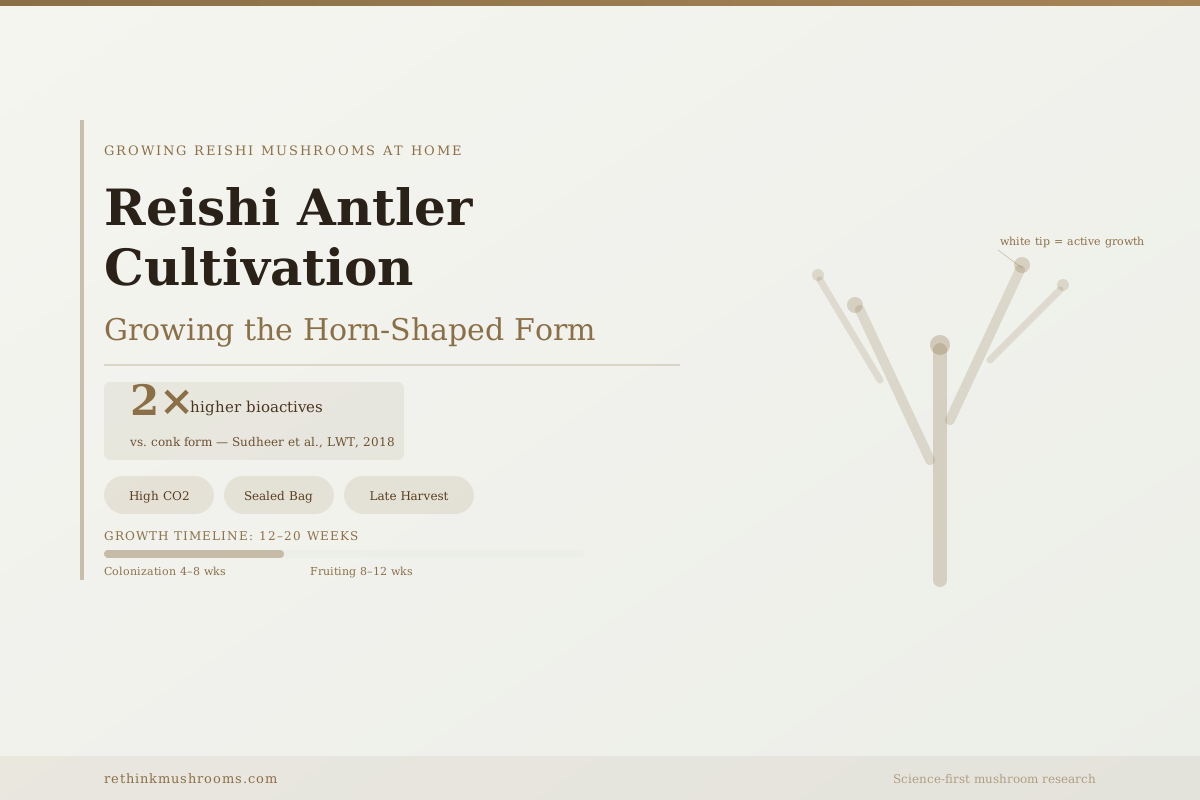
2× higher bioactives
Antler-form reishi fruiting bodies contain approximately twice the phenolics, flavonoids, water-soluble polysaccharides, and ganoderic acid compared to conk-form (kidney-shaped) material grown under the same conditions.
Sudheer et al., LWT – Food Science and Technology, 2018
CO2 threshold
above ~0.1% produces antler form; below this produces conk form
Ren 2020
ganoderic acids A and D peak at late maturation in antler form; harvest timing matters
Lower yield
the honest trade-off: antler form produces less fresh-weight volume than conk form
Sudheer et al., LWT – Food Science and Technology, 2018
 View as image ↗
Antler reishi grows when CO2 stays high inside a sealed grow bag. Keep the bag closed after colonization, maintain 70-75°F with indirect light, and the mushroom will produce elongated, branching horn-shaped forms instead of the flat kidney-shaped conk that develops with more fresh air. Antler form contains approximately twice the ganoderic acid and polysaccharide content of conk material from the same grow.[1]
That second sentence is what separates this guide from most reishi cultivation content. Competitors treat antler form as either a mistake (you forgot to give it fresh air) or a novelty (it looks cool on the shelf). Sudheer et al. (2018) measured the bioactive content of antler and conk form reishi grown under controlled conditions and found the antler material had roughly double the phenolics, flavonoids, water-soluble polysaccharides, and ganoderic acid. Growing antler reishi deliberately is a potency decision, not an aesthetic one.
For the complete beginner's introduction to growing mushrooms at home, the mushroom growing guide for beginners covers the foundations. This article focuses specifically on the antler form of reishi and how to cultivate it intentionally.
Key Takeaways
- Antler-form reishi contains approximately 2× higher phenolics, flavonoids, polysaccharides, and ganoderic acid compared to conk-form reishi grown under identical conditions (Sudheer et al., LWT, 2018)
- Antler form develops when CO2 concentration inside the growing environment stays above roughly 0.1%; this is achieved by keeping the grow bag sealed after colonization and limiting fresh air exchange (FAE)
- Thakur et al. (2024) review confirms optimal reishi growing conditions: 25-30°C (77-86°F), 80-90% humidity, pH 4.5-6, hardwood sawdust substrate
- Ren et al. (2020) found ganoderic acids A and D peak at the mature fruiting stage, while acids B, C2, and G peak earlier; harvesting too early means missing the most studied compounds
- Antler form is not reversible: once antlers have developed at high CO2, increasing fresh air exchange causes spore production, not reversion to conk form
- The honest trade-off: antler form produces significantly lower fresh-weight yield than conk form; growers choosing antler form are optimizing for concentration rather than volume
The Bioactive Case for Antler Form: This Is Not Just About Looks
Most reishi cultivation guides describe antler form as what happens when you do not provide enough fresh air exchange. The implication is that antler form is the default state of a neglected grow. That framing is backwards.
Sudheer et al. (2018) set out to deliberately produce antler-form fruiting bodies and measure what was different about them chemically.[1] Growing reishi in controlled conditions with restricted CO2 ventilation, they found that antler-form fruiting bodies contained significantly higher concentrations of every measured bioactive compound class:
- Total phenolics: approximately 2× higher in antler vs. conk form
- Total flavonoids: approximately 2× higher
- Water-soluble polysaccharides: approximately 2× higher
- Ganoderic acid content: approximately 2× higher
Same Grow, Twice the Actives
Antler vs. Conk: Bioactive Content Compared
Under identical controlled conditions, antler-form reishi carried roughly a two-fold increase in every measured compound class. Bars are indexed to conk form (baseline = 1×); the ≈ 2× magnitude is what the study reports.
The trade-off the bars do not show: antler form yields less fresh-weight material per flush. Growers choosing antler are optimizing for concentration per gram, not total volume.
Source: Sudheer et al. (2018), Fungal Biology (RTHM-01011). All four compound classes showed a reported two-fold increase in antler vs. conk form; the shared ≈ 2× index reflects that single finding and does not imply per-class precision.
Phenolics and flavonoids are antioxidant compounds. Water-soluble polysaccharides (primarily beta-glucans) are the compound class responsible for reishi's immune-activating effects. Ganoderic acids are the triterpene compounds responsible for reishi's direct anticancer, anti-inflammatory, and liver-protective activity. All four of these are higher in antler form.
The study provides a straightforward answer to the question most growing guides do not ask: if you are growing reishi for health purposes rather than just for display, antler form produces more bioactive material per mushroom. The lower fresh weight is the price; the higher compound density is the return.
For readers who want to understand why ganoderic acids matter specifically, ganoderic acids from reishi: a complete guide covers the full research picture.
What CO2 Actually Does to Reishi Growth
Reishi is native to humid, low-light forest environments where CO2 accumulates under decaying wood and within dense ground cover. In these environments, elevated CO2 is a chemical signal that the mushroom is sheltered and enclosed. The natural response: grow upward in elongated forms to push spore-producing surfaces above the CO2-rich zone and into air currents.
When CO2 drops (because the environment is more open), the mushroom receives a different signal: there is sufficient air exchange to allow lateral expansion. This triggers pileus development (the cap expands into the flat kidney or fan shape of the classic conk).
Thakur et al. (2024) reviewed the full cultivation parameter picture for Ganoderma lucidum, confirming that CO2 management is the primary morphological determinant of fruiting body form.[3] The optimal conditions for any Ganoderma grow: temperature 25-30°C (77-86°F), relative humidity 80-90%, pH 4.5-6, with hardwood substrates producing the best fruiting body quality. Within those parameters, what determines form is CO2.
The threshold that most experienced cultivators observe in practice: CO2 above approximately 0.1% (1,000 ppm) drives antler growth; below this level, the cap begins to expand toward conk form. This threshold is not established by a single controlled study at precisely that figure, but it is consistent with the CO2 levels that accumulate inside a sealed bag and the CO2 levels at which FAE (fresh air exchange) begins to shift development.
One important fact that gets repeated incorrectly in online communities: antler form is not reversible. Once elongated antler growth has been established at high CO2, introducing more fresh air exchange causes the mushroom to shift into spore production (you will see a rusty brown powder coating the antlers) rather than reverting to conk development. The form is determined early in fruiting body development.
Step-by-Step: Growing Antler Reishi in a Grow Bag
The practical process is straightforward once you understand that the goal is to deny the mushroom the fresh air it would need to form a cap.
Substrate preparation. Hardwood sawdust is the standard substrate for reishi. Oak, birch, and poplar all perform well for reishi cultivation. Thakur et al. (2024) note that hardwood substrates consistently outperform softwoods for Ganoderma fruiting quality.[3] A common mix: 80% hardwood sawdust and 20% wheat bran or rice bran as a nutrient supplement. Supplement levels above 20% increase contamination risk without proportional yield benefits. Fill your grow bags to roughly 2-3 lbs of substrate dry weight (4-6 lbs wet after hydration to approximately 60% moisture content).
Sterilization. Reishi grows more slowly than oysters or shiitake and requires a fully sterilized substrate (not just pasteurized) to minimize contamination risk. Pressure cook at 15 PSI for 2.5-3 hours, or autoclave if available. For substrate preparation methods, how to prepare mushroom substrate covers sterilization and pasteurization in detail.
Inoculation. After the bag cools to room temperature (below 75°F), inoculate with reishi grain spawn or liquid culture. Work in as clean an environment as possible. Inject liquid culture through an injection port if your bag has one, or open the bag, add grain spawn, and reseal.
Colonization. Seal the bag and keep it at 70-80°F in the dark or low light. Reishi colonizes slowly, typically 4-8 weeks for full colonization of a 5-lb bag. The bag should gradually turn white as the mycelium grows through the substrate. Full colonization is your baseline before transitioning to fruiting conditions.
Initiating antler fruiting (the key step). Once colonization is complete, you have a choice. For antler form: do not open the bag. Cut a small X or a few small holes in the plastic, just enough to allow some gas exchange and prevent total anaerobic conditions, but not enough to significantly reduce CO2. Place the bag in indirect light at 68-76°F with high ambient humidity (80-90%). Mist the bag exterior lightly once or twice daily to maintain humidity without flooding the cut.
For conk form (for comparison): cut a larger opening or remove the top of the bag entirely to allow full FAE. The mushroom will sense the lower CO2 and expand into cap form.
Growth timeline. Antler form pins (initial growth points) typically appear 2-4 weeks after initiating fruiting conditions. The antlers grow slowly, often 3-8 weeks from pin to mature antler. Total time from inoculation to harvest: typically 12-20 weeks. Patience is the primary cultivation skill for reishi.
Substrate choice across the cluster. For readers comparing substrate approaches, wood-based vs. grain-based substrates for mushroom growing and the mushroom substrate guide cover the full comparison including substrate preparation and supplement ratios.
Harvest Timing for Antler Form: When to Cut for Peak Ganoderic Acid
The choice to grow antler form optimizes the type of bioactive content. The harvest timing further determines which specific compounds are at peak concentration.
Ren et al. (2020) analyzed pileus (cap) and stipe (stem) tissue from reishi fruiting bodies at multiple growth stages and measured individual ganoderic acid species.[2] Two findings are directly relevant to antler growers:
First, the cap tissue contains significantly more ganoderic acid than the stipe. If you are growing antler form and want to maximize bioactive content per gram, the antler body itself (the elongated portion, which is analogous to cap tissue) is the most valuable part. This is also why slicing antlers through the stipe and drying everything together dilutes the potency of the cap-equivalent tissue.
Second, different ganoderic acids peak at different stages. Ganoderic acids A and D are most concentrated at the late mature fruiting stage (after active growth has stopped). Ganoderic acids B, C2, and G peak earlier, during active elongation. The compounds most commonly referenced in cancer and liver research (A and D) suggest harvesting later rather than earlier.
The practical harvest signal: harvest when active growth has stopped and the white growing margin (the white fuzzy tip on actively growing antlers) has disappeared. At this point ganoderic acids A and D are at or near peak. Earlier harvest captures different compound profiles; later harvest risks spoilage or spore release.
After harvest, drying is the next critical variable. The harvesting and drying reishi at home guide covers the research on how drying method affects bioactive retention. The key finding: low-temperature dehydration (110°F or below) or freeze drying preserves triterpenoids significantly better than high-heat oven drying.
For what to do with properly dried antler reishi, ganoderic acid extraction methods covers the extraction approaches that make the ganoderic acids bioavailable. The short version: ganoderic acids require ethanol or alcohol extraction, not just hot water. Hot water extracts the polysaccharides; alcohol extracts the triterpenes.
The Honest Trade-off: Antler Yield vs. Conk Yield
Growing antler form has a direct cost: lower fresh-weight yield.
A conk-form reishi grow will typically produce more total weight of mushroom material per flush than an antler grow from the same substrate. The mushroom expands into a large flat cap that accumulates mass efficiently. Antler form grows in elongated structures with less volume and surface area for mass accumulation.
Sudheer et al. (2018) quantify the bioactive difference, not the yield difference specifically, but the visual comparison is consistent across cultivation reports: antler form yields less by weight.[1]
The calculation that makes antler form worthwhile for health-focused growers: if a 6-week antler grow produces 80g of fresh antler with 2× the ganoderic acid per gram compared to a 6-week conk grow producing 150g, the antler material contains more total ganoderic acid than the conk despite the lower weight. Whether that calculation holds at your specific grow conditions depends on variables the current literature does not fully quantify per-substrate. The Sudheer 2018 ratio is the best evidence available.
Growers who want volume (for dried supply, for teas, for giving to others) may prefer conk form. Growers who want maximum compound concentration from a single grow, or who are specifically targeting ganoderic acid content, have a scientific basis for choosing antler form.
Troubleshooting Antler Growth
Antlers not appearing after colonization. Most common cause: CO2 levels dropped below threshold due to micro-tears in the bag or inadequate sealing. Check the bag for small holes. If the substrate has been fruited before (second flush), CO2 management often needs to be tighter to trigger antler development again.
Antlers turning brown at tips. This is spore release, indicating the mushroom has passed peak maturity. Harvest immediately to preserve potency. A light rust-brown powder coating is normal at maturity; thick accumulated powder means you have waited too long.
Short stubby antlers rather than long branching forms. Insufficient CO2 accumulation. The bag is allowing too much air exchange. Try reducing the opening size or covering cuts with tape with small pinholes rather than open cuts.
Contamination during fruiting. Reishi's slow growth makes it more vulnerable to competing molds. Ensure substrate was fully sterilized (not just pasteurized), that inoculation was done cleanly, and that the humidity source (misting water) is clean. Your first mushroom grow: step-by-step guide covers contamination prevention in more detail.
White fuzz on antler surface vs. healthy growth. Some white aerial mycelium on antler surfaces is normal during active growth. Contamination typically presents as green (trichoderma), black, or orange patches, not white.
The Bottom Line
Antler reishi is not a mistake or a novelty. Research shows antler-form fruiting bodies contain approximately twice the ganoderic acids, polysaccharides, phenolics, and flavonoids of conk-form material, making deliberate antler cultivation a potency optimization strategy. The technique is simple: keep the grow bag sealed after colonization to maintain elevated CO2. Harvest when active growth stops, prioritizing the antler cap tissue, which contains more ganoderic acid than the stipe. The trade-off is lower fresh-weight yield; the gain is higher concentration of the compounds that make reishi valuable medicinally.
Frequently Asked Questions
Sources & References
- 1RTHM-01011·Sudheer, Surya et al. (2018). “Development of antler-type fruiting bodies of Ganoderma lucidum and determination of its biochemical properties..” Fungal biology.Study breakdown →PubMed →↩
- 2RTHM-01281·Ren, Xujiao et al. (2020). “Comparative Studies on Bioactive Compounds, Ganoderic Acid Biosynthesis, and Antioxidant Activity of Pileus and Stipes of Lingzhi or Reishi Medicinal Mushroom, Ganoderma lucidum (Agaricomycetes) Fruiting Body at Different Growth Stages..” International journal of medicinal mushrooms.Study breakdown →PubMed →↩
- 3RTHM-02005·Thakur, Pratibha et al. (2024). “Exploring Ganoderma lucidum: morphology, cultivation and market potential..” World journal of microbiology & biotechnology.Study breakdown →PubMed →↩