Growing Reishi Mushrooms at Home
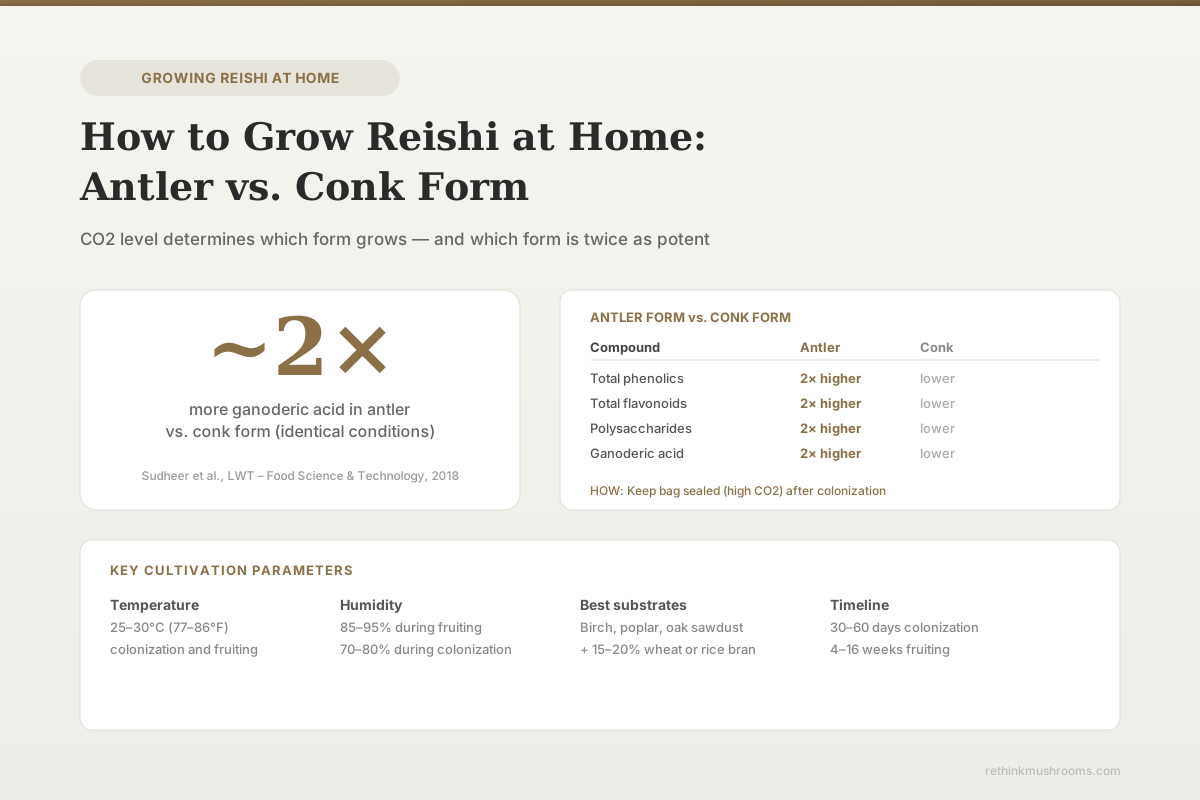
~2× more ganoderic acid in antler vs. conk form
Sudheer and colleagues measured phenolics, flavonoids, polysaccharides, and ganoderic acid in antler and conk reishi grown under identical conditions. Every metric was approximately double in the antler form. CO2 level during fruiting is the lever that controls which form develops.
Sudheer et al., Fungal Biology, 2018
25–30°C
optimal temperature range for reishi fruiting; a 2024 comprehensive review confirmed these parameters and noted hardwood substrates consistently produce the best fruiting body quality
Birch or poplar
substrate wood species that produced the highest yield and significant β-glucan variation by strain interaction in controlled reishi cultivation trials
Pileus > stipes
cap tissue contains significantly more ganoderic acid than stem tissue in fully mature reishi, making cap-focused harvest the higher-potency option
Sudheer et al., Fungal Biology, 2018
 View as image ↗
When most guides describe growing reishi at home, they treat the antler-vs-conk choice as a question of appearance or novelty. The research says it is a question of potency. Antler-form reishi, produced by maintaining high CO2 levels during fruiting, contains approximately twice the phenolic compounds, flavonoids, water-soluble polysaccharides, and ganoderic acid of conk-form reishi grown under otherwise identical conditions.[1]
This is not a minor variation. The ganoderic acids and polysaccharides that drive reishi's research interest are the same compounds appearing at twice the concentration in the antler form. For anyone growing reishi specifically for its medicinal properties, understanding this distinction changes the cultivation decision entirely.
This article covers the full cultivation path: the CO2 mechanism behind form selection, substrate choice for maximum β-glucan content, growing parameters, and harvest timing for peak ganoderic acid accumulation. For mushroom cultivation fundamentals, see how to grow mushrooms at home: a complete beginner's guide.
Key Takeaways
- Antler-form reishi contains approximately twice the phenolics, flavonoids, water-soluble polysaccharides, and ganoderic acid of conk-form reishi grown under identical conditions; the choice between forms is a potency decision, not an aesthetic one (Sudheer et al., Fungal Biology, 2018)
- CO2 level is the primary morphological determinant: high CO2 (sealed or minimally ventilated bag) produces antler form; reduced CO2 via fresh air exchange triggers pileus expansion and conk form; once antlers establish, form cannot be reversed
- Optimal reishi fruiting parameters are 25–30°C (77–86°F), 80–95% relative humidity, and pH 4.5–6; a 2024 comprehensive review confirmed these ranges and noted hardwood sawdust consistently outperforms softwood for fruiting body quality (Thakur et al., World J Microbiol Biotechnol, 2024)
- Substrate wood species affects both yield and β-glucan content independently: birch (Betula spp.) and poplar (Populus tremula) produced the highest yields in controlled trials, with β-glucan content varying significantly by strain-substrate interaction (Cortina-Escribano et al., Molecules, 2020)
- Ganoderic acids A and D peak at the mature fruiting stage; B, C2, and G peak earlier at the bud-elongation stage; pileus (cap) contains significantly more ganoderic acid than stipe (stem) tissue across all stages (Ren et al., IJMM, 2020)
- Antler form yields lower fresh weight than conk form from the same substrate block; the tradeoff is compound concentration per gram versus total harvest volume
The Form Choice Is a Potency Decision
Reishi (Ganoderma lucidum) grows in two distinct morphological forms depending on CO2 concentration in its environment:
Antler form (also called rack or deer antler reishi): elongated, branching projections that develop when CO2 stays high. The mushroom cannot expand into its normal cap shape, so it grows vertically in horn-like extensions.
Conk form (also called kidney or shelf form): the classic fan-shaped, lacquered cap that develops when fresh air exchange reduces CO2 and allows normal pileus expansion.
Most cultivation guides frame this as an either/or choice based on grower preference or bag technique. Sudheer and colleagues published a direct comparison in 2018 that changes how to frame this decision.[1] The researchers grew both forms under otherwise identical conditions and measured key bioactive markers in the harvested tissue.
| Bioactive Compound | Antler Form vs. Conk Form |
|---|---|
| Total phenolics | ~2-fold higher in antler |
| Total flavonoids | ~2-fold higher in antler |
| Water-soluble polysaccharides | ~2-fold higher in antler |
| Ganoderic acid | ~2-fold higher in antler |
The pattern was consistent across every measured parameter. The enrichment appears to result from CO2-induced restriction of cap expansion: the same metabolic carbon that would normally be distributed across a large, flat cap is concentrated in the narrower antler tissue, producing higher compound concentrations per gram.
Same Grow, Twice the Actives
Antler vs. Conk: Bioactive Content Compared
Under identical controlled conditions, antler-form reishi carried roughly a two-fold increase in every measured compound class. Bars are indexed to conk form (baseline = 1×); the ≈ 2× magnitude is what the study reports.
The trade-off the bars do not show: antler form yields less fresh-weight material per flush. Growers choosing antler are optimizing for concentration per gram, not total volume.
Source: Sudheer et al. (2018), Fungal Biology (RTHM-01011). All four compound classes showed a reported two-fold increase in antler vs. conk form; the shared ≈ 2× index reflects that single finding and does not imply per-class precision.
For a deeper look at the CO2 mechanism and how to control form deliberately, see growing reishi antlers and conks: manipulating CO2 for different forms.
How CO2 Controls Which Form Develops
CO2 is the primary morphological switch in reishi cultivation. Here is how it works in practice.
High CO2 conditions, roughly above 0.1% by volume, suppress the signaling pathways that trigger pileus expansion. The mushroom cannot form its normal flat cap. Instead, it produces elongated stipe tissue that grows vertically, creating the branching antler structures. This CO2 level is reached naturally inside a sealed grow bag where the mushroom consumes oxygen and exhales CO2.
Low CO2 conditions, achieved by opening the bag, adding a filter patch, or providing regular fresh air exchange (FAE), allow normal fruiting body development. The mushroom forms a flattened pileus and grows into the classic conk shape.
The form decision is irreversible in one direction. Once antler extensions have developed, increasing fresh air exchange will not convert them into conks. The antler portions will continue to elongate. If CO2 is reduced after antlers form, the tips may begin capping off, producing stubby extensions rather than smooth antlers, but the growth pattern cannot produce a true conk at that stage. Growers who want pure conk form should start fresh air exchange early, before the mushroom produces stipe tissue.
A 2024 comprehensive review of Ganoderma cultivation by Thakur and colleagues confirmed CO2 management as a primary cultivation variable alongside temperature and humidity in determining fruiting body morphology and quality.[2]
For the full technique on cultivating the antler form deliberately, see reishi antler cultivation: growing the beautiful horn-shaped form.
Substrate: Which Wood Produces the Best Results
Reishi is a wood-decaying species, and its bioactive production is tied to hardwood chemistry. The Thakur 2024 review confirmed that hardwood sawdust substrates consistently produce better fruiting body quality than softwood for reishi, with well-performing formulations built on oak, beech, birch, or poplar sawdust supplemented with wheat bran or rice bran at 15–20%.[2]
Cortina-Escribano and colleagues tested multiple wood species and reishi strains specifically for yield and β-glucan content.[3] Birch (Betula spp.) and poplar (Populus tremula) substrates produced the highest yields, with the best results coming from specific strain-substrate pairings (the top-yielding combination in the trial was the MUS192 strain grown on poplar). β-glucan content varied significantly by the interaction between strain and substrate, meaning both the reishi strain and the substrate wood species matter for final compound content. Choosing a high-β-glucan strain on a suboptimal substrate does not guarantee high β-glucan output.
Practical substrate formulation based on the research:
- Primary wood: hardwood sawdust (oak, beech, birch, or poplar) at 75–80% of total substrate weight
- Supplement: wheat bran or rice bran at 15–20%, providing the nitrogen the colonizing mycelium needs
- pH: adjusted to 5.5–6.0 before sterilization
- Moisture: 60–65% field capacity before sterilization
- Softwood (pine, spruce, cedar): avoid, as resinous compounds slow or inhibit colonization
Mixed hardwood sawdust pellets sold for pellet grills are a convenient home option that performs well for this species. For wood type comparisons and substrate selection decisions, see wood-based vs. grain-based substrates for mushroom growing and mushroom substrate guide: hardwood, straw, sawdust, and supplemented formulas.
Growing Parameters and Timeline
Reishi is slower than most home cultivation species and has narrower optimal ranges than oyster or shiitake. Based on the Thakur 2024 review synthesis of cultivation data:[2]
Colonization phase:
- Temperature: 25–30°C (77–86°F), with 28°C optimal for most strains
- Humidity: 70–80% relative humidity
- Duration: 30–60 days for full colonization of a 1–2 kg hardwood block
- CO2: high CO2 is tolerated and normal during colonization; do not open bags prematurely
Fruiting phase:
- Temperature: 25–30°C maintained; fluctuations below 22°C or above 33°C reduce fruiting success
- Humidity: 85–95% relative humidity required to prevent desiccation of developing primordia
- CO2: high for antler form (keep bag sealed or minimally vented); reduced for conk form
- Light: indirect light on a 12-hour cycle; reishi uses light as a directional cue but does not require high intensity
- Duration: antler form develops over 4–8 weeks; conk form can take 8–16 weeks to reach full cap expansion
The longer timeline relative to oyster or lion's mane means contamination pressure is higher. Substrate sterilization (15 PSI for 2.5 hours minimum) is more critical for reishi than for faster-fruiting species. Pasteurization alone is not sufficient. For substrate preparation details, see how to prepare mushroom substrate: sterilization and pasteurization.
For a comprehensive breakdown of all reishi-specific cultivation parameters, see reishi growing conditions: what this mushroom needs. For a complete beginner walkthrough from setup to harvest, see your first mushroom grow: step-by-step for beginners.
When to Harvest: The Stage When Ganoderic Acids Peak
Different ganoderic acids reach peak concentration at different developmental stages. Harvest timing therefore affects which specific compounds are most concentrated in the final product.
Ren and colleagues measured ganoderic acid profiles across multiple growth stages in reishi and found that the optimal harvest point depends on which compounds the grower is targeting.[4]
Ganoderic acids A and D peak at the mature fruiting body stage, when the white growth margin at the cap edge has stopped advancing and spore production is beginning. Ganoderic acids B, C2, and G peak earlier, at the bud-elongation stage, before full cap expansion. For home growers who want maximum total ganoderic acid content, harvesting at full maturity (just before or at the start of heavy spore production) captures peak levels of A and D while retaining reasonable concentrations of the earlier-peaking acids.
The Ren study also confirmed that pileus (cap) tissue contains significantly more ganoderic acid than stipe (stem) tissue across all growth stages. Harvesting with the cap intact and prioritizing cap tissue for tea, tincture, or powder produces more bioactive material per gram than using the whole mushroom including stem.
The practical harvest cue: the white, actively growing margin at the outer edge of the cap will stop advancing when growth is complete. Spore production, visible as a fine rusty-brown dust on surfaces beneath the mushroom, signals peak maturity. Research does not show a sharp compound cliff at spore production, but harvesting at this stage captures the highest measured ganoderic acid levels.
For the full harvest timing and drying guide, including how different drying methods affect ganoderic acid and polysaccharide retention, see harvesting and drying reishi at home.
The Honest Tradeoff: Antler Form Yields Less Fresh Weight
Choosing antler form over conk form has one real cost: lower fresh weight per substrate block. Conk form distributes growth across a broad, flat cap with significant tissue volume, producing more total mushroom mass per kg of substrate. Antler form concentrates growth in narrow elongated structures, resulting in less total fresh weight from the same block.
For growers whose primary goal is medicinal compound content per gram of dried product, the lower yield is not a problem. The higher compound concentration in antler form means less material is needed to achieve the same compound intake per dose. For growers who want to maximize total quantity of dried reishi from a batch, conk form produces more product per block.
Neither form is superior in all contexts. The goal determines the choice. For research on what ganoderic acids do at relevant concentrations in biological studies, see ganoderic acids from reishi: a complete guide and ganoderic acid A, B, and beyond: individual compound research.
The Bottom Line
Antler-form reishi contains approximately twice the phenolics, flavonoids, polysaccharides, and ganoderic acid of conk-form reishi grown under identical conditions, based on direct measurement by Sudheer and colleagues (2018). CO2 level during fruiting determines which form develops: sealed bags produce antler form, ventilated bags produce conk form, and the form decision is irreversible once antler growth establishes. Birch and poplar substrates produced the highest yields with significant β-glucan variation by strain-substrate interaction (Cortina-Escribano et al., 2020). Optimal parameters are 25–30°C, 85–95% humidity, hardwood substrate at pH 5.5–6. Ganoderic acids A and D peak at full maturity; cap tissue contains more ganoderic acid than stem tissue across all stages (Ren et al., 2020).
Frequently Asked Questions
Sources & References
- 1RTHM-01011·Sudheer, Surya et al. (2018). “Development of antler-type fruiting bodies of Ganoderma lucidum and determination of its biochemical properties..” Fungal biology.Study breakdown →PubMed →↩
- 2RTHM-02005·Thakur, Pratibha et al. (2024). “Exploring Ganoderma lucidum: morphology, cultivation and market potential..” World journal of microbiology & biotechnology.Study breakdown →PubMed →↩
- 3RTHM-01183·Cortina-Escribano, Marta et al. (2020). “Effect of Strain, Wood Substrate and Cold Treatment on the Yield and β-Glucan Content of Ganoderma lucidum Fruiting Bodies..” Molecules (Basel.Study breakdown →PubMed →↩
- 4RTHM-01281·Ren, Xujiao et al. (2020). “Comparative Studies on Bioactive Compounds, Ganoderic Acid Biosynthesis, and Antioxidant Activity of Pileus and Stipes of Lingzhi or Reishi Medicinal Mushroom, Ganoderma lucidum (Agaricomycetes) Fruiting Body at Different Growth Stages..” International journal of medicinal mushrooms.Study breakdown →PubMed →↩