Mushroom Supplement Dosing & Dose-Response
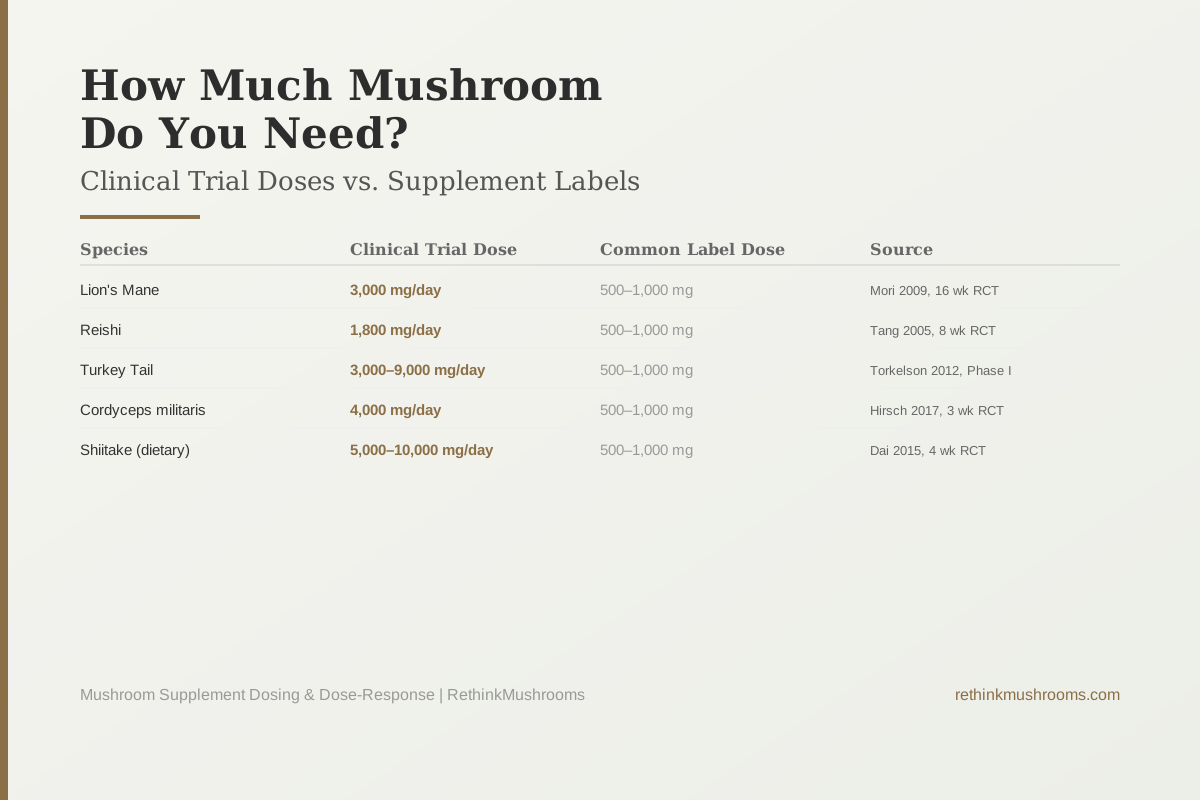
9g/day Turkey Tail upper clinical dose
A Phase I trial escalated turkey tail dosing from 3g to 9g per day in breast cancer patients with no dose-limiting toxicity at any level. Most turkey tail supplements recommend 500mg–1g. That gap is worth understanding.
Torkelson et al., ISRN Oncology, 2012
3g/day
lion's mane dose in the Mori 2009 RCT showing cognitive improvement in MCI patients over 16 weeks
1.8g/day
reishi polysaccharide dose (Ganopoly) that improved fatigue and quality of life in the Tang 2005 RCT
5-10g/day
dried shiitake intake that improved immune markers in healthy young adults over 4 weeks (Dai 2015)
Torkelson et al., ISRN Oncology, 2012
 View as image ↗
Most mushroom supplement labels recommend 500mg to 1,000mg per day. Most clinical trials that find measurable effects in humans use 1.8g to 9g per day, depending on the species and the outcome being studied. That gap between what supplements recommend and what clinical research uses is the starting point for understanding mushroom dosing.
The gap exists for several reasons: bioavailability is poor for large polysaccharides, different mushroom species have different bioactive profiles that require different amounts, and clinical trial doses are calibrated to produce detectable changes in specific outcomes. A systematic review of randomized controlled trials on fungal beta-glucans found that dose ranges vary substantially across mushroom types, with effects appearing to be both dose-dependent and outcome-dependent.[2]
This article maps what clinical trials actually use, species by species, and what outcomes those doses were associated with. For the pharmacology behind why bioavailability affects these numbers, see Mushroom Extraction Methods Explained: Hot Water, Alcohol, and Dual.
Key Takeaways
- Clinical trial doses for medicinal mushrooms are typically 1.8-9g/day, substantially higher than the 500mg-1g most supplement labels recommend
- The landmark Mori 2009 lion's mane RCT used 3g/day; the Tang 2005 reishi RCT used 1.8g/day; the Hirsch 2017 Cordyceps exercise RCT used 4g/day
- A 2012 Phase I turkey tail study escalated doses from 3g to 9g/day in breast cancer patients with no dose-limiting toxicity, establishing an unusually wide safety range
- Dietary mushroom intake can also produce measurable effects: a 2015 RCT found that eating 5-10g dried shiitake daily improved immune parameters in healthy adults over 4 weeks
- A 2023 review of 39 clinical studies on mushroom supplements in cancer care found quality of life improved in 14 of 39 studies, with adverse events mostly low-grade
- The research on dose-response in mushrooms is more complex than a simple "more is better" relationship, with some studies showing unexpected outcomes at particular doses, a pattern explored in the companion articles in this cluster
Why Mushroom Doses Are Higher Than You Might Expect
Before presenting the dose data, it helps to understand why mushroom doses measured in grams are consistent with pharmacological logic.
The primary bioactive compounds in most medicinal mushrooms are beta-glucans, large polysaccharide molecules (chains of sugars) that stimulate immune activity by binding to receptors on immune cells in the gut wall. "Large" is the key word: these molecules are too big to be meaningfully absorbed into systemic circulation intact. They work primarily by interacting with immune receptors in the digestive tract. This means a substantial amount of the ingested dose is needed at the gut interface to produce a measurable systemic response, which is part of why clinical doses are in grams rather than milligrams.
This is also why extraction method matters significantly for dose calculations. A hot-water extract that concentrates beta-glucans is not the same as an equal weight of dried whole mushroom powder. And a grain-grown mycelium product that contains significant starch residue delivers less actual bioactive compound per gram than a fruiting body extract. When clinical trial doses are referenced, the form used in the trial matters for interpreting what those numbers mean in practice.
For the full picture on how extraction affects compound density per gram, see Beta-Glucan Bioavailability: Can Your Gut Actually Absorb Them?.
The Clinical Trial Dose Table
The following table summarizes doses used in published human trials for major medicinal mushroom species.
| Species | Dose Used | Study Type | Primary Finding | Study |
|---|---|---|---|---|
| Lion's mane | 3g/day | RCT (16 weeks) | Cognitive improvement in MCI patients | Mori et al., 2009 |
| Reishi (Ganopoly) | 1.8g/day | RCT (8 weeks) | Improved fatigue and quality of life | Tang et al., 2005 |
| Turkey tail | 3-9g/day | Phase I escalation | No dose-limiting toxicity; improved immune parameters | Torkelson et al., 2012 |
| Agaricus blazei | 1.8-5.4g/day | Phase I escalation | Safe at all doses over 6 months | Ohno et al., 2011 |
| Cordyceps sinensis | 3g/day | RCT (202 patients) | Improved kidney function in renal transplant | Zhang et al., 2009 |
| Cordyceps militaris | 4g/day | RCT (3 weeks) | VO2 max improved +4.8 ml/kg/min | Hirsch et al., 2017 |
| Shiitake (dietary) | 5-10g/day dried | RCT (4 weeks) | Improved T-cell response, reduced inflammatory cytokines | Dai et al., 2015 |
| AHCC (shiitake extract) | Escalating | Phase I safety | Safety and tolerability established | Spierings et al., 2007 |
Sources: Mori 2009,[1] Tang 2005,[8] Torkelson 2012,[3] Ohno 2011,[4] Zhang 2009,[7] Hirsch 2017,[6] Dai 2015.[5]
Lion's Mane: The Most-Studied Cognitive Mushroom
The 3g/day dose from the Mori 2009 RCT is the most-cited dose figure in lion's mane supplement discussions, and for good reason. Mori and colleagues gave 3g/day of dried lion's mane fruiting body powder to 30 MCI patients for 16 weeks and found significant improvement in cognitive function scores versus placebo at every measurement point.[1] Improvement declined after stopping supplementation, which implies ongoing dosing is required for sustained effect.
The more recent 2025 RCT by Surendran and colleagues tested a standardized lion's mane extract in healthy younger adults and did not find significant improvement in cognitive performance or mood compared to placebo.[11] This is a null result in a different population (healthy young adults versus MCI patients in their 50s-80s) at a different dose and form. It does not contradict the Mori 2009 findings, but it does underscore that dose, form, and population context all interact to determine outcomes.
This complexity in the lion's mane data is explored in more depth at Mushroom Dose-Response Curves: Why More Isn't Always Better.
Turkey Tail's Wide Dose Range
The Torkelson 2012 Phase I trial is one of the more instructive dose-escalation studies in the medicinal mushroom literature.[3] The trial enrolled women with breast cancer following conventional treatment (surgery, radiation, chemotherapy) and escalated turkey tail (Trametes versicolor) polysaccharide extract doses from 3g per day through 6g and up to 9g per day. No dose-limiting toxicity was observed at any level, and immune parameters showed improvement across doses.
The practical implication is that turkey tail appears to have an unusually wide therapeutic window by the standards of bioactive compounds. Most pharmaceutical agents and many botanical supplements show toxic effects or declining benefit at doses several times the minimum effective dose. Turkey tail at 9g/day, three times the lowest dose tested, was well-tolerated.
A broader 2023 review examining 39 clinical studies of mushroom supplements in cancer care found that adverse events across all mushroom species studied were mostly grade 2 or lower, and quality of life outcomes improved in 14 of the 39 studies reviewed.[9] The cancer care context involves patients who may be simultaneously managing chemotherapy side effects, which makes the safety record across these studies more meaningful than it would be in a healthy volunteer population.
Cordyceps: Dose Data From Athletes and Clinical Patients
Cordyceps has been studied across two distinct populations with different dose contexts: athletes interested in performance and clinical patients managing specific conditions.
In the athletic performance literature, Hirsch and colleagues tested 4g/day of Cordyceps militaris mushroom blend in 28 participants for 3 weeks and found statistically significant improvements in time to exhaustion (+69.8 seconds), VO2 max (+4.8 ml/kg/min), and ventilatory threshold (+0.7 L/min) compared to placebo.[6] The 4g/day dose is consistently used across Cordyceps exercise studies.
The 2025 meta-analysis by Yang and colleagues synthesized fungal supplementation data specifically in adult athletes, covering Cordyceps alongside other species, and represents the most current synthesis of athletic performance dosing data available.[10]
In clinical patient populations, the Zhang 2009 RCT used 3g/day Cordyceps sinensis as an adjunct to standard immunosuppressive therapy in 202 renal transplant patients, finding reduced cyclosporine dose requirements and improved kidney function markers.[7] The large sample size (202 patients) makes this one of the more statistically robust Cordyceps clinical trials.
Reishi: Lower Dose, Specific Extract
The Tang 2005 reishi RCT used a specific polysaccharide extract called Ganopoly at 1.8g/day for 8 weeks and found significant improvement in fatigue scores and quality of life measures compared to placebo in patients with neurasthenia (a condition characterized by persistent fatigue and weakness).[8]
The 1.8g/day dose is lower than lion's mane or Cordyceps clinical doses, but the form matters: Ganopoly is a concentrated polysaccharide extract, not dried whole mushroom powder. The bioactive density per gram of a concentrated extract is substantially higher than the same weight of dried whole mushroom. This is why cross-species dose comparisons require attention to the form being compared, not just the weight.
The Wicks 2007 safety trial of Ganoderma lucidum in healthy subjects confirmed acceptable safety and tolerability at study doses, with normal liver enzymes, blood counts, and kidney function across the treatment period.
Maitake: A Case Study in Dose Complexity
The maitake data from Deng and colleagues illustrates why dose-response relationships in mushrooms are not always simple linear progressions.[12] In a Phase I/II dose-escalation trial of maitake polysaccharide extract in breast cancer patients, immune markers responded to the compound in dose-dependent ways, but the direction of the response was not the same for all immune markers at all doses. Some immune parameters moved one direction at lower doses and the opposite direction at higher doses.
This bidirectional pattern in a clinical trial is relevant because it suggests that for some mushroom compounds and some outcomes, the optimal dose is not the highest dose. This is a concept examined in more detail at More Isn't Always Better: The Biphasic Dose-Response in Mushrooms.
Dietary Shiitake: When Food Produces Clinical Results
Not all effective mushroom dosing requires supplements. Dai and colleagues conducted a rigorous dietary intervention study in 52 healthy young adults, having them consume 5-10g of dried shiitake mushrooms daily for 4 weeks.[5] T-cell proliferation and secretory IgA (a marker of mucosal immune function) improved significantly, while inflammatory cytokines decreased.
Dried shiitake at 5-10g per day is a dietary quantity, not a supplement dose. It represents approximately 75-150g of fresh shiitake per day. This study is notable because it shows that regular food-based consumption of mushrooms at quantities achievable through cooking can produce measurable immune changes. Eating shiitake in meals is not equivalent to doing nothing.
The distinction between dietary benefit from food and clinical outcome from therapeutic-dose supplements is explored in Therapeutic vs. Dietary Doses of Medicinal Mushrooms. For the related question of timing, see How Long Before You Feel Mushroom Supplement Effects?.
What a 500mg Capsule Actually Represents
Most commercial mushroom supplements are sold in 500mg capsules, and most labels recommend 1-2 capsules per day, giving 500mg-1,000mg of mushroom content daily.
The lion's mane clinical trial dose of 3g/day is equivalent to six 500mg capsules per day. The turkey tail upper dose of 9g/day is equivalent to eighteen 500mg capsules. Most commercial products are being sold at doses 3-18 times lower than what the clinical trial evidence was generated at.
This observation has limits: not everyone's goal requires the same dose, and supplement-grade extracts may concentrate bioactives relative to whole mushroom powder. A 500mg extract with documented 30% beta-glucan content delivers 150mg of beta-glucans, which may be more clinically relevant than 500mg of whole mushroom powder with 5% beta-glucan content delivering 25mg.
The underlying point is that comparing mushroom supplement doses requires knowing the form (whole powder vs. extract), the beta-glucan percentage of the product, and what clinical trial the target dose is based on. These numbers are not standardized across the industry, which is part of why dosing guidance is difficult to state as simple milligram amounts.
For a comparison of what different supplement forms deliver per dose, see Fruiting Body vs. Mycelium on Grain: The Debate That Defines Mushroom Supplement Quality. For the full clinical dose reference table, see Optimal Dosing for Medicinal Mushrooms: What Clinical Trials Use.
The Bottom Line
Clinical trial doses for major medicinal mushrooms are consistently higher than commercial supplement labels suggest: lion's mane 3g/day (Mori 2009), reishi 1.8g/day (Tang 2005), turkey tail 3-9g/day (Torkelson 2012), Cordyceps 3-4g/day (Zhang 2009; Hirsch 2017), and shiitake 5-10g/day as food (Dai 2015). The gap between 500mg-1g label doses and these clinical doses reflects both bioavailability constraints and the specific outcomes each trial was designed to measure. Dose-response relationships in mushrooms are not always linear: the maitake Phase I/II data showed bidirectional immune effects at different doses, and lion's mane data across different studies shows population and dose interaction effects. The companion articles in this cluster examine both the biphasic mechanisms and the species-specific data in more depth.
Frequently Asked Questions
Sources & References
- 1RTHM-00165·Mori, Koichiro et al. (2009). “Improving effects of the mushroom Yamabushitake (Hericium erinaceus) on mild cognitive impairment: a double-blind placebo-controlled clinical trial..” Phytotherapy research : PTR.Study breakdown →PubMed →↩
- 2. Source details for this reference are not yet available.
- 3RTHM-00267·Torkelson, Carolyn J et al. (2012). “Phase 1 Clinical Trial of Trametes versicolor in Women with Breast Cancer..” ISRN oncology.Study breakdown →PubMed →↩
- 4RTHM-00229·Ohno, Satoshi et al. (2011). “Phase I Clinical Study of the Dietary Supplement, Agaricus blazei Murill, in Cancer Patients in Remission..” Evidence-based complementary and alternative medicine : eCAM.Study breakdown →PubMed →↩
- 5RTHM-00368·Dai, Xiaoshuang et al. (2015). “Consuming Lentinula edodes (Shiitake) Mushrooms Daily Improves Human Immunity: A Randomized Dietary Intervention in Healthy Young Adults..” Journal of the American College of Nutrition.Study breakdown →PubMed →↩
- 6. Source details for this reference are not yet available.
- 7. Source details for this reference are not yet available.
- 8RTHM-00088·Tang, Wenbo et al. (2005). “A randomized, double-blind and placebo-controlled study of a Ganoderma lucidum polysaccharide extract in neurasthenia..” Journal of medicinal food.Study breakdown →PubMed →↩
- 9. Source details for this reference are not yet available.
- 10. Source details for this reference are not yet available.
- 11. Source details for this reference are not yet available.
- 12RTHM-00289·Deng, Gary et al. (2009). “A phase I/II trial of a polysaccharide extract from Grifola frondosa (Maitake mushroom) in breast cancer patients: immunological effects..” Journal of cancer research and clinical oncology.Study breakdown →PubMed →↩