Mushroom Supplement Dosing
3g/day lion's mane improved MCI cognition; 1.8g/day worsened recall
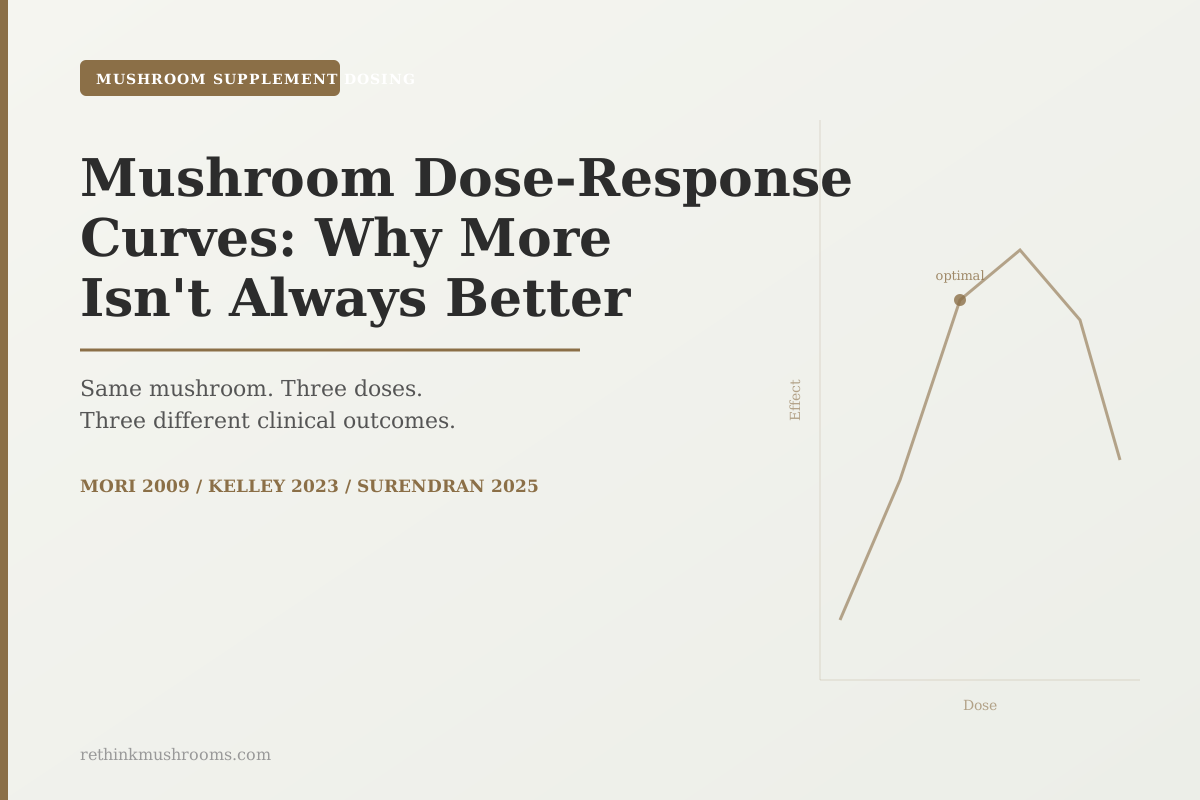
At 3g per day, lion's mane improved cognitive function in adults with early cognitive decline. At 1.8g per day in healthy young adults, 28 days of the same mushroom produced fewer words recalled than placebo. Same species, different dose, different population, opposite result.
Mori et al., Phytotherapy Research, 2009 / Kelley et al., Nutrients, 2023
+4.8 ml/kg/min
VO2 max improvement from 4g/day Cordyceps militaris in Hirsch 2017 RCT (28 adults, 3 weeks)
9g/day
maximum dose tested for turkey tail in Torkelson Phase I trial; no dose-limiting toxicity found
Biphasic
Auricularia bone extract showed opposite effects at low vs high doses in Lee 2024: first direct mushroom biphasic data
Mori et al., Phytotherapy Research, 2009 / Kelley et al., Nutrients, 2023
 View as image ↗
The standard assumption in supplement marketing is that more is better. More milligrams, more potency. But a consistent pattern in medicinal mushroom research challenges this assumption, and in one case the clinical trial data shows something more striking: a lower dose producing worse outcomes than placebo. Understanding mushroom supplement dose-response curves (how the size of an effect changes as dose changes) is essential for interpreting what the research actually says about any product that claims to replicate clinical trial benefits. This article is part of a broader look at mushroom extraction methods and what the pharmacology of these compounds actually involves.
Key Takeaways
- At 3g/day lion's mane for 16 weeks, adults with mild cognitive impairment showed significant cognitive improvement vs placebo (Mori et al., 2009)
- At 1.8g/day lion's mane for 28 days, healthy young adults showed FEWER words recalled than placebo, a negative chronic result at a lower dose (Kelley et al., 2023)
- A 2025 acute-dose RCT of standardized lion's mane extract found no significant overall improvement in cognition or mood in healthy younger adults (Surendran et al., 2025)
- A 2024 study of wood ear mushroom extract found biphasic bone effects: low doses promoted bone building, high doses showed the opposite (Lee et al., 2024)
- Cordyceps militaris at 4g/day for 3 weeks improved VO2 max by 4.8 ml/kg/min and time to exhaustion by 69.8 seconds in a 28-person RCT (Hirsch et al., 2017)
- Turkey tail was escalated from 3g to 9g/day in a Phase I trial with no dose-limiting toxicity, establishing a wide safety range but not identifying an optimal efficacy dose (Torkelson et al., 2012)
The Lion's Mane Paradox: Three Studies, One Mushroom, Three Different Outcomes
Lion's mane mushroom (Hericium erinaceus) has been studied in more human trials for cognitive effects than most medicinal mushrooms. The results, when placed side by side, illustrate the dose-response problem directly.
Study one: Mori and colleagues gave 30 adults aged 50 to 80, all with mild cognitive impairment (a level of memory decline greater than typical aging but not severe enough to cause major daily problems), 3 grams per day of dried lion's mane fruiting body powder for 16 weeks.[1] The lion's mane group showed significantly higher scores on cognitive function tests than the placebo group. When supplementation stopped, the scores returned toward baseline within four weeks, suggesting the effect was real but dependent on continued intake.
Study two: Kelley and colleagues ran a 28-day parallel-group trial giving 41 healthy adults aged 18 to 45 either 1.8 grams per day of lion's mane or placebo.[2] Participants given a single acute dose before cognitive testing showed faster reaction times on the Stroop color-word test at 60 minutes (a statistically significant result). But the group taking lion's mane chronically for 28 days recalled significantly fewer words correctly compared to placebo. The negative finding on delayed word recall was statistically significant at p less than 0.001.
Study three: Surendran and colleagues conducted a placebo-controlled RCT of a standardized lion's mane extract in healthy younger adults, looking for acute effects on cognition and mood.[3] The trial did not find a significant overall improvement in cognitive performance or mood compared to placebo.
Three studies. The same mushroom species. Three different outcomes: benefit in cognitively impaired older adults at 3g, mixed results with a negative chronic finding in healthy young adults at 1.8g, and null in healthy young adults acutely.
The variables that differ: dose (3g vs. 1.8g), population (cognitively impaired vs. healthy), and exposure duration (16 weeks vs. 28 days vs. acute). Any of these could explain the divergent results, and the current data doesn't isolate which factor matters most. The honest interpretation is that lion's mane does not have a simple dose-response story, and that "more is better" does not apply cleanly.
The animal dose-gradient data adds one more layer. Lu and colleagues tested lion's mane mycelium at 100, 200, and 400 mg per kilogram of body weight per day in mice and found dose-dependent effects on a neurotransmitter pathway associated with mood.[10] Translating mouse doses to human equivalents is imprecise, but 100 mg/kg in mice corresponds roughly to 8 mg/kg in humans by standard allometric scaling, or approximately 560 mg for a 70 kg adult. The dose-gradient existed in the animal model, but the direction of that gradient and whether it holds in humans is untested.
The Auricularia Finding: Direct Evidence of a Biphasic Mushroom Response
A dose-response curve that goes up and then comes back down, or even reverses, is called a biphasic response. It appears in pharmacology across many compound classes: stimulants, hormones, immune modulators. For medicinal mushrooms, direct experimental evidence of this pattern was published in 2024.
Lee and colleagues tested wood ear mushroom extract (Auricularia auricula-judae) on two types of bone cells: those that build bone and those that break it down.[4] At low concentrations, the extract promoted the activity of bone-building cells and inhibited the activity of bone-breakdown cells, a favorable profile for bone health. At higher concentrations, the extract showed the opposite pattern on at least one of those cell types.
This is the first direct experimental demonstration of a biphasic dose-response in a medicinal mushroom extract using isolated cell models. It wasn't in a living animal, and it was specific to Auricularia and bone biology. But it provides a biological proof of concept that mushroom extracts can produce different or opposing effects depending on concentration, not just different magnitudes of the same effect.
The mechanism in this case involves receptors on bone cells responding differently to the mushroom compounds depending on how saturated those receptors become. A similar logic applies to immune cells and beta-glucan receptors more broadly: at low concentrations, the receptor binding pattern activates one cascade of cell signaling; at concentrations that flood available receptor sites, the signaling pattern can shift.
For a deeper look at why bioavailability affects how much of any dose actually reaches the relevant receptors, how well your body absorbs beta-glucans from oral supplements covers the absorption question directly.
Cordyceps: When the Dose Data Points More Cleanly in One Direction
Not all mushrooms show the same complexity. For Cordyceps militaris and physical performance, the clinical trial data presents a cleaner picture within the studied dose range.
Hirsch and colleagues randomized 28 people to either 4 grams per day of a Cordyceps militaris mushroom blend or placebo for three weeks.[5] The Cordyceps group improved on three performance measures: VO2 max (the maximum amount of oxygen the body can use during intense exercise, a standard measure of aerobic fitness) increased by 4.8 milliliters per kilogram per minute, time to exhaustion increased by 69.8 seconds, and the ventilatory threshold (the point at which breathing rate increases rapidly during exercise) improved by 0.7 liters per minute. These were statistically significant differences from placebo.
Shin and colleagues published a 2024 randomized controlled trial of a Cordyceps militaris beverage in healthy adults and found measurable effects on immune response at the dose tested.[6] Pre-clinical dose-response work in animal models similarly found dose-dependent anti-fatigue effects, where higher doses of Cordyceps polysaccharides produced greater reductions in fatigue markers.[7]
The Cordyceps picture is not without null results in other contexts, but for the specific outcome of aerobic performance at the specific dose of 4g/day for three weeks, the clinical data shows a direction. This is in contrast to lion's mane, where the outcome depends significantly on who is taking it and for how long.
The difference likely reflects that Cordyceps' primary mechanism for performance (increasing cellular energy production via adenosine pathways) is more uniformly relevant across healthy populations than lion's mane's neurotrophin stimulation, which appears more relevant in populations with existing neurological vulnerability.
Turkey Tail and Agaricus: What Phase I Escalation Data Shows About the Safety Ceiling
Phase I clinical trials are safety studies. They establish tolerability and identify a maximum dose before conducting efficacy trials. For medicinal mushrooms, the Phase I data establishes the upper end of the safe dosing range.
Torkelson and colleagues conducted a Phase I dose escalation study of Trametes versicolor (turkey tail mushroom) in breast cancer patients following chemotherapy and radiation.[8] They escalated from 3 grams per day to 6 grams to 9 grams. No dose-limiting toxicity was observed at any level, up to and including 9 grams per day. Immune parameters improved at all doses, but the study was not designed to identify the optimal immune dose within that range.
Ohno and colleagues conducted a Phase I trial of Agaricus blazei Murill in cancer patients in remission, testing doses of 1.8g, 3.6g, and 5.4g per day for six months.[9] Safety was established at all three doses. The Phase I context means this data establishes that the body tolerates these amounts, not that these amounts are the most effective.
For readers interested in how these clinical trial doses compare to what typical supplements provide and what "therapeutic dose" means in practice, what clinical trials actually use for medicinal mushroom dosing compiles the full cross-species trial data. And for the related question of whether food-based mushroom consumption can substitute for supplements at dietary doses, therapeutic vs. dietary doses of medicinal mushrooms addresses that distinction directly.
Reading the Dose-Response Table: What the Data Actually Says
The pattern across species is clearest when organized by what was actually measured.
| Species | Dose | Duration | Population | Outcome |
|---|---|---|---|---|
| Lion's mane | 3g/day | 16 weeks | Adults with MCI, 50–80 yrs | Cognitive function improved vs placebo |
| Lion's mane | 1.8g/day | 28 days | Healthy adults, 18–45 yrs | Recall worse vs placebo; acute reaction time faster |
| Lion's mane (standardized extract) | Not disclosed | Acute | Healthy younger adults | No significant cognitive change vs placebo |
| Cordyceps militaris | 4g/day | 3 weeks | Healthy adults | VO2 max +4.8, time to exhaustion +70 sec |
| Turkey tail | 3–9g/day | N/A | Breast cancer patients | No dose-limiting toxicity; immune markers improved |
| Agaricus blazei | 1.8–5.4g/day | 6 months | Cancer patients in remission | Safety established at all doses |
| Auricularia (wood ear) | Low vs high | N/A | In vitro bone cells | Low: bone-building favored; high: opposite pattern |
The table illustrates three distinct patterns. For some mushrooms and outcomes (Cordyceps performance), increasing dose within the studied range produces increasing benefit. For others (lion's mane cognition), the outcome depends more on population characteristics than dose alone. For at least one species at the cellular level (Auricularia bone biology), the direction of effect reverses at higher concentrations.
No current study has tested whether the lion's mane dose that benefits cognitively impaired older adults would produce the same negative recall result that appeared in healthy young adults. The underlying question is whether the cognitive system's response to lion's mane depends on baseline state: stimulating neurotrophin production in a depleted system may be beneficial, while the same stimulus in a system that isn't deficient may interfere with existing neural patterns. This is a hypothesis consistent with the data, not a proven mechanism.
What This Means for Evaluating Supplement Labels
The clinical trial doses in these studies (1.8g to 9g per day, depending on species) are typically well above what supplement labels recommend. Most consumer mushroom supplements suggest 500mg to 1g per day.
Two things can be true simultaneously. First, clinical trial doses are the most studied context and the most direct basis for any efficacy claim. A product claiming to deliver the benefits from Mori 2009 but providing 500mg instead of 3g is making an unstated dose assumption. Second, lower doses might have effects that haven't been studied. Absence of evidence at lower doses is not evidence of absence.
What the dose-response data does not support is the assumption that doubling or tripling a dose produces proportionally greater benefits. For Cordyceps performance, the data shows benefit at 4g but we don't know if 8g would show double the benefit or diminishing returns. For lion's mane cognition in healthy adults, the data at 1.8g chronic suggests that more may not be better at all for this population.
The extraction method used in any given product also affects what a stated dose actually delivers. A 500mg serving of a concentrated dual-extract product represents more active compound than a 500mg serving of raw mycelium powder. For context on how extraction method translates to compound availability in a dose, how extraction methods determine what you're actually getting from a mushroom supplement covers that relationship specifically.
For the question of how bioavailability affects the effective dose reaching your cells after oral consumption, beta-glucan absorption from mushroom supplements explains why oral doses are always larger than effective systemic doses. For sibling articles in this cluster on related dosing questions, how much mushroom you need based on dose-response research covers the evidence across more species, and the biphasic dose-response in mushrooms addresses the mechanism behind the non-linear patterns documented here.
The Bottom Line
The clinical trial data for medicinal mushrooms does not support a simple "more is better" dose-response pattern. Lion's mane produced cognitive benefits at 3g/day in cognitively impaired older adults, negative recall outcomes at 1.8g/day in healthy young adults, and null results in acute healthy adult testing: three different outcomes at three different conditions. Cordyceps shows a cleaner dose-dependent performance benefit within the 4g/day range studied. Wood ear mushroom showed directly opposite effects on bone cells at low versus high concentrations in vitro, providing the first direct biphasic dose-response data for a medicinal mushroom extract. The honest conclusion is that effective dosing for medicinal mushrooms is species-specific, outcome-specific, and population-specific.
Frequently Asked Questions
Sources & References
- 1RTHM-00165·Mori, Koichiro et al. (2009). “Improving effects of the mushroom Yamabushitake (Hericium erinaceus) on mild cognitive impairment: a double-blind placebo-controlled clinical trial..” Phytotherapy research : PTR.Study breakdown →PubMed →↩
- 2. Source details for this reference are not yet available.
- 3. Source details for this reference are not yet available.
- 4. Source details for this reference are not yet available.
- 5. Source details for this reference are not yet available.
- 6. Source details for this reference are not yet available.
- 7. Source details for this reference are not yet available.
- 8RTHM-00267·Torkelson, Carolyn J et al. (2012). “Phase 1 Clinical Trial of Trametes versicolor in Women with Breast Cancer..” ISRN oncology.Study breakdown →PubMed →↩
- 9RTHM-00229·Ohno, Satoshi et al. (2011). “Phase I Clinical Study of the Dietary Supplement, Agaricus blazei Murill, in Cancer Patients in Remission..” Evidence-based complementary and alternative medicine : eCAM.Study breakdown →PubMed →↩
- 10. Source details for this reference are not yet available.