Dosing Research
9g/day
The maximum dose used in a Phase I clinical trial of turkey tail mushroom (Trametes versicolor), escalated from 3g/day in breast cancer patients with no dose-limiting toxicity reported at any level.
Torkelson et al., ISRN Oncology, 2012
15 studies
synthesized in this reference, spanning 6 major species
1.8g to 9g
range of clinical trial doses documented across species
2-10x gap
typical difference between clinical trial doses and supplement label doses
Torkelson et al., ISRN Oncology, 2012
 View as image ↗
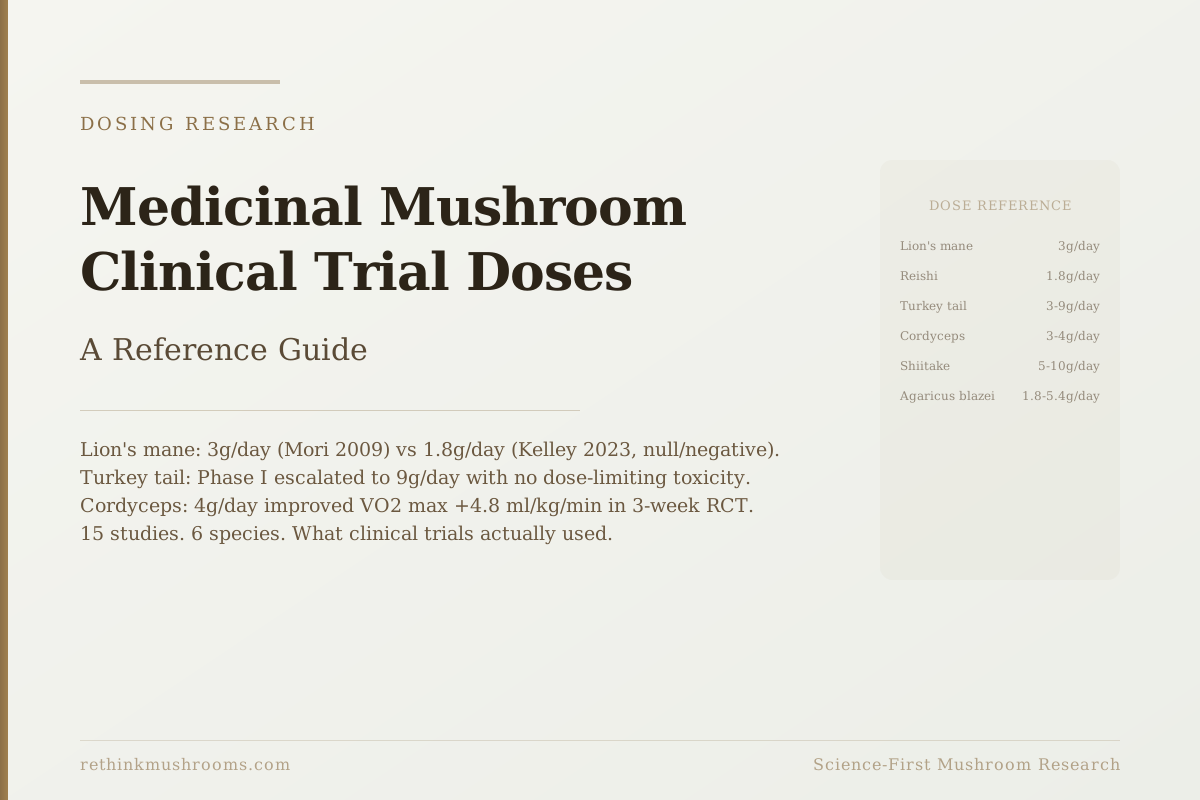
The doses used in medicinal mushroom clinical trials are almost never the same as the doses printed on supplement labels. A lion's mane RCT that showed cognitive improvement in mild cognitive impairment used 3g per day of dried fruiting body powder for 16 weeks. A reishi RCT that reduced fatigue used 1.8g per day of polysaccharide extract for 8 weeks. A turkey tail Phase I dose escalation went from 3g per day up to 9g per day. If you're taking a 500mg capsule and wondering whether it will replicate what those studies found, the medicinal mushroom clinical trial dose data says: not at a 500mg dose. This article compiles what 15 clinical trials across 6 major species actually used, so supplement labels can be evaluated against the primary evidence.
For context on how extraction method affects what's in a dose, the pillar article mushroom extraction methods explained: hot water, alcohol, and dual covers that pharmacology foundation.
Key Takeaways
- Lion's mane: 3g/day dried fruiting body for 16 weeks improved cognitive function in MCI patients (Mori 2009), but 1.8g/day for 28 days in healthy young adults produced only an acute improvement in processing speed and null-to-negative chronic cognitive results (Docherty 2023); population and dose interact clearly[1][2]
- Reishi: 1.8g/day Ganoderma polysaccharide extract for 8 weeks significantly improved fatigue and quality of life in a double-blind RCT; most commercial reishi supplements are dosed well below this level[10]
- Turkey tail: Phase I escalation from 3g to 9g/day in breast cancer patients found no dose-limiting toxicity at any level; doses in standard supplements (typically 500-1000mg) are far below this range[4]
- Cordyceps: 4g/day Cordyceps militaris for 3 weeks improved VO2 max by 4.8 ml/kg/min and time to exhaustion by 69.8 seconds vs placebo in a 28-participant exercise RCT[8]
- Shiitake: dietary doses of 5-10g dried mushroom daily (no supplement required) produced measurable immune improvements in healthy young adults over 4 weeks in a 52-participant RCT[15]
- A 2023 systematic review of 39 clinical mushroom studies found quality of life improved in 14/39 studies; adverse events were mostly grade 2 or lower across 12 different mushroom preparations[12]
Why Supplement Labels Don't Match Clinical Trial Doses
There is a consistent gap between the doses researchers use in clinical trials and the doses that appear on supplement labels. This gap has practical consequences for anyone trying to evaluate whether a mushroom supplement is likely to produce the effects described in published research.
The gap exists for several reasons. Clinical trials use doses selected to produce measurable effects, often derived from Phase I safety studies that establish tolerability at escalating doses. Supplement labels are set by manufacturers who balance cost, palatability, capsule count, and competitive positioning. A capsule costing $1 that delivers 500mg is easier to sell than a product requiring six capsules delivering 3g.
A 2021 systematic review by Vlassopoulou and colleagues covering 34 fungal beta-glucan RCTs across human health outcomes documented the dose ranges actually used in well-designed human trials, from 2.5 to 1000 mg of isolated beta-glucan daily for up to 6.5 months.[13] A 2023 systematic review by Narayanan and colleagues examining 39 clinical studies on mushroom supplements in cancer care identified 12 different mushroom preparations and found quality of life improved in 14 of those 39 studies; adverse events were mostly grade 2 or lower.[12] Clinical trial safety data supports the tolerability of doses far exceeding what most supplements deliver.
The specific species data below comes from the primary clinical studies. Where a species has a Phase I dose escalation study, that trial defines the established safety boundary. Where an RCT achieved a specific outcome, that dose is the one benchmarked in the research record.
For context on how supplement form (fruiting body vs mycelium on grain) affects how much active compound a given dose delivers, fruiting body vs. mycelium on grain: the supplement quality debate covers that directly.
Lion's Mane: Three Doses, Three Different Outcomes
No species demonstrates the dose complexity of medicinal mushrooms more clearly than Hericium erinaceus (lion's mane). The research record includes three distinct human trials, three different doses, and three different outcomes.
3g/day, 16 weeks, MCI patients (Mori 2009)
Mori and colleagues tested 3g/day of dried lion's mane fruiting body powder in 30 adults aged 50-80 with mild cognitive impairment (MCI) in a double-blind placebo-controlled RCT.[1] Cognitive function scores improved significantly vs placebo. Critically, the improvements reversed four weeks after discontinuation, suggesting the effect requires continued supplementation. This is the most-cited lion's mane study, and the 3g dose is the one on which the evidence for cognitive benefit is based.
1.8g/day, 28 days, healthy young adults (Docherty 2023)
Docherty and colleagues tested 1.8g/day of lion's mane in 41 healthy adults aged 18-45 in a double-blind, placebo-controlled, parallel-groups pilot RCT.[2] Acutely (a single dose), participants performed faster on the Stroop task at 60 minutes post-dose (p=0.005). Chronically, after 28 days of supplementation, the trial reported null and limited negative cognitive findings, with only a non-significant trend toward reduced subjective stress (p=0.051). This is a null-to-negative chronic result at a dose (1.8g) that is actually higher than most commercial supplements provide.
Why the discrepancy? Mori 2009 used MCI patients (brain function already impaired), a higher dose (3g vs 1.8g), and a longer duration (16 weeks vs 4 weeks). Docherty 2023 used healthy young adults with normal cognitive function at a lower dose for a shorter period. Population, dose, and duration all appear to interact.
Acute standardized extract, healthy young adults (Surendran 2025)
Surendran and colleagues tested acute consumption of a standardized lion's mane extract in healthy younger adults in a double-blind placebo-controlled RCT.[3] There was no significant overall improvement in cognitive performance or mood vs placebo. This is a null result from the most recent (2025) lion's mane human trial.
The pattern: lion's mane shows cognitive benefits in impaired populations at therapeutic doses (3g/day, 16 weeks). It does not show those benefits consistently in healthy adults at lower doses or shorter durations. Population and dose context are not interchangeable.
For a closer look at how lion's mane affects serotonin and dopamine pathways, how lion's mane affects serotonin and dopamine pathways covers the neurotransmitter evidence.
Reishi: 1.8g Per Day Was the Effective Dose
Tang and colleagues conducted a double-blind, randomized, placebo-controlled study of Ganoderma lucidum polysaccharide extract (branded as Ganopoly) at 1.8g per day for 8 weeks in patients with neurasthenia, a condition characterized by persistent fatigue, sleep disturbance, and reduced quality of life.[10]
At 1.8g/day of the polysaccharide extract, fatigue scores and quality of life significantly improved vs placebo. This is one of the few reishi trials establishing a specific effective dose for a measurable outcome.
The important context: this was a polysaccharide extract at 1.8g/day, not 1.8g of dried reishi fruiting body. Extracts concentrate the active compounds; a typical dried fruiting body powder at the same weight would contain substantially less polysaccharide. This is the translation problem that affects all mushroom dosing comparisons between supplement forms.
Wicks and colleagues conducted a double-blind controlled study of the safety and tolerability of Ganoderma lucidum extract (2g twice daily for 10 days) in 16 healthy volunteers; complete blood counts, blood chemistry, and urinalysis showed no adverse effects versus placebo, supporting tolerability in the gram-per-day extract range.[16]
Turkey Tail: Phase I Escalation to 9g Per Day
Turkey tail (Trametes versicolor, also known as Coriolus versicolor) has the highest documented clinical trial dose of any major medicinal mushroom species, established through a formal Phase I dose escalation study.
Torkelson and colleagues conducted a Phase I clinical trial of Trametes versicolor in women with breast cancer after chemotherapy and radiation.[4] They escalated doses from 3g per day through 6g per day to 9g per day. At each escalation, immune parameters were assessed and safety was monitored. No dose-limiting toxicity was found at any level up to 9g per day. Immune parameters improved.
This Phase I design is the gold standard for establishing a safe maximum dose. The finding that 9g per day produced no dose-limiting toxicity in cancer patients (a more vulnerable population than healthy adults) establishes a high safety ceiling for turkey tail polysaccharides.
Commercial turkey tail supplements typically provide 500mg to 2g per day. Even the starting dose in the Torkelson Phase I study (3g/day) is above what most supplements deliver.
The PSK (polysaccharide-K from Trametes versicolor) literature from Japan, covered in the Narayanan 2023 cancer supplement systematic review, reports survival benefits in the adjuvant gastric-cancer setting; PSK is used at approximately 3g per day as the standard therapeutic dose in oncology contexts.[12]
For the full turkey tail gut microbiota evidence, how turkey tail changes your gut microbiome covers the prebiotic research.
Cordyceps: 4g Per Day for Athletes, 3g Per Day in Clinical Contexts
Cordyceps has been studied in two distinct clinical populations with different dose contexts: healthy athletes seeking exercise performance and clinical patients with organ dysfunction.
Cordyceps militaris in exercise: 4g/day (Hirsch 2017)
Hirsch and colleagues randomized 28 participants to 4g/day of a Cordyceps militaris mushroom blend or placebo for 3 weeks, with exercise testing before and after.[8] The Cordyceps group improved time to exhaustion by 69.8 seconds and VO2 max by 4.8 ml/kg/min vs placebo. Ventilatory threshold increased by 0.7 L/min. These are meaningful improvements in cardiovascular performance parameters.
A 2025 systematic review and meta-analysis by Shu and colleagues synthesized the evidence on fungal supplementation in adult athletes, spanning endurance, immune function, and hematological profiles.[14] This is the most recent synthesis of the athletic performance data, and the 4g/day Hirsch dose is representative of the range used in the Cordyceps exercise trials it covers.
Cordyceps sinensis in clinical contexts: 3g/day (Li 2009)
Li and colleagues assigned 202 renal transplant patients to receive Cordyceps sinensis at 3g per day (1.0g three times daily) as an adjunct to standard immunosuppressive therapy.[9] Cyclosporine dose requirements were reduced and kidney function markers improved. This is the largest Cordyceps sinensis RCT with clinical endpoints, and 3g per day is the established dose in transplant medicine.
Ontawong and colleagues' 2024 randomized controlled trial tested a Cordyceps militaris beverage on immune response in healthy adults, reporting immune-modulating effects at clinically relevant doses with a safety profile consistent with earlier trials.[7]
Shiitake, Agaricus, and AHCC: Supporting Species Dose Data
Shiitake: dietary doses that work (Dai 2015)
Dai and colleagues randomized 52 healthy young adults to eat either 5g or 10g of dried shiitake mushrooms daily for 4 weeks (equivalent to roughly 75-150g fresh).[15] After 4 weeks, both dose groups showed significantly improved T cell proliferation, secretory IgA (a mucosal immune marker), and reduced inflammatory cytokines vs baseline. This is notable for what it is: a whole-food dietary dose, not a supplement extract, producing measurable immune changes. You don't need an extract to get immune benefits from shiitake; a daily dietary serving achieves measurable effects.
Agaricus blazei Murill: Phase I from 1.8g to 5.4g/day (Ohno 2011)
Ohno and colleagues conducted a Phase I dose escalation study of Agaricus blazei Murill (ABM) in cancer patients in remission, testing three dose levels: 1.8g, 3.6g, and 5.4g per day orally for 6 months.[5] Safety was established at all three doses. This Phase I defines the studied dose range for ABM in an oncology context.
AHCC (Lentinula edodes extract): Phase I safety in healthy adults (Spierings 2007)
Spierings and colleagues conducted a Phase I dose escalation safety study of AHCC (active hexose correlated compound, an alpha-glucan-rich extract from Lentinula edodes cultivation substrate) in healthy volunteers.[6] Safety and dose tolerance were established at the studied range. AHCC products at 3g/day are the most commonly used dose in clinical trials.
Maitake: bidirectional immune effects at different doses (Deng 2009)
A Phase I/II dose escalation study of maitake (Grifola frondosa) polysaccharide extract in breast cancer patients by Deng and colleagues found something unusual: immune effects were dose-dependent but showed unexpected bidirectional patterns depending on which immune marker was measured and which dose was used.[11] This non-linearity is a warning sign that more is not always better, and it is directly relevant to the dosing question.
What the Clinical Trial Data Means for Supplement Buyers
The data from 15 studies across 6 species points to several consistent patterns.
Clinical trial doses are typically 2-10x higher than supplement labels. Most commercial mushroom supplements deliver 500mg-1g per day. Most clinical trials showing measurable effects used 1.8g-9g per day. The exceptions are shiitake dietary studies (where fresh mushroom consumption achieves benefits) and specific extract concentrations where the active compound content per gram is much higher than a dried whole mushroom.
Dose and population interact. Lion's mane 3g/day in MCI patients showed cognitive benefit. Lion's mane 1.8g/day in healthy young adults showed a negative chronic word recall effect. These results are not contradictory. They reflect that different populations may respond differently to the same compound class at different doses. Applying MCI clinical trial data to healthy supplementers is not straightforward.
Phase I data establishes safety ceilings, not optimal doses. Turkey tail at 9g/day was safe; that does not mean 9g/day is better than 3g/day for a given outcome. Safety studies establish that a dose is tolerated; efficacy studies establish whether it works. Both types of data are needed to calibrate dosing decisions.
Extraction method and form matter for dose equivalency. 1.8g of polysaccharide extract (Tang 2005 reishi study) is not comparable to 1.8g of dried fruiting body powder. Extracts concentrate the active polysaccharides; the equivalent fruiting body dose would be substantially higher.
For more on how bioavailability affects the actual systemic dose from an oral supplement, beta-glucan bioavailability: can your gut actually absorb them? covers that pharmacology. For context on how long before clinical effects appear, how long before you feel mushroom supplement effects? covers the timing evidence.
The other articles in this cluster cover the dose-response relationships in more depth: how much mushroom do you need? dose-response research, more isn't always better: the biphasic dose-response, and therapeutic vs. dietary doses of medicinal mushrooms.
The Bottom Line
Clinical trial doses for medicinal mushrooms range from 1.8g per day (reishi, Agaricus Phase I) to 9g per day (turkey tail Phase I maximum). Lion's mane studies used 1.8-3g per day with different outcomes depending on population (MCI vs healthy adults) and duration. Cordyceps exercise trials used 4g per day; clinical Cordyceps sinensis trials used 3g per day. Shiitake showed immune benefits at dietary amounts (5-10g dried daily). Across species, commercial supplement doses of 500mg-1g are typically 2-10x below what clinical trials used to demonstrate measurable effects.
Frequently Asked Questions
Sources & References
- 1RTHM-00165·Mori, Koichiro et al. (2009). “Improving effects of the mushroom Yamabushitake (Hericium erinaceus) on mild cognitive impairment: a double-blind placebo-controlled clinical trial..” Phytotherapy research : PTR.Study breakdown →PubMed →↩
- 2RTHM-00821·Docherty, Sarah et al. (2023). “The Acute and Chronic Effects of Lion's Mane Mushroom Supplementation on Cognitive Function, Stress and Mood in Young Adults: A Double-Blind, Parallel Groups, Pilot Study..” Nutrients.Study breakdown →PubMed →↩
- 3RTHM-00952·Surendran, Geyan et al. (2025). “Acute effects of a standardised extract of Hericium erinaceus (Lion's Mane mushroom) on cognition and mood in healthy younger adults: a double-blind randomised placebo-controlled study..” Frontiers in nutrition.Study breakdown →PubMed →↩
- 4RTHM-00267·Torkelson, Carolyn J et al. (2012). “Phase 1 Clinical Trial of Trametes versicolor in Women with Breast Cancer..” ISRN oncology.Study breakdown →PubMed →↩
- 5RTHM-00229·Ohno, Satoshi et al. (2011). “Phase I Clinical Study of the Dietary Supplement, Agaricus blazei Murill, in Cancer Patients in Remission..” Evidence-based complementary and alternative medicine : eCAM.Study breakdown →PubMed →↩
- 6RTHM-00231·Spierings, Egilius L H et al. (2007). “A Phase I study of the safety of the nutritional supplement, active hexose correlated compound, AHCC, in healthy volunteers..” Journal of nutritional science and vitaminology.Study breakdown →PubMed →↩
- 7RTHM-00899·Ontawong, Atcharaporn et al. (2024). “A randomized controlled clinical trial examining the effects of Cordyceps militaris beverage on the immune response in healthy adults..” Scientific reports.Study breakdown →PubMed →↩
- 8RTHM-00473·Hirsch, Katie R et al. (2017). “Cordyceps militaris Improves Tolerance to High-Intensity Exercise After Acute and Chronic Supplementation..” Journal of dietary supplements.Study breakdown →PubMed →↩
- 9RTHM-00161·Li, Y et al. (2009). “Clinical application of Cordyceps sinensis on immunosuppressive therapy in renal transplantation..” Transplantation proceedings.Study breakdown →PubMed →↩
- 10RTHM-00088·Tang, Wenbo et al. (2005). “A randomized, double-blind and placebo-controlled study of a Ganoderma lucidum polysaccharide extract in neurasthenia..” Journal of medicinal food.Study breakdown →PubMed →↩
- 11RTHM-00289·Deng, Gary et al. (2009). “A phase I/II trial of a polysaccharide extract from Grifola frondosa (Maitake mushroom) in breast cancer patients: immunological effects..” Journal of cancer research and clinical oncology.Study breakdown →PubMed →↩
- 12RTHM-01760·Narayanan, Santhosshi et al. (2023). “Medicinal Mushroom Supplements in Cancer: A Systematic Review of Clinical Studies..” Current oncology reports.Study breakdown →PubMed →↩
- 13RTHM-01451·Vlassopoulou, Marigoula et al. (2021). “Effects of fungal beta-glucans on health - a systematic review of randomized controlled trials..” Food & function.Study breakdown →PubMed →↩
- 14RTHM-00951·Shu, Meng-Yuan et al. (2025). “Effects of fungal supplementation on endurance, immune function, and hematological profiles in adult athletes: a systematic review and meta-analysis..” Frontiers in nutrition.Study breakdown →PubMed →↩
- 15RTHM-00368·Dai, Xiaoshuang et al. (2015). “Consuming Lentinula edodes (Shiitake) Mushrooms Daily Improves Human Immunity: A Randomized Dietary Intervention in Healthy Young Adults..” Journal of the American College of Nutrition.Study breakdown →PubMed →↩
- 16RTHM-00123·Wicks, Sheila M et al. (2007). “Safety and tolerability of Ganoderma lucidum in healthy subjects: a double-blind randomized placebo-controlled trial..” The American journal of Chinese medicine.Study breakdown →PubMed →↩