Mushroom Supplement Dosing
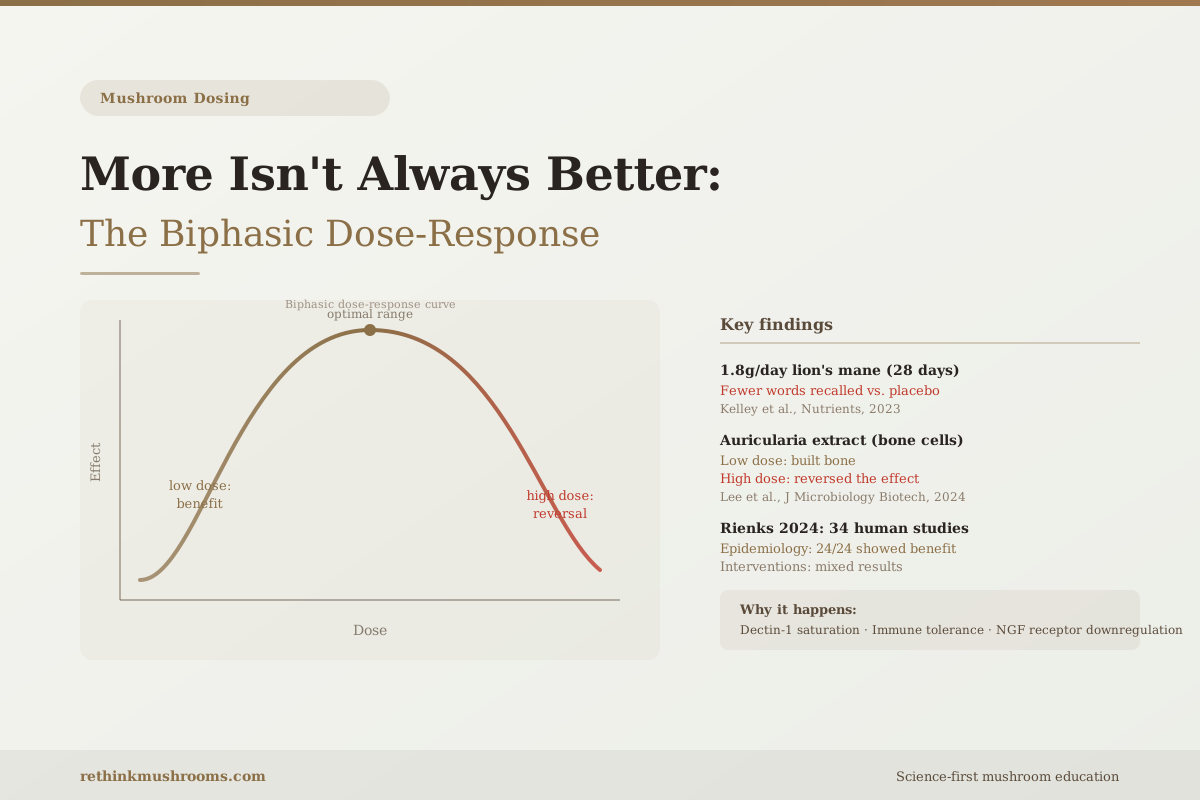
1.8g/day
In a 2023 RCT, 1.8g/day of lion's mane for 28 days caused fewer words recalled than placebo in healthy young adults. A single acute dose of the same amount improved reaction time. Same supplement, opposite outcomes depending on duration.
Kelley et al., Nutrients, 2023
Biphasic
activity documented in mushroom extract: low doses built bone, high doses reversed that effect in bone cells (Lee 2024)
24 vs 10
epidemiological studies showing consistent benefit vs intervention studies showing mixed results, a gap the biphasic pattern helps explain (Rienks 2024)
Dectin-1
the beta-glucan immune receptor that saturates with excess stimulation, triggering tolerance rather than activation
Kelley et al., Nutrients, 2023
 View as image ↗
A biphasic dose-response is when a compound produces one biological effect at low doses and a meaningfully different effect at higher doses. In medicinal mushrooms, this pattern has been documented experimentally: the same extract from wood ear mushroom promoted bone formation in bone cells at lower concentrations and inhibited that same process at higher concentrations. The same biphasic pattern appears across immune and neurological pathways, and it has a practical consequence for anyone taking mushroom supplements over weeks or months.
This is not a fringe theoretical concern or a hypothetical extrapolation from pharmacology textbooks. A 2023 double-blind RCT in healthy young adults found that 28 days of lion's mane supplementation produced worse word recall than placebo, at a dose that is commonly sold in commercial products. A 2024 in vitro study documented the concentration-dependent direction reversal in mushroom extract directly. The gap between what epidemiological studies find and what intervention trials find is, in part, explained by this phenomenon.
For the foundation on what extraction methods determine about compound concentration in a given dose, see mushroom extraction methods explained. This article focuses on the biphasic dose-response specifically: the evidence, the mechanisms, and what it means for interpreting the mushroom supplement research.
Key Takeaways
- Lee et al. (2024) documented biphasic dose-response in Auricularia (wood ear mushroom) extract on bone cells: low doses promoted bone formation, high doses inhibited the same process
- Kelley et al. (2023) found 1.8g/day lion's mane for 28 days produced significantly fewer words recalled than placebo, while an acute single dose improved Stroop reaction time at 60 minutes
- Surendran et al. (2025) found no significant cognitive or mood improvement from standardized lion's mane extract versus placebo in healthy young adults, consistent with a population-by-dose interaction
- Lu et al. (2018) documented dose-dependent antidepressant effects in animals given lion's mane at 100, 200, and 400mg/kg, providing a dose-gradient picture within the ascending part of the curve
- Deng et al. (2009) found that maitake polysaccharide extract produced bidirectional immune effects at different doses in the same clinical trial, with specific immune markers reversing direction as dose increased
- Rienks et al. (2024) found 24 epidemiological studies showed consistent mushroom-cognition benefit while 10 intervention studies showed mixed results, a pattern consistent with dose-context mismatch
The 2024 Evidence: Wood Ear Mushroom Did the Opposite at High Doses
The clearest direct experimental evidence of biphasic dose-response in a medicinal mushroom extract appeared in a 2024 paper by Lee et al., examining wood ear mushroom, also known as Auricularia auricula-judae.[1]
Lee's team studied the extract's effects on bone cells in the laboratory. Bone tissue maintains itself through a balance between two competing processes: osteogenesis, which builds new bone, and osteoclastogenesis, which breaks down existing bone. Whether bone grows stronger or weaker depends on which side of this balance is winning at any given time.
At lower concentrations of Auricularia extract, the balance shifted toward osteogenesis. The extract promoted bone-building activity. At higher concentrations of the same extract, the direction reversed. Osteogenic activity was inhibited, and the balance shifted toward bone breakdown.
The same compound. The same biological system. Two opposite outcomes depending on the amount.[1]
This study's significance extends beyond bone health. What it demonstrates is the general principle that mushroom compounds can produce inverted dose-response curves in biological tissue: not just diminishing returns as dose increases, but genuine reversal. This behavior follows from receptor biology, which operates through saturation and negative feedback rather than through simple additive effects.
The Human Clinical Parallel: Lion's Mane at 1.8g/Day Produced Worse Memory Than Placebo
The Auricularia bone data is from cells outside a living body. The clinical question is whether this same pattern appears in humans taking real supplement doses over weeks.
Kelley et al. published a 2023 double-blind RCT examining lion's mane supplementation in 41 healthy young adults.[2] Participants received either 1.8g/day of lion's mane mushroom supplement or placebo for 28 days.
The primary chronic supplementation result was negative: participants who took lion's mane for 28 days recalled significantly fewer words than placebo participants (p less than 0.001). Chronic supplementation at this dose produced a measurably worse memory outcome.
The study also tested an acute single-dose condition. A single dose of the same supplement improved Stroop task reaction time at 60 minutes post-ingestion.[2]
Acute dose: improved processing speed. Chronic dose at the same amount, daily for 28 days: impaired word recall. Two time horizons, two different directions from the same compound.
Surendran et al. published a 2025 double-blind RCT examining standardized lion's mane extract for acute cognitive and mood effects in healthy younger adults.[3] No significant overall improvement in cognitive performance or mood appeared versus placebo. The younger, healthier population showed no benefit from standardized acute dosing.
These findings connect: clinical trials in older adults with mild cognitive impairment, using 3g/day for 16 weeks, have found positive cognitive outcomes. The healthy, younger populations in Kelley and Surendran's trials, receiving lower doses, showed null or negative results on cognitive measures. Dose, population, and duration all interact to determine where on the dose-response curve a particular study lands.
For an overview of what doses clinical trials have actually used across all major mushroom species, see optimal dosing for medicinal mushrooms: what clinical trials use.
The Animal Dose-Gradient: Three Doses, Three Outcomes
Animal studies allow something human RCTs usually cannot: testing multiple doses in parallel under controlled conditions, to map the shape of the dose-response curve directly.
Lu et al. conducted this experiment for lion's mane mycelium in 2018.[4] Animals received lion's mane mycelium at 100, 200, or 400mg/kg body weight per day for four weeks. Effects were measured through a pathway involving BDNF, a protein that supports the growth and maintenance of neurons, and is central to lion's mane's neurological mechanism.
Dose-dependent antidepressant effects were found across the three doses: higher doses within this range produced stronger antidepressant outcomes. At these concentrations, the dose-response was ascending.
The key question the study cannot answer is where the curve turns. Based on receptor biology and the clinical data from Kelley 2023, it does not continue upward indefinitely. At some point, the NGF-receptor system that mediates lion's mane's neurological effects downregulates in response to sustained stimulation, and the net effect plateaus or reverses.
For dose-response data tables comparing outcomes across species and dose levels side by side, see mushroom dose-response curves: why more isn't always better.
The Biphasic Immune Mechanism: When the Beta-Glucan Receptor Gets Overwhelmed
For mushrooms whose primary bioactive compounds are beta-glucans, the biphasic pattern follows from immune receptor biology.
Beta-glucans activate immune cells primarily by binding to a receptor called Dectin-1. Think of Dectin-1 as the cellular scanner that recognizes fungal compounds and triggers an immune response. Like all biological receptors, Dectin-1 operates within a range. Low-to-moderate stimulation produces calibrated immune activation. Sustained high-dose stimulation triggers a compensation response.
When the Dectin-1 receptor is persistently and heavily activated, the immune system deploys regulatory T-cells to suppress the response, and receptor density decreases. The system adapts to the persistent signal by reducing its sensitivity to that signal. The net result, continued high-dose stimulation producing less immune activation, and eventually a shift toward immune tolerance rather than immune activation, is the mechanism underlying the biphasic immune response.
Deng et al. documented a real-world correlate in a Phase I/II clinical trial of maitake polysaccharide extract in breast cancer patients.[5] The trial was designed to escalate dose and monitor immune response. The results showed bidirectional effects: specific immune markers showed one direction of change at lower doses and the opposite direction at higher doses. The same extract, the same patient population, but the direction of the immune response for certain markers reversed as dose increased.
Islam et al.'s 2021 systematic review of randomized controlled trials on fungal beta-glucans across health outcomes documented dose-dependent effects on immune parameters, with dose-response relationships that were non-linear across different markers and populations.[6]
Shetty et al.'s 2021 systematic review of clinical trials using fungal beta-glucans as cancer adjuvants noted that clinical therapeutic doses are often substantially higher than standard supplement doses, and that immune response patterns do not scale simply with dose elevation.[7]
An important piece of context: the amount of beta-glucan that actually reaches the immune system from an oral supplement depends heavily on gut absorption and bioavailability, not just the label dose. For that layer of the story, see beta-glucan bioavailability: can your gut actually absorb them.
The Neurological Mechanism: NGF Stimulation Has a Ceiling
For lion's mane specifically, the biphasic pattern follows a different mechanism: the NGF-stimulation pathway has built-in receptor feedback.
Lion's mane contains hericenones and erinacines, which stimulate the production of NGF, a protein that promotes neuron growth and the maintenance of existing neural connections. The cognitive benefits attributed to lion's mane in animal studies and some human trials are linked to this NGF-stimulating mechanism.
NGF works through receptors on neuron surfaces. When NGF binds to these receptors, it triggers cascades that support neuron health. But receptor systems include negative feedback: sustained, heavy stimulation triggers receptor downregulation. The cell reduces the number of available receptor sites, making the system less sensitive to further NGF stimulation.
This is why chronic daily use of neurologically active compounds often shows diminishing returns over time. An initial dose activates fully-available, responsive receptors and produces clear cognitive effects. Sustained daily dosing, particularly at higher amounts, triggers downregulation. By week four, the receptor landscape has changed. The Kelley 2023 result, where 28 days of 1.8g/day produced worse memory than placebo, is consistent with receptor downregulation reaching a clinically meaningful threshold by that timepoint.
The animal dose-gradient from Lu et al. shows antidepressant effects scaling upward through three dose levels, consistent with ascending dose-response in the dose range tested. What the animal data cannot tell us is where the curve turns. The human clinical data from Kelley suggests the curve turns somewhere in the range that includes chronic 1.8g/day in healthy young adults.
Whether the curve-turning point is earlier in younger, healthy populations than in older populations with cognitive impairment, whether 3g/day in a 16-week study crosses a different threshold, and how extraction method affects effective compound concentration per dose gram all remain open questions. How extraction method changes what's in a given dose is covered in dual extraction: why it matters for full-spectrum mushroom products.
What 34 Studies Show About Why Epidemiology and Interventions Disagree
The biphasic pattern helps explain a puzzle that runs through the mushroom research literature.
Rienks et al. conducted a systematic review in 2024 examining 34 human studies on mushrooms and neurocognitive and mood outcomes across the lifespan.[8]
The epidemiological studies, 24 of them, showed consistent benefit. People who consumed more mushrooms performed better cognitively or reported better mood outcomes compared to those who ate fewer. The pattern was reliable across studies.
The intervention studies, 10 of them, showed mixed results. Some showed benefit. Some showed no effect.
One interpretation: people who eat mushrooms habitually consume them in moderate dietary amounts as part of a varied diet, often spread across meals over years. The intervention studies typically administered concentrated extracts at fixed doses for defined periods. Those fixed doses, chosen before the biphasic pattern was well-documented, may in some cases push into the portion of the dose-response curve where effects plateau or reverse.
Epidemiological mushroom consumption typically means eating 50-100g fresh weight per meal, a few times per week. A 3g/day concentrated extract taken daily is a different pharmacological exposure: higher dose, more concentrated compounds, and no off-days. Whether that difference explains the epidemiological-intervention gap is not confirmed by the current evidence, but the pattern is consistent with it.
For how dietary mushroom doses compare to supplement doses used in trials, see therapeutic vs. dietary doses of medicinal mushrooms. For the general dose-response picture across species, see how much mushroom do you need?.
The Bottom Line
The biphasic dose-response in medicinal mushrooms, where low doses produce one effect and higher doses produce a different or opposite effect, has moved from theoretical to documented. Lee et al.'s 2024 in vitro study showed Auricularia extract promoting bone formation at low concentrations and inhibiting it at high ones. Kelley et al.'s 2023 RCT found 1.8g/day lion's mane for 28 days produced worse word recall than placebo in healthy young adults, while a single acute dose improved reaction time. Two mechanisms drive this pattern: Dectin-1 receptor saturation triggers immune tolerance at high beta-glucan doses, and NGF receptor downregulation reduces the neurological signal from sustained lion's mane stimulation. Rienks et al.'s 2024 review of 34 human studies found epidemiological data consistently positive and intervention trial data mixed, a gap consistent with dose-context mismatch. The current evidence does not establish clear safe upper-dose thresholds for individual species, but it establishes that the dose-response curve for mushroom supplements is not linear.
Frequently Asked Questions
Sources & References
- 1. Source details for this reference are not yet available.
- 2. Source details for this reference are not yet available.
- 3. Source details for this reference are not yet available.
- 4. Source details for this reference are not yet available.
- 5RTHM-00289·Deng, Gary et al. (2009). “A phase I/II trial of a polysaccharide extract from Grifola frondosa (Maitake mushroom) in breast cancer patients: immunological effects..” Journal of cancer research and clinical oncology.Study breakdown →PubMed →↩
- 6. Source details for this reference are not yet available.
- 7. Source details for this reference are not yet available.
- 8. Source details for this reference are not yet available.