Mushrooms, IBS & FODMAPs
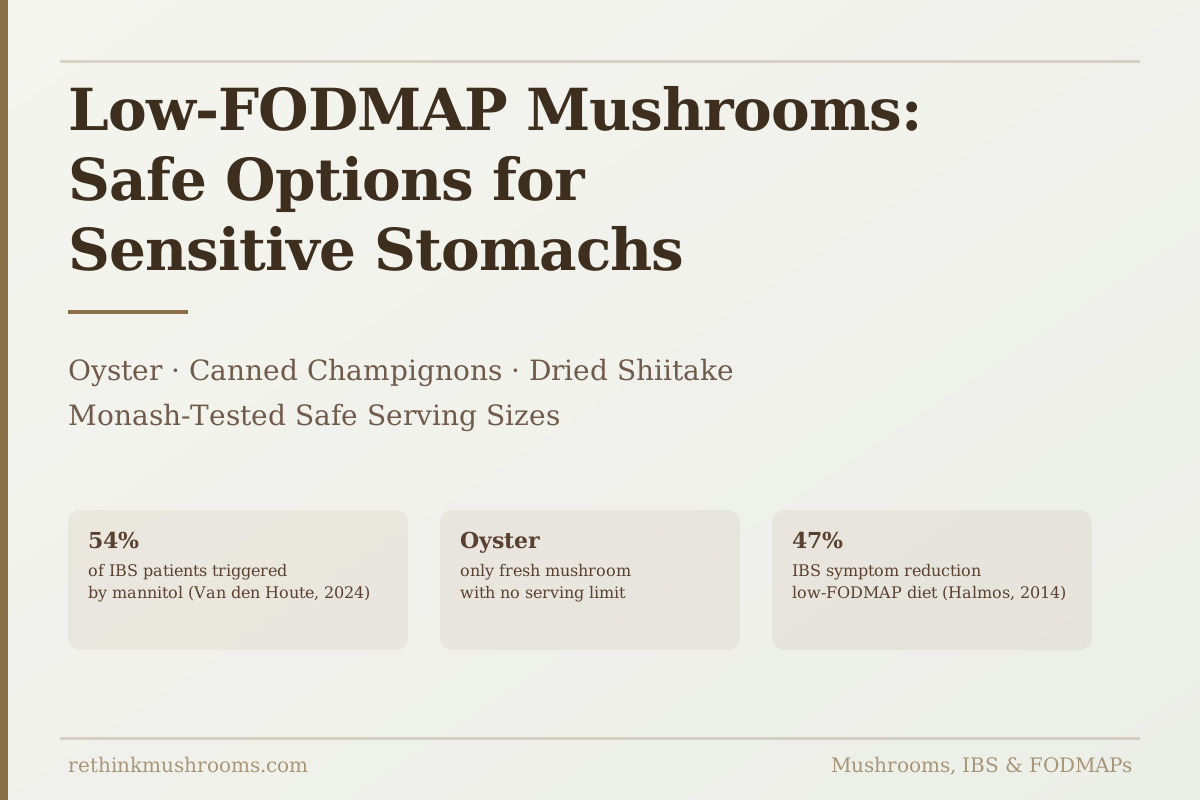
54%
Mannitol, the main polyol in common mushrooms, triggered IBS symptoms in 54% of patients in a 2024 blinded reintroduction trial. Oyster, canned, and dried varieties fall well below the threshold at tested serving sizes.
Van den Houte et al., Gastroenterology, 2024
47%
reduction in IBS symptom scores on a low-FODMAP diet (Halmos, 2014)
Oyster
the only fresh mushroom with no serving size restriction on the low-FODMAP diet
75g
safe serving of canned champignons, drained; canning removes the problem compound
Van den Houte et al., Gastroenterology, 2024
 View as image ↗
The most commonly eaten mushroom in the world, the white button mushroom, is also one of the worst triggers for people with IBS. It is high in mannitol, a small sugar alcohol that triggered IBS symptoms in 54% of patients in a 2024 blinded clinical trial.[1] If you have IBS and have decided mushrooms are off the table, it is worth knowing that this conclusion almost certainly came from this one species.
Several low-FODMAP mushroom options exist, and some are genuinely unrestricted at any typical serving size. More than that: the same varieties that are safe for IBS also contain the prebiotic fiber compounds that may help gut bacteria rather than harm them. Choosing the right mushroom is not just about avoiding a flare. It can mean actively supporting the gut microbiome without restriction.
This guide covers what the research shows about which mushrooms are safe, why the chemistry of canning changes the calculation for some species, and how to get practical value out of the low-FODMAP options.
For the broader picture of how mushrooms interact with gut bacteria, see Mushrooms as Prebiotics: How They Feed Your Gut Bacteria.
Key Takeaways
- Mannitol, the small sugar alcohol in most common mushrooms, triggered IBS symptoms in 54% of patients in a 2024 blinded reintroduction trial (Van den Houte et al., Gastroenterology)
- A 21-day low-FODMAP diet cut IBS symptom scores from 44.9 to 22.8 compared to a typical diet, a 47% improvement across all IBS subtypes (Halmos et al., Gastroenterology, 2014)
- Oyster mushrooms are the only fresh variety with no serving size restriction on the low-FODMAP diet; safe at any typical portion
- Canned champignons are low FODMAP at 75g drained because water-soluble mannitol leaches into the brine during canning; discarding the liquid removes most of it
- Dried shiitake (2 pieces), dried porcini (1 tablespoon), and dried black chanterelles (1/8 cup) all fall within Monash-tested low-FODMAP thresholds
- Low-FODMAP varieties like oyster retain their prebiotic beta-glucan fraction, which is a different molecule from mannitol and may actively support gut bacteria (Kulshreshtha, Probiotics and Antimicrobial Proteins, 2024)
Why Most Common Mushrooms Trigger IBS: The Mannitol Problem
Mushrooms contain two types of molecules that matter for IBS, and they behave in completely opposite ways in the gut.
The first type is mannitol, a small sugar alcohol found in the fluid and cell walls of many mushrooms. Mannitol is a FODMAP: a fermentable short-chain carbohydrate that draws water into the small intestine and then ferments rapidly in the colon, producing gas. People with IBS have a gut that is unusually sensitive to this stretching and gas production, which is why the same amount of mannitol that passes without incident in most people causes bloating, cramping, and altered bowel habits in IBS patients.
The second type is polysaccharides, large fiber-like molecules including beta-glucans and chitin that form the structural scaffolding of mushrooms. These molecules are too large to be absorbed in the small intestine and do not cause the osmotic or fermentation effects that drive IBS symptoms. They are not FODMAPs.
Most people with IBS learn the first lesson (mushrooms can trigger symptoms) but miss the second (not all mushrooms, and not all mushroom molecules, are the problem). The mannitol content varies significantly by species, and the polysaccharide content is largely independent of the mannitol content.
The clinical evidence for managing mannitol is strong. In a 2024 blinded crossover trial, Van den Houte and colleagues tested individual FODMAP groups in IBS patients to determine which ones reliably caused symptoms.[1] Mannitol triggered symptoms in 54% of participants. For comparison, fructans (found in wheat, onion, and garlic) triggered 56%. Mannitol is not a minor FODMAP subclass. It is one of the two most clinically significant groups, and mushrooms are its primary dietary source for many people.
The broader dietary framework is equally well-supported. In a randomized crossover trial, Halmos and colleagues assigned 30 IBS patients and 8 healthy controls to either a low-FODMAP diet or a typical Australian diet for 21 days each.[2] Overall GI symptom scores fell to 22.8 on the low-FODMAP arm compared to 44.9 on the typical diet arm. All IBS subtypes benefited. A 2022 network meta-analysis by Black and colleagues, published in Gut, reviewed multiple dietary approaches for IBS and ranked the low-FODMAP diet first across every symptom endpoint studied.[3]
The case for managing dietary mannitol is not a dietitian preference or precautionary principle. It is one of the most robustly evidenced dietary strategies in IBS research.
Low-FODMAP Mushrooms: The Complete List With Safe Serving Sizes
Several mushroom varieties pass the low-FODMAP threshold at practical serving sizes, as tested by Monash University's FODMAP research program. The key principle is that varieties with lower mannitol content, or forms where mannitol has been partially removed by processing, stay below the levels that cause IBS symptoms.
The low-FODMAP options, from most permissive to most restricted:
-
Oyster mushrooms: No serving size restriction documented for typical eating portions. The only fresh mushroom that can be used freely without FODMAP concern. Suitable for any culinary application.
-
Enoki mushrooms: Low FODMAP at standard serving sizes. Their thin, delicate structure comes with a different polysaccharide and mannitol composition than Agaricus bisporus varieties, and they have not been flagged as a FODMAP concern.
-
Canned champignons: Low FODMAP at 75g drained weight. Must be thoroughly drained; the brine contains the leached mannitol. The canning process is what makes this option possible (explained in detail in the next section).
-
Dried shiitake: Low FODMAP at 2 pieces, approximately 3 grams dried weight. This is a small portion but sufficient for using dried shiitake as a flavoring ingredient in broths, sauces, and grain dishes.
-
Dried porcini: Low FODMAP at 1 tablespoon. Like dried shiitake, this works best as an umami-adding ingredient rather than a primary mushroom component.
-
Dried black chanterelles: Low FODMAP at 1/8 cup dried.
Not on the list: fresh white button, cremini, and portobello mushrooms. These are all the same species at different maturity stages. They are high FODMAP at typical serving sizes and are the most widely consumed mushrooms globally. This combination is why mushrooms have a reputation as an IBS problem food.
For a detailed breakdown of the FODMAP content numbers behind these classifications and why mannitol levels vary between species, see FODMAPs in Mushrooms: Which Are Safe for IBS?.
Why Canned Champignons Work When Fresh Button Mushrooms Don't
Fresh white button mushrooms are high FODMAP. Canned champignons are low FODMAP at 75g drained. The same species, opposite outcomes: the difference is entirely about what happens to mannitol during the canning process.
Mannitol is water-soluble. When mushrooms sit in liquid at the elevated temperatures of the canning process, water-soluble compounds migrate out of the mushroom tissue and into the surrounding brine. Mannitol, being a small, water-soluble molecule, leaches readily into the canning liquid.
When you drain a can of champignons and discard the liquid, you are removing a significant portion of the original mannitol content. The mushroom retains its fiber structure, its beta-glucan content, and its flavor compounds, but with the problematic polyol substantially reduced.
The 75g drained threshold is specific, not a general approximation. Monash testing found that at this weight, after thorough draining, the remaining mannitol falls below the symptomatic level for IBS. At larger portions, the residual mannitol can still accumulate to cause symptoms even in canned form.
A few practical points follow from the mechanism. First, rinsing the drained champignons with water removes additional residual liquid and further reduces the mannitol exposure, at the cost of some flavor. Second, adding any of the canning liquid back into a dish reintroduces the mannitol that was successfully removed. Discarding the brine entirely is the point of the strategy.
Third, the same logic applies in principle to cooking methods that use water: boiling fresh mushrooms and discarding the cooking liquid should reduce mannitol content, because mannitol will leach into the boiling water the same way it leaches into brine. However, canning has more systematic FODMAP testing data behind it. Boiling reduction has not been tested as thoroughly for FODMAP thresholds.
The World's Most Popular Mushroom Is Also the Biggest IBS Trigger
Agaricus bisporus is the scientific name for white button mushrooms, cremini mushrooms, and portobello mushrooms. These are not three different species. They are the same species harvested at different maturity stages: white button is the youngest, cremini is slightly older (also called "baby bella"), and portobello is the fully mature form.
Agaricus bisporus accounts for the majority of mushroom consumption globally. It shows up in salads, pastas, stir-fries, burgers, pizzas, and soups in volumes that dwarf any other culinary mushroom. A 2020 scoping review by Blumfield and colleagues documented the bioactive composition of Agaricus bisporus systematically, noting its mannitol content alongside its beta-glucan content and other gut-relevant compounds.[4] The health-promoting compounds in this mushroom are real. The FODMAP problem is equally real.
For IBS patients, the practical consequence is that most "mushroom" experiences in everyday cooking involve this one high-FODMAP species. When someone reports that mushrooms reliably trigger their IBS, they are almost certainly eating Agaricus bisporus in its fresh form, probably at portions well above any plausible FODMAP threshold.
This is worth emphasizing because many people have concluded, reasonably, that all mushrooms cause problems for them. That conclusion may be wrong, or at least incomplete. Someone who has avoided all mushrooms after repeated reactions to button mushrooms may find that oyster mushrooms, or even properly drained canned champignons, are entirely tolerable. The reaction to Agaricus bisporus is not evidence that mushrooms as a category are off-limits.
The canned pathway (75g drained) is the main practical option for people who want the familiar flavor and texture of champignon-type mushrooms without the FODMAP consequence.
The Prebiotic Upside: Low-FODMAP Varieties That Actually Help Gut Bacteria
Choosing low-FODMAP mushrooms is not only about symptom management. The varieties that are safe for IBS also contain the fraction of mushroom chemistry that may actively support gut health.
A 2024 review by Kulshreshtha, published in Probiotics and Antimicrobial Proteins, addressed this directly.[5] The review drew a clear distinction between two types of mushroom molecules: the prebiotic polysaccharide fraction (beta-glucans and related large-molecule fibers) and the FODMAP-problematic fraction (mannitol, a small polyol). These molecules are chemically different and behave differently in the gut.
Beta-glucans are large, structural molecules. When they reach the colon intact, beneficial bacteria selectively ferment them, producing short-chain fatty acids and expanding in population. This is prebiotic function. Mannitol is a small sugar alcohol that causes osmotic effects and rapid fermentation before beneficial bacteria can productively use it. The two processes are not in conflict. They involve different molecules in different parts of the gut.
Oyster mushrooms, the most permissive option on the low-FODMAP list, are among the better-studied species for prebiotic beta-glucan content. The insight from the Kulshreshtha review is that choosing an oyster mushroom over a button mushroom is not simply a symptom-reduction strategy. It is choosing a species where the beneficial polysaccharide fraction is intact and accessible while the symptom-producing polyol fraction is negligible.
It is also worth noting what chitin, another structural molecule in mushrooms, is not. Chitin is indigestible by human enzymes, and it does not have the osmotic or fermentative properties that produce IBS symptoms. Indigestible fiber is not the same as a FODMAP trigger. For more on how chitin's behavior differs from the FODMAP mechanism, see Chitin in Mushrooms: Indigestible Fiber or Underrated Prebiotic?.
For species-level comparisons of which mushrooms deliver the strongest prebiotic profiles, including those that align with the low-FODMAP safe list, see Which Mushrooms Are the Best Prebiotics? A Species Comparison.
Practical Preparation Guide: Getting the Most From Safe Mushrooms
The Monash data provides specific thresholds, and several practical principles follow from them.
Oyster mushrooms as the default substitution. Any recipe that calls for sauteed, roasted, or soup mushrooms can use oyster mushrooms without portion restriction. The texture is different from button mushrooms: oyster mushrooms are slightly more tender and have a milder flavor. They work well in stir-fries, pasta dishes, soups, and as a side prepared with garlic oil (note: garlic itself is a high-FODMAP food; garlic-infused oil is the IBS-safe alternative, as the FODMAP compounds in garlic do not transfer to oil).
Drain canned champignons properly. Drain the can fully, then let the mushrooms sit in a colander for a few minutes to release additional liquid. For recipes where the texture permits, pressing gently with a paper towel removes more. Do not add the brine to the dish. Canned champignons work well in cooked applications: pasta sauces, soups, grain salads, and pizza toppings. Their texture softens significantly during canning, which makes them less suitable for dishes where mushroom chew is important.
Use dried mushrooms as a flavor layer, not a main ingredient. The safe serving sizes for dried shiitake (2 pieces) and dried porcini (1 tablespoon) are small in volume but intense in flavor. A few pieces of dried shiitake rehydrated in hot water and chopped finely adds significant depth to a broth or sauce. The rehydrating liquid carries concentrated umami but also the water-soluble compounds from the dried mushroom; whether to include or discard it depends on your individual FODMAP sensitivity at these small quantities.
It is worth understanding why dried mushrooms work differently than fresh, since the logic is counterintuitive. Drying concentrates all compounds in the mushroom, including mannitol. On a per-gram basis, dried mushrooms have more mannitol than fresh. But the safe serving size for dried mushrooms is much smaller in weight than for fresh, and the practical portion used in cooking (a few pieces of dried shiitake for flavor, not a full cup of fresh sliced mushrooms as the main ingredient) keeps total mannitol exposure low.
Watch for cumulative FODMAP loading. The low-FODMAP system is threshold-based, and FODMAP groups add together across a meal. Eating 75g of canned champignons alongside several pieces of dried shiitake in the same dish adds their mannitol contributions together. Both may be technically within their individual thresholds, but the combined mannitol load may approach or exceed symptom-triggering levels in highly sensitive individuals.
Consider mushroom extracts for therapeutic doses. For people interested in the gut-health benefits of mushroom polysaccharides at meaningful doses, hot-water extracted mushroom powders concentrate the beta-glucan fraction while leaving most of the mannitol behind in the process. At 1-2g daily doses, mannitol exposure from extracts is negligible compared to eating whole mushrooms. The supplement pathway and its clinical evidence are covered in Mushroom Supplements and IBS: Bypassing the FODMAP Problem.
For a full picture of how mushrooms interact with IBS beyond the FODMAP question, including the clinical evidence on both sides, see Mushrooms for IBS: Can They Help or Hurt?.
A Note on Evidence Limits
The FODMAP data for individual mushroom species comes from Monash University's analytical chemistry program, not from clinical trials where IBS patients specifically ate those species. The analytical approach measures actual FODMAP content and applies thresholds derived from symptom-challenge studies. It is evidence-based but operates differently from a randomized trial.
The clinical evidence from Halmos 2014, Van den Houte 2024, and Black 2022 supports the FODMAP framework overall. Van den Houte's 2024 blinded trial specifically established mannitol as a major IBS trigger, which gives clinical support to the species distinctions: high-mannitol mushrooms (Agaricus bisporus) are a confirmed problem, and low-mannitol options represent genuine risk reduction.[1][2][3]
Individual IBS tolerance varies. Some people react to amounts below Monash thresholds; others tolerate amounts above them. The thresholds are evidence-based starting points for a systematic reintroduction approach, not universal cutoffs. The standard clinical approach is to use the threshold data as an initial guide, observe individual responses, and adjust accordingly.
The Bottom Line
The IBS problem with mushrooms is specific: it is mannitol, a small water-soluble polyol found at high levels in Agaricus bisporus (button, cremini, portobello) that triggers symptoms in 54% of IBS patients. Oyster mushrooms, canned champignons at 75g drained, and several dried varieties fall below the threshold. These low-FODMAP options are not just symptom-neutral: they retain the prebiotic beta-glucan fraction that Agaricus bisporus also contains, meaning the safe choices are also the gut-health-supporting ones. The FODMAP problem and the beneficial polysaccharide fraction live in chemically different molecules in the same mushroom.
Frequently Asked Questions
Sources & References
- 1. Source details for this reference are not yet available.
- 2RTHM-00596·Halmos, Emma P et al. (2014). “A diet low in FODMAPs reduces symptoms of irritable bowel syndrome..” Gastroenterology.Study breakdown →PubMed →↩
- 3. Source details for this reference are not yet available.
- 4. Source details for this reference are not yet available.
- 5. Source details for this reference are not yet available.