Mushrooms, IBS & FODMAPs
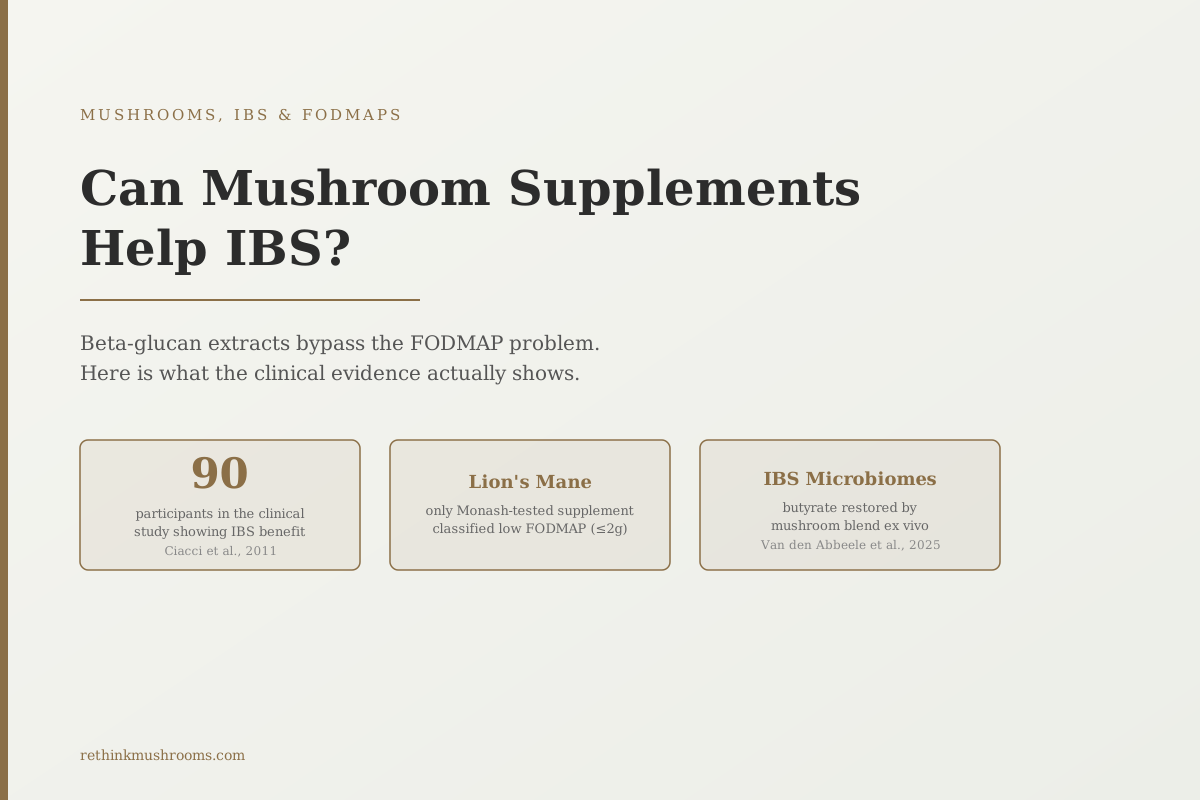
90 participants
In a 90-person clinical study, beta-glucan supplements significantly improved bloating, flatulence, and abdominal pain in IBS patients compared to untreated controls.
Ciacci et al., European Review for Medical and Pharmacological Sciences, 2011
IBS microbiomes
showed restored butyrate production after a mushroom blend in a 2025 ex vivo study (Van den Abbeele et al., 2025)
Lion's mane powder
the only Monash University-tested mushroom supplement classified low FODMAP at doses of 2g or less
Beta-glucans are not FODMAPs
large polysaccharide molecules, not polyols or sugars; the biochemical key to the extraction bypass
Ciacci et al., European Review for Medical and Pharmacological Sciences, 2011
 View as image ↗
There is a paradox at the center of mushroom use and IBS. Gastroenterologists and dietitians tell IBS patients to avoid mushrooms because of their mannitol content, a small polyol molecule that is one of the most common FODMAP triggers. At the same time, a 2011 clinical study by Ciacci and colleagues found that beta-glucan supplements, derived from the same fungi, significantly improved bloating, flatulence, and abdominal pain in IBS patients compared to untreated controls.[1] These findings are not contradictory. They reflect the fact that a mushroom contains at least two biochemically distinct types of compounds, and they do not behave the same way in the digestive system. This article explains how mushroom extracts can deliver the gut health benefits of mushrooms while substantially reducing the FODMAP problem that makes whole mushrooms risky for sensitive digestive systems. The broader landscape of mushrooms and gut health is covered in mushrooms as prebiotics: how they feed your gut bacteria.
Key Takeaways
- Beta-glucan supplements from fungi significantly improved bloating, flatulence, and abdominal pain in IBS patients versus untreated controls in a 90-person clinical study (Ciacci et al., 2011)
- A follow-up study confirmed that beta-glucan and inositol supplementation improved quality of life in IBS patients, extending findings beyond symptom relief to functional outcomes (Spagnuolo et al., 2017)
- Hot-water extraction concentrates large polysaccharide molecules (beta-glucans) while the small polyol molecule responsible for FODMAP symptoms (mannitol) is present at much lower doses per serving in extracts than in whole mushrooms
- A 2025 ex vivo study using actual IBS patient microbiomes found a mushroom blend restored butyrate production and improved gut barrier integrity markers (Van den Abbeele et al., 2025)
- Lion's mane powder is the only mushroom supplement tested and classified low FODMAP by Monash University's database, at doses of 2g or less
- A 2021 systematic review of randomized controlled trials on fungal beta-glucans found effects across immune, metabolic, and gastrointestinal parameters (Vlassopoulou et al., 2021)
Why Whole Mushrooms Are a FODMAP Problem but Extracts Work Differently
To understand why extracts sidestep the FODMAP issue, two molecules need to be distinguished: mannitol and beta-glucan.
Mannitol is the primary FODMAP in most edible mushrooms. It is a small sugar alcohol, a polyol, that is incompletely absorbed in the small intestine. In people with IBS, the unabsorbed mannitol draws water into the gut by osmosis and reaches the colon, where gut bacteria ferment it rapidly. The result is gas, bloating, pain, and altered bowel habits. This is the mechanism behind the low-FODMAP dietary approach to IBS management.
Beta-glucan is a fundamentally different type of molecule. It is a large polysaccharide, essentially a long chain of linked glucose units, that makes up part of the mushroom cell wall. Its molecular size prevents it from being absorbed in the same way small molecules are. It is not a FODMAP because FODMAP sensitivity is specifically about small, rapidly fermentable molecules. Beta-glucan is large and slow to ferment, and it behaves as a prebiotic, feeding beneficial bacteria rather than causing rapid gas production.
When mushrooms undergo hot-water extraction, the polysaccharide fraction, including beta-glucans, concentrates in the extract. The mannitol fraction, being a small water-soluble molecule, also carries over to some degree, but the per-serving dose in a concentrated extract is substantially lower than eating whole mushrooms. Kulshreshtha, in a 2024 review published in Probiotics and Antimicrobial Proteins, documented this molecular distinction directly: the prebiotic polysaccharide fraction of mushrooms is categorically different from the small-molecule polyol fraction that creates FODMAP concerns.[2]
Monash University, the research group that developed and maintains the FODMAP classification database, has tested lion's mane mushroom powder and classified doses of 2g or less as low FODMAP. This is the only mushroom supplement with this specific classification. It does not mean other extracts are high FODMAP, but it means lion's mane powder has the clearest formal designation.
For a deeper look at why indigestible fiber from mushrooms does not behave as a FODMAP trigger, see chitin in mushrooms: indigestible fiber or underrated prebiotic.
The Clinical Evidence: What Beta-Glucan Supplements Did in IBS Patients
Most mushroom content in the gut health space either cites no clinical trials at all or cites animal research. The two clinical studies below are almost entirely absent from competitor content, which makes them the most important starting point for this conversation.
Ciacci and colleagues (2011) administered a supplement called Biointol, containing beta-glucan combined with inositol and digestive enzymes, to IBS patients in a study published in the European Review for Medical and Pharmacological Sciences. Fifty IBS patients received the supplement and were compared to 40 untreated controls, for a total of 90 participants. The supplemented group showed significant improvement in bloating, flatulence, and abdominal pain relative to controls.[1] The symptoms that improved, gas, distension, and pain, are precisely the symptoms most commonly linked to intestinal fermentation and FODMAP sensitivity.
The combination product limits what can be attributed to beta-glucan specifically. Inositol and digestive enzymes also have gut health effects. But the mechanism proposed by the authors is consistent with beta-glucan's known prebiotic activity: feeding beneficial bacteria that produce short-chain fatty acids, modulating fermentation, and supporting the gut mucosal environment.
Spagnuolo and colleagues (2017) followed this work with a study extending the findings to quality-of-life outcomes. Using the same supplement formulation in both IBD and IBS patients, they documented improved quality-of-life measures that extended beyond symptom reduction to functional daily outcomes.[3]
Vlassopoulou and colleagues (2021) published a systematic review in Food and Function specifically examining randomized controlled trial evidence on fungal beta-glucans across health applications, including gastrointestinal endpoints. The review found effects across immune, metabolic, and gastrointestinal parameters, providing a broader evidence framework beyond the Ciacci and Spagnuolo studies.[4]
Taken together, this evidence establishes a direct line from mushroom polysaccharides to IBS symptom benefit. It does not prove that any specific mushroom supplement will reduce IBS symptoms, because the products tested were combination formulas and the evidence base is limited. But it demonstrates a plausible, clinically supported mechanism for why the polysaccharide fraction of mushrooms could help rather than harm an IBS gut.
For the full evidence picture on how mushrooms and IBS interact at the population level, including the FODMAP diet clinical data, see mushrooms for IBS: FODMAP considerations and symptom management research.
The 2025 IBS Microbiome Discovery: Mushroom Blends and Butyrate
One of the limitations of the Ciacci and Spagnuolo studies is that they used a combination product and did not use IBS-specific microbiome data to explain the mechanism. A 2025 study filled part of this gap.
Van den Abbeele and colleagues (2025) published data in the International Journal of Molecular Sciences from an experiment using microbiome samples taken directly from IBS patients, not healthy controls. They populated an ex vivo model, a system that maintains living gut bacteria outside the body, with IBS patient-derived microbiomes. The mushroom blend, combined with triacetin, restored butyrate production in those IBS microbiomes and improved gut barrier integrity markers.[5]
Butyrate matters specifically in IBS because IBS patients frequently have reduced butyrate production compared to healthy controls. Butyrate is the primary energy source for the cells lining the colon. Low butyrate is associated with increased intestinal permeability and worsened IBS symptoms. The fact that a mushroom blend corrected butyrate production in IBS patient microbiomes, not healthy volunteer microbiomes, is clinically meaningful even in a pre-clinical model.
This is not a randomized clinical trial and cannot prove that mushroom supplementation improves IBS outcomes in living patients. It is evidence that the mechanism, correcting dysbiotic microbiome function in IBS, is possible with a mushroom-based intervention. No competitor in the mushroom or IBS dietary guidance space has incorporated this data.
Lion's Mane: The Safest Starting Point for IBS Patients
Among mushroom species with clinical data and clear FODMAP classification, lion's mane (Hericium erinaceus) occupies a distinct position.
Menon and colleagues published a 2025 systematic review in Frontiers in Nutrition specifically examining lion's mane as a supplement, covering benefits, side effects, and the overall safety profile. The review documented gut health benefits alongside a tolerable side effect profile across the studies examined.[6] This makes it the species with both the most clinical documentation for gut health and the clearest formal FODMAP designation at the supplement level.
The preclinical rationale extends beyond gut health. Diling and colleagues (2017) published data from a mouse model of inflammatory bowel disease in Oncotarget, showing that lion's mane extract relieved bowel inflammation by modulating gut microbiota composition and immune signaling pathways.[7] An important distinction: inflammatory bowel disease (Crohn's disease, ulcerative colitis) is a different condition from irritable bowel syndrome. IBD involves structural inflammation; IBS does not. The shared mechanism, gut-barrier integrity and microbiome modulation, is relevant to both, but the Diling data does not directly predict IBS outcomes.
The practical significance of the Monash classification is that IBS patients who follow a low-FODMAP approach have a direct anchor point: lion's mane powder at 2g or less has been formally evaluated and classified. Other mushroom species and supplement forms have not undergone the same Monash classification process, which does not mean they are high FODMAP, but it does mean they lack the same formal designation.
For species-specific gut health research, see lion's mane for gut health: gastroprotective effects and research and which mushrooms are the best prebiotics.
What to Look for in a Mushroom Supplement for IBS
The research on mushroom supplements and IBS does not produce a protocol with verified clinical parameters. It produces a set of mechanistic reasoning that informs what makes a supplement more or less likely to fit the IBS context.
Beta-glucan content over mushroom weight. The Ciacci study used a supplement with beta-glucan as the active polysaccharide fraction. Products that specify beta-glucan content per serving, rather than just mushroom weight, align more closely with what clinical studies have measured. A product listing "500mg of mushroom powder" without polysaccharide content information provides less useful data than one listing beta-glucan percentage.
Hot-water extraction versus raw powder. Hot-water extraction concentrates polysaccharides and makes the prebiotic compounds more bioavailable. Raw mycelium powder, especially grain-grown mycelium, may contain significant starch residue from the growth substrate rather than predominantly mushroom polysaccharides. For IBS patients, the extraction method affects both the beta-glucan concentration and the per-dose FODMAP burden.
Serving size and total FODMAP exposure. Even with extraction, some mannitol carries over into finished supplements. Lower serving sizes reduce the total polyol dose. The Monash FODMAP designation for lion's mane powder applies specifically at 2g or less, which is a practical dosing reference.
Evidence-based species selection. Among the species with the most documented gut health effects and clearest FODMAP classification, lion's mane has the strongest individual case. Turkey tail, oyster mushroom, and reishi each have prebiotic and gut-modulating evidence as documented in the broader prebiotic literature.[2]
What the Evidence Cannot Yet Say
The studies reviewed here have real limitations. The Ciacci and Spagnuolo clinical findings used a combination product. Isolating what is specifically attributable to the beta-glucan fraction versus the inositol or enzyme components was not possible from the study design. No randomized controlled trial has tested a pure mushroom beta-glucan supplement versus placebo specifically in IBS patients for a pre-specified symptom outcome.
The Van den Abbeele 2025 data is from an ex vivo model. The restoration of butyrate in a laboratory model of IBS patient microbiomes is mechanistically informative but does not prove clinical outcomes.
Duration effects remain unstudied in human IBS populations. How long a mushroom supplement needs to be taken to produce meaningful microbiome change is not established.
Species-specific effects for IBS have not been compared in head-to-head trials. Whether lion's mane outperforms turkey tail, or whether blends outperform single-species supplements, is not answered by the current evidence base.
For readers evaluating mushroom use across all IBS-relevant contexts, including which whole mushroom species are safe to eat and which to avoid, see FODMAPs in mushrooms: which are safe for IBS and mushrooms for IBS: can they help or hurt. For a full list of safe whole-food mushroom options, see low-FODMAP mushroom options for sensitive stomachs.
The Bottom Line
Mushroom beta-glucan supplements occupy a different position from whole mushrooms in the IBS context. The large polysaccharide molecules that make up beta-glucans are not FODMAPs, and extraction concentrates them while reducing the per-serving dose of mannitol, the small polyol that triggers IBS symptoms. Two clinical studies found direct IBS symptom benefit from beta-glucan supplementation. A 2025 ex vivo study showed a mushroom blend restored butyrate production in IBS patient-derived microbiomes. Lion's mane powder at 2g or less carries the only formal low-FODMAP designation for a mushroom supplement from Monash University's database.
Frequently Asked Questions
Sources & References
- 1. Source details for this reference are not yet available.
- 2. Source details for this reference are not yet available.
- 3. Source details for this reference are not yet available.
- 4. Source details for this reference are not yet available.
- 5. Source details for this reference are not yet available.
- 6. Source details for this reference are not yet available.
- 7. Source details for this reference are not yet available.