Mushrooms, IBS & FODMAPs
54% of IBS patients
In a 2024 blinded randomized trial, mannitol (the sugar alcohol concentrated in most common mushrooms) triggered IBS symptoms in 54% of participants, making it one of the most reliably problematic FODMAP categories.
Van den Houte et al., Gastroenterology, 2024
75g drained
safe canned champignon serving (Monash University FODMAP database)
21 days
low-FODMAP diet duration in the Halmos 2014 RCT that halved IBS symptom scores
2 pieces
safe dried shiitake serving size for IBS (Monash University FODMAP database)
Van den Houte et al., Gastroenterology, 2024
 View as image ↗
A 2024 blinded randomized trial tested which FODMAP categories actually triggered IBS symptoms when participants could not see what they were consuming. Mannitol, the sugar alcohol that accumulates in most common mushrooms, triggered symptoms in 54% of IBS participants.[2] That places mushrooms alongside fructans (found in wheat, garlic, and onion) as one of the most reliably problematic FODMAP categories. But the answer to whether you can eat mushrooms with IBS is not a blanket no. The species you choose and how you prepare it determines whether you are eating something that causes a flare or something with no serving-size restriction at all.
This guide covers the specific FODMAP status of the most commonly eaten mushroom varieties, using Monash University FODMAP database data, which is the clinical standard used by gastroenterologists and IBS-specialist dietitians. For the broader picture of how mushrooms interact with gut bacteria, see Mushrooms as Prebiotics: How They Feed Your Gut Bacteria.
Key Takeaways
- In a 2024 blinded reintroduction trial, mannitol (the primary FODMAP in mushrooms) triggered IBS symptoms in 54% of patients, confirming it as one of the most significant FODMAP triggers
- Oyster mushrooms are the only common fresh mushroom classified low FODMAP with no serving-size restriction in Monash University testing
- Canned champignons (white button mushrooms) become low FODMAP at 75g drained because mannitol is water-soluble and leaches into the brine
- The same mushroom species can be high FODMAP fresh and low FODMAP in a small dried portion; the form matters as much as the species
- Button, cremini, and portobello mushrooms are all the same species (Agaricus bisporus) and are the highest-FODMAP mushrooms most people regularly eat
- A 21-day low-FODMAP diet reduced IBS symptom scores from 44.9 to 22.8 in a randomized crossover trial (Halmos et al., 2014), validating why FODMAP content of individual foods matters
Why Most Mushrooms Trigger IBS: The Mannitol Mechanism
FODMAPs is an acronym for a category of short-chain carbohydrates that the small intestine absorbs poorly. They reach the large intestine largely intact, where they do two things: they draw water into the gut through osmosis (water follows them across the intestinal wall), and they get fermented by gut bacteria that produce gas as a byproduct. The combination of extra fluid and gas in the gut produces the bloating, cramping, and altered bowel habits that characterize IBS symptoms.
Mannitol is a polyol, which is the "P" in FODMAPs. It is a sugar alcohol the body digests poorly, and it accumulates in high concentrations in the cell walls of most common mushroom species. When you eat fresh button mushrooms, cremini, or portobello, you are consuming a significant mannitol load.
The clinical evidence for mannitol as a specific trigger is now direct. Van den Houte and colleagues published a blinded randomized reintroduction trial in Gastroenterology in 2024, testing individual FODMAP categories against each other.[2] In blinded conditions, where patients did not know which FODMAP they were consuming, mannitol triggered symptoms in 54% of IBS participants. Fructans triggered 56%. These are the two most clinically significant FODMAP categories for IBS, and mushrooms are the primary dietary source of mannitol for most people.
Halmos and colleagues demonstrated in a 2014 randomized crossover trial that a low-FODMAP diet (eliminating mannitol along with other FODMAPs) reduced overall IBS symptom scores from 44.9 on a typical Australian diet to 22.8, a reduction of nearly half.[1] The trial enrolled 30 IBS patients and 8 healthy controls, with participants spending 21 days on each dietary pattern in a crossover design. All IBS subtypes benefited.
Which Mushrooms Are Safe for IBS: The FODMAP Species Table
Monash University, which developed and maintains the FODMAP classification system, has tested common mushroom species for their FODMAP content at specific portion sizes. The following table reflects their classification data.
| Mushroom | Form | FODMAP Status | Safe Serving |
|---|---|---|---|
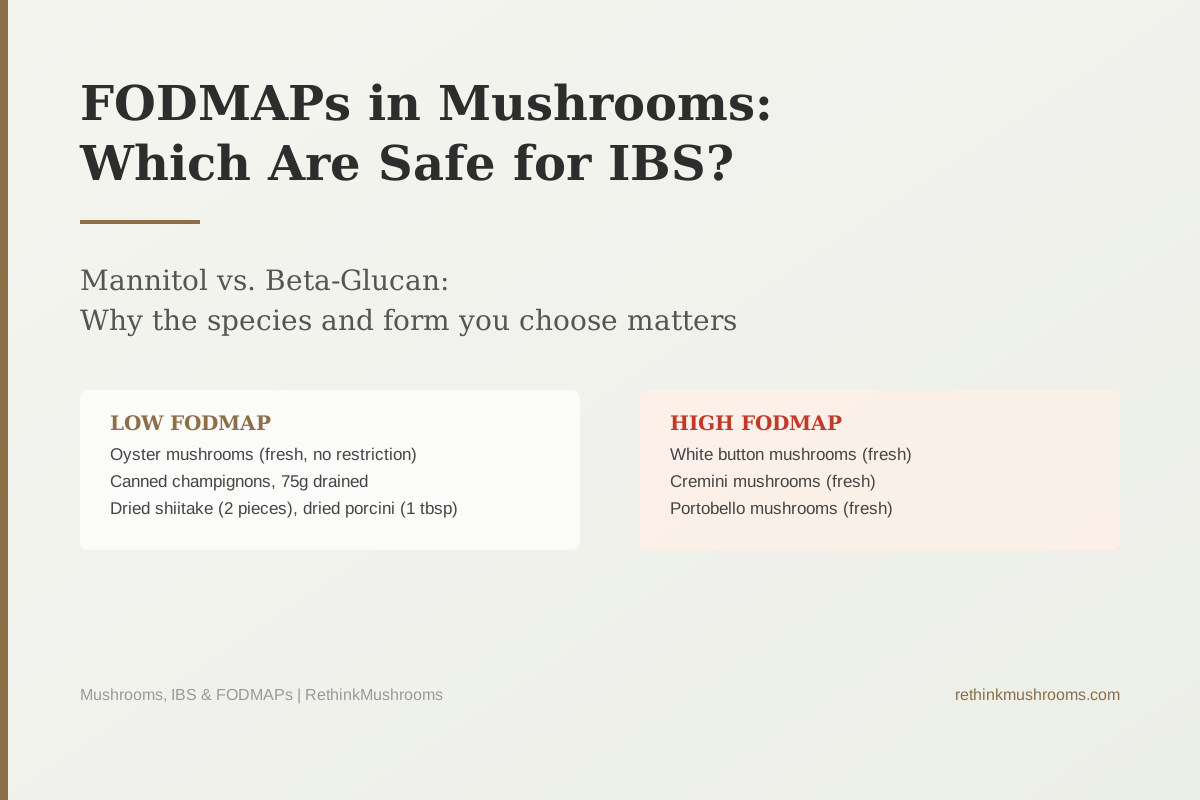
| Oyster mushrooms | Fresh | Low FODMAP | No restriction at standard portions |
| Champignons (button mushrooms) | Canned, drained | Low FODMAP | 75g (drained well) |
| Shiitake | Dried | Low FODMAP | 2 pieces (rehydrated) |
| Porcini | Dried | Low FODMAP | 1 tablespoon |
| Black chanterelles | Dried | Low FODMAP | ⅛ cup |
| White button mushrooms | Fresh | High FODMAP | Not safe at standard portions |
| Cremini mushrooms | Fresh | High FODMAP | Not safe at standard portions |
| Portobello mushrooms | Fresh | High FODMAP | Not safe at standard portions |
| Shiitake | Fresh | High FODMAP | Not safe at standard portions |
The pattern across this table is not random. Fresh high-FODMAP mushrooms are high because their mannitol content is intact and concentrated in the whole food. Low-FODMAP entries are low either because the species is naturally lower in mannitol (oyster mushrooms) or because the preparation method has removed or reduced the mannitol load (canning, draining, and the small serving sizes of dried varieties).
For related reading on safe mushroom options and preparation approaches, see Low-FODMAP Mushroom Options for Sensitive Stomachs.
The Portobello Problem: The Most-Eaten Mushroom Is the Worst Offender
Button mushrooms, cremini, and portobello mushrooms are the same biological species, Agaricus bisporus, at different stages of development. White button mushrooms are the youngest. Cremini are slightly more mature with darker caps. Portobello mushrooms are fully mature and large-capped. All three are high in mannitol and high FODMAP when eaten fresh.
Blumfield and colleagues published a comprehensive scoping review of Agaricus bisporus research in 2020, documenting the species' bioactive composition including its mannitol and beta-glucan content alongside its widespread consumption.[3] Agaricus bisporus is the most consumed mushroom species globally, which means the mushroom most likely to appear in a salad, stir-fry, or pasta dish is also the one most likely to trigger an IBS flare.
This is a practical problem because most food labeling and restaurant menus say "mushrooms" without specifying species. When mushrooms appear in a dish without specification, the default assumption is almost always Agaricus bisporus. For IBS patients avoiding high-FODMAP foods, that unlabeled mushroom is a meaningful risk.
The two exceptions in this species group are small: canned preparations of Agaricus bisporus, drained thoroughly, bring the mannitol load down to a level Monash classifies as low FODMAP at 75g. Fresh, they do not.
Why Canned Mushrooms Are Different from Fresh
The most counterintuitive finding in mushroom FODMAP data is that canned champignons (canned button mushrooms in European labeling) are classified low FODMAP when fresh button mushrooms are not. The mechanism is specific: mannitol is water-soluble.
When mushrooms are canned in liquid, mannitol leaches out of the mushroom flesh and into the surrounding brine over time. By the time you drain a can of champignons, a substantial portion of the mannitol has migrated into the liquid you just poured down the sink. What remains in the drained mushroom is lower in mannitol than the same mushroom would be if eaten fresh.
The important qualifier is "drained well." Rinsing canned mushrooms further reduces residual mannitol. Using canned champignons without draining, or in dishes where the canning liquid is incorporated into the food, does not provide the same FODMAP reduction.
This is also why cooking mushrooms in water or broth can reduce their FODMAP load compared to dry-heat methods like roasting or sautéing without liquid, where mannitol stays in the mushroom rather than leaching into cooking liquid.
Dried Mushrooms: Flavor Without the FODMAP Load
Dried mushrooms occupy a specific niche in IBS-safe cooking: small serving sizes with concentrated flavor. The reason dried varieties like shiitake, porcini, and black chanterelles appear in the low-FODMAP column is that the Monash-tested serving sizes are small enough to keep mannitol below the threshold that triggers IBS symptoms.
Two pieces of dried shiitake, rehydrated and used in a dish, deliver the umami depth of a much larger fresh mushroom serving but at a fraction of the mannitol load. One tablespoon of dried porcini, used as a flavor agent in a soup or sauce, provides very little mannitol per dish.
The practical implication is that dried mushrooms function well as seasoning or flavor enhancement in IBS-safe cooking, even for species that would be high FODMAP in larger fresh quantities. The same dried shiitake mushrooms that are low FODMAP at two pieces would be high FODMAP if eaten in fresh quantities.
For a comparison of how fresh and dried preparations affect other nutritional properties of mushrooms, see Mushrooms for IBS: Can They Help or Hurt?.
Oyster Mushrooms: The Standout Safe Option
Oyster mushrooms are the exception in the fresh mushroom category. Monash University classifies them as low FODMAP with no serving-size restriction at standard portions. This distinction reflects a genuine difference in composition: oyster mushrooms accumulate less mannitol than Agaricus bisporus species, making them naturally lower in the specific FODMAP compound that triggers IBS symptoms in most mushroom-sensitive patients.
Oyster mushrooms are also among the better-studied mushroom species for their prebiotic fiber content, specifically their beta-glucan polysaccharides. The prebiotic angle is distinct from the FODMAP question: beta-glucans are large fiber molecules that gut bacteria ferment slowly and beneficially, producing short-chain fatty acids that support gut lining integrity. This is different from the rapid fermentation of small mannitol molecules that causes gas and bloating.
For readers interested in which fresh mushrooms offer the most prebiotic benefit alongside low FODMAP status, see Which Mushrooms Are the Best Prebiotics? A Species Comparison. For the specific relationship between chitin (another mushroom fiber) and IBS, see Chitin in Mushrooms: Indigestible Fiber or Underrated Prebiotic?.
The Molecular Distinction: Why Extracts Work When Whole Mushrooms Don't
Every mushroom contains two structurally different types of compounds that behave very differently in the gut.
The first type is mannitol: a small, freely soluble sugar alcohol. Mannitol absorbs poorly in the small intestine, draws water into the gut through osmosis, and gets fermented rapidly by gut bacteria. This is why fresh high-FODMAP mushrooms cause IBS symptoms.
The second type is beta-glucan: a large polysaccharide fiber. Beta-glucans are not a FODMAP. They are too large to be absorbed in the small intestine, they do not cause osmotic water draw, and they ferment slowly rather than rapidly. Slow, selective fermentation by specific gut bacteria produces beneficial short-chain fatty acids rather than the rapid gas production that causes IBS bloating.
Hot-water mushroom extracts, produced by boiling mushrooms and concentrating the resulting liquid, preferentially extract beta-glucan polysaccharides. Mannitol carries through into extracts as well, but at much lower doses per standard 1-2g supplement serving than eating whole mushrooms. This biochemical separation is why mushroom extracts and supplements represent a different pathway for IBS patients than fresh mushroom consumption.
For the clinical evidence on mushroom beta-glucan supplements specifically in IBS populations, see Mushroom Supplements and IBS: Bypassing the FODMAP Problem. For information on the distinction between IBS (irritable bowel syndrome) and IBD (inflammatory bowel disease) and how mushrooms relate to each, see Anti-Inflammatory Mushrooms for Inflammatory Bowel Disease.
The Bottom Line
The FODMAP status of mushrooms is determined primarily by mannitol content, which varies significantly by species and preparation method. Fresh button, cremini, and portobello mushrooms (all Agaricus bisporus) are the highest-FODMAP mushrooms most people eat. Oyster mushrooms are the standout fresh alternative, classified low FODMAP with no serving restriction. Canned champignons (drained), dried shiitake (2 pieces), dried porcini (1 tablespoon), and dried black chanterelles (⅛ cup) are low FODMAP through either lower mannitol content or preparation-based mannitol reduction. The 2024 Van den Houte blinded trial confirms mannitol as a clinically significant trigger in 54% of IBS patients, making species selection meaningful for symptom management.
Frequently Asked Questions
Sources & References
- 1RTHM-00596·Halmos, Emma P et al. (2014). “A diet low in FODMAPs reduces symptoms of irritable bowel syndrome..” Gastroenterology.Study breakdown →PubMed →↩
- 2. Source details for this reference are not yet available.
- 3. Source details for this reference are not yet available.