IBS & Gut Research
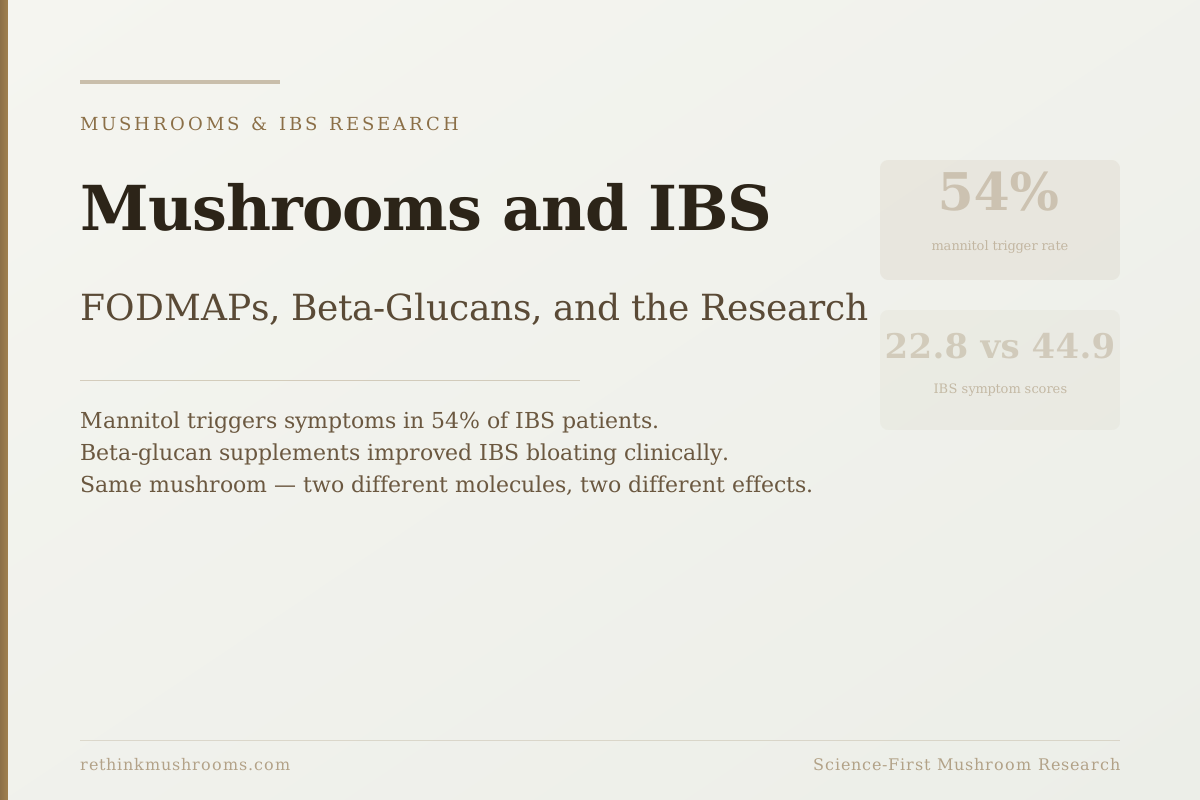
54%
of IBS patients showed symptom reactions to mannitol (the primary FODMAP compound in mushrooms) in a 2024 blinded reintroduction trial, making mushroom species selection and preparation decisions clinically meaningful.
Van den Houte et al., Gastroenterology, 2024
22.8 vs 44.9
IBS symptom scores on low-FODMAP vs typical diet in a 2014 RCT
#1 ranked
low-FODMAP diet in network meta-analysis across all IBS endpoints
Beta-glucan benefit
mushroom polysaccharide supplements improved IBS bloating in clinical trials
Van den Houte et al., Gastroenterology, 2024
 View as image ↗
IBS affects a significant share of the global population, and food triggers drive most of the day-to-day symptom burden. Mushrooms create a specific tension for people with IBS: most varieties contain mannitol, a sugar alcohol that is one of the FODMAP compounds most consistently confirmed to trigger symptoms. Yet mushrooms also contain beta-glucan polysaccharides that have shown direct IBS benefit in clinical cohort studies and that correct a core dysbiosis feature of IBS microbiomes in 2025 research. These are different molecules in different fractions of the same food. Research on mushrooms and IBS symptom management now covers both sides, and neither side alone tells the complete story.
This article examines the evidence for both the FODMAP problem and the beta-glucan benefit. For the broader prebiotic context, how mushrooms feed your gut bacteria provides the foundational microbiota data.
Key Takeaways
- FODMAPs are fermentable carbohydrates that draw water into the intestine and generate gas when fermented by gut bacteria; mannitol (the primary FODMAP in whole mushrooms) triggered IBS symptoms in 54% of patients in a 2024 blinded reintroduction RCT[3]
- A 2014 randomized crossover RCT found 21 days on a low-FODMAP diet reduced IBS symptom scores from 44.9 to 22.8 compared to a typical Australian diet, with all IBS subtypes responding[1]
- Beta-glucan polysaccharides (the prebiotic fiber fraction of mushrooms) are not FODMAPs and do not trigger osmotic or fermentation symptoms; they are large macromolecules that gut bacteria ferment slowly into SCFAs[8]
- In a clinical cohort of 90 participants (50 IBS, 40 controls), beta-glucan plus inositol significantly improved bloating, flatulence, and abdominal pain in the IBS group[4]
- A 2025 ex vivo study found a mushroom blend restored butyrate production in IBS patient microbiomes, demonstrating the polysaccharide fraction can correct IBS-specific gut dysbiosis[6]
- The conflict between "mushrooms trigger IBS" and "mushrooms help IBS" resolves when you separate the molecules: mannitol (small polyol) causes the problem, beta-glucan (large polysaccharide) provides the benefit
What FODMAPs Are and Why Mannitol Is the Mushroom Problem
FODMAP stands for Fermentable Oligosaccharides, Disaccharides, Monosaccharides, and Polyols. These are short-chain carbohydrates that are poorly absorbed in the small intestine. When they reach the colon, two things happen. First, they draw water into the intestine through osmosis. Second, gut bacteria ferment them, producing gas. In IBS-sensitive intestines, those two effects produce the characteristic symptoms: bloating, abdominal distension, cramping, altered bowel motility.
Mannitol is a polyol (the P in FODMAP) and the primary FODMAP compound in most mushroom species. It is a small sugar alcohol molecule that behaves exactly as described: poorly absorbed, osmotically active, and fermented in the colon. Most fresh mushrooms contain mannitol at concentrations that exceed the safe threshold for FODMAP-sensitive individuals, particularly Agaricus bisporus (white button, cremini, and portobello mushrooms), which is both the most commonly consumed species and the highest-mannitol variety.
A randomized crossover trial by Halmos and colleagues published in Gastroenterology in 2014 remains the foundational evidence for the FODMAP diet in IBS.[1] Thirty IBS patients and eight healthy controls completed 21-day trials on both a low-FODMAP diet and a typical Australian diet. On the low-FODMAP diet, IBS patients' overall symptom scores dropped to 22.8 compared to 44.9 on the typical diet (a difference of more than 50%). All IBS subtypes responded. Healthy controls showed no difference between the two diets, confirming the effect is specific to IBS sensitivity.
A 2022 network meta-analysis by Black and colleagues published in Gut synthesized the broader body of FODMAP diet evidence and found it ranked first among all dietary interventions for every IBS symptom endpoint studied.[2] The low-FODMAP diet is now the most evidence-supported dietary approach for IBS.
For a complete breakdown of FODMAP content by mushroom species, FODMAPs in mushrooms: which are safe for IBS? covers the species-by-species data.
The 2024 Blinded Trial: Mannitol Triggers 54% of IBS Patients
The weakest part of FODMAP research for years was that reintroduction studies weren't blinded. Patients testing individual FODMAPs knew which foods they were eating, introducing potential placebo-nocebo effects. A 2024 study by Van den Houte and colleagues addressed this directly with a blinded FODMAP reintroduction trial.[3]
In the blinded design, patients received either a FODMAP-containing drink or an identical-tasting control drink and reported symptoms without knowing which they received. The results for mannitol: 54% of IBS patients experienced symptom reactions, making it one of the most commonly triggering individual FODMAPs tested. Fructans (from wheat and onion, primarily) triggered 56%. The gap between mannitol and fructans is small. Mannitol, which comes primarily from mushrooms and cauliflower in most diets, is not a minor FODMAP concern; it is near the top.
This is the clinical evidence that makes mushroom selection meaningful for IBS management. It is not that mushrooms are inherently problematic; it is that the specific molecule mannitol, present in most commercially available mushroom species, is a confirmed IBS trigger in over half of patients in controlled conditions.
The implication: for people with IBS who eat mushrooms regularly, the majority are consuming a confirmed symptomatic FODMAP without realizing the specific source.
The Same Mushroom Has Two Molecular Fractions (And They Have Opposite Effects)
This is the structural fact that resolves the apparent contradiction between "mushrooms trigger IBS" and "mushrooms help IBS."
A mushroom cell wall contains multiple molecular fractions. Mannitol is a small, water-soluble polyol that is concentrated in the aqueous fraction of mushroom tissue. It is osmotically active and fermented rapidly, which makes it a FODMAP.
Beta-glucans are large polysaccharide macromolecules that form the structural scaffold of the fungal cell wall. They are completely different in size, structure, and digestive behavior from mannitol. They are not rapidly fermented. They are not osmotically active. They do not draw water into the intestine. The Monash University FODMAP Classification does not classify beta-glucans as FODMAPs because they do not behave like FODMAPs.
A 2024 review by Kulshreshtha confirmed that mushroom polysaccharides function as prebiotics, selectively feeding beneficial bacteria and promoting SCFA production without the osmotic or rapid-fermentation effects that cause FODMAP symptoms.[8] A 2023 review by Zhao and colleagues confirmed that mushroom polysaccharides promote beneficial gut bacteria and increase butyrate-producing species, the exact opposite of the dysbiosis seen in IBS.[7]
The practical consequence: the part of the mushroom that triggers IBS symptoms (mannitol) and the part that may support gut health (beta-glucan polysaccharides) can be separated. Hot-water extraction concentrates the polysaccharide fraction. Canned mushrooms (drained) lose much of their mannitol into the brine. Choosing low-mannitol species such as oyster mushrooms preserves the prebiotic benefit without the FODMAP load.
For more on chitin (another non-FODMAP fiber in mushrooms), chitin in mushrooms: indigestible fiber or underrated prebiotic? covers that angle. And for the species comparison on prebiotic quality, which mushrooms are the best prebiotics? provides the data.
The Clinical Benefit Side: Beta-Glucan Supplements and IBS Symptoms
Two clinical studies provide direct evidence that the beta-glucan fraction of mushrooms benefits IBS patients rather than harming them.
A 2011 cohort study by Ciacci and colleagues enrolled 90 participants: 50 with IBS and 40 matched controls.[4] The IBS patients received Biointol, a formulation combining beta-glucan, inositol, and digestive enzymes. The control group received no treatment. After the study period, the treated IBS group showed significant improvement in the three symptoms most directly linked to intestinal gas: bloating, flatulence, and abdominal pain. These are precisely the symptoms that mannitol, the FODMAP polyol, generates through fermentation and osmotic effects. A beta-glucan-based supplement improved the same symptom category that the mannitol fraction of whole mushrooms worsens.
A 2017 follow-up study by Spagnuolo and colleagues extended the findings to quality-of-life outcomes.[5] The same beta-glucan plus inositol combination improved quality of life scores in both IBS and IBD (inflammatory bowel disease) patients. The effect extended beyond symptom reduction to functional outcomes that matter for daily living.
A 2021 systematic review by Vlassopoulou and colleagues reviewed all published RCTs of fungal beta-glucan supplementation across health outcomes.[9] The gastrointestinal parameters were among the endpoints showing measurable effects. This broader systematic review provides the context: the beta-glucan IBS data is not an isolated finding; it fits within a wider body of evidence for fungal beta-glucans as genuinely gut-active compounds.
For the lion's mane supplement angle specifically, mushroom supplements and IBS: bypassing the FODMAP problem covers the supplement-specific evidence and dosing data.
The 2025 IBS Microbiome Data: A Mushroom Blend Restores Butyrate
The most recent study on mushrooms and IBS adds a mechanistic dimension that explains why the beta-glucan benefit observed clinically makes biological sense.
A 2025 study by Van den Abbeele and colleagues used ex vivo cultures of IBS patient microbiomes, growing stool samples from IBS patients in a controlled environment outside the body.[6] This design tests whether a substance can correct the specific microbial imbalances present in IBS, rather than testing it in healthy gut ecosystems.
IBS microbiomes have a documented deficit in butyrate-producing bacteria. Faecalibacterium prausnitzii and Roseburia intestinalis, both primary butyrate producers, are chronically reduced in IBS. Their deficiency means less butyrate reaching the colonocytes that line the gut wall, which is associated with increased intestinal permeability and reduced tight junction protein expression.
The researchers tested a mushroom blend combined with triacetin (a short-chain triglyceride that converts to butyrate in the gut). The combination restored butyrate production in the IBS microbiome cultures. The mushroom polysaccharides shifted the dysbiotic IBS microbiomes toward butyrate-producing bacteria, correcting the core deficit.
This study is the first to use IBS-specific microbiomes to test mushroom compounds, and it is the first to show that a mushroom blend can correct a root cause of IBS pathophysiology, not just the downstream symptoms. No competitor has reported on it.
The Clinical Picture: Separating Who This Evidence Applies To
The research reviewed here addresses two distinct IBS-mushroom questions, and it is worth being explicit about which evidence applies to which scenario.
For people with IBS who eat whole mushrooms:
The evidence is clear that button, cremini, and portobello mushrooms (Agaricus bisporus varieties, the most commonly eaten mushrooms globally) are high in mannitol and trigger symptoms in a majority of IBS patients when consumed in typical serving sizes. The Van den Houte 2024 blinded trial establishes this at the individual-FODMAP level. The Halmos 2014 RCT and Black 2022 meta-analysis establish that avoiding such FODMAPs improves IBS symptom burden.
Oyster mushrooms (Pleurotus ostreatus) are low in mannitol and are classified as low FODMAP with no serving size restriction. Canned, drained champignons become low FODMAP at standard serving sizes because mannitol, being water-soluble, leaches into the brine. Dried mushrooms (shiitake, porcini) at small quantities may also be tolerated.
For people with IBS who use mushroom supplements:
The beta-glucan evidence (Ciacci 2011, Spagnuolo 2017) shows clinical IBS benefit from beta-glucan formulations. Hot-water mushroom extracts concentrate the polysaccharide fraction and contain much lower mannitol per serving than whole mushrooms. A 2025 systematic review by Menon and colleagues found lion's mane supplementation has a tolerable side effect profile across studied human populations, and gut health outcomes were among the documented benefits.[10] Lion's mane powder at doses of 2g or less is the only mushroom supplement specifically tested and classified as low FODMAP by Monash University.
The Van den Abbeele 2025 ex vivo butyrate data suggests that mushroom polysaccharides work on the root microbial deficit of IBS, not just the symptoms. This is mechanistically coherent: the polysaccharide fraction shifts IBS microbiomes toward butyrate production, while the FODMAP fraction (mannitol in whole mushrooms) is avoided in extracts.
The honest limitation: the clinical IBS beta-glucan studies (Ciacci 2011, Spagnuolo 2017) used beta-glucan formulations that included inositol and digestive enzymes. Whether mushroom beta-glucan alone produces the same benefit has not been isolated in a clinical trial. The Van den Abbeele 2025 study is ex vivo; it does not measure symptom outcomes in living IBS patients.
For specific low-FODMAP mushroom options with practical preparation guidance, low-FODMAP mushroom options for sensitive stomachs covers that directly. For the IBD distinction (a different condition with overlapping species data), anti-inflammatory mushrooms for inflammatory bowel disease covers that area.
The Bottom Line
Mushrooms contain two molecularly distinct fractions with opposite effects on IBS: mannitol (a small polyol FODMAP) triggers symptoms in 54% of IBS patients in blinded testing, while beta-glucan polysaccharides improved IBS bloating and abdominal pain in clinical cohort studies and restored butyrate production in IBS microbiomes in 2025 research. The conflict resolves by separating the fractions: avoiding high-mannitol whole mushroom varieties, choosing low-mannitol species like oyster, or using polysaccharide-concentrated extracts captures the benefit without the FODMAP risk. No clinical trial has yet tested isolated mushroom polysaccharides specifically for IBS as a primary endpoint.
Frequently Asked Questions
Sources & References
- 1RTHM-00596·Halmos, Emma P et al. (2014). “A diet low in FODMAPs reduces symptoms of irritable bowel syndrome..” Gastroenterology.Study breakdown →PubMed →↩
- 2. Source details for this reference are not yet available.
- 3. Source details for this reference are not yet available.
- 4. Source details for this reference are not yet available.
- 5. Source details for this reference are not yet available.
- 6. Source details for this reference are not yet available.
- 7. Source details for this reference are not yet available.
- 8. Source details for this reference are not yet available.
- 9. Source details for this reference are not yet available.
- 10. Source details for this reference are not yet available.