Psilocybin & Addiction
Region-specific dopamine effects
Sakashita and colleagues measured dopamine in two brain regions simultaneously after psilocin in awake rats: dopamine increased in the nucleus accumbens (reward region) but decreased in the medial prefrontal cortex (control region) — a pattern that explains why psilocybin's effects on stimulant addiction are indirect and complex.
Sakashita et al., Biological & Pharmaceutical Bulletin, 2015
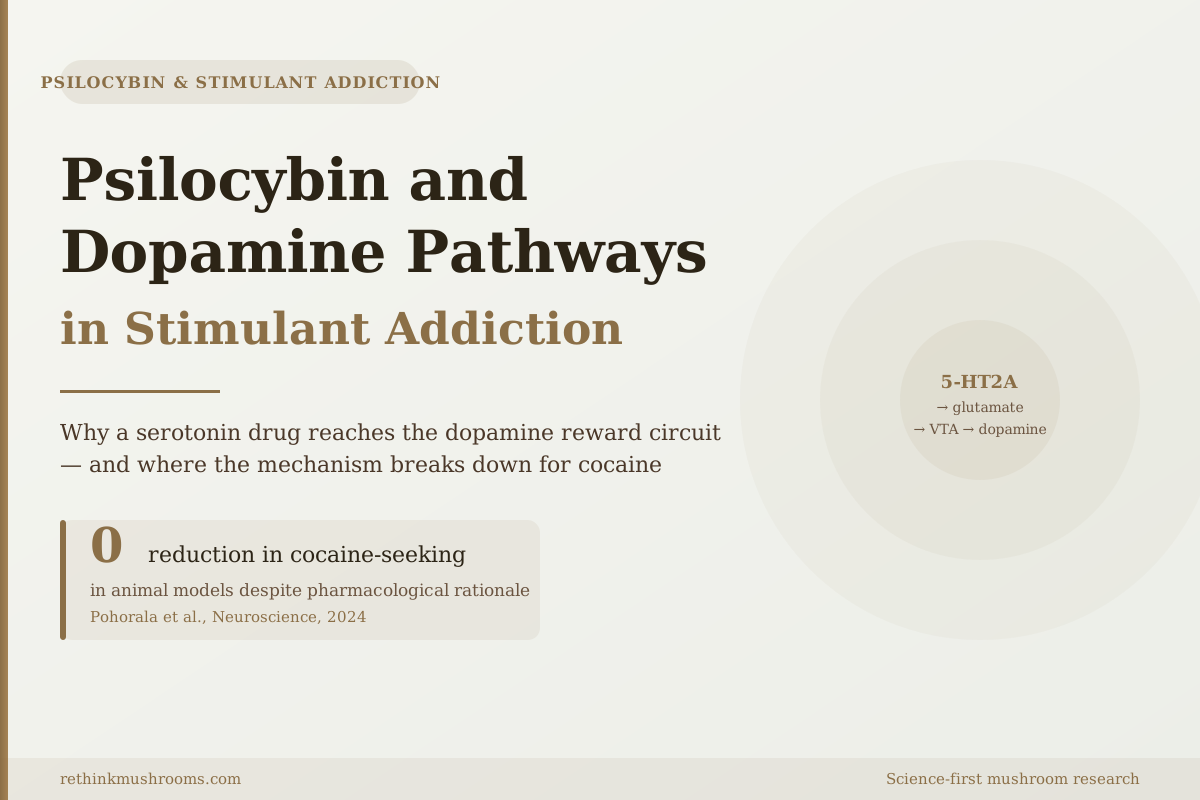
5-HT2A
the serotonin receptor psilocybin activates that indirectly increases dopamine in the reward circuit
5-HT2C
a second serotonin receptor that works in the opposite direction, inhibiting mesolimbic dopamine
Null
psilocybin's behavioral effect on cocaine cue reinstatement in animal models despite the dopamine activity (Pohorala 2024)
Sakashita et al., Biological & Pharmaceutical Bulletin, 2015
 View as image ↗
Psilocybin is a serotonin drug. It binds to 5-HT2A receptors, and that binding is what produces its psychedelic effects and, researchers believe, most of its therapeutic effects. Cocaine is a dopamine drug. It blocks dopamine transporters, flooding the nucleus accumbens with dopamine and producing intense euphoria followed by a crash that drives craving.
These are different systems. That gap is the central challenge for anyone proposing psilocybin for stimulant addiction, and it's the question no popular coverage of psilocybin dopamine pathways and stimulant addiction mechanism has yet addressed directly.
The honest answer is that psilocybin does affect dopamine, but indirectly, in ways that are region-specific, and insufficient to override cocaine's direct dopamine flooding in preclinical models. Understanding why requires looking at two receptor systems, two brain regions, and what happens when you measure dopamine in both at once. The broader research on psilocybin for alcohol addiction — where the mechanism is better supported — provides a useful contrast.
Key Takeaways
- Sakashita and colleagues (2015) gave psilocin to awake rats and measured dopamine in two regions simultaneously: nucleus accumbens dopamine increased, medial prefrontal cortex dopamine decreased — the reward system and the control system moved in opposite directions
- Howell and Cunningham (2015) mapped the mechanism: 5-HT2A receptor activation stimulates glutamate release, which activates VTA dopamine neurons, which increases nucleus accumbens dopamine; 5-HT2C activation works oppositely, inhibiting mesolimbic dopamine — psilocybin activates both receptors, creating complex net effects
- Heshmati and colleagues (2024) found psilocybin reduces alcohol self-administration via selective activation of left nucleus accumbens neurons — direct evidence for reward-circuit modulation working for alcohol
- Pohorala and colleagues (2024) found psilocybin did not reduce cocaine cue reinstatement in rodents despite the pharmacological rationale — the indirect dopamine effects may be insufficient for cocaine's dopamine-driven conditioning
- Valdez and colleagues (2024) propose that moderate tonic striatal dopamine elevation could dampen excessive phasic dopamine spikes from cocaine cues — a hypothesis that has not yet been validated in animal behavioral models
- Brett and colleagues (2023) argue the primary mechanism for psilocybin in stimulant addiction is neuroplasticity and psychological transformation rather than direct dopamine modulation — an explanation for why human trials may succeed where animal models predict null
The Core Paradox: A Serotonin Drug for a Dopamine Problem
Cocaine's mechanism is direct. It binds to dopamine transporters, the proteins responsible for pulling released dopamine back into neurons, and blocks them. The result is a large, fast accumulation of dopamine in the nucleus accumbens, the brain's reward hub. This dopamine surge is what produces cocaine's euphoria, and the tolerance and craving that follow develop precisely because the dopamine system tries to compensate for repeated artificial flooding.
Psilocybin binds primarily to 5-HT2A receptors, a serotonin receptor subtype. Its psychedelic effects, and the changes in self-perception and thinking pattern that make it therapeutically interesting, come from this serotonergic mechanism. Psilocybin does not directly block dopamine transporters. It does not directly substitute for cocaine at any receptor. The pharmacological logic that makes opioid substitution therapy work — methadone occupying the same receptors as heroin — does not apply here.
So why would psilocybin help cocaine or methamphetamine addiction at all?
The answer researchers are exploring has two parts. The first is indirect pharmacology: serotonin and dopamine systems are closely interconnected, and 5-HT2A receptor activation does influence dopamine release through a specific neural circuit. The second is psychological mechanism: psilocybin-assisted therapy may work primarily by disrupting the psychological and behavioral patterns of addiction rather than by pharmacologically substituting for the drug. The pharmacological story is the subject of this article. The psychological story is covered in psilocybin and stimulant addiction: early-phase research on cocaine and meth.
How 5-HT2A Receptor Activation Reaches Dopamine: The Neural Circuit
Howell and Cunningham's 2015 review established the detailed pharmacological mechanism connecting psilocybin's serotonin receptors to the dopamine system.[2]
5-HT2A receptors are densely expressed on pyramidal neurons in the prefrontal cortex. When psilocybin activates these receptors, it stimulates these pyramidal neurons to release glutamate, the brain's main excitatory neurotransmitter. That glutamate release reaches the ventral tegmental area (VTA), the origin of dopamine-producing neurons in the mesolimbic pathway. Stimulating VTA neurons via glutamate increases their firing, which in turn increases dopamine release in the nucleus accumbens.
This is the 5-HT2A-to-dopamine pathway: 5-HT2A activation at the prefrontal cortex triggers a glutamatergic cascade that ends in dopamine release in the reward center. But it's indirect — a multi-step process that operates on a different timescale and with different intensity than cocaine's direct dopamine transporter blockade.
The 5-HT2C receptor complicates the picture further. Psilocybin also activates 5-HT2C receptors, which are expressed on GABA interneurons that inhibit VTA dopamine neurons. When 5-HT2C is activated, it puts the brakes on mesolimbic dopamine release. Psilocybin activates both 5-HT2A (which accelerates dopamine) and 5-HT2C (which slows it), creating competing effects whose net outcome depends on dose, receptor density, and regional expression patterns.
Howell and Cunningham frame this as a therapeutically relevant mechanism specifically for cocaine use disorder: the balance of 5-HT2A and 5-HT2C activation may differentially affect phasic (cue-triggered burst) versus tonic (baseline) dopamine release. If psilocybin could shift this balance to reduce the phasic dopamine spikes that cocaine cues trigger, it might weaken the cue-craving association. The data on whether this actually happens comes next.
Direct Measurement: What Dopamine Actually Does After Psilocin
Sakashita and colleagues' 2015 study is the most direct measurement of psilocin's dopamine effects available in the literature.[1] Rather than inferring dopamine changes from behavioral outcomes, they placed microdialysis probes in two brain regions of awake, freely moving rats, allowing real-time measurement of extracellular dopamine and serotonin as psilocin was administered.
The results showed the region-specific divergence that the pharmacological mechanism predicts. In the nucleus accumbens, psilocin increased extracellular dopamine. In the medial prefrontal cortex, psilocin decreased dopamine. In the prefrontal cortex, serotonin increased.
What this means: the reward circuit and the control circuit moved in opposite directions. The nucleus accumbens, which cocaine floods with dopamine, saw a moderate increase from psilocin. The medial prefrontal cortex, which provides top-down inhibitory control over impulse and drug-seeking behavior, saw a dopamine decrease. Reduced prefrontal dopamine is associated with weakened executive control over behavior, which is precisely the opposite of what successful addiction treatment aims for.
This region-specific pattern helps explain why psilocybin's dopamine pharmacology is genuinely complicated for stimulant addiction. It's not that psilocybin has no dopamine effects. It does. But the effects differ by region, and the pattern observed — nucleus accumbens up, prefrontal cortex down — is not straightforwardly therapeutic for cocaine's dopamine-driven conditioning.
Where the Dopamine Mechanism Works: The Alcohol Contrast
Heshmati and colleagues' 2024 study provides a useful mechanistic contrast.[3] They found psilocybin reduces alcohol self-administration in rodents via selective activation of left nucleus accumbens neurons. The finding demonstrates that psilocybin can produce reward-circuit modulation that changes drug-taking behavior, at least for alcohol.
The Sakashita data helps interpret this. If psilocybin increases nucleus accumbens dopamine and simultaneously decreases prefrontal control, the net behavioral effect might depend on which influence dominates under different conditions. For alcohol, which also involves GABA and opioid receptor systems alongside dopamine, psilocybin's selective nucleus accumbens activation may be sufficient to produce a sustained reduction in alcohol-seeking. For cocaine, which operates almost entirely through direct dopamine flooding, the indirect and partial dopamine modulation may not be sufficient to override the strongly conditioned behavior.
This is the substance-specific mechanism hypothesis: psilocybin's dopamine effects are real but indirect and region-specific, and their therapeutic relevance differs depending on how central direct dopamine action is to the addiction being treated. For psilocybin and neuroplasticity: rewiring the brain, the mechanism goes beyond direct dopamine and may explain why therapeutic outcomes differ from what pharmacological models predict.
The Tonic Dopamine Hypothesis for Cocaine
Valdez and colleagues' 2024 review of psychedelics across substance use disorders proposes a specific mechanistic hypothesis for how psilocybin might still work for cocaine addiction despite the indirect dopamine pathway.[5]
Cocaine addiction involves not just dopamine flooding during use, but a long-lasting disruption of baseline (tonic) dopamine in the striatum. Chronic cocaine use depletes tonic dopamine, leaving the reward system in a chronically understimulated state that makes ordinary rewards feel flat and makes cocaine-associated cues produce disproportionately large phasic dopamine spikes. This is the neurobiological basis of cocaine craving: the brain is dopamine-depleted, and cocaine-paired cues promise the most reliable rescue.
The hypothesis: if psilocybin modestly elevates tonic striatal dopamine, it could partially restore baseline reward function, reducing the subjective urgency of cocaine cues. A more normalized baseline would produce a less exaggerated phasic response to cues, potentially weakening the cue-craving association.
This mechanism is pharmacologically coherent and grounded in what psilocybin is known to do to dopamine. What Pohorala and colleagues' 2024 null result shows is that, at tested doses in rodent cue reinstatement models, it doesn't produce the expected behavioral effect.[4] Whether the hypothesis is wrong, the dose is wrong, the model is insufficient, or the effect requires the human therapeutic context to emerge is what clinical trials would need to answer.
The Neuroplasticity Alternative: Beyond Pharmacology
Brett and colleagues' 2023 rationale paper for psilocybin-assisted therapy in methamphetamine use disorder makes the argument that direct dopamine pharmacology may be the wrong primary mechanism to focus on for stimulant addiction.[6] The proposed primary mechanisms for stimulant addiction are neuroplasticity-based: psilocybin increases dendritic spine density and temporarily disrupts the Default Mode Network, opening a window of psychological flexibility during which habitual patterns of thought and behavior, including addiction-maintaining narratives and compulsive drug-seeking, are more amenable to change.
This is not a pharmacological substitution mechanism. It's an argument that for stimulant addictions, where direct receptor substitution is not available and psychological damage to motivational circuitry is severe, the relevant intervention is neurobiological flexibility rather than pharmacological correction.
The implication for the dopamine question: whether psilocybin produces the exact right dopamine changes in the nucleus accumbens and prefrontal cortex may matter less than whether it produces structural neuroplasticity and psychological reorganization that makes recovery possible. That is not something animal cue reinstatement models can test. It requires human trials, which is where the research needs to go.
For the specific dopamine pathways article in the psilocybin and cocaine addiction: emerging research evidence base, and for the preclinical animal data in full, see psychedelics and stimulant use disorder: preclinical evidence.
The Bottom Line
Psilocybin's connection to dopamine runs through two serotonin receptors: 5-HT2A activation increases nucleus accumbens dopamine via a glutamatergic circuit, while 5-HT2C activation inhibits mesolimbic dopamine, creating competing effects. Direct measurement by Sakashita 2015 confirmed the region-specific divergence: nucleus accumbens dopamine up, prefrontal cortex dopamine down. For alcohol, this reward-circuit modulation reduces self-administration in animal models. For cocaine, a 2024 study found null behavioral effects despite the pharmacological activity. The tonic dopamine restoration hypothesis offers a coherent mechanistic story, but it has not been validated in cocaine behavioral models. Whether neuroplasticity and psychological transformation mechanisms can succeed where direct dopamine pharmacology appears insufficient is what human clinical trials are designed to test.
Frequently Asked Questions
Sources & References
- 1RTHM-00731·Sakashita, Yuichi et al. (2015). “Effect of psilocin on extracellular dopamine and serotonin levels in the mesoaccumbens and mesocortical pathway in awake rats..” Biological & pharmaceutical bulletin.Study breakdown →PubMed →↩
- 2RTHM-00693·Howell, Leonard L et al. (2015). “Serotonin 5-HT2 receptor interactions with dopamine function: implications for therapeutics in cocaine use disorder..” Pharmacological reviews.Study breakdown →PubMed →↩
- 3. Source details for this reference are not yet available.
- 4RTHM-01967·Pohořalá, Veronika et al. (2024). “Psilocybin administered following extinction sessions does not affect subsequent cocaine cue reinstatement in male and female rats and mice..” Neuroscience.Study breakdown →PubMed →↩
- 5RTHM-02007·Valdez, Tamara et al. (2024). “Therapeutic Potential of Psychedelic Compounds for Substance Use Disorders..” Pharmaceuticals (Basel.Study breakdown →PubMed →↩
- 6RTHM-01663·Brett, Jonathan et al. (2023). “Exploring psilocybin-assisted psychotherapy in the treatment of methamphetamine use disorder..” Frontiers in psychiatry.Study breakdown →PubMed →↩