Psilocybin & Addiction
2 species, same null
Pohorala and colleagues tested psilocybin in both rats and mice using the cocaine cue reinstatement model. In neither species did psilocybin reduce cocaine-seeking behavior — while other studies showed psilocybin did reduce heroin-seeking and alcohol self-administration.
Pohorala et al., Neuroscience, 2024
NAcc DA up
psilocin increased dopamine in the nucleus accumbens (reward region) in awake rats (Sakashita 2015)
mPFC DA down
psilocin simultaneously decreased dopamine in the prefrontal cortex (control region) — substance-specific divergence
Heroin: yes
psilocybin reduced heroin-seeking in animal models (Chen 2025) — direct contrast with the cocaine null result
Pohorala et al., Neuroscience, 2024
 View as image ↗
Preclinical evidence is where addiction research begins. Before any drug reaches human clinical trials, researchers test it in animal models designed to replicate specific features of addiction: drug-seeking, cue-triggered craving, self-administration, and relapse behavior. These models are imperfect proxies for human addiction, but they're the foundation that clinical trials are built on. When a drug fails in animal models, researchers don't abandon it — but they do want to understand why.
For psilocybin and stimulant use disorder, the preclinical evidence is mixed in a specific and important way. Psilocybin shows positive preclinical results for opioid and alcohol addiction. For cocaine specifically, the psychedelics stimulant use disorder preclinical evidence includes a 2024 null result across two rodent species that the field needs to account for honestly. Understanding why that null result happened, what the dopamine data shows, and what mechanisms might still support human clinical trials requires looking at the studies directly.
This article is the scientific foundation article for this cluster. It covers the animal models, the key findings, and the mechanistic data that contextualizes why stimulant addiction may respond differently to psilocybin than opioid or alcohol addiction. For the broader picture including human pilot data, see psilocybin and stimulant addiction: early-phase research on cocaine and meth and how psilocybin breaks addiction: the neuroscience explained.
Key Takeaways
- Pohorala and colleagues (2024) tested psilocybin in rats and mice using the cocaine cue reinstatement model and found no reduction in cocaine-seeking behavior in either species — a null result across two rodent species is more robust than a single-species null
- By contrast, Chen and colleagues (2025) found psilocybin reduced heroin-seeking in animal models, and Heshmati and colleagues (2024) found psilocybin reduced alcohol self-administration via selective nucleus accumbens activation
- Sakashita and colleagues (2015) directly measured dopamine after psilocin in awake rats: dopamine increased in the nucleus accumbens (reward region) but decreased in the medial prefrontal cortex (top-down control region) — a region-specific divergence that helps explain why psilocybin's mechanism is complex for stimulant addiction
- Howell and Cunningham (2015) established that 5-HT2A receptor activation increases dopamine in the reward pathway indirectly, while 5-HT2C activation inhibits it — the net effect on cocaine-driven dopamine is uncertain and likely insufficient to override direct dopamine flooding
- Valdez and colleagues (2024) propose that psilocybin's moderate tonic dopamine elevation could theoretically attenuate the excessive phasic dopamine spikes triggered by cocaine cues, but this mechanism has not been validated in behavioral animal models
- Brett and colleagues (2023) argue that for stimulant addiction specifically, psilocybin's primary mechanism is not pharmacological but psychological — neuroplasticity, DMN disruption, and identity transformation — and these mechanisms are not easily captured in rodent models
How Animal Models Measure Addiction Behavior
Before reviewing the data, a primer on what these experiments actually test, because the methodology matters for interpreting null results honestly.
Self-administration models train animals to press a lever to receive a drug. A reduction in lever pressing after a treatment means the treatment reduced how much the animal wants to take the drug. This measures drug-taking behavior.
Cue reinstatement models first train animals to self-administer a drug, then extinguish the behavior (stop rewarding lever presses), then expose the animal to cues previously associated with the drug (lights, sounds, smells) and measure whether lever pressing resumes. This measures cue-triggered relapse behavior, which is one of the most clinically relevant phenomena in addiction: the way an ex-user's environment can trigger intense craving months or years after stopping.
Conditioned place preference measures whether an animal associates a physical location with the rewarding properties of a drug, and whether that association changes after treatment.
Each model measures something different about the addiction cycle. A drug that fails in cue reinstatement but works in self-administration (or vice versa) may have mechanism-specific effects. A null result in cue reinstatement means the treatment didn't interrupt the association between cues and drug-seeking under the specific conditions tested. It doesn't necessarily mean the drug has no effect on any part of the addiction cycle.
The 2024 Cocaine Null: What Pohorala Found Across Two Species
The most important preclinical finding for psilocybin and cocaine use disorder comes from Pohorala and colleagues' 2024 study specifically designed to test whether psilocybin would reduce cocaine cue reinstatement.[1]
The design was rigorous. Both rats and mice were trained to self-administer cocaine and then run through extinction training. Psilocybin was administered following extinction sessions. Then animals were exposed to cocaine-associated cues to test whether the drug-seeking behavior that had been extinguished would resume. Psilocybin at the tested doses did not reduce cocaine cue reinstatement in either species, male or female.
The two-species result matters. A null result in a single species could reflect a species-specific pharmacological artifact or an inadequate dose. A null result that holds across both rats and mice, across sexes, is more informative. It suggests the failure is not a methodological quirk but a real property of how psilocybin interacts with cocaine-conditioned behavior under these conditions.
A 2024 review by Valdez and colleagues synthesizing psychedelic research across substance use disorders notes this substance-specific pattern directly: psilocybin does not affect reinstatement in cocaine models.[6] The review places this alongside generally positive results for other substance classes and raises the question of mechanism.
Where Psilocybin Does Work in Animal Models: The Heroin and Alcohol Contrast
The cocaine null result is most meaningful understood against what psilocybin does do in other substance models.
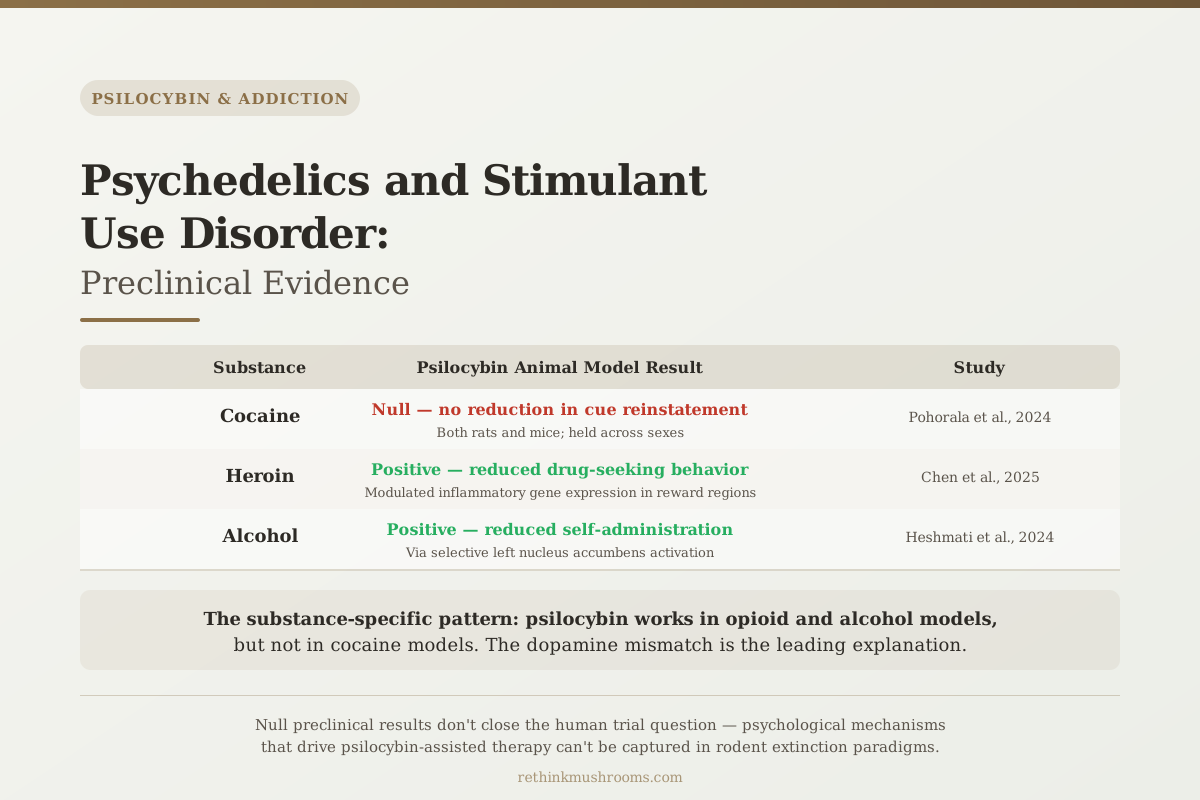
Chen and colleagues' 2025 animal study found that psilocybin reduced heroin-seeking behavior in rodents.[5] This is the opioid comparison: same drug (psilocybin), same class of model (drug-seeking behavior), different substance of abuse, and a positive result. The contrast is direct and substance-specific.
Heshmati and colleagues' 2024 study found psilocybin reduced alcohol self-administration in rodents via selective activation of left nucleus accumbens neurons.[4] This adds a third data point: psilocybin reduces alcohol taking through a specific reward-circuit mechanism. The finding also provides a mechanistic clue: selective nucleus accumbens activation appears to be a route through which psilocybin modulates alcohol reward behavior.
| Substance | Psilocybin Animal Model Result | Study |
|---|---|---|
| Cocaine | Null — no reduction in cue reinstatement | Pohorala et al., 2024 |
| Heroin | Positive — reduced drug-seeking behavior | Chen et al., 2025 |
| Alcohol | Positive — reduced self-administration | Heshmati et al., 2024 |
This table represents the current preclinical comparison. It does not mean psilocybin will fail in humans with cocaine use disorder, because human therapeutic contexts introduce psychological mechanisms that animal models can't capture. But it does suggest that whatever mechanisms drive psilocybin's beneficial effects for opioid and alcohol addiction operate differently or less effectively in cocaine models.
Why the Systems Are Different: The Dopamine Data
The mechanism question comes down to dopamine. Cocaine acts on dopamine transporters, blocking reuptake and flooding the nucleus accumbens with dopamine. Psilocybin acts primarily on serotonin (5-HT2A) receptors. These are different systems, and their interaction is indirect and complex.
Sakashita and colleagues' 2015 study is the most direct measurement available.[2] They measured extracellular dopamine levels in real time in awake rats after psilocin administration, in two different brain regions simultaneously. In the nucleus accumbens, the reward region, psilocin increased dopamine. In the medial prefrontal cortex, the top-down control region that modulates impulse and craving, psilocin decreased dopamine. Serotonin increased in the prefrontal cortex.
This region-specific pattern is important. The nucleus accumbens dopamine increase could theoretically modulate reward sensitivity. But the prefrontal cortex dopamine decrease is a complication: the prefrontal cortex is needed for inhibitory control over drug-seeking. Reducing prefrontal dopamine could, in principle, impair exactly the top-down suppression of cocaine cravings that treatment aims to strengthen.
Howell and Cunningham's 2015 pharmacological review of 5-HT2 receptors and dopamine in cocaine use disorder maps the mechanism in detail.[3] The 5-HT2A receptor, when activated, stimulates glutamate release from prefrontal pyramidal neurons, which activates VTA dopamine neurons, which increases dopamine in the nucleus accumbens. The 5-HT2C receptor, also activated by psilocybin to a lesser degree, works in the opposing direction, reducing mesolimbic dopamine. The net effect on phasic dopamine release triggered by cocaine cues is therefore uncertain and depends on the balance of 5-HT2A and 5-HT2C activation.
Valdez's 2024 review proposes a specific hypothesis: moderate psilocybin-induced elevation of tonic (baseline) striatal dopamine could reduce the excessive phasic bursts triggered by cocaine cues, essentially lowering the system's reactivity to drug-associated triggers.[6] This is a reasonable mechanistic argument. What the Pohorala 2024 result tells us is that, at tested doses and in rodent extinction-reinstatement paradigms, this hypothesized effect did not translate into behavioral change. The mechanism may be real; the effect size may be insufficient; or rodent models may simply not capture it.
Why Null Preclinical Results Don't Settle the Human Question
Brett and colleagues' 2023 rationale paper for psilocybin-assisted therapy in methamphetamine use disorder raises a point that applies equally to cocaine.[7] Rodent cue reinstatement models test direct pharmacological effects on drug-conditioned behavior. They do not model the human experience of insight, identity change, and psychological flexibility that psilocybin-assisted therapy aims to facilitate.
For opioid addiction, psilocybin may produce direct pharmacological engagement with the circuits that drive drug-seeking, explaining why the animal model results are positive. For stimulant addiction, the proposed mechanism is primarily psychological and neuroplasticity-based: psilocybin opens a window of cognitive flexibility and disrupts the Default Mode Network's tendency to reinforce habitual patterns of drug use and self-narrative. This mechanism is hard to test in rodents, which don't have the same capacity for insight, meaning-making, or identity restructuring that human therapy leverages.
This is not a rationalization for ignoring null results. It is the field's genuine hypothesis for why human trials may succeed even where animal models show null effects, and it needs to be tested directly in controlled human studies. The absence of that human data is the core gap in the stimulant addiction literature as of 2026. For the psilocybin and neuroplasticity rewiring the brain mechanism that underlies this hypothesis, see that article.
The full picture for the cocaine-specific clinical pipeline, including the UAB trial and observational findings, is covered in psilocybin for cocaine addiction: emerging research. For the dopamine pathways mechanism in more depth, see psilocybin and dopamine pathways: implications for stimulant addiction.
The Bottom Line
The preclinical evidence for psilocybin and stimulant use disorder is substance-specific. For cocaine, the 2024 Pohorala study found null results in both rats and mice using cue reinstatement models — in contrast to positive results for heroin-seeking (Chen 2025) and alcohol self-administration (Heshmati 2024). The mechanistic data from Sakashita 2015 shows psilocin produces opposing dopamine effects in the reward circuit and prefrontal cortex, and Howell 2015 maps the 5-HT2A/2C crosstalk as an indirect and uncertain route to modulating cocaine-driven dopamine. The proposed explanation for why human trials may still succeed despite animal model null results is that psilocybin's primary mechanism for stimulant addiction operates through neuroplasticity and psychological transformation rather than direct pharmacological engagement with drug-seeking circuits.
Frequently Asked Questions
Sources & References
- 1RTHM-01967·Pohořalá, Veronika et al. (2024). “Psilocybin administered following extinction sessions does not affect subsequent cocaine cue reinstatement in male and female rats and mice..” Neuroscience.Study breakdown →PubMed →↩
- 2RTHM-00731·Sakashita, Yuichi et al. (2015). “Effect of psilocin on extracellular dopamine and serotonin levels in the mesoaccumbens and mesocortical pathway in awake rats..” Biological & pharmaceutical bulletin.Study breakdown →PubMed →↩
- 3RTHM-00693·Howell, Leonard L et al. (2015). “Serotonin 5-HT2 receptor interactions with dopamine function: implications for therapeutics in cocaine use disorder..” Pharmacological reviews.Study breakdown →PubMed →↩
- 4. Source details for this reference are not yet available.
- 5. Source details for this reference are not yet available.
- 6RTHM-02007·Valdez, Tamara et al. (2024). “Therapeutic Potential of Psychedelic Compounds for Substance Use Disorders..” Pharmaceuticals (Basel.Study breakdown →PubMed →↩
- 7RTHM-01663·Brett, Jonathan et al. (2023). “Exploring psilocybin-assisted psychotherapy in the treatment of methamphetamine use disorder..” Frontiers in psychiatry.Study breakdown →PubMed →↩