Psilocybin & Stimulant Addiction
0 Trials
No published clinical trial has tested psilocybin for cocaine use disorder. The rationale for investigating it rests entirely on evidence from other substances and preclinical neuroscience.
As of April 2026
40.5%
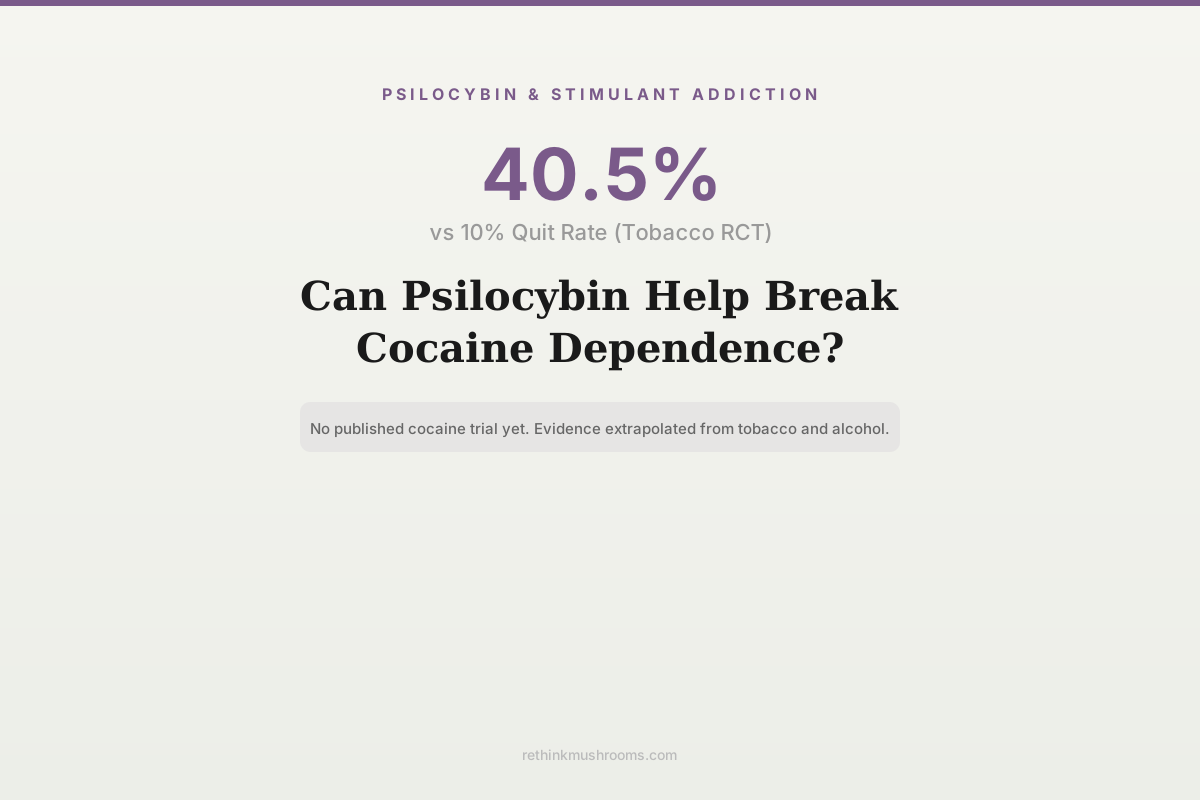
quit rate with psilocybin vs 10% nicotine patch in a smoking cessation RCT
83%
reduction in heavy drinking days with psilocybin vs placebo in an AUD trial
2 Ongoing
early-phase trials of psilocybin for cocaine use disorder (as of 2026)
As of April 2026
 View as image ↗
This article is about evidence that does not yet exist. No published clinical trial has tested psilocybin for cocaine use disorder (CUD). There are no efficacy data, no dose-response curves, no safety profiles specific to people with cocaine dependence. What does exist is a converging set of findings from other substance use disorders, from population surveys, and from neuroscience that makes the hypothesis plausible enough to test. Two early-phase trials are now underway. Whether psilocybin will prove useful for cocaine addiction is a genuinely open question with an honest answer: we do not know yet. For related research on psilocybin and the dopamine system, see psilocybin and dopamine pathways: implications for stimulant addiction.
Key Takeaways
- No published clinical trial has tested psilocybin specifically for cocaine use disorder; two early-phase trials are ongoing at UCLA and the University of Alabama at Birmingham (as of 2026)
- In a pilot RCT, 40.5% of smokers receiving psilocybin plus CBT achieved 6-month biochemically verified abstinence versus 10% on nicotine patch plus CBT (OR 6.12, p=0.003) (Johnson et al., 2026)
- In the first double-blind RCT for alcohol use disorder, psilocybin reduced heavy drinking days by 83% versus 51% for placebo over 32 weeks (Bogenschutz et al., 2022)
- A NSDUH population survey found that past use of peyote/mescaline (but not LSD or psilocybin) was associated with lower odds of past-year substance dependence (aOR 0.68, p<0.001) (Rabinowitz et al., 2022)
- A single psilocybin dose increased synaptic density in pig prefrontal cortex and hippocampus, persisting at least 7 days, measured by SV2A PET imaging (Raval et al., 2021)
- Psilocybin promotes neuroplasticity and induces rapid antidepressant-like effects in mice through structural dendritic spine growth in prefrontal cortex (Zhao et al., 2024)
Why Cocaine Addiction Is Uniquely Difficult to Treat
Cocaine use disorder lacks any FDA-approved pharmacological treatment. This distinguishes it from alcohol (naltrexone, acamprosate, disulfiram), opioids (methadone, buprenorphine, naltrexone), and tobacco (nicotine replacement, varenicline, bupropion). Behavioral therapies produce modest outcomes: contingency management and CBT show the best evidence, but relapse rates remain high, with most clinical trials reporting 40-60% relapse within the first year of treatment.
Cocaine's primary mechanism is blockade of the dopamine transporter, causing dopamine accumulation in the synaptic cleft and producing the intense reinforcing effects that drive compulsive use. Chronic cocaine use reorganizes reward circuits, reducing baseline dopamine receptor density and function, which creates a persistent vulnerability to craving and relapse even after extended abstinence. This neuroadaptation is why cocaine addiction is classified as a chronic, relapsing condition.
The absence of effective pharmacotherapy has motivated interest in alternative approaches, including psychedelic-assisted therapy. The rationale is not that psilocybin acts on dopamine circuits directly (it primarily targets serotonin 5-HT2A receptors), but that it may disrupt entrenched behavioral patterns through neuroplasticity-related mechanisms that operate upstream of the specific neurotransmitter system involved in each addiction.
The Tobacco Evidence: Psilocybin's Strongest Addiction Data
The strongest published evidence for psilocybin in addiction treatment comes from tobacco, which shares certain features with cocaine dependence: both are driven by powerful reinforcement learning, both produce persistent craving after cessation, and both have high relapse rates despite available treatments.
Johnson et al. (2014) published the foundational open-label pilot study: 15 psychiatrically healthy smokers (mean 31 years of smoking, mean 19 cigarettes per day, mean 6 prior quit attempts) received two to three moderate-to-high doses of psilocybin (20-30 mg/70 kg) within a structured 15-week smoking cessation program. At 6-month follow-up, 12 of 15 participants (80%) showed biologically verified abstinence, substantially exceeding the under 35% rates typical of other pharmacological and behavioral interventions.[1]
Johnson et al. (2017) reported long-term follow-up of this cohort. At 12 months, 10 of 15 participants (67%) remained abstinent. At a mean of 30 months (range 16-57 months), 9 of 15 (60%) were confirmed abstinent. Notably, 86.7% of participants rated their psilocybin experiences among the five most personally meaningful and spiritually significant experiences of their lives.[2]
Johnson et al. (2026) published the pilot randomized clinical trial comparing psilocybin to nicotine patch: 82 smokers were randomized to receive either one high dose of psilocybin (30 mg/70 kg) or 8-10 weeks of nicotine patch, both with 13-week manualized CBT. At 6-month follow-up, 40.5% of the psilocybin group showed biochemically verified prolonged abstinence versus 10% in the nicotine patch group (OR 6.12, 95% CI 1.99-23.26, p=0.003). Seven-day point prevalence abstinence was 52.4% versus 25.0% (OR 3.30, p=0.01). No serious adverse events were attributed to psilocybin.[3] For a deeper dive into these results, see 80% quit rate: how psilocybin helps smokers stop.
Garcia-Romeu et al. (2014) analyzed the role of mystical-type experiences during psilocybin sessions and found that the strength of the mystical experience was a significant predictor of tobacco abstinence outcomes, suggesting the therapeutic mechanism involves more than pharmacology alone.[4]
The Alcohol Evidence: Psilocybin's First Double-Blind RCT for Addiction
Bogenschutz et al. (2022) published the landmark double-blind RCT of psilocybin for alcohol use disorder (AUD). Ninety-five adults with DSM-IV alcohol dependence were randomized to receive either psilocybin (25-40 mg/70 kg) or diphenhydramine (active placebo) during two day-long sessions, alongside 12 weeks of manualized psychotherapy combining motivational enhancement therapy and CBT.[5]
Over the 32-week double-blind follow-up period, the psilocybin group showed an 83% reduction in heavy drinking days from baseline, compared to 51% in the placebo group. The mean percentage of heavy drinking days was 9.7% in the psilocybin group versus 23.6% in the placebo group. This is the first rigorous, double-blind, placebo-controlled demonstration that psilocybin-assisted therapy can reduce substance use more effectively than psychotherapy with an active placebo.
The AUD trial is more relevant to cocaine than the tobacco trials in one respect: alcohol and cocaine both act on mesolimbic dopamine circuits (alcohol indirectly, cocaine directly), whereas nicotine acts primarily through nicotinic acetylcholine receptors. If psilocybin's anti-addiction effect operates through a mechanism upstream of specific reward circuits, the AUD success makes cocaine application more plausible.
Borrowed Evidence
What Psilocybin Has Been Shown To Do — And Where Cocaine Sits
Tobacco
6-month biochemically verified abstinence
Johnson et al., 2026
Alcohol
Reduction in heavy drinking days (32 wks)
Bogenschutz et al., 2022
Cocaine
No measured outcome of any kind
The tobacco and alcohol rows are randomized human data. The cocaine row is intentionally empty: the entire rationale for testing psilocybin in cocaine use disorder is transferred from these other substances and from mechanism, not from any direct measurement in cocaine.
Sources: Johnson et al., JAMA Network Open, 2026 (tobacco, 40.5% vs 10.0%; RTHM-02234); Bogenschutz et al., JAMA Psychiatry, 2022 (alcohol, 83% vs 51%; RTHM-01488). Cocaine: no published trial as of 2026.
Population Data: Psychedelic Use and Cocaine Dependence
Rabinowitz et al. (2022) used 2017 National Survey on Drug Use and Health (NSDUH) data (n=56,276) to test whether past naturalistic use of classic psychedelics was associated with substance dependence or abuse.[6]
The results were mixed. Past use of peyote/mescaline was associated with lower odds of past-year substance dependence or abuse (adjusted OR 0.68, p<0.001). Past use of LSD and psilocybin were associated with increased odds of substance dependence or abuse, though this may reflect reverse causation (people with substance problems may be more likely to try various drugs, including psychedelics). Past use of classic psychedelics was not associated with nicotine dependence.
Population survey data cannot establish causation. People who have used psilocybin differ from non-users in ways that surveys cannot fully capture. The peyote/mescaline finding is interesting because these substances are often used in ceremonial contexts (Native American Church) with structured social support, which may be a more relevant analogue to clinical psilocybin-assisted therapy than recreational LSD or psilocybin use. The data do not support claiming that psychedelic use protects against cocaine addiction, but they do argue against the hypothesis that psychedelic exposure worsens it.
The Neuroplasticity Mechanism
The biological rationale for why psilocybin might help with cocaine addiction centers on neuroplasticity, the brain's capacity to reorganize synaptic connections.
Raval et al. (2021) provided the first in vivo evidence that psilocybin increases synaptic density in mammalian brain tissue. Using SV2A PET imaging in pigs, they showed that a single psilocybin dose increased synaptic vesicle glycoprotein 2A (a marker of synaptic density) in prefrontal cortex and hippocampus, with effects persisting at least 7 days after administration. The same dose decreased 5-HT2A receptor density, consistent with receptor downregulation following agonist stimulation.[7] For the receptor science underlying this, see 5-HT2A receptor density and psilocybin response.
Zhao et al. (2024) extended the neuroplasticity evidence in mice, demonstrating that psilocybin promotes structural dendritic spine growth in prefrontal cortex neurons and induces rapid, sustained antidepressant-like behavioral effects. The structural changes (new spine formation) are distinct from the acute pharmacological effects (5-HT2A agonism) and persist beyond the drug's elimination from the body.[8]
Cocaine addiction is characterized by reduced synaptic density and dendritic spine loss in prefrontal cortex, the brain region responsible for impulse control, decision-making, and executive function. The loss of prefrontal synaptic connections is thought to weaken the brain's capacity to override drug-seeking impulses generated by subcortical reward circuits. If psilocybin can restore prefrontal synaptic density, it could theoretically strengthen the top-down control mechanisms that chronic cocaine use has degraded.
Madsen et al. (2019) established the receptor pharmacology underlying psilocybin's effects, showing that the psychedelic experience correlates with serotonin 2A receptor occupancy and plasma psilocin levels, providing the dose-response framework for future clinical applications.[9]
The Subjective Experience Component
Noorani et al. (2018) published a qualitative analysis of participant accounts from the psilocybin smoking cessation study, finding that participants described the experience as providing new perspectives on their relationship with smoking, a sense of interconnectedness, and a reorientation of personal values away from the habitual behavior.[10]
This subjective component is relevant to cocaine because cocaine addiction, like tobacco addiction, involves deeply entrenched behavioral routines, identity constructs ("I'm a user"), and social contexts that reinforce use. If psilocybin's therapeutic mechanism includes disrupting rigid self-models and allowing new perspectives on habitual behavior, this mechanism is substance-agnostic and could theoretically apply to cocaine as readily as to tobacco or alcohol.
The counterargument is that cocaine dependence involves more acute physiological withdrawal effects, stronger dopaminergic reinforcement, and different social contexts than tobacco or alcohol use in many populations. Whether psilocybin's capacity to shift psychological perspective can override the more intense neurochemical reinforcement of cocaine is unknown. For how psilocybin changes brain connectivity patterns that might underlie this perspective shift, see brain connectivity before and after psilocybin: visual evidence.
Ongoing Trials
Two early-phase clinical trials are investigating psilocybin specifically for cocaine use disorder as of 2026:
- UCLA: Establishing safe administration of psilocybin in individuals with cocaine use disorder, focusing on cardiovascular and subjective effects (the cardiovascular monitoring is important because both psilocybin and cocaine can increase heart rate and blood pressure, creating a potential safety concern in active users)
- University of Alabama at Birmingham: A placebo-controlled pilot study of 40 patients with cocaine dependence
Neither trial has published results. The safety question is particularly important for cocaine: psilocybin and cocaine both activate sympathetic nervous system responses, and the combination could theoretically pose cardiovascular risks. The ongoing trials are designed to establish safety profiles before efficacy can be assessed.
Cardiovascular Safety
ModerateCombining psilocybin with active cocaine use carries unstudied cardiovascular risk
Concern
Both psilocybin and cocaine activate the sympathetic nervous system and can raise heart rate and blood pressure. In someone who is actively using cocaine, the overlapping cardiovascular load is a theoretical risk that has not been characterized in any published study.
What the research says
No published trial has measured this interaction. The UCLA early-phase trial is specifically designed to establish the cardiovascular and subjective safety of psilocybin in individuals with cocaine use disorder before any efficacy question is addressed.
Particularly relevant for: People with active or recent cocaine use
What to do
This article is educational and not medical advice. Psilocybin is a Schedule I substance in the United States; it should not be combined with cocaine or used to self-treat addiction outside a supervised clinical trial. Anyone seeking help for cocaine dependence should consult a licensed clinician.
UCLA cocaine use disorder safety trial (ongoing, as of 2026)
What the Evidence Supports and What It Does Not
- Cocaine-specific animal modelsmissing
No published psilocybin cocaine self-administration data underpin this article; the preclinical evidence here is neuroplasticity, not cocaine behavior
- Human case reportsmissing
None published for psilocybin in cocaine use disorder
- Early-phase human trialscurrent
Two early-phase trials ongoing (UCLA safety; UAB placebo-controlled pilot, n=40) — no results reported
- Large randomized controlled trialmissing
None conducted
- Meta-analysismissing
Not possible without trial data
For cocaine specifically, the ladder is nearly empty: two early-phase trials are underway but none have reported. Every higher rung of confidence — the tobacco and alcohol RCTs — belongs to other substances, and is borrowed by analogy rather than measured in cocaine.
UCLA and University of Alabama at Birmingham trial registrations (as of 2026)
| Question | Current evidence | Confidence |
|---|---|---|
| Does psilocybin help with tobacco addiction? | Yes: pilot RCT showed OR 6.12 for abstinence vs nicotine patch | Moderate |
| Does psilocybin help with alcohol use disorder? | Yes: double-blind RCT showed 83% vs 51% reduction in heavy drinking | Moderate |
| Does psilocybin help with cocaine addiction? | Unknown: no published trial data | None |
| Is the neuroplasticity mechanism relevant to cocaine? | Plausible: cocaine degrades prefrontal synapses; psilocybin promotes their growth | Low |
| Is psilocybin safe in people with cocaine use disorder? | Unknown: under investigation in two ongoing trials | None |
| Do population surveys support the hypothesis? | Mixed: peyote/mescaline associated with lower SUD odds; LSD/psilocybin associations inconsistent | Low |
For the broader research on psychedelics and stimulant use disorders, see psilocybin and stimulant addiction: early-phase research on cocaine and meth, and for the preclinical evidence specifically, see psychedelics and stimulant use disorder: preclinical evidence.
The Bottom Line
No published clinical trial has tested psilocybin for cocaine use disorder. The rationale rests on the tobacco cessation RCT (40.5% vs 10% quit rate), the alcohol use disorder RCT (83% vs 51% reduction in heavy drinking), neuroplasticity evidence showing psilocybin restores synaptic density in prefrontal cortex, and population data with mixed results on psychedelic use and substance dependence. Two early-phase trials are underway. Whether psilocybin's anti-addiction effects generalize from tobacco and alcohol to cocaine remains an open question.
Frequently Asked Questions
Sources & References
- 1RTHM-00328·Johnson, Matthew W et al. (2014). “Pilot study of the 5-HT2AR agonist psilocybin in the treatment of tobacco addiction..” Journal of psychopharmacology (Oxford.Study breakdown →PubMed →↩
- 2RTHM-00475·Johnson, Matthew W et al. (2017). “Long-term follow-up of psilocybin-facilitated smoking cessation..” The American journal of drug and alcohol abuse.Study breakdown →PubMed →↩
- 3RTHM-00960·Johnson, Matthew W et al. (2026). “Psilocybin or Nicotine Patch for Smoking Cessation: A Pilot Randomized Clinical Trial..” JAMA network open.Study breakdown →PubMed →↩
- 4RTHM-00321·Garcia-Romeu, Albert et al. (2014). “Psilocybin-occasioned mystical experiences in the treatment of tobacco addiction..” Current drug abuse reviews.Study breakdown →PubMed →↩
- 5RTHM-00746·Bogenschutz, Michael P et al. (2022). “Percentage of Heavy Drinking Days Following Psilocybin-Assisted Psychotherapy vs Placebo in the Treatment of Adult Patients With Alcohol Use Disorder: A Randomized Clinical Trial..” JAMA psychiatry.Study breakdown →PubMed →↩
- 6RTHM-00792·Rabinowitz, Jonina et al. (2022). “The association between naturalistic use of psychedelics and co-occurring substance use disorders..” Frontiers in psychiatry.Study breakdown →PubMed →↩
- 7RTHM-00714·Raval, Nakul Ravi et al. (2021). “A Single Dose of Psilocybin Increases Synaptic Density and Decreases 5-HT2A Receptor Density in the Pig Brain..” International journal of molecular sciences.Study breakdown →PubMed →↩
- 8RTHM-00920·Zhao, Xiangting et al. (2024). “Psilocybin promotes neuroplasticity and induces rapid and sustained antidepressant-like effects in mice..” Journal of psychopharmacology (Oxford.Study breakdown →PubMed →↩
- 9RTHM-00578·Madsen, Martin K et al. (2019). “Psychedelic effects of psilocybin correlate with serotonin 2A receptor occupancy and plasma psilocin levels..” Neuropsychopharmacology : official publication of the American College of Neuropsychopharmacology.Study breakdown →PubMed →↩
- 10RTHM-00523·Noorani, Tehseen et al. (2018). “Psychedelic therapy for smoking cessation: Qualitative analysis of participant accounts..” Journal of psychopharmacology (Oxford.Study breakdown →PubMed →↩