Psilocybin & Addiction
Day 28 craving reduction
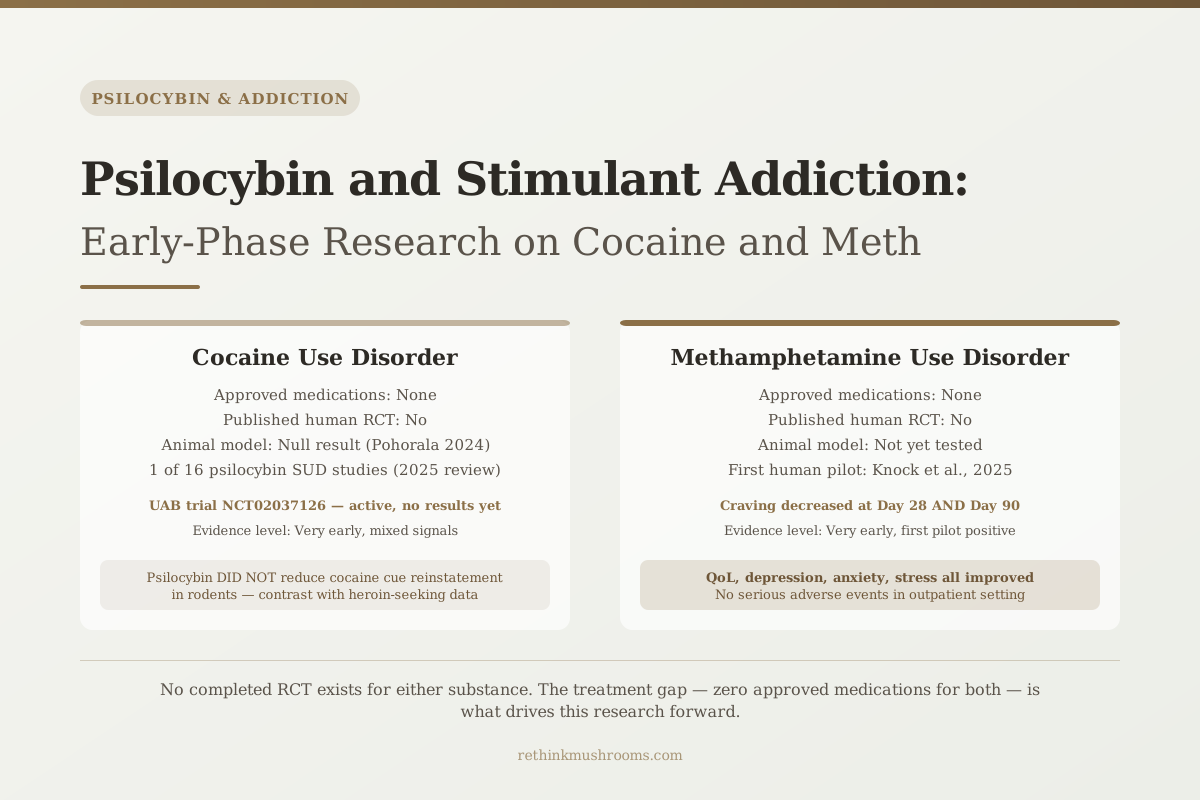
Knock and colleagues' 2025 open-label pilot, the first human study of psilocybin for methamphetamine use disorder, found meth cravings decreased significantly from baseline at both day 28 and day 90, with improved quality of life and no serious adverse events.
Knock et al., Journal of Substance Use & Addiction Treatment, 2025
0
approved medications for cocaine or methamphetamine use disorder as of 2026
1 of 16
psilocybin SUD studies addressing cocaine, per the 2025 systematic review — showing how early this field is
Null
psilocybin's effect on cocaine cue reinstatement in the Pohorala 2024 rodent study
Knock et al., Journal of Substance Use & Addiction Treatment, 2025
 View as image ↗
There are no approved medications for cocaine use disorder. There are no approved medications for methamphetamine use disorder either. Unlike opioid addiction, where methadone, buprenorphine, and naltrexone give clinicians real pharmacological options, stimulant addiction has none. Contingency management, a behavioral intervention that rewards abstinence with vouchers or small prizes, is one of the few evidence-based options for both conditions, and while it helps many patients, relapse rates remain high.
That treatment gap is what's driving interest in psilocybin-assisted therapy for both cocaine and methamphetamine use disorder. In 2025, Knock and colleagues published the first human pilot data for psilocybin in methamphetamine use disorder: craving decreased significantly from baseline at day 28 and remained lower at day 90.[1] The psilocybin stimulant addiction research for cocaine looks different: a 2024 rodent study found psilocybin did not reduce cocaine cue-induced relapse behavior, a null result that stands in notable contrast to more consistent animal data for opioids.[4]
The research on psilocybin for alcohol addiction, with multiple completed RCTs, offers a reference point for how far behind the cocaine and methamphetamine evidence currently sits. That distance matters for reading this research honestly.
Key Takeaways
- Knock and colleagues (2025) published the first open-label pilot of psilocybin-assisted psychotherapy for methamphetamine use disorder: craving decreased significantly at both day 28 and day 90 follow-up; quality of life, depression, anxiety, and stress all improved; no safety concerns in outpatient settings
- Methamphetamine use disorder has no approved pharmacotherapy; psilocybin's proposed mechanisms for meth — neuroplasticity, DMN disruption, emotional processing facilitation — are different from its mechanism for alcohol, which has direct reward-circuit data (Brett et al., Frontiers in Psychiatry, 2023)
- Pohorala and colleagues (2024) found psilocybin did NOT reduce cocaine cue-induced reinstatement in rodent models — a null result that contrasts with positive animal data for heroin-seeking (Chen et al., 2025) and alcohol self-administration
- A 2025 systematic review of all psilocybin SUD studies found only 1 study (of 16 published) directly addressed cocaine use disorder — placing this among the most evidence-sparse areas of psilocybin addiction research
- The cocaine-meth distinction matters: cocaine has more epidemiological research but more skeptical animal data; meth has the first positive human pilot but no animal model data yet
- No completed randomized controlled trial for psilocybin in either cocaine or methamphetamine use disorder has been published as of 2026
The Treatment Vacuum: Why Both Cocaine and Meth Lack What Opioid Addiction Has
Opioid use disorder has three FDA-approved medications: methadone, buprenorphine (with and without naloxone), and naltrexone. These work by directly engaging the opioid receptor system, either substituting for the drug of addiction or blocking its effects. The pharmacological logic is clear: opioids target the opioid receptor; opioid medications also target the opioid receptor.
Cocaine and methamphetamine both primarily dysregulate dopamine, flooding the brain's reward system with more dopamine than it can regulate. There is no approved dopamine agonist or antagonist that works the way opioid medications do for opioid addiction. Decades of research attempting to find one have not produced an approved compound. For methamphetamine specifically, the approved stimulant treatments used for ADHD (amphetamines themselves) are sometimes used off-label with limited evidence, but no medication is approved for methamphetamine use disorder.
This is why psilocybin researchers find stimulant addiction worth studying. If psilocybin works for addiction via psychological and neuroplasticity mechanisms, rather than by directly substituting for the addictive substance, then the absence of a pharmacological competitor doesn't disqualify it. The question is whether those indirect mechanisms are enough.
A 2025 systematic review of all published psilocybin studies for substance use disorders found only 1 study specifically addressing cocaine use disorder out of 16 published studies in the field.[3] The review found stronger evidence for alcohol and tobacco. For stimulants, the honest characterization is that research is at the earliest exploratory stage.
The First Human Data for Meth: What Knock 2025 Found
Until 2025, no published human study had tested psilocybin-assisted therapy specifically for methamphetamine use disorder. A 2023 rationale paper by Brett and colleagues had laid out the theoretical case for the combination, but without human data to point to.[2]
Knock and colleagues changed that. Their 2025 pilot enrolled adults with methamphetamine use disorder in an open-label study of psilocybin-assisted psychotherapy. The findings, published in the Journal of Substance Use and Addiction Treatment, showed methamphetamine craving decreased significantly from baseline at day 28 and remained lower at day 90.[1] Quality of life improved. Depression, anxiety, and stress scores all moved in the right direction. The outpatient setting showed no safety concerns.
Two things about this result are worth holding in mind. First, what it means: this is feasibility and safety data. An open-label pilot with no control group cannot tell us whether the improvement came from psilocybin's pharmacological action, the intensive therapeutic support that accompanies it, expectancy effects, natural fluctuation in craving over time, or some combination. This is not evidence of efficacy. It is evidence that a larger randomized trial is worth running, and that psilocybin-assisted therapy is deliverable in this population without serious adverse events.
Second, what makes the craving trajectory notable: the day-90 result. Most craving-focused treatments show improvement during active therapy that fades when treatment ends. The persistence at three months, in a single-dose study, is the same kind of durable signal seen in the alcohol and tobacco trials. Whether that durability holds in a larger controlled study is the question a Phase 2 trial would answer.
For more on how the craving reduction mechanism works across addictions, see psilocybin and craving reduction: mechanisms of action.
Why Methamphetamine May Be a Particularly Good Candidate
Brett and colleagues' 2023 rationale paper makes an argument that's worth understanding, because it explains why some researchers think psilocybin's mechanism may actually be better suited to meth addiction than to other stimulant use disorders.[2]
Methamphetamine does something to the brain that cocaine does with less severity: it produces profound and lasting changes to motivational circuitry. Long-term meth use reduces dopamine transporter density, shrinks the prefrontal cortex, and damages the neural architecture of goal-directed behavior. People in early meth recovery often describe a state of anhedonia and motivational paralysis that can last months — the brain struggling to experience reward from anything. This motivational damage is a major reason why treatment is difficult and relapse is common even in people who genuinely want to stop.
Psilocybin's proposed benefit for this profile is not pharmacological substitution. It's neuroplasticity. Psilocybin increases dendritic spine density, temporarily disrupts the Default Mode Network (the brain's self-referential rut), and appears to open a window of psychological flexibility during which entrenched patterns of thought and behavior are more amenable to change. For meth addiction, where the problem is partly a brain that has lost its capacity for normal reward and motivation, this neuroplasticity-based mechanism may be more directly relevant than for conditions with less structural brain damage.
This is the theoretical case. The Knock 2025 pilot provides early human support for it. What it doesn't provide is a mechanistic explanation of which of these proposed pathways actually drove the craving reduction seen at day 28 and day 90.
For the broader picture of psilocybin's neuroplasticity mechanism in addiction, see neuroplasticity and addiction: how psilocybin opens a window and how psilocybin breaks addiction: the neuroscience explained.
The Cocaine Animal Model Problem: Null Results Researchers Can't Ignore
The cocaine preclinical picture looks different from meth, and the difference matters for anyone trying to read this field honestly.
Pohorala and colleagues ran a rigorous 2024 study specifically designed to test whether psilocybin reduces cocaine cue-induced relapse behavior in rodents.[4] They trained rats and mice to self-administer cocaine, then put them through extinction training, then tested whether psilocybin administered after extinction would reduce responding to cocaine-associated cues. The result was a null finding: psilocybin at the tested doses did not reduce cocaine cue reinstatement in either rats or mice.
This is not the result typically reported in popular coverage of psilocybin and addiction. And the contrast with other substances makes it more striking. Chen and colleagues' 2025 animal study found psilocybin reduced heroin-seeking behavior in rodents.[5] Other work has shown psilocybin reduces alcohol self-administration through selective nucleus accumbens activation. For cocaine, the animal model data is null.
A 2024 review by Valdez and colleagues looking at psychedelics across substance use disorders provides context for why.[6] Psilocybin's 5-HT2A receptor activation has indirect dopamine effects, but those effects are indirect and region-specific, not the kind of direct dopamine manipulation that cocaine produces and that would be needed to override a strongly dopamine-conditioned behavior. The review proposes a specific mechanism: moderate elevation of tonic (baseline) dopamine in the striatum could reduce the hyperactive bursts of dopamine triggered by cocaine cues. But this mechanism has not been validated in animal models that would show the expected craving reduction.
The null result doesn't mean psilocybin won't help people with cocaine use disorder. Animal models of cue reinstatement don't map perfectly to human treatment responses, and the psychological mechanisms of psilocybin, the shift in self-narrative, the opening of motivation for change, the disruption of rigid behavioral patterns, might contribute to cocaine recovery in ways that animal models can't capture. But the null result is a data point that the field needs to take seriously, and it explains why the psilocybin cocaine research pipeline moves more cautiously than other areas.
For the detailed preclinical evidence across stimulant use disorders, including the animal models and why the cocaine results diverge from opioid results, see that article.
Side by Side: How the Cocaine and Meth Evidence Compares
| Cocaine Use Disorder | Methamphetamine Use Disorder | |
|---|---|---|
| Approved medications | None | None |
| Completed human RCT published | No | No |
| First human pilot data | Not yet published (trial at UAB: NCT02037126) | Knock et al. (2025) — craving decreased at day 28 and day 90 |
| Animal model results | Null: no cue reinstatement reduction (Pohorala 2024) | Not yet tested in published animal studies |
| Studies in 2025 systematic review | 1 of 16 psilocybin SUD studies | Not separately quantified |
| Proposed primary mechanism | Indirect dopamine crosstalk via 5-HT2A (complex) | Neuroplasticity, DMN disruption, motivation restoration |
| Theoretical strength | Moderate — pharmacological rationale is indirect | Moderate-high — neuroplasticity rationale is specific to meth damage |
| Evidence level (overall) | Very early, mixed preclinical | Very early, first human pilot positive |
The side-by-side comparison shows why these are being studied separately despite both being "stimulant addictions." Meth currently has the more promising early trajectory: the first human pilot is positive and the theoretical basis is specific to what meth uniquely does to the brain. Cocaine has more epidemiological and observational data (including naturalistic studies of psychedelic use in the population), but its animal model results are more discouraging, and the pharmacological mechanism is harder to explain.
For comparison with an addiction category that has substantially stronger psilocybin evidence, see psilocybin and opioid use disorder: can psychedelics break the cycle?.
What Comes Next: Registered Trials and the Research Timeline
The UAB trial (NCT02037126) is the most discussed active study for psilocybin and cocaine use disorder. Early non-published conference presentations from this trial have reported signals consistent with what the broader field has seen, including improved quality of life and days of abstinence. Published results from a completed randomized trial have not yet appeared.
For methamphetamine, the Knock 2025 study establishes a safety and feasibility baseline for a larger Phase 2 randomized trial. The investigators noted that their pilot data supports proceeding to a controlled study. Additional groups have registered methamphetamine trials in Australia and North America.
The 2025 systematic review of all psilocybin SUD research was direct about the stimulant gap: the evidence base for cocaine and meth is years behind alcohol and tobacco.[3] The review found the overall safety profile of psilocybin across populations favorable, which removes one barrier to expanding into stimulant populations. What's needed now is randomized efficacy data. The realistic timeline for published Phase 2 results in either condition is 2028 or later.
For the sibling articles covering specific aspects of this evidence, see psilocybin for cocaine addiction: emerging research, can psilocybin help break cocaine dependence?, and psilocybin and dopamine pathways: implications for stimulant addiction.
The Bottom Line
Two stimulant addictions, cocaine and methamphetamine, both lack approved medications, and both are early-stage targets for psilocybin research. Methamphetamine has the more encouraging current trajectory: the Knock 2025 pilot showed craving reductions at day 28 and day 90 in the first human study, and the theoretical basis (neuroplasticity repairing meth-induced brain damage) is specific and testable. Cocaine's animal model data is more discouraging: a 2024 rodent study found psilocybin did not reduce cocaine cue reinstatement, in contrast to positive heroin-seeking data. No completed RCT exists for either substance as of 2026, and the overall evidence level places stimulant addiction among the least-proven areas of psilocybin addiction research.
Frequently Asked Questions
Sources & References
- 1RTHM-02112·Knock, Elizabeth et al. (2025). “Psilocybin-assisted psychotherapy for methamphetamine use disorder: A pilot open-label safety and feasibility study..” Addiction (Abingdon.Study breakdown →PubMed →↩
- 2RTHM-01663·Brett, Jonathan et al. (2023). “Exploring psilocybin-assisted psychotherapy in the treatment of methamphetamine use disorder..” Frontiers in psychiatry.Study breakdown →PubMed →↩
- 3. Source details for this reference are not yet available.
- 4RTHM-01967·Pohořalá, Veronika et al. (2024). “Psilocybin administered following extinction sessions does not affect subsequent cocaine cue reinstatement in male and female rats and mice..” Neuroscience.Study breakdown →PubMed →↩
- 5. Source details for this reference are not yet available.
- 6RTHM-02007·Valdez, Tamara et al. (2024). “Therapeutic Potential of Psychedelic Compounds for Substance Use Disorders..” Pharmaceuticals (Basel.Study breakdown →PubMed →↩