Psilocybin & Addiction
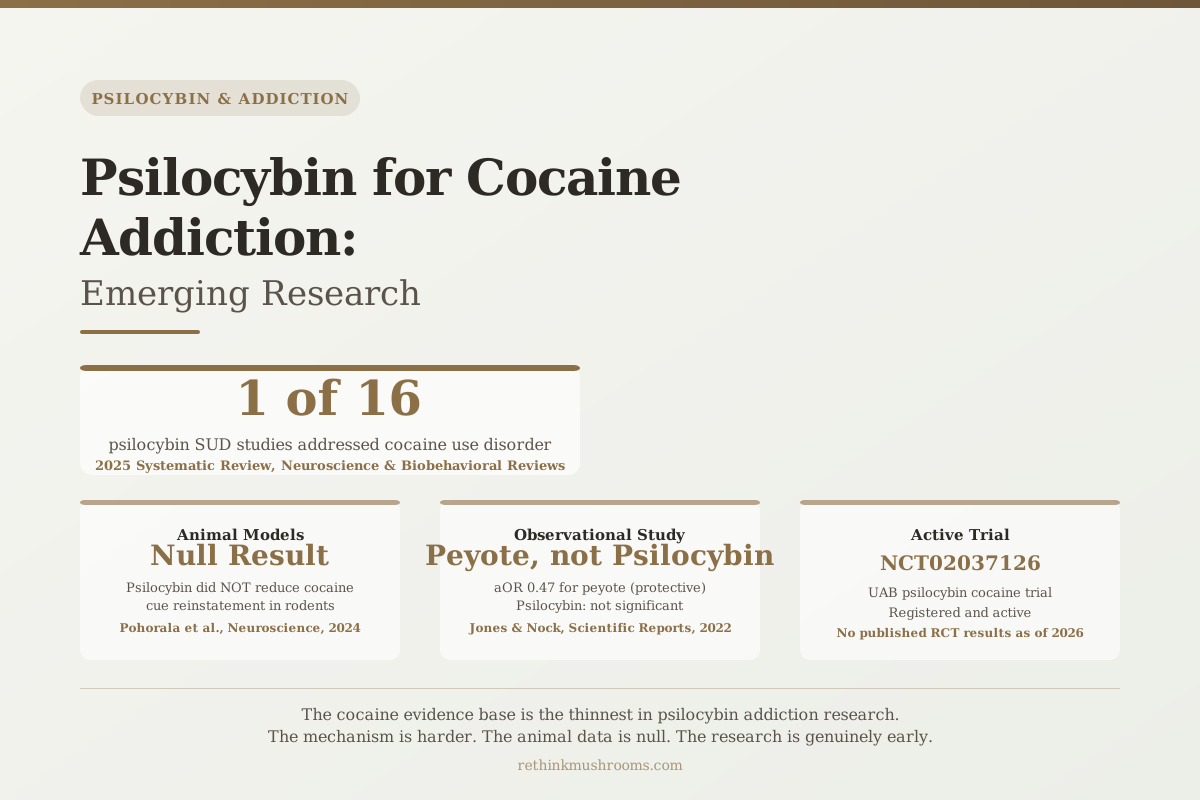
1 of 16 SUD studies
The 2025 systematic review of psilocybin for substance use disorders found only 1 study out of 16 published specifically addressed cocaine use disorder — placing this among the most evidence-sparse areas of psilocybin addiction research.
Systematic Review, Neuroscience & Biobehavioral Reviews, 2025
aOR 0.47
cocaine use disorder odds ratio with peyote — but psilocybin specifically showed no significant association (Jones & Nock, 2022)
Null
psilocybin's effect on cocaine cue reinstatement in rodents — a critical finding absent from popular coverage (Pohorala 2024)
NCT02037126
the UAB psilocybin cocaine trial: active, no published RCT results as of 2026
Systematic Review, Neuroscience & Biobehavioral Reviews, 2025
 View as image ↗
When psilocybin researchers publish new findings on addiction, the headlines usually involve alcohol, tobacco, or opioids. Cocaine use disorder occupies a quieter corner of the literature, and for good reason: the psilocybin cocaine addiction research base is thin, the mechanism is harder to explain than for other substances, and the preclinical data is mixed in ways that don't support confident predictions.
A 2025 systematic review of all published psilocybin research for substance use disorders found that only 1 of 16 studies specifically addressed cocaine use disorder.[1] No completed randomized controlled trial has been published for psilocybin and cocaine use disorder as of 2026. The UAB trial (NCT02037126) is active; its results have not appeared in print. The research on psilocybin for alcohol addiction — with multiple completed RCTs — represents how far ahead other substances are.
This is an honest review of where the psilocybin for cocaine addiction research stands, what the preclinical evidence shows, where the active trials are, and what specific findings have been misread in popular coverage.
Key Takeaways
- A 2025 systematic review found only 1 of 16 published psilocybin SUD studies addressed cocaine use disorder — the thinnest evidence base in the stimulant addiction cluster
- Pohorala and colleagues (2024) found psilocybin did NOT reduce cocaine cue reinstatement in rodent models — a null result that contrasts with positive animal data for heroin-seeking and alcohol self-administration
- Jones and Nock (2022) analyzed 214,505 US adults and found peyote (adjusted odds ratio 0.47) had a significant protective association with cocaine use disorder; psilocybin specifically did NOT show a statistically significant association — a critical distinction that most coverage misses
- Howell and Cunningham (2015) established the core mechanism challenge: cocaine acts directly on the dopamine system; psilocybin targets serotonin (5-HT2A/2C), with only indirect dopamine effects via glutamatergic crosstalk
- The UAB trial (NCT02037126) is the primary active clinical study; no published randomized results exist as of 2026
- Valdez and colleagues (2024) propose that psilocybin's moderate elevation of tonic striatal dopamine may reduce the hyperactive cue-triggered dopamine spikes of cocaine addiction — a mechanistic hypothesis that animal models have not yet validated
Where Cocaine Stands: The Thinnest Evidence Base in Stimulant Research
The 2025 systematic review covering all published psilocybin substance use disorder studies provides the clearest overview of where cocaine sits.[1] Across 16 published psilocybin SUD studies, the review found: alcohol with the strongest clinical evidence base, tobacco with strong evidence, opioids with moderate evidence, and cocaine with a single early study. The review noted the overall safety profile for psilocybin across populations was favorable, which removes one barrier to expanding into cocaine-focused trials. But the efficacy question for cocaine remains unanswered.
| Substance | Completed RCTs | Evidence Level |
|---|---|---|
| Alcohol | Multiple (NYU, Johns Hopkins) | Strong |
| Tobacco | Yes | Strong |
| Opioids | Emerging | Moderate |
| Cocaine | None published | Very early |
| Methamphetamine | None published | Very early (first pilot 2025) |
This table reflects the state of the literature as of the 2025 review, not a judgment about whether cocaine is treatable. The absence of completed RCTs reflects how recently cocaine entered the psilocybin research agenda, not a conclusion about likely efficacy.
The review identified early positive signals in the cocaine study that was included, including improved quality of life and days of abstinence, but a single non-randomized study cannot support clinical conclusions. The review's honest framing is that stimulant addiction is a major gap in the psilocybin literature that warrants targeted research investment.
The Mechanism Challenge: Why Cocaine Is Harder to Target Than Alcohol
Psilocybin works primarily through serotonin receptors, specifically 5-HT2A. Cocaine works through dopamine transporters, blocking the reuptake of dopamine to flood the brain's reward system. These are different biological systems, which creates a genuine question about whether psilocybin can pharmacologically engage the specific circuitry that cocaine dysregulates.
Howell and Cunningham's 2015 review established the detailed mechanism for how psilocybin's serotonin receptors interact with the dopamine system.[5] The 5-HT2A receptor, when activated by psilocybin, stimulates glutamate release from pyramidal neurons in the prefrontal cortex, which in turn activates dopamine-producing neurons in the ventral tegmental area (VTA), increasing dopamine release in the nucleus accumbens, the brain's primary reward region. A second serotonin receptor, 5-HT2C, works in the opposing direction: activating 5-HT2C reduces mesolimbic dopamine.
What this means in practice: psilocybin creates complex, region-specific dopamine changes. In the reward-related mesolimbic pathway, 5-HT2A activation increases dopamine. In the prefrontal cortex, which provides top-down inhibition of drug-seeking, effects are different. Psilocybin does not act on dopamine transporters directly. Its dopamine effects are indirect, slower, and more diffuse than cocaine's direct dopamine flood.
This is why psilocybin's proposed mechanism for cocaine addiction is primarily psychological and neuroplasticity-based rather than pharmacological: not dopamine substitution, but disruption of the psychological patterns and neural rigidity that maintain cocaine use. The question is whether that indirect mechanism is sufficient to produce the kind of durable behavior change that pharmacological mechanisms produce for opioid addiction. The animal model data suggests it may be more complicated than that.
The Null Result That No Journalist Is Reporting
The most important data point in the psilocybin cocaine research literature is one that popular coverage consistently omits: the Pohorala 2024 null result in animal models.
Pohorala and colleagues trained rats and mice to self-administer cocaine, then ran them through extinction training, then tested whether psilocybin given after extinction would reduce responding to cocaine-associated cues — the standard cue reinstatement model for predicting relapse.[2] In both rats and mice, at the doses tested, psilocybin did not reduce cocaine cue-induced reinstatement. The null result held across species and sexes.
The contrast with other substances makes this more significant. For heroin, animal studies have found psilocybin reduces drug-seeking behavior. For alcohol, animal work has found psilocybin reduces self-administration via selective nucleus accumbens activation. For cocaine specifically, the cue reinstatement data is null.
Valdez and colleagues' 2024 review of psychedelics across substance use disorders identifies the same substance-specific pattern.[4] They propose that psilocybin's moderate elevation of tonic (baseline) striatal dopamine could theoretically reduce the excessive phasic (cue-triggered) dopamine bursts that drive cocaine craving. The mechanism is plausible. But the Pohorala data shows it has not translated to the expected behavioral outcome in animal models.
This doesn't mean psilocybin won't help people with cocaine use disorder. Animal cue reinstatement models are imperfect proxies for human treatment response, and the psychological transformation mechanism that psilocybin may produce in human therapeutic contexts is not captured in rodent extinction-reinstatement paradigms. But the null result is a data point that any honest review of the literature needs to present, and it explains why the cocaine research is moving cautiously. For the full preclinical evidence picture, see psychedelics and stimulant use disorder: preclinical evidence.
The Observational Study Most Coverage Gets Wrong
The most cited population-level study in this area is Jones and Nock 2022, a survey-based analysis of 214,505 US adults from the National Survey on Drug Use and Health (2015-2019).[3] The paper examined whether lifetime use of classic psychedelics was associated with lower rates of cocaine use disorder.
The headline finding in most coverage: psychedelics are associated with lower cocaine use disorder. What that coverage consistently omits: the protective association was specific to peyote, not psilocybin. In the adjusted analysis, peyote use was associated with 53% lower odds of cocaine use disorder (adjusted odds ratio 0.47). Psilocybin use did not show a statistically significant protective association with cocaine use disorder in the same data set.
This distinction matters. Peyote contains mescaline, which has a different receptor profile and different cultural contexts of use (often in structured ceremonial settings) than psilocybin mushrooms. The finding that peyote shows a protective association doesn't translate into evidence that psilocybin does. Whether the peyote finding reflects the pharmacology of mescaline, the structured ceremonial context of peyote use, the population characteristics of people who use peyote, or some combination, is not answered by this observational study. And even the peyote finding, because it's observational and cross-sectional, cannot establish causation.
The Jones and Nock 2022 result is useful context: it suggests that classic psychedelic use in general may be associated with reduced cocaine use disorder in the population. It does not specifically validate psilocybin for cocaine use disorder, and it should not be used as though it does.
The UAB Trial and the Active Research Pipeline
The University of Alabama at Birmingham trial (NCT02037126) is the most discussed active clinical study for psilocybin and cocaine use disorder. The trial has been registered and recruiting; as of 2026, no peer-reviewed randomized results have been published. Early non-published reports from conference presentations have noted signals consistent with the general direction of psilocybin addiction research, including improved quality of life and days of abstinence, but published data has not yet appeared for independent evaluation.
Beyond UAB, several other groups have registered psilocybin cocaine trials. The overall pipeline is thin relative to alcohol and tobacco. The 2025 systematic review noted the major evidence gap and called for targeted investment in stimulant-focused research.[1]
The realistic timeline for published Phase 2 RCT results for psilocybin and cocaine use disorder is 2028 or later. The absence of results is not evidence of failure; it reflects how recently the cocaine research agenda began and how long clinical trial timelines run.
For the broader stimulant addiction picture comparing cocaine to methamphetamine (where the first human pilot was published in 2025), see psilocybin and stimulant addiction: early-phase research on cocaine and meth. For how psilocybin's general addiction mechanism works, see how psilocybin breaks addiction: the neuroscience explained. For the specific question of whether psilocybin reduces cocaine cravings and by what mechanism, see psilocybin and craving reduction: mechanisms of action.
For comparison with an addiction category where the evidence is substantially more developed, see psilocybin and opioid use disorder: can psychedelics break the cycle?.
The Bottom Line
As of 2026, psilocybin for cocaine use disorder has no published randomized controlled trial, a 2024 null result in rodent cue reinstatement models, and an observational finding that attributes protective associations to peyote rather than psilocybin specifically. The 2025 systematic review found cocaine as the most evidence-sparse stimulant target in the psilocybin SUD literature. The UAB trial (NCT02037126) is active; the theoretical mechanism via 5-HT2A-mediated dopamine modulation is coherent but not yet supported by preclinical behavioral data. This is an area to watch, not an area where conclusions can yet be drawn.
Frequently Asked Questions
Sources & References
- 1. Source details for this reference are not yet available.
- 2RTHM-01967·Pohořalá, Veronika et al. (2024). “Psilocybin administered following extinction sessions does not affect subsequent cocaine cue reinstatement in male and female rats and mice..” Neuroscience.Study breakdown →PubMed →↩
- 3RTHM-01547·Jones, Grant M et al. (2022). “Exploring protective associations between the use of classic psychedelics and cocaine use disorder: a population-based survey study..” Scientific reports.Study breakdown →PubMed →↩
- 4RTHM-02007·Valdez, Tamara et al. (2024). “Therapeutic Potential of Psychedelic Compounds for Substance Use Disorders..” Pharmaceuticals (Basel.Study breakdown →PubMed →↩
- 5RTHM-00693·Howell, Leonard L et al. (2015). “Serotonin 5-HT2 receptor interactions with dopamine function: implications for therapeutics in cocaine use disorder..” Pharmacological reviews.Study breakdown →PubMed →↩