Reishi as Adaptogen
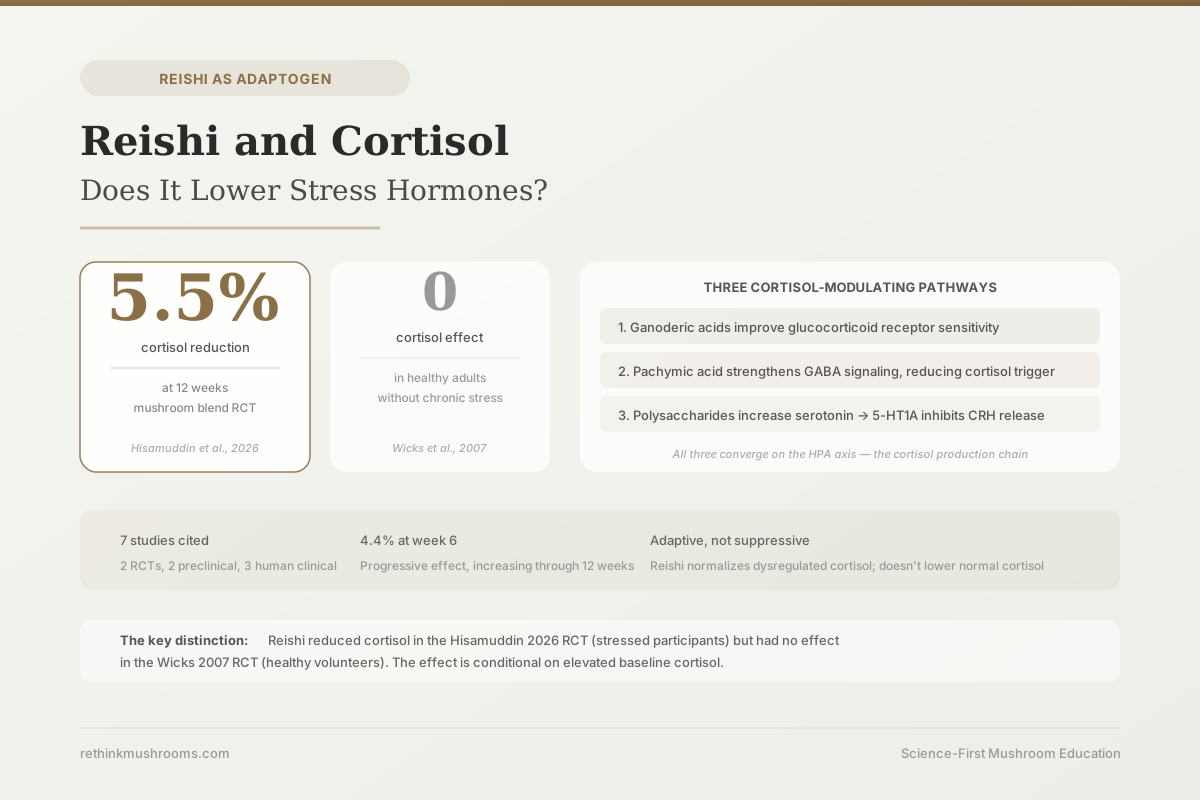
5.5% cortisol reduction
A 12-week double-blind RCT found a mushroom blend including Reishi reduced serum cortisol by 4.4% at week 6 and 5.5% at week 12. In a separate double-blind RCT in healthy unstressed volunteers, Reishi produced no cortisol reduction at all.
Hisamuddin et al., Brain and Behavior, 2026; Wicks et al., Human Psychopharmacology, 2007
4.4%
cortisol reduction at week 6 in the Hisamuddin 2026 controlled trial
0
cortisol effect in healthy non-stressed adults in a separate double-blind RCT (Wicks 2007)
12 wks
minimum duration showing measurable cortisol reduction in controlled trial data
Hisamuddin et al., Brain and Behavior, 2026; Wicks et al., Human Psychopharmacology, 2007
 View as image ↗
The short answer to whether Reishi lowers cortisol is: probably, if your cortisol is elevated from chronic stress, and not if you're healthy and unstressed. That distinction matters more than any single study result, and it's what most supplement content gets wrong by either overclaiming or dismissing entirely.
The controlled human data for Reishi and cortisol is limited but more specific than most people know. A 2026 double-blind randomized controlled trial published in Brain and Behavior measured serum cortisol at 6 and 12 weeks in participants taking a mushroom blend. A 2007 double-blind RCT in healthy volunteers specifically looked for cortisol effects and found none. Together, these two trials define the window where Reishi's cortisol effects actually show up: in people whose stress systems are dysregulated, not in people whose stress systems are working normally. This article covers what those trials found, how the mechanism works, what the supporting human evidence shows, and what's still missing. For the broader context on Reishi's biology and effects, see What Is Reishi Mushroom? A Science-Based Introduction.
Key Takeaways
- A 12-week double-blind RCT found a mushroom blend including Reishi reduced serum cortisol by 4.4% at week 6 and 5.5% at week 12, alongside significant reductions in anxiety and fatigue — the first controlled human cortisol data of its kind, unreported in consumer content (Hisamuddin et al., Brain and Behavior, 2026)
- A separate double-blind RCT in healthy non-stressed volunteers found Reishi produced no significant stress-reducing or cortisol-lowering effects, confirming Reishi is adaptive: it modulates dysregulated systems without suppressing normal function (Wicks et al., Human Psychopharmacology, 2007)
- Reishi's active compounds work through three pathways to affect cortisol: ganoderic acids improving glucocorticoid receptor sensitivity for better cortisol feedback, a GABA-potentiating compound that reduces the brain's cortisol trigger signal, and a serotonin mechanism that inhibits the same trigger from a different angle (Singh et al., 2016; Zhao et al., 2021)
- An RCT in breast cancer patients — whose cortisol physiology mirrors chronic burnout — found 1000mg/day of Reishi spore powder significantly reduced cancer-related fatigue at 4 weeks, the strongest direct human fatigue evidence for any mushroom supplement (Zhao et al., Phytomedicine, 2012)
- A human RCT in fibromyalgia patients (n=56) found Reishi significantly improved mood and health-related quality of life; fibromyalgia shares the cortisol blunting and autonomic dysfunction pattern of burnout (Pazzi et al., 2020)
- Based on available RCT data, the minimum window for measurable cortisol effects appears to be 6-12 weeks of consistent daily use, with effects continuing to increase through 12 weeks
The 2026 RCT: First Controlled Human Cortisol Numbers From a Mushroom Blend That Includes Reishi
In 2026, Hisamuddin and colleagues published results from a 12-week randomized double-blind placebo-controlled trial measuring physiological outcomes including serum cortisol in participants taking a mushroom blend supplementation.[1]
Serum cortisol was reduced by 4.4% versus placebo at week 6, and by 5.5% at week 12. The progression matters. Effects were present and increasing over the trial period, which is consistent with a mechanism that requires weeks of sustained compound accumulation to recalibrate a hormonal system. The trial also measured anxiety and fatigue, both of which showed significant reductions. This is the most current controlled human evidence for mushroom-mediated cortisol reduction and has not appeared in consumer health content.
A few honest caveats apply. The study used a mushroom blend, not isolated Reishi. Attributing the cortisol reduction specifically to Reishi's contribution within the blend requires inferential reasoning from preclinical and mechanistic evidence, not direct proof. The compound-specific attribution is reasonable but not confirmed by this trial alone. Second, the absolute magnitude — 5.5% cortisol reduction — is modest. It is not a pharmaceutical-scale intervention. It is, however, a measurable, controlled effect in the direction of reduced chronic stress load, observed across 12 weeks of consistent use.
The 6-week vs. 12-week difference is also worth noting: effects were larger at 12 weeks than at 6. Reishi is not an acute intervention that works in days. The adaptogenic time course appears to be weeks to months, not hours.
The Critical Null Result: Why Reishi Had No Cortisol Effect in Healthy Adults
The 2026 RCT result is best understood alongside a 2007 trial that produced the opposite finding.
Wicks and colleagues published a double-blind randomized placebo-controlled trial of Ganoderma lucidum in healthy volunteers over 10-12 weeks.[2] The participants were healthy adults without elevated stress. The result: Reishi was safe and well-tolerated, but produced no significant stress-reducing or cortisol-lowering effects.
This is not a negative finding for Reishi. It is the hallmark of how adaptogens are supposed to work. An adaptogen, by definition, normalizes dysregulated systems without pushing normal systems in the wrong direction. A cortisol-lowering drug given to someone with normal cortisol would be dangerous: cortisol is essential for immune function, blood sugar regulation, blood pressure, and the normal stress response. You don't want it suppressed below normal.
What the Wicks 2007 and Hisamuddin 2026 trials together establish is that Reishi's effect is conditional on the starting state. If your cortisol regulation is working normally, Reishi does not force it downward. If it is elevated due to chronic stress exposure, there is a controlled signal that Reishi can reduce it. This explains why anecdotal reports are genuinely mixed: someone with normal baseline cortisol who tries Reishi for stress will likely feel nothing meaningful. Someone with dysregulated cortisol from ongoing chronic stress may feel a real difference. Both experiences can be accurate without contradiction.
Three Pathways: How Reishi Reaches Cortisol From Three Different Directions
The body produces cortisol through a chain of signals: the brain's hypothalamus releases a trigger chemical, which tells the pituitary gland to send another signal, which tells the adrenal glands to release cortisol. This three-step chain is called the HPA axis (hypothalamic-pituitary-adrenal axis). Reishi appears to modulate it at multiple points.
Pathway one: improving how the body responds to its own cortisol feedback. The body has a built-in cortisol thermostat: cortisol in the bloodstream binds to receptors in the brain that then reduce the hypothalamus's trigger signal. This negative feedback loop is what keeps cortisol from staying elevated indefinitely. In people with chronic stress, this loop can become less sensitive, like a thermostat that doesn't respond well. Ganoderic acids, the characteristic bioactive compounds in Reishi, appear to improve the sensitivity of these cortisol-sensing receptors, helping the feedback loop respond more efficiently. A more responsive thermostat means cortisol doesn't need to stay as elevated to achieve its regulatory purpose.
Pathway two: reducing the hypothalamic trigger signal through GABA enhancement. GABA is the brain's primary calming chemical: it quiets neural activity. The neurons in the hypothalamus that release the cortisol trigger signal are inhibited by GABA. Pachymic acid, a compound found in Reishi and related fungi, strengthens GABA receptor activity, which in turn inhibits the neurons that send the cortisol-triggering signal. Singh and colleagues tested four Ganoderma species in anxiolytic behavioral models and found antianxiety effects comparable to diazepam (a pharmaceutical that works via GABA enhancement) at higher doses, confirming this GABA pathway produces measurable behavioral effects.[3]
Pathway three: serotonin-mediated inhibition of the cortisol trigger. Reishi polysaccharides, via a gut microbiota pathway, appear to increase serotonin production. Serotonin activates a specific receptor type called 5-HT1A on serotonin-producing neurons in the brainstem. Those neurons project to and inhibit the hypothalamic neurons that release the cortisol trigger signal. Zhao and colleagues demonstrated that Reishi spore compounds produced antidepressant-like effects specifically through 5-HT1A receptor activation, confirming this serotonergic pathway is mechanistically active in vivo.[4]
Shevelev and colleagues found that Reishi produced blood pressure reduction in stress-sensitive hypertensive rats, mediated by inhibition of the sympathetic nervous system — the branch of the nervous system that co-activates with the stress response and cortisol release.[5] Sympathetic inhibition provides a fourth point of intervention parallel to the three HPA pathways above. For more on the specific compounds driving these effects, see Ganoderic Acids: The Unique Triterpenes in Reishi.
High Cortisol vs. Flat Cortisol: The Burnout Pattern That Changes the Expected Direction
Cortisol in chronic stress doesn't always look like cortisol in acute stress. In the first days and weeks of a stressor, cortisol is typically elevated: high morning peak, slower return to baseline. In prolonged chronic stress and burnout, the pattern often inverts: the system becomes depleted and desensitized so that cortisol output is blunted — low amplitude, flat curve, reduced morning spike.
This distinction matters for interpreting Reishi's cortisol effects. In acute stress, Reishi may help bring cortisol down toward normal. In burnout-type cortisol blunting, Reishi may help normalize the curve upward by improving HPA responsiveness.
The Zhao 2012 trial in breast cancer patients is the most directly relevant human evidence here.[6] Breast cancer patients on endocrine therapy frequently develop cancer-related fatigue, which shares the same physiological signature as burnout: blunted HPA response, reduced cortisol amplitude, and chronically suppressed energy. Zhao and colleagues found that 1000mg/day of Reishi spore powder for four weeks significantly reduced cancer-related fatigue and improved quality of life compared to placebo. This is the strongest direct human fatigue evidence for any mushroom supplement, and it comes from a population whose HPA physiology mirrors burnout. The effect went in the energy-restoring direction, consistent with normalizing a blunted HPA curve rather than suppressing an elevated one.
Pazzi and colleagues ran an RCT in women with fibromyalgia and found Reishi significantly improved mood and health-related quality of life compared to placebo.[7] Fibromyalgia involves chronic HPA dysregulation, reduced cortisol reactivity, and autonomic dysfunction — the same physiological profile as burnout. Improvement in this population is a clinical proxy for Reishi's effects on the chronic stress conditions most relevant to people researching cortisol support.
For the evidence on Reishi's effects on burnout and fatigue specifically, see Reishi for Burnout: Research on Fatigue and Stress Recovery. For the HPA axis mechanisms in more depth, see Reishi and the HPA Axis: Mechanisms of Stress Resilience.
What the Human Evidence Shows (and Where the Gaps Are)
The honest summary of the human evidence: limited in quantity, but specific in what it establishes.
The two gold-standard trials are Hisamuddin 2026 (cortisol reduction, mushroom blend, 12 weeks) and Wicks 2007 (no effect in healthy adults, 10-12 weeks). These are the only controlled trials measuring cortisol directly. Both are well-designed. Together they establish the conditional nature of Reishi's cortisol effects.
The supporting human RCT evidence — Zhao 2012 (cancer fatigue), Pazzi 2020 (fibromyalgia QoL) — was not conducted in general-population stress contexts and did not measure cortisol directly. The populations studied have the right physiology for extrapolating the relevance of Reishi's HPA effects, but extrapolation is not confirmation.
What's missing: a direct cortisol RCT in general adults with elevated baseline cortisol from chronic occupational or life stress, measured over 12 weeks or more. The Hisamuddin 2026 trial is the closest available evidence. Its participants were not specifically selected for elevated stress, but cortisol reduction was observed. A trial stratifying participants by baseline cortisol level would likely show larger effects in the high-baseline group and smaller or no effects in the normal-baseline group — consistent with both Hisamuddin and Wicks. That trial hasn't been published.
For Reishi's effects on anxiety, a related outcome sharing the same HPA mechanisms, see Reishi for Anxiety: Clinical and Preclinical Evidence. For how cortisol normalization connects to sleep quality, see How Long Does Reishi Take to Improve Sleep?.
Practical Context: Timeline, Tested Dose, and Who Benefits Most
Timeline. The Hisamuddin 2026 trial shows a clear time course: 4.4% reduction at week 6, 5.5% at week 12. The effect grew over the duration. The Zhao 2012 cancer fatigue improvement was observed at 4 weeks. The Wicks 2007 healthy-volunteer trial ran for 10-12 weeks with no effect throughout. The minimum window for expecting measurable cortisol effects appears to be 6-12 weeks of consistent daily use.
Dose. The Zhao 2012 trial used 1000mg/day of Reishi spore powder specifically. The Hisamuddin 2026 trial used a mushroom blend; the dose of Reishi-specific compounds is not separately specified. The 1000mg/day spore powder figure from Zhao 2012 is the most specific dose data from a human trial with relevant fatigue outcomes. Most commercial Reishi supplements are not standardized to the same extract types or concentrations used in trials, making direct dose translation uncertain.
Who benefits most. The evidence points most clearly toward people with elevated or dysregulated cortisol from chronic stress. The Wicks 2007 null result in healthy volunteers, combined with the Hisamuddin 2026 positive result, defines the response population. Reishi is a normalizing agent that produces measurable effects when the stress hormone system is dysregulated. It is not a suppressive agent that forces cortisol downward regardless of starting state. For a broader look at Reishi as an adaptogen across its full stress effects, see Reishi as an Adaptogen: How It Helps the Body Handle Stress. For how the autonomic nervous system intersects with these cortisol effects, see Reishi and Heart Rate Variability: Autonomic Nervous System Research.
The Bottom Line
The evidence for Reishi and cortisol is specific in a way most health content doesn't capture: it reduces cortisol in people with elevated stress-related baseline cortisol, and does not reduce it in healthy non-stressed adults. The best direct data is from Hisamuddin 2026 (4.4-5.5% reduction over 12 weeks in a mushroom blend RCT) and Wicks 2007 (null result in healthy volunteers). The mechanistic pathways through ganoderic acids, GABA enhancement, and serotonin-mediated CRH suppression are reasonably well characterized in preclinical models. Human fatigue RCTs in cancer and fibromyalgia populations provide the strongest clinical proxy evidence. The evidence supports a real but conditional effect, with a 6-12 week timeline and maximum benefit in people whose cortisol regulation is already dysregulated.
Frequently Asked Questions
Sources & References
- 1. Source details for this reference are not yet available.
- 2. Source details for this reference are not yet available.
- 3. Source details for this reference are not yet available.
- 4. Source details for this reference are not yet available.
- 5. Source details for this reference are not yet available.
- 6. Source details for this reference are not yet available.
- 7. Source details for this reference are not yet available.