Reishi as Adaptogen
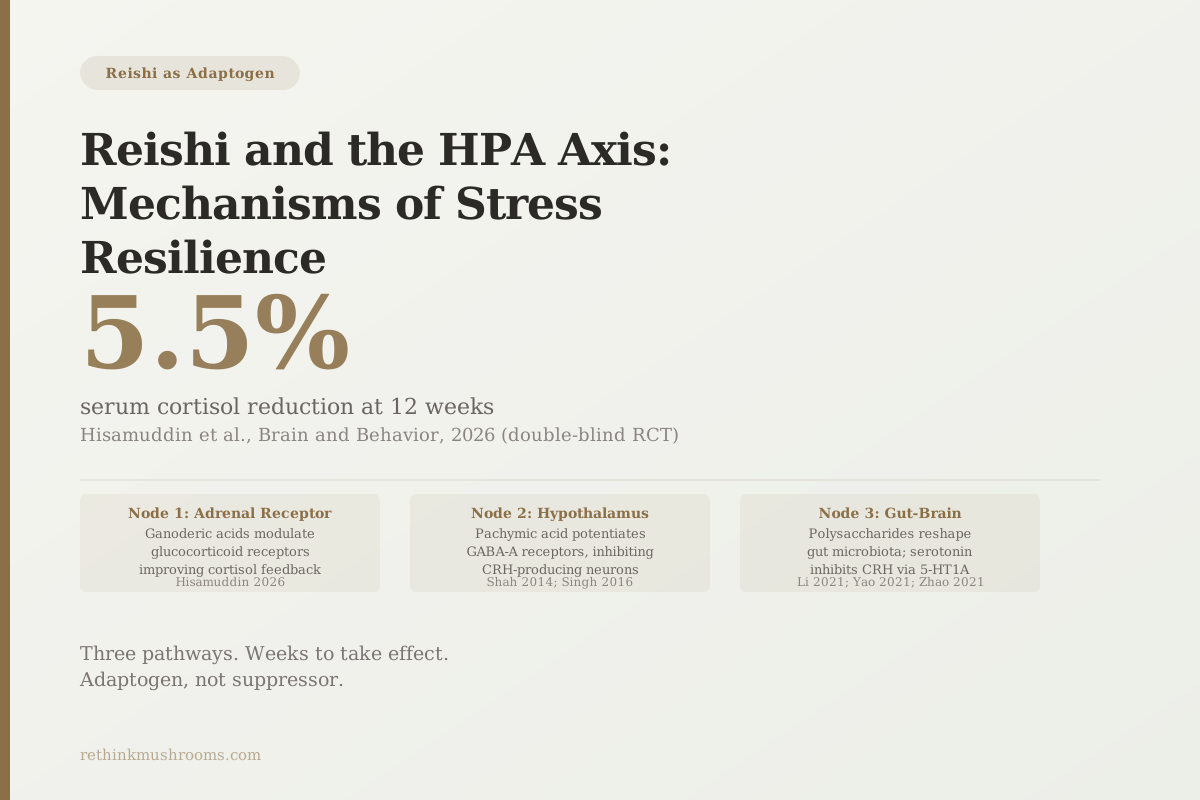
5.5% cortisol reduction at 12 weeks
A 2026 double-blind randomized controlled trial found mushroom supplementation including reishi reduced serum cortisol by 4.4% at week 6 and 5.5% at week 12, with significant reductions in anxiety and fatigue, compared to a slight cortisol increase in the placebo group.
Hisamuddin et al., Brain and Behavior, 2026
3 nodes
reishi modulates the HPA stress cascade at three distinct points: adrenal receptor, hypothalamic GABA-A, and gut serotonin
Diazepam-level
antianxiety effect in rodents via GABA-A pathway — the same receptor target as pharmaceutical benzodiazepines (Singh 2016)
Weeks needed
stress-protective HSP70 proteins only induced with chronic (not acute) Ganoderma treatment — the mechanism behind reishi's adaptogen time course (Xuan 2015)
Hisamuddin et al., Brain and Behavior, 2026
 View as image ↗
The HPA axis — the hypothalamic-pituitary-adrenal axis — is the three-gland chain that runs the body's stress hormone system. When it's working properly, it produces cortisol in pulses that peak in the morning and taper off through the day, responding appropriately to acute threats and recovering between them. When it's dysregulated by chronic stress, the familiar symptoms follow: fatigue that doesn't respond to sleep, low mood, difficulty recovering from exertion, disrupted sleep, and a reduced capacity to handle further stress.
These are also precisely the conditions that reishi has been traditionally used for, and that the emerging research literature is beginning to address mechanistically.
The mechanism isn't one pathway. Reishi appears to modulate the HPA axis at three distinct points: at the adrenal glucocorticoid receptor, where ganoderic acids may improve cortisol's feedback signal; at the hypothalamic paraventricular nucleus, where pachymic acid potentiates GABA-A receptors to inhibit the first step of the stress cascade; and through the gut-serotonin pathway, where polysaccharides reshape gut microbiota to increase hypothalamic serotonin and suppress the stress-signaling hormone CRH. Understanding why reishi requires weeks to build stress resilience — not hours — requires understanding all three nodes.
For a broader introduction to reishi as an adaptogen, see Reishi as an Adaptogen: How It Helps the Body Handle Stress. For the cortisol evidence specifically, see Reishi and Cortisol: Does It Lower Stress Hormones?. For reishi's foundational compound profile, see the reishi overview.
Key Takeaways
- The HPA (hypothalamic-pituitary-adrenal) axis is the three-gland system that produces cortisol; chronic stress dysregulates it by reducing glucocorticoid receptor sensitivity, causing feedback failure and prolonged cortisol elevation
- Reishi modulates the HPA axis at three nodes: adrenal glucocorticoid receptors (ganoderic acids), hypothalamic CRH neurons via GABA-A (pachymic acid), and gut-brain serotonin pathway (polysaccharides)
- Pachymic acid potentiates GABA-A receptors in the hypothalamus, inhibiting CRH-producing neurons before they fire the stress cascade (Shah 2014); four Ganoderma species showed antianxiety effects comparable to diazepam in rodent models via the same GABA-A pathway (Singh 2016)
- Reishi polysaccharides reshape gut microbiota, increasing hypothalamic serotonin, which activates 5-HT1A receptors that inhibit CRH neurons (Li 2021; Yao 2021; Zhao 2021) — three independent studies confirming the same gut-CRH inhibition pathway
- Stress-protective HSP70 proteins are only induced by chronic (not acute) Ganoderma treatment in brain cells, providing a cellular mechanism for why reishi requires 6–12 weeks to build measurable stress resilience (Xuan 2015)
- The 2026 Hisamuddin RCT (mushroom blend including reishi) showed 5.5% cortisol reduction at week 12 with significant anxiety and fatigue reductions vs. placebo — the most current direct human evidence for HPA modulation by mushroom supplementation
What the HPA Axis Does and What Goes Wrong in Chronic Stress
The HPA axis is the body's primary hormonal stress response system. The name describes three linked glands: the hypothalamus (in the brain), the pituitary gland (just below the brain), and the adrenal glands (above the kidneys).
The cascade begins in the hypothalamus, specifically in a region called the paraventricular nucleus. When the brain perceives a threat, PVN neurons release CRH (corticotropin-releasing hormone) into the portal circulation that connects the hypothalamus to the pituitary. CRH tells the pituitary to release ACTH (adrenocorticotropic hormone) into the bloodstream. ACTH tells the adrenal glands to synthesize and release cortisol.
Cortisol does the actual stress work: mobilizing glucose, suppressing immune activity temporarily, heightening alertness, and directing resources toward immediate survival. Once cortisol reaches a sufficient level, it feeds back to both the hypothalamus and pituitary via glucocorticoid receptors — protein docking stations that cortisol binds to, triggering gene expression changes — and turns off the cascade. This negative feedback is how the stress response ends.
The problem with chronic stress is that repeated activation eventually desensitizes the glucocorticoid receptors. When the receptors that carry cortisol's "enough" signal stop responding efficiently, the feedback fails. Cortisol levels stay elevated longer than they should. In time, the system compensates by blunting its output — in burnout and prolonged fatigue states, cortisol may paradoxically become chronically low, with a flattened diurnal curve that leaves people tired in the morning and unable to mount a stress response.
This is what HPA axis dysregulation looks like in practice. Reishi's adaptogenic action targets this dysfunctional system specifically.
Node 1: Adrenal Receptor — How Ganoderic Acids Improve Cortisol Feedback
Ganoderic acids are lanostane-type triterpenes — a class of molecules built on a four-ring carbon skeleton. Cortisol is a steroid hormone with the same tetracyclic (four-ring) core structure. This structural similarity is not coincidental in terms of biological activity.
Glucocorticoid receptors — the cellular sensors that cortisol binds to — can also recognize and interact with molecules that share cortisol's structural scaffold. Several ganoderic acids from reishi appear to act as glucocorticoid receptor modulators, binding these receptors and improving their sensitivity to cortisol's feedback signal.
The practical consequence: rather than suppressing cortisol directly, ganoderic acids help the negative feedback system work more effectively. The same cortisol that was previously failing to shut off the cascade now registers more efficiently, producing a more appropriate — and more proportionate — stress response.
This is consistent with what the controlled human evidence shows. The 2026 Hisamuddin double-blind RCT found mushroom supplementation (including reishi) reduced serum cortisol by 4.4% at week 6 and 5.5% at week 12 compared to a slight increase in the placebo group, alongside significant reductions in anxiety and fatigue scores.[1] This magnitude of cortisol reduction is consistent with improved negative feedback rather than pharmacological suppression — the difference between a system working better and a system being artificially dampened.
Node 2: Hypothalamus — Pachymic Acid and GABA-A Inhibition of CRH
The second intervention point is earlier in the cascade: before CRH is released, at the neurons that produce it.
GABA — gamma-aminobutyric acid — is the primary inhibitory neurotransmitter in the brain. GABA-A receptors are the molecular docking stations through which GABA quiets neurons. When GABA binds to GABA-A receptors on CRH-producing neurons in the hypothalamic paraventricular nucleus, those neurons become less likely to fire. Less CRH is released. The downstream cascade doesn't get started as forcefully.
Pharmaceutical benzodiazepines (diazepam, lorazepam, clonazepam) work by potentiating GABA-A receptors — they make GABA more effective at quieting neurons. This is why they are effective anxiolytics and sedatives. They reduce anxiety by dampening the hypothalamic firing that initiates the stress cascade, among other effects.
Pachymic acid, a triterpene found in Ganoderma lucidum and related fungi, appears to work through the same receptor. Shah and colleagues demonstrated in 2014 that pachymic acid enhanced the sleep-promoting effects of pentobarbital in mice by potentiating GABA-A receptor activity.[2] GABA-A potentiation at the hypothalamic paraventricular nucleus is the mechanism by which this translates to reduced CRH secretion and lower sympathetic nervous system activity.
The behavioral evidence for this GABA-ergic mechanism is provided by Singh and colleagues in 2016, who tested four Ganoderma species in standard rodent anxiety models — the elevated plus maze and open field test.[3] All four species showed antianxiety effects. Ganoderma lucidum's effect was comparable to diazepam at higher doses, and the mechanism was confirmed as GABA-ergic. The difference from pharmaceutical benzodiazepines: the antianxiety effect occurred without the sedation seen at diazepam doses — suggesting partial rather than full GABA-A potentiation, consistent with a modulating rather than suppressing action.
For the related antianxiety clinical evidence, see Reishi for Anxiety: Clinical and Preclinical Evidence.
Node 3: Gut-Brain — Polysaccharides, Serotonin, and CRH Inhibition
The third HPA modulation pathway runs through the gut.
The gut microbiome produces neurotransmitters and metabolites that communicate with the brain. Serotonin is synthesized in substantial amounts by enterochromaffin cells in the gut lining. A portion of this gut-derived serotonin reaches the brain — specifically the hypothalamus — via the bloodstream and the vagus nerve, the main communication cable between the gut and the brain that carries parasympathetic signals.
In the hypothalamus, serotonin binds to 5-HT1A receptors (5-HT1A is a specific type of serotonin receptor that produces inhibitory effects when activated on certain neurons). On CRH-producing neurons in the paraventricular nucleus, 5-HT1A receptor activation suppresses CRH release — damping the HPA cascade before it starts.
Three independent studies establish this pathway for reishi polysaccharides specifically.
Li and colleagues in 2021 found that Ganoderma lucidum polysaccharides reduced depression-like behaviors in chronically stressed mice by reshaping their gut microbiota — increasing beneficial Lactobacillus species and reducing Helicobacter — which lowered systemic inflammatory markers and normalized HPA axis activity.[4]
Yao and colleagues in 2021 found that GL polysaccharides promoted sleep in mice specifically via the gut-serotonin pathway: microbiota restoration increased hypothalamic serotonin, serotonin inhibited CRH via 5-HT1A receptors, and gut-brain communication via the vagus nerve contributed to increased parasympathetic tone.[5]
Zhao and colleagues in 2021 tested Ganoderma lucidum spore polysaccharide-peptide in a rodent depression model and found antidepressant effects specifically mediated by 5-HT1A receptor activation — the same receptor subtype on hypothalamic CRH neurons that serotonin inhibits.[6]
All three studies are in animal models — the translational step to humans is not complete. But three independent research groups documenting the same pathway (polysaccharides → gut microbiota → serotonin → 5-HT1A → CRH inhibition) from different experimental angles constitutes strong preclinical evidence for a coherent mechanism. For the sleep dimension of this gut-serotonin pathway, see Mushrooms for Better Sleep: What the Research Shows.
Why Reishi Requires Weeks: The Chronic Adaptation
Reishi is marketed in many contexts as an acute stress remedy. The evidence suggests it doesn't work that way, and understanding why is part of understanding what "adaptogen" actually means.
Xuan and colleagues demonstrated in 2015 that chronic — but not acute — treatment with a water-soluble Ganoderma extract increased HSP70 in rat brain astrocytes.[7] HSP70 (heat shock protein 70) is a cellular chaperone protein — a cellular stress-protective molecule that helps other proteins fold correctly under stress conditions and prevents cellular damage when the cell is under metabolic or oxidative pressure. HSP70 is part of a family of proteins called vitagenes, which are only induced by sustained, repeated mild stress or by compounds that signal sustained mild stress to the cell.
The significance: Ganoderma's protective effect on brain cells isn't immediate. It requires the cells to be exposed to the compound repeatedly over time before they upregulate their internal protective machinery. This is the cellular mechanism behind the well-documented adaptogen time course: you don't feel measurably different after one dose of reishi, but after 6–12 weeks, the system has genuinely changed.
This aligns with the Hisamuddin 2026 RCT timeline: 4.4% cortisol reduction at week 6, 5.5% at week 12 — the effect grew over time as HPA axis recalibration accumulated.[1] The gut microbiome also remodels gradually under sustained polysaccharide exposure — it doesn't shift in days.
For readers interested in the burnout-specific application — the conditions most associated with HPA axis blunting rather than elevation — see Reishi for Burnout: Research on Fatigue and Stress Recovery. For the autonomic nervous system dimension of this stress physiology, see Reishi and Heart Rate Variability: Autonomic Nervous System Research. For a deeper profile of the ganoderic acids responsible for adrenal receptor modulation, see Ganoderic Acids: The Unique Triterpenes in Reishi.
The Bottom Line
Reishi modulates the HPA axis — the body's master stress hormone system — through three parallel mechanisms: ganoderic acids at the adrenal glucocorticoid receptor, improving cortisol feedback sensitivity; pachymic acid potentiating hypothalamic GABA-A receptors to suppress CRH release before the cascade begins; and polysaccharides reshaping gut microbiota to increase hypothalamic serotonin, which inhibits CRH via 5-HT1A receptors. All three pathways require chronic exposure to produce measurable effects, consistent with HSP70 stress-protective protein induction only appearing with sustained treatment. The 2026 Hisamuddin RCT provides the most current direct human evidence: 5.5% cortisol reduction and significant anxiety and fatigue reductions at week 12 in a double-blind placebo-controlled trial.
Frequently Asked Questions
Sources & References
- 1. Source details for this reference are not yet available.
- 2. Source details for this reference are not yet available.
- 3. Source details for this reference are not yet available.
- 4. Source details for this reference are not yet available.
- 5. Source details for this reference are not yet available.
- 6. Source details for this reference are not yet available.
- 7. Source details for this reference are not yet available.