Reishi as Adaptogen
3 mechanisms
Reishi is proposed to buffer stress through three biological pathways. All three have been demonstrated only in rodents. The human record is six controlled trials — three positive, two null, and one that never measured stress at all.
Tang et al., J Medicinal Food, 2005; Chu et al., Pharmacology Biochemistry and Behavior, 2007
0 of 3
proposed stress mechanisms demonstrated in humans rather than animals
132
participants in the largest reishi trial in a fatigue disorder — fatigue fell 28.3% vs 20.1% on placebo
2 null
controlled trials found no significant stress or mood benefit, including one in fibromyalgia
Tang et al., J Medicinal Food, 2005; Chu et al., Pharmacology Biochemistry and Behavior, 2007
 View as image ↗
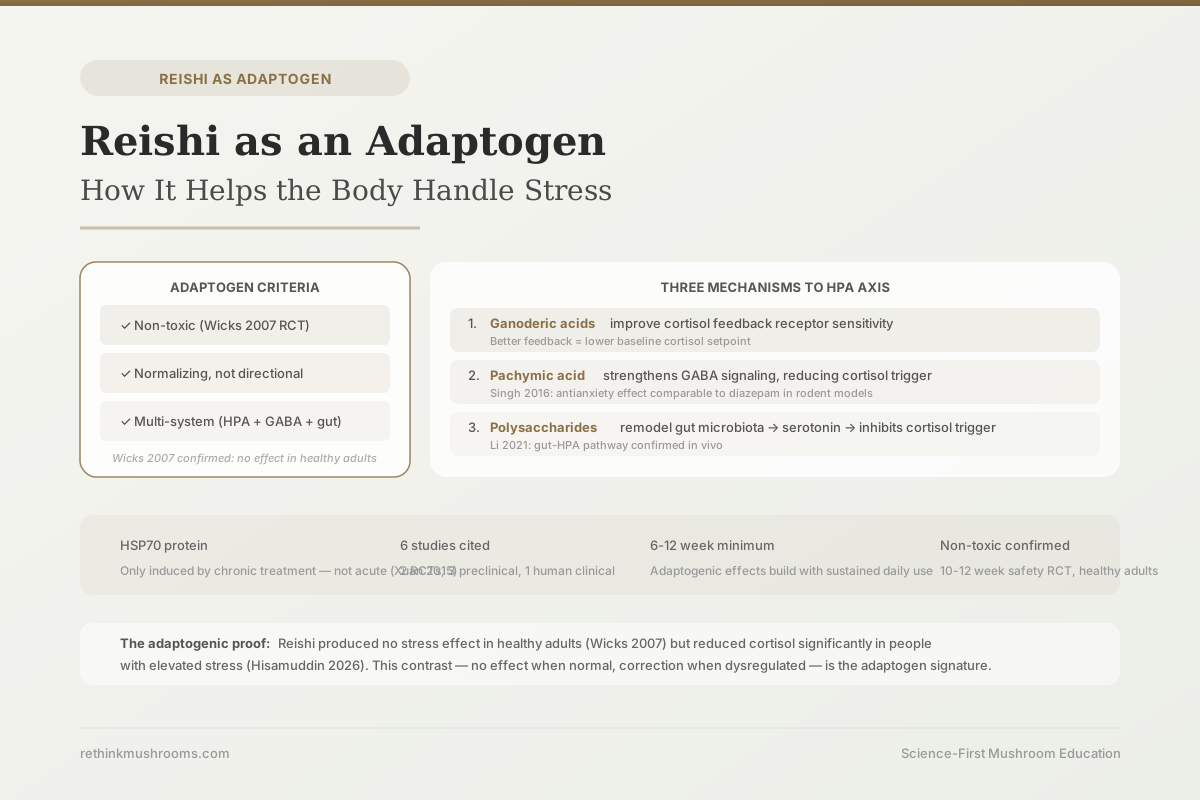
The word "adaptogen" gets used loosely in supplement marketing to mean roughly anything that helps with stress. The original definition is more precise: a substance that is non-toxic at therapeutic doses, works through multiple physiological systems rather than one specific pathway, and normalizes the body's stress response without pushing it in either direction — not sedating, not stimulating, just restoring balance. By those criteria, reishi has a better-documented case than most substances marketed as adaptogens.
"Better documented than most adaptogens" is a lower bar than it sounds. Reishi's stress claim rests on two separate bodies of evidence that are usually blended together and shouldn't be. The mechanistic work is genuinely interesting and entirely preclinical — rodents, not people. The human work is six controlled trials, most of them small, one of them testing a five-mushroom blend rather than reishi, and two of them finding nothing at all. This article keeps those two bodies of evidence apart, because the honest version of the reishi stress story only becomes visible when you do.
If you only read one thing
Reishi is the most-studied mushroom for stress, and the largest human trial — 132 people with a diagnosed fatigue disorder — found a real improvement in fatigue and wellbeing over 8 weeks. But every proposed mechanism has only been shown in rodents, two controlled trials found no significant benefit, and the trial most often cited for cortisol reduction tested a five-mushroom blend, not reishi alone. Treat it as a promising, low-risk 8-to-12-week experiment, not an established treatment.
Key Takeaways
- Reishi meets the formal adaptogen criteria on paper — but the strongest evidence for each criterion is weaker than commonly claimed, and the "normalizing, not directional" property has been tested in humans exactly once
- Three mechanisms are proposed: benzodiazepine-site GABA activity (Chu 2007), lowered corticosterone with restored serotonin and norepinephrine via BDNF (Zhao 2021), and Dectin-1 neuroimmune signalling (Li 2021). All three are rodent studies. None has been demonstrated in a human
- The largest human trial gave 1,800 mg of a reishi polysaccharide extract three times daily for 8 weeks to 132 people with neurasthenia: fatigue fell 28.3% from baseline versus 20.1% on placebo, and wellbeing rose 38.7% versus 29.7% (Tang 2005)
- The 2026 trial usually cited as proof reishi lowers cortisol tested a blend of five mushrooms, with reishi one of five, and was funded by the manufacturer with company staff among the authors — cortisol fell 5.5% at 12 weeks, but none of it can be attributed to reishi specifically (Hisamuddin 2026)
- Two controlled trials found nothing: a 12-week crossover trial found no change in urine cortisol or catecholamines (Chu 2012), and a fibromyalgia pilot found no significant between-group differences on mood or quality of life (Pazzi 2020)
- Pachymic acid, frequently listed as reishi's calming triterpene, is not a reishi compound at all — it belongs to Poria cocos, a different fungus
- Every human trial that measured a benefit ran for 4 weeks or longer, and the safety trial most often cited as "long-term" actually lasted 10 days (Wicks 2007)
What "Adaptogen" Actually Means, and Whether Reishi Qualifies
The concept was developed in Soviet pharmacological research in the 1950s and 1960s, originally to identify substances that could sustain performance under stress without the side effects of stimulants. Nikolai Lazarev and Israel Brekhman established three criteria: the substance must be non-toxic; it must have a normalizing effect regardless of the direction of the dysregulation; and it must act through multiple physiological systems rather than one specific pathway.
Reishi has a partial case on all three. On safety, a double-blind randomized placebo-controlled trial gave 16 healthy volunteers 2 grams of extract twice daily and found no adverse effects across ECG, blood counts, blood chemistry and urinalysis.[4] That trial ran for 10 consecutive days — it is frequently described online as a 10-to-12-week long-term safety study, which it was not. Its authors close by saying a long-term dose-escalating safety trial is still warranted.
On multiple systems, reishi's stress-related effects touch the HPA axis, GABA signalling, the serotonergic system and innate immune signalling — a genuinely broad reach, documented below.
On the normalizing criterion, there is one useful human data point, and it is easy to misread. A 12-week randomized double-blind crossover trial gave 1.44 g/day of reishi to 26 patients with borderline blood pressure or cholesterol and measured urine catecholamines and cortisol. Neither changed.[3] In a population whose stress hormones were not markedly dysregulated to begin with, reishi did not push them in either direction. That is consistent with the non-directional property an adaptogen is supposed to have — but a null result is weak evidence for anything, and it is equally consistent with reishi simply not affecting cortisol.
Three Proposed Mechanisms, and How Far Each One Reaches
Reishi's stress claim is usually explained through three pathways that converge on the HPA axis.
Mechanism Source Audit
Three Proposed Mechanisms, and What Each Study Actually Measured
Each lane names the paper that tested the pathway, the animal model it ran in, and how far the finding has travelled. All three stop at the same rung.
Reishi extract shortened sleep latency and lengthened sleeping time in pentobarbital-treated rats. Flumazenil, a benzodiazepine-receptor blocker, significantly reversed those effects.
The same extract had no effect on sleep architecture in normal, untreated rats at 80 and 120 mg/kg.
A spore-derived polysaccharide-peptide lowered serum corticosterone, restored brain serotonin and norepinephrine, and raised prefrontal BDNF, synapsin I and PSD95.
The behavioural effect was completely blocked by the BDNF antagonist K252a — the pathway runs through BDNF, not directly through a cortisol receptor.
Reishi polysaccharides lowered IL-1β and TNF-α, raised IL-10 and BDNF, and calmed microglial activation and astrocyte proliferation in the hippocampus.
Effects were mediated through the Dectin-1 receptor. No gut-microbiota measurement was made in this study.
Bottom line: all three mechanisms are preclinical. None has been demonstrated in a human being. Reishi’s human evidence is about outcomes — fatigue, wellbeing, cortisol — not about which pathway produced them.
Sources: Chu et al. (2007), Pharmacology Biochemistry and Behavior; Zhao et al. (2021), Applied Microbiology and Biotechnology; Li et al. (2021), Brain Research Bulletin.
Mechanism one: benzodiazepine-site GABA activity. GABA is the brain's main calming neurotransmitter, and the neurons that fire the HPA trigger are partly under GABA control. A 2007 study found that reishi aqueous extract significantly shortened sleep latency and increased sleeping time in pentobarbital-treated rats — and that flumazenil, a drug that blocks the benzodiazepine site on the GABA-A receptor, significantly reversed those effects.[5] Blocking the receptor abolished the effect, which is the standard way to show a pathway is actually load-bearing rather than merely present. The authors concluded reishi "may be a herb having benzodiazepine-like hypnotic activity at least in part."
The same study contains a detail worth holding onto: reishi had no effect on sleep architecture in normal, untreated rats at either dose tested. The effect showed up only in animals whose systems had already been perturbed. That is the state-dependence an adaptogen is supposed to show, observed at the mechanistic level.
A separate 2016 study tested four Ganoderma species in the elevated plus maze, a standard rodent anxiety model, and found that a methanol extract of G. lucidum at 200 mg/kg significantly increased time spent in the open arms, comparable to diazepam at 2 mg/kg.[6] This is often cited as confirmation of the GABA pathway. It is not: the study measured behaviour, not receptors, and its own authors attribute the activity to the phenols and flavonoids in the active fraction. Diazepam was the benchmark drug, not evidence of a shared mechanism.
Mechanism two: HPA output and monoamines. A 2021 study isolated a 28-kDa polysaccharide-peptide from reishi spores and tested it in mice under chronic unpredictable mild stress. It decreased serum corticosterone (the rodent equivalent of cortisol), reversed the stress-induced decline in brain serotonin and norepinephrine while leaving dopamine untouched, and raised BDNF, synapsin I and PSD95 in the prefrontal cortex.[7] Critically, pretreatment with a BDNF antagonist completely blocked the effect — so the pathway runs through neurotrophic signalling, not through direct action on a cortisol receptor. This is the closest thing reishi has to direct evidence of HPA modulation, and it is in mice.
Mechanism three: neuroimmune signalling. A 2021 study in the chronic social defeat stress model found that reishi polysaccharides reduced the inflammatory cytokines IL-1β and TNF-α, increased the anti-inflammatory cytokine IL-10 and BDNF, and calmed microglial activation and astrocyte proliferation in the hippocampus — all mediated through the Dectin-1 receptor.[8] Chronic stress drives neuroinflammation, and neuroinflammation feeds back onto HPA activity, so this is a plausible indirect route. Note that this study did not measure gut bacteria; the widely repeated claim that reishi works on stress by remodelling the microbiome is not supported by it. For the compounds behind these effects, see Ganoderic Acids: The Unique Triterpenes in Reishi, and for the pathway in more depth, Reishi and the HPA Axis: Mechanisms of Stress Resilience.
Compound Attribution
Is Pachymic Acid Reishi's Calming Compound?
The claim
“Pachymic acid, a triterpene in reishi, strengthens GABA-A receptor activity and is responsible for reishi's calming effect.”
Supplement copy and aggregator articles that pull triterpene names from adjacent medicinal-mushroom literature without checking the source organism.
What research shows
UnsupportedPachymic acid is not a reishi compound. It is a characteristic lanostane triterpene of Poria cocos, a different medicinal fungus. The GABA-A research on pachymic acid used Poria-derived material.
Reishi does have well-documented triterpenoids — ganoderic acids, ganoderenic acids, ganoderol, ganoderiol and lucidenic acids — and it does have genuine benzodiazepine-site evidence via Chu 2007. The mechanism is real; the compound usually named for it is imported from another mushroom.
Chu et al. (2007), Pharmacology Biochemistry and Behavior
The Human Evidence: Six Controlled Trials
No trial has tested reishi in healthy adults with ordinary occupational stress using stress as the primary endpoint. What exists is six controlled trials in adjacent populations, and they do not all point the same way.
Human Trial Ledger
Every Controlled Human Trial Behind the Reishi Stress Claim
Three trials found improvement, two found nothing, and one never measured stress at all. Listed together, with the caveats that usually get dropped.
Agent: Reishi alone — Ganopoly, 1800 mg ×3/day
Fatigue −28.3% from baseline vs −20.1% placebo; clinical severity −15.5% vs −4.9%; wellbeing +38.7% vs +29.7%.
Agent: Five-mushroom blend — reishi is 1 of 5
Serum cortisol −4.4% at week 6 and −5.5% at week 12 vs −0.7% and −0.8% on placebo (p < 0.001); ACTH −10.5% and −8.1%; anxiety, fatigue and sleep improved.
Industry-funded: sponsored by the manufacturer, with company R&D staff among the authors. Reishi cannot be separated from the other four mushrooms.
Agent: Reishi alone — spore powder
Improved physical wellbeing and fatigue subscale; less anxiety and depression; better quality of life; no serious adverse effects.
Pilot trial in a clinical population, not a general-stress population.
Agent: Reishi alone — 1.44 g/day
Urine catecholamines and cortisol showed no significant differences across treatments.
Agent: Reishi alone — 6 g/day micro-milled
No statistically significant between-group differences on mood, depression, life satisfaction or quality of life. A within-group trend only.
Pilot. Frequently miscited as a positive result.
Agent: Reishi alone — 2 g twice daily
No adverse effects vs placebo across ECG, blood counts, blood chemistry and urinalysis.
Did not measure any stress outcome, and ran for 10 days — not 10 weeks. The authors call for a long-term trial to still be done.
No trial has tested reishi in healthy adults with ordinary occupational stress using stress as the primary endpoint. The closest is Tang 2005, in a diagnosed fatigue disorder.
Sources: Tang et al. (2005), Journal of Medicinal Food; Hisamuddin et al. (2026), Brain and Behavior; Zhao et al. (2012), eCAM; Chu et al. (2012), British Journal of Nutrition; Pazzi et al. (2020), Healthcare; Wicks et al. (2007), American Journal of Chinese Medicine.
Tang, Gao, Chen, et al. (2005) · Journal of Medicinal Food
- Population
- 132 randomised (123 assessable) Chinese patients with neurasthenia diagnosed by ICD-10 criteria
- Intervention
- Ganopoly, a G. lucidum polysaccharide extract, 1,800 mg three times daily for 8 weeks
- Comparator
- Matched placebo, randomised double-blind parallel design
- Finding
- Sense of fatigue fell 28.3% from baseline versus 20.1% on placebo. Clinical Global Impression severity fell 15.5% versus 4.9%. Sense of wellbeing rose 38.7% versus 29.7%.
positive The largest and longest reishi trial in a stress-adjacent population, and the strongest single piece of human evidence for the adaptogen claim. Neurasthenia is a fatigue and exhaustion disorder, not general occupational stress, so the population is narrower than the claim it is usually used to support. Placebo also improved substantially, which is typical for subjective fatigue endpoints.
Tang et al. (2005), Journal of Medicinal Food 8(1):53-8
Hisamuddin, Ramli, Leo, et al. (2026) · Brain and Behavior
- Population
- 50 adults, randomised, double-blind, placebo-controlled, assessed at baseline, 6 weeks and 12 weeks
- Intervention
- A proprietary five-mushroom blend containing Hericium erinaceus, Cordyceps militaris, Ganoderma lucidum, Lentinula edodes and Grifola frondosa
- Comparator
- Matched placebo
- Finding
- Serum cortisol fell 4.4% at week 6 and 5.5% at week 12 from baseline, versus 0.7% and 0.8% on placebo (p < 0.001). ACTH fell 10.5% and 8.1%. Anxiety, fatigue and sleep quality all improved significantly.
narrow-scope This is the trial most often cited as proof that reishi lowers cortisol, and it cannot support that claim. Reishi is one of five mushrooms in the product, with no reishi-only arm, so the effect cannot be attributed to it. The trial was funded by the manufacturer and several authors are employees of the company's R&D department. The progressive 6-to-12-week pattern is genuine and useful; the reishi attribution is not.
Hisamuddin et al. (2026), Brain and Behavior 16(1):e71193
Pazzi, Adsuar, Domínguez-Muñoz, et al. (2020) · Healthcare
- Population
- Women with fibromyalgia, a condition involving chronic HPA dysregulation and a disturbed stress profile
- Intervention
- 6 g/day of micro-milled G. lucidum carpophores for 6 weeks
- Comparator
- Matched placebo, double-blind randomised pilot design
- Finding
- No statistically significant between-group differences on happiness, depression, satisfaction with life or health-related quality of life. A within-group trend toward improvement was visible in the reishi group but did not separate from placebo.
null This trial is routinely cited as showing reishi 'significantly improved mood and quality of life in fibromyalgia'. It showed the opposite. Its authors state plainly that additional studies are needed. As a small pilot it cannot rule out a real effect either — but it cannot be used as evidence for one.
Pazzi et al. (2020), Healthcare (Basel) 8(4)
Two further trials fill in the picture. A 4-week randomized pilot gave reishi spore powder to 48 breast cancer patients experiencing cancer-related fatigue during endocrine therapy and found significant improvement in physical wellbeing and the fatigue subscale, along with less anxiety and depression and better quality of life, with no serious adverse effects.[10] And the 12-week crossover trial described earlier found no change in urine cortisol or catecholamines.[3]
- Cell studiescompleted
Corticosterone-injured PC12 cells; receptor and cytokine work supporting the proposed pathways
- Animal studiescompleted
Flumazenil-reversible GABA activity, corticosterone reduction via BDNF, Dectin-1 neuroimmune signalling — all three mechanisms live here
- Small human trialscurrent
Six controlled trials, largest 132 participants. Three positive, two null, one safety-only. One tests a five-mushroom blend
- Large RCT in a general stressed populationmissing
No adequately powered trial of reishi alone, with stress as the primary endpoint, in adults with ordinary chronic stress
- Meta-analysismissing
Too few comparable reishi-specific stress trials to pool
Reishi's adaptogen claim is supported by consistent rodent mechanism work and a handful of small human trials in specific clinical populations. It is not supported by any large trial in ordinary stressed adults, and the two null trials are part of the record.
Tang et al. (2005); Hisamuddin et al. (2026); Chu et al. (2012); Pazzi et al. (2020); Zhao et al. (2012)
How Long Before Anything Happens
The consistent pattern across the human trials is that nothing was measured before four weeks, and the trials that found effects ran for four to twelve weeks. Tang 2005 measured at 8 weeks.[1] Hisamuddin 2026 measured at 6 and 12 weeks and found the cortisol change larger at 12 weeks than at 6.[2] Zhao 2012 measured at 4 weeks. Pazzi 2020 ran 6 weeks and found nothing.[11]
The animal work points the same direction without proving it. A 2015 study found that pretreating diabetic mice with a reishi mycelium culture extract for a week before an ischemic insult significantly reduced neurological deficits, brain infarction volume and neuronal cell death.[9] The protection came from sustained pretreatment, not from a dose given at the moment of stress — a chronic-dosing design, though the study measured tissue injury rather than any stress-resilience marker.
Be careful how much weight that carries. There is no published evidence identifying a specific molecular change in humans that accumulates with weeks of reishi use. The "build-up over weeks" story is an inference from trial design — the trials that found effects were long — not a demonstrated mechanism. What can be said honestly is that no trial has shown a benefit from a single dose, and every trial that showed a benefit ran a month or more. If you are evaluating reishi, that sets the horizon.
Practical Guidance
Can you take reishi daily? The trials used daily dosing throughout, at doses from 1.44 g/day up to 6 g/day of milled fruiting body or 5,400 mg/day of a polysaccharide extract, for 4 to 12 weeks, with no serious adverse events reported in any of them. No trial has reported tolerance or dependence. Nothing in the human record suggests daily use over this horizon is a problem.
What should you expect? Based on the best single trial, a moderate improvement in fatigue and subjective wellbeing over about 8 weeks in someone whose baseline is genuinely depleted — with the honest caveat that placebo produced a substantial share of that improvement, and that two controlled trials found no significant benefit at all.
Does it help with anxiety? The mechanistic case is the strongest part of the reishi story, and it is entirely preclinical. Human anxiety data comes from the 2026 blend trial as a secondary outcome, which cannot be attributed to reishi. There is no trial of reishi alone with anxiety as a primary endpoint. For the full picture, see Reishi for Anxiety: Clinical and Preclinical Evidence.
Before You Start
ModerateReishi Is Well Tolerated in Trials — But Not Risk-Free in Context
Concern
The controlled trials reported no serious adverse events, but they were small (16 to 132 participants) and short (10 days to 12 weeks), which is not enough to detect uncommon harms. Reishi is also not inert: it has documented effects on platelet function and immune signalling, and it is studied for interactions with anticoagulant and immunosuppressant medication.
What the research says
Treat reishi as a supplement with real pharmacological activity rather than a food. Talk to a doctor or pharmacist before starting if you take anticoagulants or antiplatelet drugs, immunosuppressants, or medication for blood pressure or blood sugar, and before any planned surgery.
Particularly relevant for: Anyone on prescription medication, pregnant or breastfeeding, or with an autoimmune condition
What to do
Do not use reishi in place of treatment for a diagnosed anxiety, depressive or stress-related disorder. This article is research education, not medical advice.
Wicks et al. (2007), American Journal of Chinese Medicine; Chu et al. (2012), British Journal of Nutrition
For the specific question of reishi and measured cortisol, see Reishi and Cortisol: Does It Lower Stress Hormones?. For the burnout-specific evidence, see Reishi for Burnout: Research on Fatigue and Stress Recovery. For how reishi's sleep effects relate to all of this, see How Long Does Reishi Take to Improve Sleep?.
The Bottom Line
Reishi has a partial case for adaptogen status. It is non-toxic across every trial that has looked, it reaches multiple physiological systems, and there is one human data point consistent with the non-directional property. Three mechanisms are proposed — benzodiazepine-site GABA activity, corticosterone reduction through BDNF signalling, and Dectin-1 neuroimmune modulation — and all three have been demonstrated only in rodents. The human record is six controlled trials: the largest, in 132 people with neurasthenia, found fatigue fell 28.3% versus 20.1% on placebo over 8 weeks; the most-cited cortisol trial tested a five-mushroom blend and was manufacturer-funded; and two trials found no significant effect. Pachymic acid, commonly named as reishi's calming compound, belongs to a different mushroom. The practical read is an 8-to-12-week trial with modest expectations, not an established treatment.
Frequently Asked Questions
Sources & References
- 1RTHM-00088·Tang, Wenbo et al. (2005). “A randomized, double-blind and placebo-controlled study of a Ganoderma lucidum polysaccharide extract in neurasthenia..” Journal of medicinal food.Study breakdown →PubMed →↩
- 2RTHM-00959·Hisamuddin, Ahmad Safiyyu'd-Din et al. (2026). “Adaptogenic Effects of Mushroom Blend Supplementation on Stress, Fatigue, and Sleep: A Randomised, Double-Blind, and Placebo-Controlled Trial..” Brain and behavior.Study breakdown →PubMed →↩
- 3RTHM-00247·Chu, Tanya T W et al. (2012). “Study of potential cardioprotective effects of Ganoderma lucidum (Lingzhi): results of a controlled human intervention trial..” The British journal of nutrition.Study breakdown →PubMed →↩
- 4RTHM-00123·Wicks, Sheila M et al. (2007). “Safety and tolerability of Ganoderma lucidum in healthy subjects: a double-blind randomized placebo-controlled trial..” The American journal of Chinese medicine.Study breakdown →PubMed →↩
- 5RTHM-00210·Chu, Qing-Ping et al. (2007). “Extract of Ganoderma lucidum potentiates pentobarbital-induced sleep via a GABAergic mechanism..” Pharmacology.Study breakdown →PubMed →↩
- 6RTHM-00826·Singh, Ranjeet et al. (2016). “Evaluation of Antianxiety Potential of Four Ganoderma (Agaricomycetes) Species from India in Mice..” International journal of medicinal mushrooms.Study breakdown →PubMed →↩
- 7RTHM-01473·Zhao, Shuang et al. (2021). “Antidepressant-like effect of Ganoderma lucidum spore polysaccharide-peptide mediated by upregulation of prefrontal cortex brain-derived neurotrophic factor..” Applied microbiology and biotechnology.Study breakdown →PubMed →↩
- 8RTHM-01386·Li, Haoran et al. (2021). “Ganoderma lucidum polysaccharides ameliorated depression-like behaviors in the chronic social defeat stress depression model via modulation of Dectin-1 and the innate immune system..” Brain research bulletin.Study breakdown →PubMed →↩
- 9RTHM-00748·Xuan, Meiyan et al. (2015). “Chronic Treatment with a Water-Soluble Extract from the Culture Medium of Ganoderma lucidum Mycelia Prevents Apoptosis and Necroptosis in Hypoxia/Ischemia-Induced Injury of Type 2 Diabetic Mouse Brain..” Evidence-based complementary and alternative medicine : eCAM.Study breakdown →PubMed →↩
- 10RTHM-00276·Zhao, Hong et al. (2012). “Spore Powder of Ganoderma lucidum Improves Cancer-Related Fatigue in Breast Cancer Patients Undergoing Endocrine Therapy: A Pilot Clinical Trial..” Evidence-based complementary and alternative medicine : eCAM.Study breakdown →PubMed →↩
- 11RTHM-00648·Pazzi, Francesco et al. (2020). “Ganoderma lucidum Effects on Mood and Health-Related Quality of Life in Women with Fibromyalgia..” Healthcare (Basel.Study breakdown →PubMed →↩