Reishi as Adaptogen
3g/day
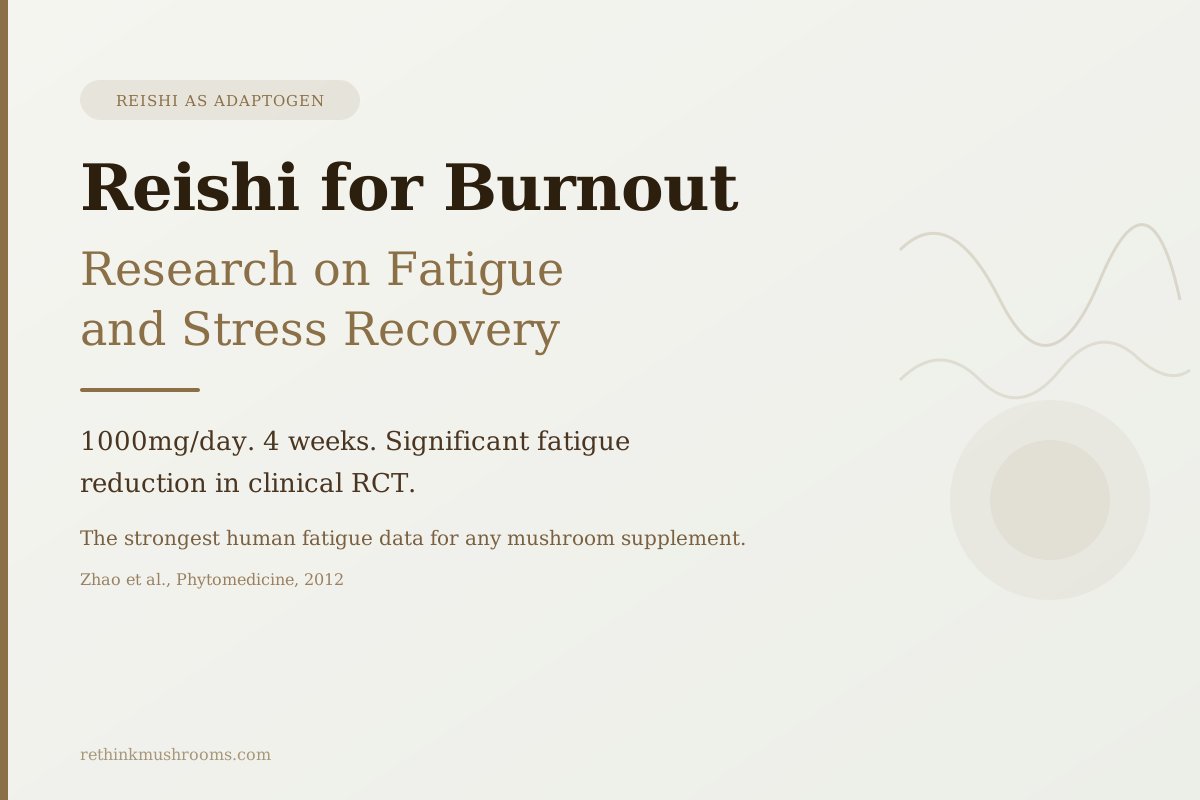
In the strongest human fatigue trial for any mushroom supplement, 1000mg of reishi spore powder taken three times daily (3g/day) for 4 weeks significantly reduced fatigue and improved quality of life in a pilot RCT of cancer-related fatigue patients, a condition that shares burnout's core physiology.
Zhao et al., eCAM, 2012
4 weeks
duration of the Zhao 2012 cancer-fatigue pilot RCT showing significant improvement
64 women
in the Collado 2015 fibromyalgia trial showing improved physical fitness
5.5%
cortisol reduction at 12 weeks in the Hisamuddin 2026 double-blind RCT
Zhao et al., eCAM, 2012
 View as image ↗
No clinical trial has enrolled burnout patients and tested reishi against a placebo. That research doesn't exist yet. What does exist is a set of randomized controlled trials in two populations whose fatigue physiology is strikingly similar to burnout: people with cancer-related fatigue and people with fibromyalgia. The physiology these conditions share with burnout (dysregulated stress hormones, autonomic dysfunction, persistent inflammatory signaling, non-restorative sleep) is why their trial data is relevant to reishi burnout recovery research.
The evidence is limited but not absent. A 2012 pilot clinical trial is the strongest human fatigue data for any mushroom supplement published to date. A pair of small fibromyalgia RCTs looks at the physical and psychological dimensions of fatigue recovery. And a 2026 double-blind trial in a non-clinical, stressed population measured both fatigue and cortisol changes over 12 weeks.
This article covers what those trials actually found, why the populations matter, and what the practical evidence looks like for someone researching reishi burnout recovery. For a broader overview of how reishi works as an adaptogen, see Reishi as an Adaptogen: How It Helps the Body Handle Stress. For the full reishi introduction, see What Is Reishi Mushroom: The Science Behind the Mushroom of Immortality.
Key Takeaways
- The strongest human fatigue evidence for reishi comes from a 2012 pilot RCT (Zhao et al., n=48) in breast cancer patients: 1000mg spore powder three times daily (3g/day total) for 4 weeks significantly reduced cancer-related fatigue and improved quality of life vs. placebo.
- Cancer-related fatigue and burnout share the same physiological profile: HPA axis dysregulation, cortisol curve flattening, sympathetic nervous system overactivity, and inflammatory-driven fatigue that doesn't resolve with rest.
- Two small fibromyalgia RCTs extend the evidence: Collado 2015 (n=64) found improved aerobic endurance, flexibility, and movement velocity vs. an active comparator; Pazzi 2020 (double-blind, placebo-controlled) found only a non-significant trend toward improved mood and life satisfaction. Together they probe both the physical and psychological dimensions, but the psychological result did not reach significance.
- A 2026 double-blind RCT (Hisamuddin et al.) using a five-mushroom blend that includes reishi found serum cortisol reduced by 4.4% at 6 weeks and 5.5% at 12 weeks, alongside significant fatigue reduction. This is a blend, not isolated reishi.
- No direct burnout RCT exists for reishi or any other mushroom. The clinical proxy population data is the best available evidence.
- The evidence-based dose from the fatigue-specific trial is 1000mg spore powder three times daily (3g/day); the evidence-based time window is 4-12 weeks, with the two fibromyalgia trials both running 6 weeks.
Burnout and Cancer Fatigue: The Same Physiology, Different Causes
Burnout is not just being very tired. It is a recognized stress-driven physiological state with a specific pattern: the HPA axis (the brain-body chain that controls cortisol production) becomes dysregulated, typically producing a flattened daily cortisol curve rather than the normal morning spike and daytime decline. The autonomic nervous system shifts toward chronic sympathetic dominance, meaning the system stays in a low-level "alert" state even at rest. Inflammatory signaling increases. Sleep becomes non-restorative even when total sleep hours are adequate.
The result is a fatigue that doesn't respond to rest. People with burnout sleep but don't recover. They take vacations but return to work still exhausted. This is because the problem isn't insufficient sleep: it's a dysregulated stress physiology that is generating fatigue independently of sleep.
Cancer-related fatigue, in cancer patients undergoing chemotherapy or endocrine therapy, has the same physiological profile. It is one of the most disabling and treatment-resistant symptoms in oncology, and it is not caused by lack of sleep. It is caused by the same combination of HPA dysregulation, sympathetic overactivation, and chronic inflammatory signaling that produces burnout.
This is why Zhao and colleagues' 2012 clinical trial in cancer patients is relevant to burnout recovery. If reishi reduces fatigue in a population where the underlying physiology is HPA dysregulation and inflammatory fatigue, it is likely working on the same physiological pathways relevant to burnout.
Fibromyalgia provides a second proxy population. Fibromyalgia involves chronic widespread pain, but the fatigue is central to the condition and has the same physiological signature: reduced HRV (meaning the autonomic nervous system is stuck in sympathetic dominance), flattened cortisol curves, poor sleep quality, and elevated inflammatory markers. People with fibromyalgia do not have structural muscle damage explaining their fatigue; they have dysregulated stress physiology.
The Zhao 2012 RCT: The Strongest Human Fatigue Data for Any Mushroom
Zhao and colleagues conducted a randomized, placebo-controlled pilot trial published in Evidence-Based Complementary and Alternative Medicine (eCAM) in 2012, enrolling 48 breast cancer patients who were undergoing endocrine therapy and experiencing cancer-related fatigue.[1] Participants received either 1000mg of reishi spore powder three times a day (3g/day total) or a matched placebo for four weeks.
The results showed a statistically significant reduction in cancer-related fatigue in the reishi group compared to placebo, along with improvements in physical well-being and quality of life measures. The study stands out in the mushroom research literature for two reasons: it tested fatigue in a controlled trial design, and the patient population (cancer patients with HPA and inflammatory stress) makes the results more directly relevant to burnout than a healthy volunteer study would be. Its main limitation is scale: it was a pilot trial with 48 patients, so the finding needs replication in a larger study.
The preparation used matters: spore powder, not a polysaccharide extract or whole fruiting body powder. Reishi spores are the reproductive spores of the mushroom, and broken-spore preparations (where the tough outer cell wall is cracked to improve bioavailability) are standard for supplements. The 3g/day dose (1000mg taken three times daily) is the most directly supported dosing for fatigue-specific outcomes based on this trial.
Four weeks is a short trial duration for an adaptogen, which typically requires chronic treatment to build physiological resilience. The Zhao 2012 results appearing within four weeks may reflect the acute anti-inflammatory and HPA-modulatory effects of the ganoderic acids in the spore preparation, rather than the longer-term stress-resilience building that requires weeks of consistent use.
Two Fibromyalgia RCTs: Physical Recovery and Psychological Recovery
Collado Mateo and colleagues published a randomized controlled trial in Nutrición Hospitalaria in 2015, enrolling 64 women with fibromyalgia and comparing Ganoderma lucidum (6g/day for 6 weeks) against an active comparator, Ceratonia siliqua (carob), rather than an inert placebo.[2] The measured outcomes were physical fitness tests: aerobic endurance, lower-body flexibility, and movement velocity.
The reishi group showed significant improvements in aerobic endurance, lower-body flexibility, and velocity, while the Ceratonia siliqua comparator group showed no significant change. This finding is important for burnout for a reason that most burnout content ignores: burnout is not only a psychological condition. The chronic cortisol and inflammatory dysregulation of burnout reduces physical capacity, endurance, and strength. Recovery from burnout means recovering physical as well as psychological function. A trial showing that reishi improves aerobic endurance and functional fitness in a population with HPA-dysregulated chronic fatigue is directly relevant.
Pazzi and colleagues published a separate double-blind, placebo-controlled trial in 2020, also in women with fibromyalgia, focusing on the psychological and quality-of-life dimension.[3] This trial did not reach statistical significance: it found a non-significant trend toward improved happiness, greater life satisfaction, and reduced depression in the reishi group, but no significant between-group differences. Fibromyalgia patients characteristically have both physical and psychological impairment; the two trials together probe both dimensions, but only the physical-fitness result was statistically significant.
The Collado 2015 and Pazzi 2020 trials draw on the same clinical population (women with fibromyalgia) and are both small, which means they represent a narrow evidence base from a single condition rather than independent replications across diverse populations. That limits how strongly the findings generalize.
For an understanding of how reishi affects the underlying HPA physiology that drives this fatigue, see Reishi and the HPA Axis: Mechanisms of Stress Resilience. For the cortisol evidence specifically, see Reishi and Cortisol: Does It Lower Stress Hormones?.
The Hisamuddin 2026 RCT: Fatigue and Cortisol in a General Population
The most recently published controlled trial relevant to reishi and fatigue is the Hisamuddin 2026 double-blind RCT, published in Brain and Behavior, which enrolled 50 adults with moderate-to-severe stress (a non-clinical population, without a formal clinical fatigue diagnosis) and followed participants for 12 weeks.[4]
The study used a five-mushroom blend (lion's mane, cordyceps, reishi, shiitake, and maitake) rather than isolated reishi. This is an important distinction: the cortisol and fatigue results cannot be attributed to reishi alone, since the formulation combined multiple mushroom species. The reported results: serum cortisol reduced by 4.4% at week 6 and 5.5% at week 12 in the supplement group, a statistically significant drop versus placebo (p<0.001). Fatigue was also significantly reduced alongside the cortisol changes.
The 12-week design is the longest of the human trials in this cluster and provides the clearest evidence for a time course: effects build progressively over 6 to 12 weeks. The inclusion of a non-clinical population (stressed adults rather than patients with an established clinical diagnosis) is also meaningful: the supplement produced cortisol and fatigue changes in people who had not yet reached a clinical diagnosis.
The fact that cortisol decreased and fatigue improved simultaneously does not establish causation (cortisol reduction causing fatigue improvement), but it is consistent with the HPA normalization hypothesis that links the mechanistic studies to the clinical outcomes.
Evidence by Proximity to Burnout
Reishi & Burnout — No Direct Trial, Four Proxy Trials of Varying Strength
There is no reishi burnout RCT. The case is built from human trials in populations that share burnout’s fatigue physiology. Bar width reflects how directly and how strongly each trial speaks to burnout recovery.
Direct burnout RCT
gapDoes not yet exist
No trial has enrolled people with diagnosed burnout and tested reishi against a placebo. This tier is empty.
Cancer-related fatigue
evidenceZhao 2012 [1]
Pilot RCT (n=48) in breast-cancer patients on endocrine therapy: 1000 mg spore powder three times daily (3 g/day) for 4 weeks significantly reduced fatigue and improved quality of life vs placebo. Closest physiological proxy for burnout.
Fibromyalgia — physical fitness
evidenceCollado 2015 [2]
64 women, 6 g/day for 6 weeks: significant gains in aerobic endurance, lower-body flexibility, and movement velocity vs a Ceratonia siliqua (carob) active comparator.
Fibromyalgia — mood & quality of life
mixedPazzi 2020 [3]
Double-blind, placebo-controlled pilot, 6 g/day for 6 weeks: only a non-significant trend toward improved happiness, life satisfaction, and reduced depression — no significant between-group difference.
Stressed adults — mushroom blend
evidenceHisamuddin 2026 [4]
50 adults with moderate-to-severe stress, 12 weeks on a five-mushroom blend that includes reishi: significant fatigue reduction and serum cortisol down 4.4% (wk 6) and 5.5% (wk 12) vs placebo. A blend, not isolated reishi.
How to read it: the top tier is empty because the direct experiment has never been run. The strongest evidence sits one step down, in cancer-related fatigue, where a placebo-controlled pilot showed a real fatigue benefit. The fibromyalgia physical-fitness result is solid; the fibromyalgia mood result was only a trend; and the general-population signal comes from a blend, not reishi alone. Consistent direction, modest and indirect strength.
Sources: Zhao 2012 [1]; Collado 2015 [2]; Pazzi 2020 [3]; Hisamuddin 2026 [4]. Bar widths reflect directness and strength of evidence per tier, not quantitative effect sizes.
"Adrenal Fatigue," What the Evidence Validates, and What It Doesn't
People researching reishi burnout fatigue frequently encounter the term "adrenal fatigue." This warrants a direct comment: adrenal fatigue is not a recognized clinical diagnosis. The term is not used in endocrinology, and the idea that the adrenal glands become physically exhausted and unable to produce cortisol is not supported by evidence in the absence of Addison's disease (a specific, testable medical condition).
What is real and validated is the symptom cluster the term is trying to describe: persistent fatigue that doesn't resolve with rest, poor stress tolerance, sleep disruption that fails to produce recovery, and difficulty concentrating. These symptoms are real. They correspond to a pattern of HPA axis dysregulation: not adrenal gland failure, but disrupted signaling in the brain-body chain that governs cortisol timing and amplitude.
Reishi's proposed mechanisms target the signaling dysregulation rather than adrenal gland output directly. Preclinical (laboratory and animal) research suggests that ganoderic acids may influence glucocorticoid-receptor signaling that governs the cortisol feedback loop, and that reishi polysaccharides can modulate gut microbiota in ways that lower the inflammatory input driving the HPA system into overdrive. These are mechanistic hypotheses from lab and animal work, not endpoints measured in the human fatigue trials above.
The practical evidence suggests that 4 weeks is the minimum meaningful trial period based on the Zhao 2012 results, and 12 weeks is a more realistic window for the cortisol normalization seen in Hisamuddin 2026. The most studied dose for fatigue-specific outcomes is 1000mg of spore powder taken three times daily (3g/day), though different preparations (extracts standardized for ganoderic acid content) may work through similar mechanisms at different doses.
For the historical context of reishi's traditional use for fatigue and nervous exhaustion, see Ganoderma lucidum and Neurasthenia: Historical and Modern Research. For the anxiety angle that frequently accompanies burnout, see Reishi for Anxiety: Clinical and Preclinical Evidence. For HRV as a biomarker of stress recovery, see Reishi and Heart Rate Variability: Autonomic Nervous System Research.
This article is for education only and is not medical advice. Persistent fatigue and burnout can overlap with treatable conditions (thyroid disease, anemia, depression, sleep disorders), and reishi can interact with anticoagulants, immunosuppressants, and blood-pressure or blood-sugar medications. Talk to your doctor before starting reishi or any supplement, especially if you take prescription medication or have an ongoing health condition.
The Bottom Line
No direct burnout RCT exists for reishi. The available clinical evidence comes from cancer-related fatigue (Zhao 2012: 1000mg spore powder three times daily / 3g/day, 4 weeks, significant fatigue reduction in a 48-patient pilot RCT) and fibromyalgia (Collado 2015: improved physical fitness in 64 women vs. an active comparator; Pazzi 2020: only a non-significant trend toward improved mood), two conditions that share burnout's HPA dysregulation physiology. A 2026 double-blind RCT (Hisamuddin et al.) in stressed adults using a five-mushroom blend found cortisol reduced by 5.5% and fatigue improved at 12 weeks. The evidence-based dose is 1000mg spore powder three times daily (3g/day); the evidence-based time window is 4 to 12 weeks. "Adrenal fatigue" as a label is not clinically validated, but the HPA dysregulation physiology it describes is real and is the target of reishi's proposed mechanisms.
Frequently Asked Questions
Sources & References
- 1RTHM-00276·Zhao, Hong et al. (2012). “Spore Powder of Ganoderma lucidum Improves Cancer-Related Fatigue in Breast Cancer Patients Undergoing Endocrine Therapy: A Pilot Clinical Trial..” Evidence-based complementary and alternative medicine : eCAM.Study breakdown →PubMed →↩
- 2RTHM-00679·Collado Mateo, Daniel et al. (2015). “GANODERMA LUCIDUM IMPROVES PHYSICAL FITNESS IN WOMEN WITH FIBROMYALGIA..” Nutricion hospitalaria.Study breakdown →PubMed →↩
- 3RTHM-00648·Pazzi, Francesco et al. (2020). “Ganoderma lucidum Effects on Mood and Health-Related Quality of Life in Women with Fibromyalgia..” Healthcare (Basel.Study breakdown →PubMed →↩
- 4RTHM-00959·Hisamuddin, Ahmad Safiyyu'd-Din et al. (2026). “Adaptogenic Effects of Mushroom Blend Supplementation on Stress, Fatigue, and Sleep: A Randomised, Double-Blind, and Placebo-Controlled Trial..” Brain and behavior.Study breakdown →PubMed →↩