Mushrooms and Cardiovascular Health
3 human trials — none positive
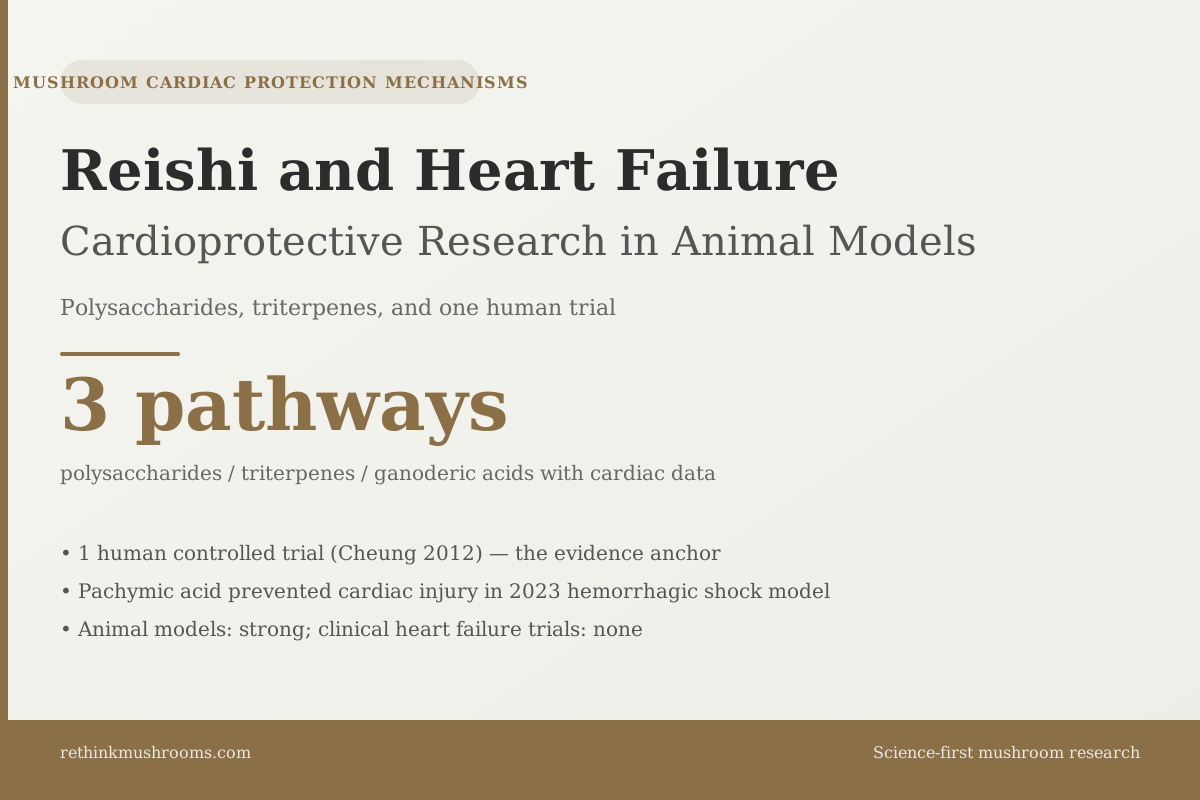
Reishi's cardioprotective reputation rests on animal and cell research, where the effects are large and consistent. Every controlled human trial of Ganoderma lucidum for cardiovascular risk factors has come back null, including a Cochrane review of five trials in 398 participants.
Klupp et al., Cochrane Database of Systematic Reviews, 2015
SMD −2.03
LDL-C reduction across 49 animal studies (Aref 2023)
−0.07 mmol/L
total cholesterol change in humans, 95% CI −0.57 to 0.42 (Cochrane 2015)
0 trials
of reishi in people with diagnosed heart failure
Klupp et al., Cochrane Database of Systematic Reviews, 2015
 View as image ↗
The most important thing to know about reishi and heart failure research is what kind of evidence exists. Not what it suggests, not what it promises. What it is.
There are no trials of reishi in people with diagnosed heart failure. There are three controlled human studies of Ganoderma lucidum for cardiovascular risk factors, and none of them found a significant benefit.[1][2][3] There is, separately, a deep and internally consistent body of animal and cell research showing that reishi compounds reduce oxidative stress, suppress inflammatory cytokines, lower serum lipids, and protect cardiac tissue from injury.
Both of those statements are true at the same time, and the distance between them is the actual story. This article is about that distance: what the preclinical research genuinely demonstrates, why it has not carried over into people, and what would have to happen for the claim to change. For the broader landscape of how mushroom compounds affect the cardiovascular system, the mushrooms and cholesterol research guide provides the full picture.
Key Takeaways
- No controlled trial has ever tested reishi in people with diagnosed heart failure; the human literature is about cardiovascular risk factors in people with borderline hypertension, hyperlipidaemia, or type 2 diabetes
- A 2015 Cochrane review of five trials in 398 participants found no statistically significant effect of G. lucidum on total cholesterol (WMD −0.07 mmol/L, 95% CI −0.57 to 0.42), LDL-C (WMD +0.02 mmol/L), HbA1c, BMI, blood pressure, or triglycerides[3]
- Chu and colleagues' 2012 crossover trial (26 patients, 1.44 g/day, 12 weeks) found no change in blood pressure and no change in plasma antioxidant status; insulin and HOMA-IR were lower on Lingzhi, and lipid signals were confounded by carry-over[1]
- Klupp and colleagues' 2016 double-blind RCT (84 participants, 3 g/day, 16 weeks) concluded outright that the evidence "does not support the use of Ganoderma lucidum for treatment of cardiovascular risk factors" in metabolic syndrome[2]
- In animals the same endpoints move substantially: a meta-analysis of 49 animal studies found LDL-C dropped with a standardized mean difference of −2.03 (95% CI −2.37 to −1.69), and triterpenoid-plus-polysaccharide feeding reduced aortic plaque area in high-fat-diet rabbits[8][5]
- The most direct cardiac-tissue result is pachymic acid preventing hemorrhagic-shock-induced cardiac injury in rats via M1-to-M2 macrophage repolarization and NF-κB suppression — but pachymic acid is a Poria cocos triterpene, not an established reishi constituent[4]
- Reishi is not a cardiac medication and has no established role in treating heart failure; the Cochrane reviewers also noted a non-significant excess of (non-serious) adverse events at four months. This article is not medical advice
Evidence Hierarchy
Reishi & the Heart — Not an Empty Top, a Negative One
Most preclinical-to-clinical gap charts show a deep base of mechanism studies narrowing to an empty human tier — promising work still waiting for its first trial. Reishi cardioprotection has a rarer shape. The human tier is not empty; it has been reached three times and returned null each time. Bar width shows how much direct evidence exists at each tier. Bar colour shows which way that evidence points.
Trial in diagnosed heart failure
no evidenceDoes not exist
No trial has enrolled people with diagnosed heart failure, and none has measured the endpoints that define efficacy in heart failure medicine — mortality, hospitalization, or ejection fraction.
Human trials in risk-factor populations
null resultChu 2012 · Klupp 2016 · Cochrane 2015
Reached three times, negative three times. Chu 2012 (n = 26, 1.44 g/day, 12 wk) found no change in blood pressure or plasma antioxidant status. Klupp 2016 (n = 84, 3 g/day, 16 wk) found no effect on any primary or secondary outcome. The 2015 Cochrane review pooled 5 trials in 398 participants and found no significant effect on cholesterol, LDL-C, blood pressure, triglycerides, HbA1c, or BMI.
Animal models
supportiveAref 2023 · Li 2021 · Sudheesh 2009 · Shevelev 2018
Deep and quantitatively large. A 49-study meta-analysis put LDL-C reduction at SMD −2.03 (95% CI −2.37 to −1.69). Rabbits fed Ganoderma spore oil and powder at 0.3 g/kg/day for four months showed significantly reduced aortic plaque area. Aged rats given ethanolic extract for 15 days showed enhanced Krebs cycle dehydrogenase and complex IV activity in heart tissue. Hypertensive ISIAH rats showed blood pressure reduction comparable to losartan.
Cell & endothelial mechanisms
supportiveLi 2021
The widest tier and the most mechanistically specific. In ox-LDL-stimulated human endothelial cells, Ganoderma reduced ROS and malondialdehyde by inhibiting NF-κB p65 and the LOX-1 scavenger receptor; in THP-1 macrophages it suppressed inflammatory polarization and TNF-α via Notch1 and DLL4, and increased foam-cell apoptosis.
How to read it: the bottom two tiers are wide and green — reishi's cell and animal cardiovascular evidence is both plentiful and consistently positive. The third tier is narrow and red, which is the crucial detail: those human trials were run, and they did not reproduce the animal result. The top tier is empty because no one has taken reishi into a heart failure population at all. A claim that reishi protects the heart is a claim about the green tiers being read as if they were the red one.
Sources: Chu 2012 [1]; Klupp 2016 [2]; Klupp 2015 Cochrane [3]; Li 2021 [5]; Sudheesh 2009 [6]; Aref 2023 [8]; Shevelev 2018 [11]. Bar widths are illustrative of evidence depth per tier, not quantitative effect sizes.
What Reishi Contains and Why Researchers Study It for Cardiac Protection
Reishi (Ganoderma lucidum) produces a set of bioactive compounds that is unusual among commonly eaten mushrooms. A 2022 review catalogued 495 compounds across 25 Ganoderma species, with triterpenes as the primary constituents alongside polysaccharides, steroids, nucleosides, and proteins.[10] Two of those classes carry nearly all of the cardiovascular research.
Polysaccharides (primarily beta-glucans and Ganoderma-specific polysaccharides) are the structural carbohydrates found throughout the fruiting body and mycelium. In cardiovascular models they have been studied mainly for effects on oxidative stress and lipid handling. In the high-fat-diet rabbit model, Ganoderma polysaccharides administered alongside triterpenoids reduced reactive oxygen species and malondialdehyde generation in oxidized-LDL-stimulated human endothelial cells, by inhibiting upregulation of NF-κB p65 and the scavenger receptor LOX-1.[5]
Triterpenes (including the ganoderic acids) are bitter compounds concentrated in the fruiting body and spores. They are structurally related to steroids and interact with multiple signalling pathways. A 2026 systematic review and meta-analysis screened over 3,000 records and included 23 preclinical studies of G. lucidum triterpenes; every included study reported significant anti-inflammatory effects, with reductions in TNF-α, IL-1β, and IL-6 driven primarily by downregulation of MAPK and TLR-4/NF-κB signalling.[7]
A frequently repeated claim is that ganoderic acids protect the heart indirectly by inhibiting HMG-CoA reductase, the enzyme statins target. The lipid-lowering itself is well documented in animals, but the specific HMG-CoA reductase mechanism is not established in the primary reishi cardiovascular literature, and this article does not assert it. The 2021 review by Chan and colleagues is more measured, concluding that G. lucidum shows antioxidative, antihypertensive, hypoglycaemic, lipid-lowering, and anti-inflammatory properties across in vitro and animal work, while the health benefits in clinical trials remain unconfirmed.[9]
The Human Trials: Three Anchors, All Null
Reishi's cardiovascular reputation is often introduced with a reference to "a controlled human trial." There is more than one, and reading them changes the picture rather than supporting it.
Chu et al. (2012) · British Journal of Nutrition
- Population
- 26 patients with borderline elevated blood pressure and/or cholesterol (23 evaluable)
- Intervention
- 1.44 g/day Lingzhi (Ganoderma lucidum), 12 weeks
- Comparator
- Matching placebo, randomised double-blind crossover with placebo-controlled run-in
- Finding
- No change in BMI or blood pressure on Lingzhi versus placebo. Plasma antioxidant status, urine catecholamines and cortisol, and blood lymphocyte subsets showed no significant differences. Plasma insulin and HOMA-IR were lower after Lingzhi than placebo. Triglycerides fell and HDL-cholesterol rose in the first treatment period, but significant carry-over effects prevented complete analysis of those parameters.
null Null on the cardiovascular endpoints it was designed to test; the authors' own framing points toward mild antidiabetic effects, not cardioprotection.
Chu TTW et al., Br J Nutr 2012;107(7):1017-27. PMID 21801467.
This is the study most often cited as evidence that reishi protects the heart. It is a well-designed small crossover trial, and on the cardiovascular parameters it measured — blood pressure, antioxidant status — it found nothing. Its authors concluded that Lingzhi "might have mild antidiabetic effects" and called for further study in patients with hyperglycaemia.
Klupp et al. (2016) · Scientific Reports
- Population
- 84 participants with type 2 diabetes mellitus and metabolic syndrome
- Intervention
- 3 g/day Ganoderma lucidum, with or without Cordyceps sinensis, 16 weeks
- Comparator
- Placebo, prospective double-blind randomised placebo-controlled design
- Finding
- No effect on the primary outcomes — HbA1c (baseline-adjusted difference in means 0.13%, 95% CI −0.35 to 0.60, p = 0.60) and fasting plasma glucose (0.03 mmol/L, 95% CI −0.90 to 0.96, p = 0.95) — and no effect on any secondary outcome across 16 weeks. No overall increased risk of adverse events with either active treatment.
null The authors state the trial 'does not support the use of Ganoderma lucidum for treatment of cardiovascular risk factors' in this population. Prospectively registered (ACTRN12606000485538).
Klupp NL et al., Sci Rep 2016;6:29540. PMID 27511742.
The 2016 trial is larger, longer, higher-dosed, and prospectively registered — the closest thing to a definitive human test in this literature. It is unambiguously negative.
What the Cochrane review adds
Between those two trials sits a 2015 Cochrane systematic review by the same lead author, which searched CENTRAL, MEDLINE, EMBASE, Science Direct, and several Chinese-language databases with no language restriction, and handsearched the International Journal of Medicinal Mushrooms.[3]
Five trials with 398 participants met inclusion criteria; three contributed data suitable for pooled analysis, comparing 1.4 g to 3 g per day over 12 to 16 weeks, all in participants with type 2 diabetes. Risk of bias was low for one study and unclear for the other four. The pooled results found no statistically or clinically significant reduction in HbA1c (WMD −0.10%, 95% CI −1.05 to 0.85, 130 participants), total cholesterol (WMD −0.07 mmol/L, 95% CI −0.57 to 0.42, 107 participants), LDL-cholesterol (WMD +0.02 mmol/L, 95% CI −0.41 to 0.45, 107 participants), or BMI, and no significant differences in blood pressure or triglycerides.
The reviewers' conclusion is direct: evidence from a small number of randomised controlled trials does not support the use of G. lucidum for treatment of cardiovascular risk factors in people with type 2 diabetes.
Safety
LowA non-significant excess of adverse events at four months
Concern
In the Cochrane pooled analysis, participants who took Ganoderma lucidum for four months were 1.67 times more likely to report an adverse event than those on placebo (RR 1.67, 95% CI 0.86 to 3.24).
What the research says
The reviewers noted these were not serious side effects, and the confidence interval crosses 1.0, so this is a signal to watch rather than a demonstrated harm. The 2016 Klupp trial separately reported no overall increased risk of adverse events. Long-term safety data at cardiac-relevant durations does not exist.
Particularly relevant for: Adults with type 2 diabetes taking 1.4–3 g/day for 12–16 weeks
What to do
Reishi is not a cardiac medication. Anyone with diagnosed heart disease, or taking anticoagulant, antihypertensive, or antidiabetic medication, should consult their physician before adding it. This is not medical advice.
Klupp NL et al., Cochrane Database Syst Rev 2015;(2):CD007259. PMID 25686270.
Where the Animal Evidence Actually Is Strong
None of this means the preclinical research is weak. It is the opposite: the animal literature is deep, quantitatively large, and mechanistically coherent. That is precisely what makes the human null results interesting rather than boring.
A 2023 systematic review and meta-analysis screened 358 studies and pooled 49 animal experiments of G. lucidum on lipid parameters.[8] The effect sizes are not marginal: triglycerides fell with a standardized mean difference of −1.52 (95% CI −1.79 to −1.24), total cholesterol −1.51 (−1.75 to −1.27), LDL-cholesterol −2.03 (−2.37 to −1.69), and VLDL −1.06 (−1.638 to −0.482), while HDL-cholesterol rose (SMD +1.03, 0.73 to 1.33). The authors noted that different doses produced varying degrees of effectiveness.
Translation Gap
The Same Five Lipid Endpoints, Measured in Animals and in People
Left: pooled results from 49 animal studies. Right: pooled results from the Cochrane review of human trials. Every animal interval sits clear of the no-effect line. Every human interval crosses it. The two panels use different metrics on different scales, so the comparison to make is not bar against bar — it is each interval against its own dashed zero.
Animals (Aref 2023). LDL-C fell with SMD −2.03 (95% CI −2.37 to −1.69) across 49 studies; total cholesterol −1.51, triglycerides −1.52, VLDL −1.06, and HDL-C rose +1.03. These are large, precisely estimated effects, and the authors noted that different doses produced different degrees of effectiveness.
Humans (Cochrane 2015). Total cholesterol changed by −0.07 mmol/L (95% CI −0.57 to 0.42) and LDL-C by +0.02 mmol/L (−0.41 to 0.45), both in 107 participants. Triglycerides and blood pressure showed no statistically significant differences. HDL-C and VLDL were not pooled.
Why this is the key chart: a null human result is easy to wave away as an underpowered trial that simply missed a real effect. But the human intervals here are not merely wide — they are centred on approximately zero, with point estimates of −0.07 and +0.02 mmol/L. The animal literature predicts a large effect; the human data measured no effect at all. Dose, preparation, model severity, and duration all differ between the two panels, and no study has yet isolated which of those explains the gap.
Sources: Aref M et al., J Res Med Sci 2023;28:70 (PMID 38116485) [8]; Klupp NL et al., Cochrane Database Syst Rev 2015;(2):CD007259 (PMID 25686270) [3]. SMD (standardized mean difference, unitless) and WMD (weighted mean difference, mmol/L) are different metrics on independent scales and are not comparable in magnitude.
Downstream of the lipid numbers, the structural endpoint moves too. Li and colleagues fed Japanese big-ear white rabbits Ganoderma spore oil and spore powder (0.3 g/kg body weight/day) for four months on an atherosclerosis-inducing diet.[5] Serum triglycerides, total cholesterol, and LDL-C were significantly lower than in the model group, and the area of aortic plaque was significantly reduced. Companion cell work in the same paper traced the mechanism: reduced ROS and MDA in ox-LDL-stimulated endothelial cells via NF-κB p65 and LOX-1 inhibition, reduced TNF-α and inhibited inflammatory macrophage polarization via Notch1 and DLL4, and increased apoptosis of foam cells.
Two other animal results are worth naming because they target the heart and the vasculature directly rather than the lipid panel:
- Cardiac mitochondrial function. Sudheesh and colleagues gave aged male Wistar rats a 70% ethanolic G. lucidum extract (50 and 250 mg/kg) once daily for 15 days and measured enzymes in heart tissue. Krebs cycle dehydrogenases (isocitrate, alpha-ketoglutarate, succinate, malate) and electron transport chain complex IV activity were significantly enhanced (P < 0.05), with DL-alpha-lipoic acid as positive control.[6] Energy-starved cardiac mitochondria are a real feature of the failing heart, which makes this one of the more mechanistically on-target findings in the corpus.
- Blood pressure. Shevelev and colleagues administered Reishi water extract intragastrically to hypertensive ISIAH rats for seven weeks and reported blood pressure reduction comparable to losartan, with the additional finding — unlike losartan — of significantly increased cerebral blood flow.[11] For the reishi-specific blood pressure literature in depth, the reishi and hypertension research article covers the ACE inhibition and vasodilation data separately.
For the broader picture of how mushroom compounds interact with cardiac remodeling after injury, the mushroom polysaccharides and cardiac remodeling article covers the detailed biology, and the cordyceps and myocardial ischemia article covers a parallel evidence base in a different species.
Pachymic Acid: The Most Cited Cardiac Result, and an Attribution Problem
The single most direct cardiac-injury result associated with this research area is a 2023 study in the American Journal of Chinese Medicine.[4] Male Sprague-Dawley rats received intraperitoneal pachymic acid (7.5 or 15 mg/kg) daily for three days, after which hemorrhagic shock was induced by drawing blood through a femoral artery catheter followed by resuscitation.
Hemorrhagic shock produced abnormalities in hemodynamics, serum cardiac enzymes, and cardiac structure, and induced cardiac apoptosis. Pachymic acid pretreatment alleviated all of these. It also suppressed IL-1β, IL-6, and TNF-α at both mRNA and protein level in heart tissue, reduced inflammatory cell infiltration, and shifted macrophage polarization — decreasing M1 markers (CD86, iNOS) while increasing M2 markers (CD206) — through NF-κB pathway suppression.
That is a genuinely good study. The problem is the attribution.
Compound attribution
Is pachymic acid a reishi compound?
The claim
“Pachymic acid is a reishi triterpene, so the 2023 cardiac-injury result is evidence for reishi's cardioprotective effects.”
Poria cocos and Ganoderma lucidum are both Polyporales fungi that produce lanostane-type triterpenes, and the two are frequently discussed together in traditional-medicine formulations, so their compounds get pooled in secondary sources.
What research shows
UnsupportedThe 2023 study itself describes pachymic acid as 'a triterpenoid extracted from Poria cocos.' Pachymic acid is characteristically a Poria cocos constituent; a PubMed search for pachymic acid together with Ganoderma returns two records, neither of which establishes it as a Ganoderma lucidum constituent.
This does not make the cardiac finding less real — it makes it evidence about pachymic acid and Poria cocos rather than about reishi. Reishi's own triterpene cardiac evidence rests on the lipid, plaque, mitochondrial, and blood-pressure work described above, not on this study.
Liu Z et al., Am J Chin Med 2023;51(8):2157-2173 (PMID 37865871); PubMed query 'pachymic acid AND Ganoderma', 2 records.
Two further caveats apply even on its own terms. Hemorrhagic shock is an acute, trauma-driven form of cardiac injury, distinct from the chronic remodeling of heart failure. And the design was pretreatment — three days of dosing before the insult — which answers a prevention question rather than a treatment question. Reishi's own triterpene profile overlaps with the antiplatelet and anti-inflammatory mechanisms covered in the reishi triterpenes and arterial plaque article.
The Gap Between Animal Research and Treating Heart Failure
Heart failure is a chronic, progressive condition in which the heart muscle cannot pump enough blood to meet the body's demands. Standard treatment combines ACE inhibitors, beta-blockers, mineralocorticoid antagonists, diuretics, and SGLT2 inhibitors, each supported by large randomized trials with mortality and hospitalization endpoints.
Reishi has not entered that arena at all. Every human trial reviewed here enrolled people with borderline hypertension, hyperlipidaemia, or type 2 diabetes — risk-factor populations, not heart failure populations. None measured mortality, hospitalization, or left ventricular ejection fraction. The animal studies use acute injury models, aged-rat physiology, or biochemical endpoints rather than the clinical outcomes that define efficacy in heart failure medicine.
- Cell and mechanistic studiescompleted
Endothelial and macrophage work: NF-κB p65 and LOX-1 inhibition, reduced ROS and MDA, Notch1/DLL4-mediated suppression of inflammatory macrophage polarization
- Animal modelscompleted
Deep and quantitatively large: 49-study lipid meta-analysis, aortic plaque reduction in rabbits, cardiac mitochondrial enzyme enhancement in aged rats, losartan-comparable blood pressure reduction in hypertensive rats
- Small human trials in risk-factor populationscurrent
Three completed: Chu 2012 (n=26, null on BP and antioxidant status), Klupp 2016 (n=84, null on all primary and secondary outcomes), plus the trials pooled in Cochrane 2015 — the tier exists but the results are negative
- Trial in diagnosed heart failuremissing
No trial has enrolled people with heart failure, and no trial has measured mortality, hospitalization, or ejection fraction
- Meta-analysis of human cardiac outcomesmissing
The 2015 Cochrane review pooled human risk-factor data and found no significant effect; there is no body of human cardiac-outcome trials to pool
Reishi cardioprotection is not an early-stage story waiting for its first human test. The human tier has been reached three times and returned null each time, while the preclinical tiers below it remain strong. That combination — deep positive preclinical evidence, repeated negative human evidence — is the defining feature of this literature.
Chu 2012 [1]; Klupp 2016 [2]; Klupp 2015 Cochrane [3]; Aref 2023 [8]; Li 2021 [5]; Sudheesh 2009 [6]; Shevelev 2018 [11].
Why the translation fails is not settled, and the honest answer is that nobody knows. Plausible contributors include dose (animal studies commonly use body-weight-scaled doses far above the 1.4–3 g/day used in humans), preparation (spore oil, spore powder, ethanolic extract, and water extract are chemically different products), model severity (high-fat-diet rabbits and hypertensive rat strains start from a more extreme baseline than borderline-hyperlipidaemic humans), and duration. The trials that would separate these explanations have not been run.
Antrodia camphorata, a Taiwanese medicinal fungus with overlapping cardiac research, sits in a similar position — strong animal data, thin human trials. The Antrodia camphorata and heart protection article covers that literature.
What the Research Shows About Reishi and Cardiovascular Health
Reading this corpus honestly produces a narrower claim than the popular one, and a more interesting one.
Reishi is a multi-pathway botanical with well-characterized anti-inflammatory, antioxidant, and lipid-lowering activity in preclinical systems, including several results measured directly in cardiac tissue. Those findings are real, replicated across laboratories, and quantitatively substantial. They justify continued research. They do not establish a human cardiovascular benefit, because that has been tested and not found.
For population-level context, Krittanawong and colleagues' 2021 systematic review in the American Journal of Medicine identified seven prospective studies of edible mushroom consumption and cardiovascular risk, reporting possible favourable effects on lipid profiles.[12] That is observational data about edible mushrooms in the diet, not about Ganoderma supplementation, and the two should not be merged.
For anyone with established heart failure considering reishi, the position is straightforward: reishi has never been tested as a heart failure treatment, the trials that tested related endpoints were negative, and it should not be used in place of or alongside cardiac medication without a physician's involvement. This article is not medical advice.
The mushrooms and cardiac protection mechanisms article covers the five key mechanisms by which mushroom compounds have been documented to affect cardiac tissue, placing reishi's mechanisms in the context of the broader class of medicinal mushrooms.
The Bottom Line
Reishi's cardioprotective reputation is built almost entirely on preclinical evidence. In animals, Ganoderma lucidum lowers LDL-cholesterol with a pooled standardized mean difference of −2.03 across 49 studies, reduces aortic plaque area in high-fat-diet rabbits, enhances heart mitochondrial enzyme activity in aged rats, and lowers blood pressure comparably to losartan in hypertensive rats. In humans, the picture reverses: Chu 2012 found no change in blood pressure or antioxidant status, Klupp 2016 found no effect on any outcome, and the 2015 Cochrane review of five trials in 398 participants found no significant effect on cholesterol, LDL, blood pressure, triglycerides, or HbA1c. No trial has ever enrolled people with diagnosed heart failure. The mechanisms are real; the human cardiac benefit is unproven.
Frequently Asked Questions
Sources & References
- 1RTHM-00247·Chu, Tanya T W et al. (2012). “Study of potential cardioprotective effects of Ganoderma lucidum (Lingzhi): results of a controlled human intervention trial..” The British journal of nutrition.Study breakdown →PubMed →↩
- 2RTHM-00429·Klupp, Nerida L et al. (2016). “A double-blind, randomised, placebo-controlled trial of Ganoderma lucidum for the treatment of cardiovascular risk factors of metabolic syndrome..” Scientific reports.Study breakdown →PubMed →↩
- 3RTHM-00380·Klupp, Nerida L et al. (2015). “Ganoderma lucidum mushroom for the treatment of cardiovascular risk factors..” The Cochrane database of systematic reviews.Study breakdown →PubMed →↩
- 4RTHM-01740·Liu, Zhenfeng et al. (2023). “Pachymic Acid Prevents Hemorrhagic Shock-Induced Cardiac Injury by Suppressing M1 Macrophage Polarization and NF-[Formula: see text]B Signaling Pathway..” The American journal of Chinese medicine.Study breakdown →PubMed →↩
- 5RTHM-01387·Li, Yanhong et al. (2021). “Ganoderma lucidum triterpenoids and polysaccharides attenuate atherosclerotic plaque in high-fat diet rabbits..” Nutrition.Study breakdown →PubMed →↩
- 6RTHM-00317·Sudheesh, N P et al. (2009). “Ganoderma lucidum (Fr.) P. Karst enhances activities of heart mitochondrial enzymes and respiratory chain complexes in the aged rat..” Biogerontology.Study breakdown →PubMed →↩
- 7RTHM-02241·Pozzobon, Rafaela Guedes et al. (2026). “Anti-Inflammatory Potential of Ganoderma lucidum Triterpenes: A Systematic Review and Meta-Analysis of Preclinical Evidence..” Pharmaceuticals (Basel.Study breakdown →PubMed →↩
- 8RTHM-01656·Aref, Maryam et al. (2023). “Effect of Ganoderma lucidum on serum lipid profiles: A systematic review and meta-analysis on animal studies..” Journal of research in medical sciences : the official journal of Isfahan University of Medical Sciences.Study breakdown →PubMed →↩
- 9RTHM-01332·Chan, Sze Wa et al. (2021). “The beneficial effects of Ganoderma lucidum on cardiovascular and metabolic disease risk..” Pharmaceutical biology.Study breakdown →PubMed →↩
- 10RTHM-01519·Galappaththi, Mahesh C A et al. (2022). “A Review of Ganoderma Triterpenoids and Their Bioactivities..” Biomolecules.Study breakdown →PubMed →↩
- 11RTHM-00530·Shevelev, Oleg B et al. (2018). “Hypotensive and neurometabolic effects of intragastric Reishi (Ganoderma lucidum) administration in hypertensive ISIAH rat strain..” Phytomedicine : international journal of phytotherapy and phytopharmacology.Study breakdown →PubMed →↩
- 12RTHM-01376·Krittanawong, Chayakrit et al. (2021). “Mushroom Consumption and Cardiovascular Health: A Systematic Review..” The American journal of medicine.Study breakdown →PubMed →↩