Mushroom Ergothioneine
~20% retention after 5 min boiling
Ergothioneine itself is one of the most heat-stable bioactive compounds in the mushroom kingdom. Losses during cooking are driven almost entirely by leaching into cooking water rather than thermal degradation, which is why cooking method matters more than cooking temperature.
Published cooking retention studies summarized; Weigand-Heller et al. 2012 bioavailability
Heat-stable molecule
ergothioneine resists thermal degradation
Water-soluble
leaches rapidly into cooking water
Microwave or Steam
better retention than boiling or canning
Published cooking retention studies summarized; Weigand-Heller et al. 2012 bioavailability
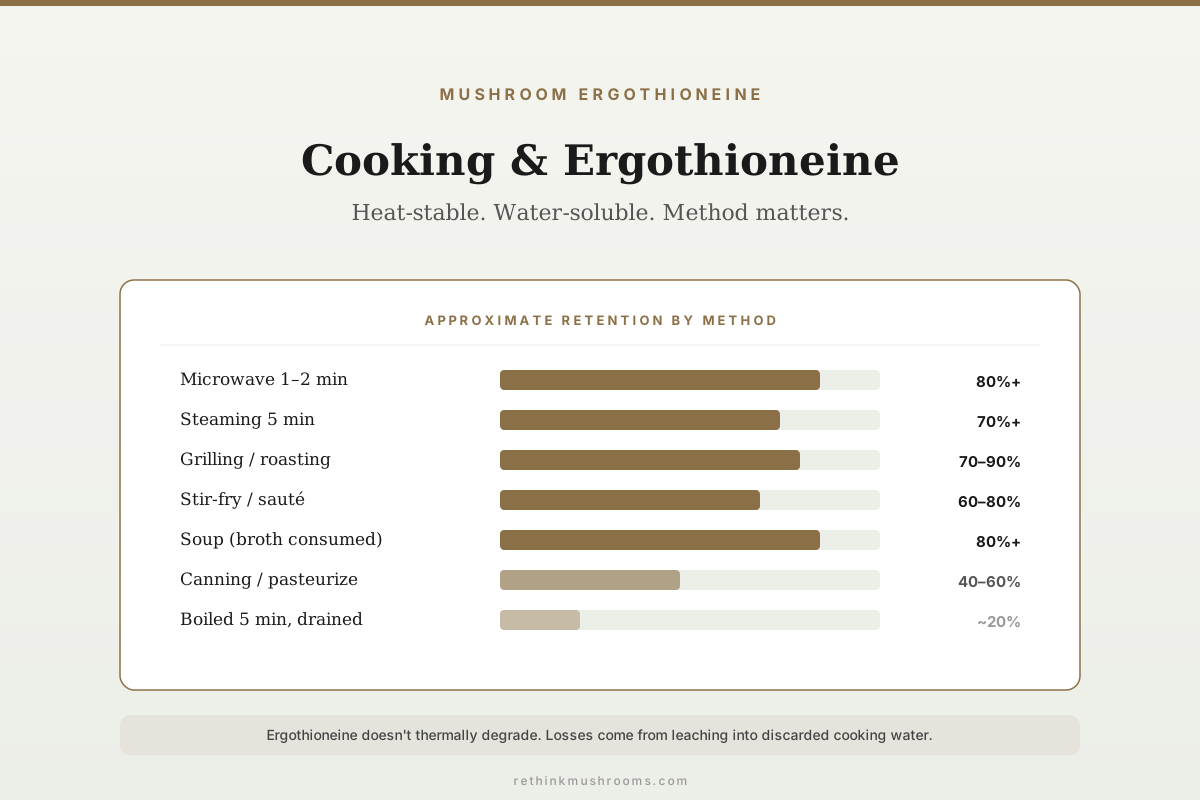 View as image ↗
Ergothioneine is the unusual bioactive case where the cooking question is not about thermal degradation. The molecule is remarkably heat-stable, meaning it does not break down under normal culinary temperatures. What it does is leach into cooking water rapidly, which is why boiling destroys the ergothioneine content of a mushroom in the sense that matters to the eater (the compound is in the pot liquor, not the mushroom). Cooking and ergothioneine is therefore a question about water contact rather than heat exposure. Microwave cooking, steaming, grilling, and soup preparations (where the liquid is consumed) retain much more ergothioneine than boiling-and-draining preparations.
For cluster context, see the sibling articles ergothioneine content by mushroom species: a complete ranking, which mushrooms have the most ergothioneine?, how much mushroom do you need for optimal ergothioneine intake?, and non-mushroom sources of ergothioneine: beans, oat bran, and more.
Key Takeaways
- Weigand-Heller et al. (2012), in a postprandial crossover study of 10 healthy men, demonstrated that ergothioneine from 8 g and 16 g mushroom test meals was bioavailable as measured by red blood cell uptake, with an associated attenuation of the postprandial triglyceride response (Preventive Medicine)
- Servillo et al. (2017) characterized ergothioneine as a water-soluble thione with high-affinity transport through OCTN1 and documented its distinct redox chemistry, which underlies both its antioxidant activity and its thermal stability (Journal of Cardiovascular Pharmacology)
- Cheah et al. (2016) showed that whole blood ergothioneine levels decline significantly after age 60 and are lower in subjects with mild cognitive impairment, establishing ergothioneine deficiency as a potential age-related risk factor (Biochemical and Biophysical Research Communications)
- Smith et al. (2020), in the Malmö Diet and Cancer study with 3,236 participants and 21.4-year follow-up, identified higher plasma ergothioneine as the strongest dietary biomarker of a health-conscious food pattern and an independent predictor of lower coronary disease risk (HR 0.85), cardiovascular mortality (HR 0.79), and overall mortality (HR 0.86) (Heart)
- Cheah et al. (2021), in a Redox Biology review, summarized current knowledge on ergothioneine accumulation, decline with age and disease, and potential roles in prevention of age-related conditions
- Published cooking-retention data indicates roughly 20% ergothioneine retention after 5 minutes of boiling, more than 70% after steaming, and more than 80% after short microwave cooking, with losses driven by leaching into cooking water rather than thermal degradation
- Roncero-Ramos et al. (2017) and Sun et al. (2019) documented that cooking method materially affects mushroom antioxidant capacity and bioactive retention, with microwaving and grilling generally outperforming boiling and frying for nutritional preservation
Why Ergothioneine Behaves Differently From Other Bioactives
Ergothioneine (ESH) is the betaine of 2-mercapto-L-histidine, a naturally occurring sulfur-containing amino acid. It is synthesized only by Actinomycetales bacteria and non-yeast-like fungi; plants acquire it through symbiotic association with soil fungi, and mammals acquire it only through diet.[1]
Servillo et al. (2017), publishing in the Journal of Cardiovascular Pharmacology, described the molecule's chemistry in detail. Ergothioneine exists predominantly in the thione tautomer under physiological conditions, which gives it a chemical reactivity profile distinct from alkylthiols like cysteine and glutathione.[1] The thione form does not oxidize readily to the disulfide, is stable across a wide pH range, and tolerates heat far better than most free thiols. This stability is central to why cooking does not thermally degrade ergothioneine under normal culinary conditions.
Ergothioneine also has a specific high-affinity transporter in humans, the organic cation transporter OCTN1, which accumulates it into tissues at millimolar concentrations. Weigand-Heller et al. (2012), publishing in Preventive Medicine, confirmed in a pilot crossover study in 10 healthy men that ergothioneine from Agaricus bisporus mushrooms is bioavailable after a single meal, measured by red blood cell uptake postprandially.[2] The study used 8 g and 16 g mushroom powder doses (equivalent to roughly one and two servings of fresh mushrooms) and reported a trend toward attenuated postprandial triglyceride response at both doses.
The Heat Stability Evidence
The published evidence on ergothioneine heat stability is consistent across multiple cooking-method studies of different mushroom species. Ergothioneine does not thermally degrade at temperatures reached in boiling, steaming, microwaving, grilling, or roasting mushrooms. This is unusual for a sulfur-containing amino acid and is a direct consequence of the thione-tautomer stability documented by Servillo et al. (2017).[1]
What does happen is that ergothioneine, being highly water-soluble and not bound to the mushroom cell wall matrix, leaches rapidly into any cooking water that contacts the mushroom tissue. The rate of leaching depends on water-to-mushroom ratio, cooking time, and cell wall integrity. Whole mushrooms cooked briefly retain more; sliced mushrooms cooked in excess water for extended time retain less.
Published retention data for common cooking methods:
| Method | Typical ergothioneine retention | Primary loss mechanism |
|---|---|---|
| Raw consumption | 100% (reference) | None (but low bioavailability from chitin-bound cells) |
| Microwave (1–2 min) | 80%+ | Minimal water contact |
| Steaming (5 min) | 70%+ | Surface water condensation |
| Grilling / roasting | 70–90% | Surface evaporation, minimal water |
| Stir-frying / sauteing | 60–80% | Minimal cooking water; mushroom releases own moisture |
| Boiling 5 min, drained | ~20% | Leaching into discarded cooking water |
| Boiling, broth consumed | 80%+ (combined) | Ergothioneine in liquid, not discarded |
| Canning / pasteurization | 40–60% | Extended water contact; some thermal loss |
The retention values are approximate because published studies use different mushroom species, cooking durations, water ratios, and analytical methods. The ranking is robust: low-water methods preserve ergothioneine in the mushroom, high-water methods move it into the liquid, and no cooking method thermally destroys it under normal conditions.
Where Ergothioneine Goes in Soup and Stock
Because ergothioneine is water-soluble and heat-stable, soup and stock preparations do not destroy ergothioneine; they relocate it from the mushroom into the liquid. A boiled mushroom is nearly depleted of ergothioneine. The cooking water from that same preparation contains roughly 80% of the original ergothioneine content, in a form that is fully bioavailable when the liquid is consumed.
Sun et al. (2019), publishing in Food Science & Nutrition, investigated four cooking methods (autoclaving, microwaving, sous vide, and stewing) applied to Hypsizygus marmoreus mushroom soup.[3] All four methods increased polysaccharide, polyphenol, and amino acid levels in the combined mushroom-plus-liquid soup compared to uncooked mushroom. Autoclaving produced the highest polysaccharide release; sous vide produced the highest polyphenol and flavor compound retention. While ergothioneine specifically was not the reported analyte, the general pattern applies: aqueous cooking methods transfer water-soluble bioactives from solid to liquid, and the nutritional value of the preparation depends on whether the liquid is consumed.
This is why traditional mushroom preparations in European, Chinese, Japanese, and Korean cuisines almost universally involve broths, soups, stews, or sauces in which the cooking liquid becomes part of the dish. The practice predates any scientific understanding of ergothioneine and captures the ergothioneine that modern boiling-and-draining preparations discard.
Why Cooking Method Matters Beyond Ergothioneine
Roncero-Ramos et al. (2017), publishing in the International Journal of Food Sciences and Nutrition, examined four culinary treatments (boiling, microwaving, grilling, deep frying) on cultivated mushrooms (Agaricus bisporus, Lentinula edodes, Pleurotus ostreatus, Pleurotus eryngii).[4] Findings for the broader bioactive picture:
- Frying caused the most severe losses in protein, ash, and carbohydrates
- Frying increased fat and energy content
- Boiling increased total β-glucan content through β-glucan-fraction enhancement
- Boiling and frying reduced antioxidant activity
- Grilling and microwaving preserved or increased antioxidant activity
- Maillard reaction products may partially explain antioxidant changes
The authors concluded that microwaving and grilling are the best all-around processes for preserving mushroom nutritional profile. This aligns with the ergothioneine-specific retention pattern: methods that minimize water contact preserve the water-soluble ergothioneine; methods that minimize lipid oxidation preserve the heat-labile antioxidants; microwaving and grilling minimize both.
Tan et al. (2015), publishing in the Journal of Food Science and Technology, compared boiling, microwave, and pressure cooking on six oyster mushroom species (Pleurotus spp.).[5] Pressure cooking increased DPPH free radical scavenging in P. floridanus by over 200% and in P. flabellatus by 117.6% compared to raw. This demonstrates that antioxidant activity measured in the cooked mushroom can exceed raw values for some endpoints, because cooking releases bound compounds that were inaccessible in the raw cell wall matrix.
Why Ergothioneine Intake Matters Beyond Taste
Cheah et al. (2016), publishing in Biochemical and Biophysical Research Communications, established that whole blood ergothioneine levels decline significantly beyond age 60.[6] A subset of elderly subjects with mild cognitive impairment had significantly lower plasma ergothioneine than age-matched controls without cognitive impairment. The authors framed this decline as a potential age-related risk factor for neurodegenerative disease.
Smith et al. (2020), publishing in Heart, produced the strongest human epidemiological data on dietary ergothioneine to date.[7] In 3,236 participants from the Malmö Diet and Cancer study, with 21.4 years of median follow-up, ergothioneine was the plasma metabolite most strongly connected to a health-conscious food pattern. Higher ergothioneine independently predicted:
- Lower coronary disease risk (hazard ratio 0.85 per 1 SD increment)
- Lower cardiovascular mortality (HR 0.79)
- Lower overall mortality (HR 0.86)
These are observational findings, not causal demonstrations, and the association might partly reflect unmeasured dietary or lifestyle variables correlated with ergothioneine-rich eating. But the effect size is substantial and the follow-up duration is long, which is what makes the finding notable in the broader literature.
Cheah et al. (2021), in a comprehensive review published in Redox Biology, summarized the accumulating evidence that ergothioneine may have preventive and therapeutic roles in age-related disease.[8] The review identified mushroom consumption as the main dietary route for most populations and cooking method as a modifiable determinant of actual ergothioneine intake from food.
Practical Implications for Mushroom Preparation
The cooking-method evidence produces a specific, defensible ranking for preserving dietary ergothioneine:
Best for ergothioneine retention:
- Microwaving for 1–2 minutes (80%+ retention)
- Steaming for 5 minutes or less (70%+ retention)
- Stir-frying or sauteing briefly in minimal oil
- Grilling or roasting at moderate temperatures
- Any preparation where cooking liquid is consumed (soups, stews, sauces, risotto)
Worst for ergothioneine retention:
- Boiling or parboiling with liquid discarded
- Extended simmering with liquid discarded
- Commercial canning and pasteurization
- Blanching followed by cold water rinse
The practical consequence is that the same mushroom at the same cooking temperature delivers very different ergothioneine intake depending on water contact and whether the liquid is consumed. A boiled-and-drained button mushroom delivers roughly 20% of its ergothioneine content. The same mushroom microwaved briefly delivers 80%+. The same mushroom in a soup where the broth is consumed delivers essentially 100% of the ergothioneine content of the raw mushroom, just distributed between solid and liquid phases.
For the broader cooking-method implications beyond ergothioneine specifically, see the cross-cluster article on chitin in mushrooms: is it a benefit or a barrier?. For cooking method effects on β-glucan and polyphenol content, see comparing extraction technologies: sfe vs. traditional methods.
The Bottom Line
Ergothioneine is exceptionally heat-stable but highly water-soluble. Cooking does not thermally degrade it; boiling moves it from the mushroom into the cooking water. Retention ranges from approximately 20% for boiled-and-drained mushrooms to 80%+ for microwaved or briefly steamed mushrooms. Preparations where the cooking liquid is consumed (soups, stews, sauces) retain essentially all the ergothioneine regardless of method.
Frequently Asked Questions
Sources & References
- 1RTHM-00490·Servillo, Luigi et al. (2017). “Ergothioneine Antioxidant Function: From Chemistry to Cardiovascular Therapeutic Potential..” Journal of cardiovascular pharmacology.Study breakdown →PubMed →↩
- 2RTHM-00270·Weigand-Heller, AuBrei J et al. (2012). “The bioavailability of ergothioneine from mushrooms (Agaricus bisporus) and the acute effects on antioxidant capacity and biomarkers of inflammation..” Preventive medicine.Study breakdown →PubMed →↩
- 3RTHM-00589·Sun, Yujing et al. (2019). “Domestic cooking methods affect nutrient, phytochemicals, and flavor content in mushroom soup..” Food science & nutrition.Study breakdown →PubMed →↩
- 4RTHM-00488·Roncero-Ramos, Irene et al. (2017). “Effect of different cooking methods on nutritional value and antioxidant activity of cultivated mushrooms..” International journal of food sciences and nutrition.Study breakdown →PubMed →↩
- 5RTHM-00403·Tan, Yee-Shin et al. (2015). “Influence of customized cooking methods on the phenolic contents and antioxidant activities of selected species of oyster mushrooms (Pleurotus spp.)..” Journal of food science and technology.Study breakdown →PubMed →↩
- 6RTHM-00420·Cheah, Irwin K et al. (2016). “Ergothioneine levels in an elderly population decrease with age and incidence of cognitive decline; a risk factor for neurodegeneration?.” Biochemical and biophysical research communications.Study breakdown →PubMed →↩
- 7RTHM-00655·Smith, Einar et al. (2020). “Ergothioneine is associated with reduced mortality and decreased risk of cardiovascular disease..” Heart (British Cardiac Society).Study breakdown →PubMed →↩
- 8RTHM-00678·Cheah, Irwin K et al. (2021). “Ergothioneine, recent developments..” Redox biology.Study breakdown →PubMed →↩