Ergothioneine & Pregnancy
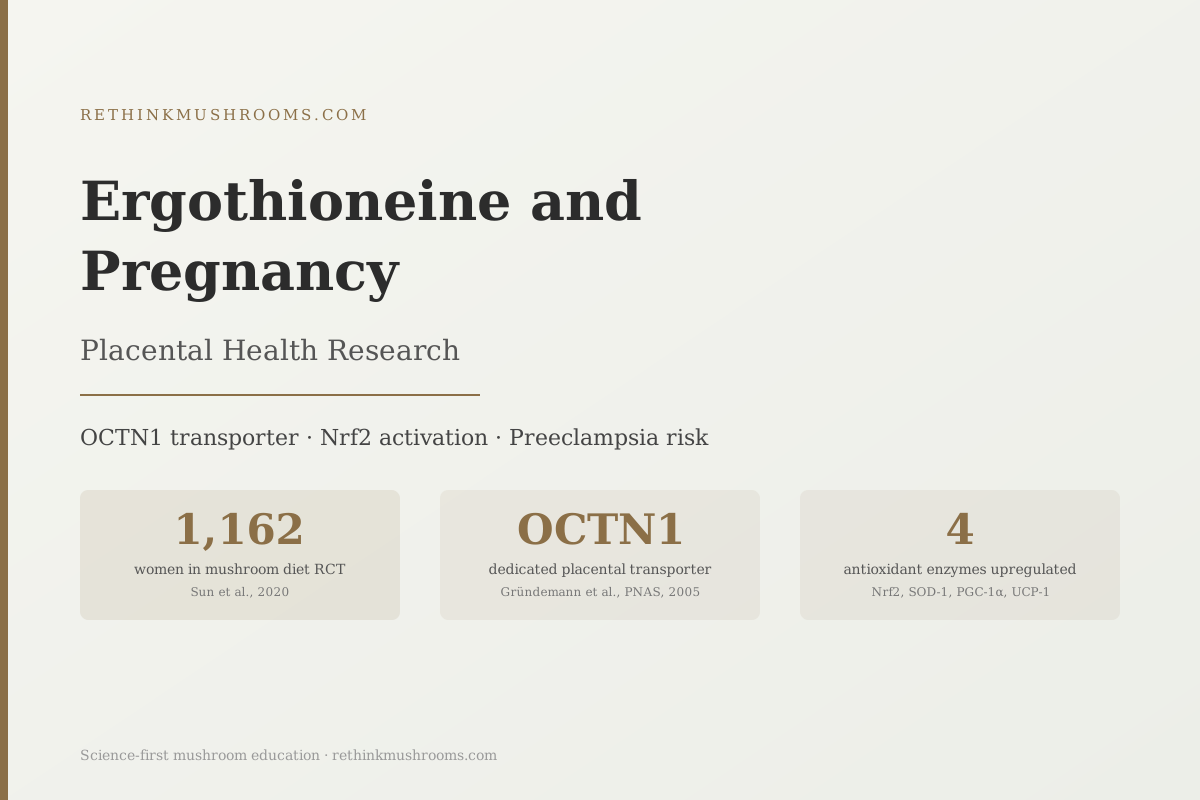
1,162 pregnant women
In a randomized controlled trial, consuming 100g of mushrooms daily from pre-pregnancy through 20 weeks significantly reduced gestational hypertension, preeclampsia, and gestational diabetes.
Sun et al., Food & Nutrition Research, 2020
OCTN1
dedicated ergothioneine transporter expressed in placenta
4 enzymes
Nrf2, SOD-1, PGC-1α, UCP-1 upregulated in placenta by ergothioneine
EFSA cleared
safe under proposed uses for pregnant and breastfeeding women, 2017
Sun et al., Food & Nutrition Research, 2020
 View as image ↗
Ergothioneine is a sulfur-containing antioxidant found almost exclusively in mushrooms. The body cannot produce it and obtains it entirely through diet. What makes it relevant to pregnancy is a specific protein in the placenta: OCTN1, encoded by the gene SLC22A4, which acts as a dedicated, high-affinity importer for ergothioneine and no other known physiological compound. The placenta does not just allow ergothioneine to pass through. It actively concentrates it. That biological investment is what makes low ergothioneine levels during pregnancy worth paying attention to.
Low ergothioneine in plasma correlates with higher preeclampsia risk, and animal research shows that supplementing ergothioneine reduces the hallmarks of placental distress. The evidence is not yet from human interventional trials, but the evidence arc connecting dietary mushroom intake to placental antioxidant defense is more developed than most people realize.
For context on what ergothioneine is and where the body gets it, the ergothioneine overview article covers the biochemistry and dietary sources.
Key Takeaways
- The OCTN1 transporter (SLC22A4), which has no other known substrate in humans, is expressed in the placenta, confirming active maternal-fetal ergothioneine transport
- Ergothioneine at 25 mg/kg/day in a rat preeclampsia model reduced blood pressure, lowered sFlt-1, and upregulated four placental antioxidant enzymes (Nrf2, SOD-1, PGC-1α, UCP-1)
- Metabolomics analysis of the same model showed improvements in plasma oxidative stress markers and placental oxidative status with ergothioneine treatment
- In a 1,162-person randomized trial, 100g/day mushroom consumption from pre-pregnancy to 20 weeks significantly reduced preeclampsia, gestational hypertension, and gestational diabetes
- EFSA reviewed ergothioneine safety for pregnant and breastfeeding women in 2017 and concluded the margin of exposure was sufficient at anticipated dietary intake levels
- No human intervention trial has directly tested ergothioneine supplementation on placental health outcomes; dietary mushroom consumption is the closest available human evidence
Why the Placenta Has Its Own Dedicated Ergothioneine Importer
Most antioxidants reach the placenta passively, through general diffusion or broad transport mechanisms. Ergothioneine is different. In 2005, Gründemann and colleagues identified OCTN1 (SLC22A4) as a dedicated, high-affinity transporter for ergothioneine specifically.[1] OCTN1 actively imports ergothioneine against its concentration gradient, concentrating it in target tissues. And it does this for ergothioneine alone — no other physiological compound uses this transporter as its primary mechanism.
The practical implication is significant: the body treats ergothioneine as important enough to build dedicated infrastructure to move it where it needs to go. A 2020 review by Borodina and colleagues mapped which tissues accumulate ergothioneine and found a consistent pattern: tissues under high oxidative stress — liver, kidneys, red blood cells, and the placenta — concentrate ergothioneine most heavily.[2]
The placenta is among the most metabolically active organs in the body during pregnancy. It processes oxygen, nutrients, and hormones at high rates, generating oxidative byproducts constantly. The presence of OCTN1 there is the body's response to that oxidative challenge. The placenta imports ergothioneine because it needs it.
What this means practically: maternal plasma ergothioneine levels set the upper limit on how much the placenta can accumulate. A woman whose diet provides little ergothioneine — which means limited or no mushroom consumption, since mushrooms are essentially the only dietary source — has a placenta working with less antioxidant capacity than one whose diet includes regular mushroom intake. For a deeper explanation of the OCTN1 biology, the OCTN1 transporter article covers the molecular mechanisms.
And since only fungi produce ergothioneine, the article on why only fungi synthesize it explains why dietary sources are so limited and what the body's evolutionary response to that scarcity looks like.
Preeclampsia as an Oxidative Stress Disease: The Ergothioneine Connection
Preeclampsia affects roughly 5–8% of pregnancies globally and is defined by new-onset hypertension after 20 weeks gestation, often accompanied by organ damage and fetal growth restriction. Understanding why it develops is important for understanding why ergothioneine might matter.
The prevailing mechanistic model, supported by a 2018 systematic review by Kerley and colleagues, positions preeclampsia as primarily an oxidative stress disease of the placenta.[3] In the early stages of a preeclamptic pregnancy, the placenta does not remodel the maternal blood vessels properly. Blood flow to the placenta becomes ischemic and irregular. This ischemia triggers a burst of mitochondrial reactive oxygen species production in placental cells. The overwhelmed placenta releases inflammatory signals and the antiangiogenic protein sFlt-1 into maternal circulation, which then causes the systemic effects: high blood pressure, protein in urine, and organ stress.
Ergothioneine targets this pathway at its root. Kerley's review describes how ergothioneine specifically scavenges mitochondrial reactive oxygen species, activates the Nrf2 transcription factor (which coordinates the production of the body's endogenous antioxidant enzymes), and accumulates in the placenta via OCTN1 precisely where the oxidative burden is highest. The review calls for human intervention trials in preeclampsia, noting that the mechanistic case for ergothioneine is stronger than for most antioxidants that have been tested.
What Ergothioneine Does to a Stressed Placenta: The Williamson 2020 Findings
The most mechanistically complete animal evidence comes from Williamson and colleagues, who tested ergothioneine in the reduced uterine perfusion pressure (RUPP) rat model.[4] In RUPP rats, blood flow to the uterus is surgically restricted, creating a hypertensive pregnancy state that reproduces several key features of human preeclampsia.
Rats with RUPP preeclampsia given 25 mg/kg/day ergothioneine showed four changes in placental tissue compared to untreated RUPP controls:
Nrf2 upregulation. Nrf2 is the master switch for antioxidant gene expression. When activated, it triggers a coordinated increase in the enzymes that neutralize reactive oxygen species. Ergothioneine-treated placental tissue showed significantly higher Nrf2 expression.
SOD-1 upregulation. Superoxide dismutase 1 converts superoxide, the most common mitochondrial reactive oxygen species, into hydrogen peroxide and oxygen. Higher SOD-1 means more capacity to handle the free radicals that drive placental dysfunction.
PGC-1α upregulation. This protein regulates mitochondrial biogenesis and energy metabolism. Its upregulation by ergothioneine suggests the treatment was improving the mitochondria's own efficiency, not just scavenging the reactive oxygen species they produced.
UCP-1 upregulation. Uncoupling protein 1 reduces the proton gradient in mitochondria, decreasing the amount of free radical byproduct generated during energy production.
The net result of all four changes was lower mitochondrial reactive oxygen species in placental tissue, lower circulating sFlt-1 (the antiangiogenic marker that drives the systemic features of preeclampsia), reduced blood pressure, and significantly rescued fetal weights in the ergothioneine-treated RUPP animals.
This is not correlation — it is a dose-response intervention that turned on specific molecular machinery and produced measurable improvement in four clinically relevant outcomes. For the relationship between ergothioneine levels and preeclampsia risk in human cohort data, the preeclampsia risk article covers what the 2023 cohort studies found.
The Metabolomics Picture: What Depletion Looks Like Biochemically
A second study using the same RUPP rat model adds depth to the Williamson findings. Morillon and colleagues examined the metabolic plasma profile of RUPP rats given ergothioneine, looking not just at individual markers but at the broader biochemical signature of placental stress.[5]
The untreated RUPP animals showed a characteristic metabolic profile of oxidative dysfunction: elevated sFlt-1, elevated oxidative stress markers in plasma, and a placental oxidative state consistent with chronic mitochondrial stress. When ergothioneine was given, this profile shifted toward the profile of healthy non-RUPP animals. Oxidative stress markers fell. sFlt-1 dropped. The placental oxidative environment improved.
What makes this study valuable beyond confirming Williamson's findings is the metabolomics approach: it shows that ergothioneine treatment doesn't just improve a few target markers but shifts the entire biochemical fingerprint of placental stress. This suggests ergothioneine is acting at an upstream regulatory level, not just as a simple free radical sponge.
The Closest Human Evidence: Sun 2020's 1,162-Person Mushroom Trial
No human study has directly tested ergothioneine supplementation during pregnancy. The closest available human evidence is an RCT by Sun and colleagues that tested whether a dietary intervention centered on mushroom consumption could affect pregnancy outcomes.[6]
The trial enrolled 1,162 pregnant women (582 in the mushroom diet group, 580 controls) and asked the intervention group to consume 100g of mushrooms daily from before conception through 20 weeks of gestation. The results were statistically significant across five outcomes: reduced gestational hypertension (P=0.023), reduced preeclampsia (P=0.014), reduced gestational diabetes (P=0.047), reduced excessive gestational weight gain (P=0.032), and reduced macrosomia in overweight women (P=0.007).
This is direct human evidence that a dietary pattern providing mushroom-sourced ergothioneine — alongside other mushroom nutrients — significantly reduced the pregnancy conditions most associated with placental dysfunction.
The important limitation is attribution: mushrooms contain multiple biologically active compounds beyond ergothioneine (beta-glucans, vitamin D, selenium, polysaccharides), and Sun's trial did not test ergothioneine in isolation. The trial also used Chinese mushroom varieties in a Chinese study population, and generalization to other populations requires caution. But the effect size on preeclampsia and gestational hypertension in a 1,162-person RCT is substantial and unlikely to be noise.
For practical guidance on which mushrooms are safe during pregnancy and how to approach dietary mushroom intake, the mushroom consumption during pregnancy article covers the dietary evidence in detail.
Safety: What EFSA Concluded for Pregnant Women
A legitimate question about any dietary compound in pregnancy is safety. The European Food Safety Authority reviewed synthetic ergothioneine as a novel food ingredient in 2017, specifically including pregnant and breastfeeding women in the assessment.[7]
EFSA's conclusion was that the margin of exposure (610) was sufficient at the maximum anticipated intake of 1.31 mg/kg/day, and that ergothioneine was safe under proposed uses for this population. The panel reviewed available toxicology, pharmacokinetics, and exposure data and found no signals of harm.
This safety clearance applies to synthetic ergothioneine at specific intake levels. Culinary mushrooms consumed as food during pregnancy are considered safe under standard dietary guidance. The EFSA assessment provides regulatory backing for the safety of ergothioneine exposure during pregnancy — it does not, however, establish efficacy for any specific clinical outcome.
What the Evidence Doesn't Yet Tell Us
The research described here establishes several things: the placenta has the machinery to import ergothioneine; supplementation improves placental antioxidant status in animal models; metabolomics data confirms a shift in the biochemical signature of placental stress; human cohort data shows an inverse relationship between ergothioneine levels and preeclampsia risk; and a large dietary RCT found that regular mushroom consumption reduced preeclampsia rates.
What is still missing:
A human supplementation trial. No randomized study has given ergothioneine to pregnant women and measured placental outcomes. The animal mechanism is well-described; the human translation is untested.
An attribution study. Sun 2020 shows mushroom diet works, but not why. Separating ergothioneine from other mushroom bioactives requires a controlled trial with measurable plasma ergothioneine.
A dose-response curve in humans. Ho 2023 established a threshold in observational data (protection begins at 300 ng/ml; peaks at 462 ng/ml), but dietary dose-to-plasma level relationships have not been established for common culinary mushrooms in pregnant women specifically.
For the full biomarker picture, including the 2023 cohort data establishing specific protective thresholds, the preeclampsia biomarker article covers what the evidence currently supports.
The Bottom Line
The placenta actively imports ergothioneine via the dedicated OCTN1 transporter, which is expressed there because the organ faces high oxidative stress throughout pregnancy. Animal research in a preeclampsia model shows ergothioneine upregulates four placental antioxidant enzymes, reduces sFlt-1, and rescues fetal weight. A 1,162-person mushroom diet RCT found statistically significant reductions in preeclampsia and gestational hypertension. Human supplementation trials in pregnant women have not been completed; dietary culinary mushrooms are safe and represent the currently available practical approach to maintaining ergothioneine intake during pregnancy.
Frequently Asked Questions
Sources & References
- 1RTHM-00154·Gründemann, Dirk et al. (2005). “Discovery of the ergothioneine transporter..” Proceedings of the National Academy of Sciences of the United States of America.Study breakdown →PubMed →↩
- 2RTHM-01175·Borodina, Irina et al. (2020). “The biology of ergothioneine, an antioxidant nutraceutical..” Nutrition research reviews.Study breakdown →PubMed →↩
- 3RTHM-00968·Kerley, Robert N et al. (2018). “The potential therapeutic effects of ergothioneine in pre-eclampsia..” Free radical biology & medicine.Study breakdown →PubMed →↩
- 4RTHM-01301·Williamson, Rachel D et al. (2020). “L-(+)-Ergothioneine Significantly Improves the Clinical Characteristics of Preeclampsia in the Reduced Uterine Perfusion Pressure Rat Model..” Hypertension (Dallas.Study breakdown →PubMed →↩
- 5RTHM-01256·Morillon, Aude-Claire et al. (2020). “Effect of L-Ergothioneine on the metabolic plasma profile of the RUPP rat model of pre-eclampsia..” PloS one.Study breakdown →PubMed →↩
- 6RTHM-01292·Sun, Linlin et al. (2020). “A mushroom diet reduced the risk of pregnancy-induced hypertension and macrosomia: a randomized clinical trial..” Food & nutrition research.Study breakdown →PubMed →↩
- 7RTHM-00920·Turck, Dominique et al. (2017). “Statement on the safety of synthetic l-ergothioneine as a novel food - supplementary dietary exposure and safety assessment for infants and young children, pregnant and breastfeeding women..” EFSA journal. European Food Safety Authority.Study breakdown →PubMed →↩