Ergothioneine & Pregnancy
96 of 97 preeclampsia cases had ergothioneine below the protective threshold
In a 432-woman cohort, 96 of the 97 women who developed preeclampsia had plasma ergothioneine below 462 ng/ml, the 90th percentile and apparent protective level.
Kenny et al., Bioscience Reports, 2023
300 ng/ml
minimum level where dose-response protection begins (Ho 2023)
P=0.012
statistical significance of non-linear dose-response curve
1,162 women
in mushroom diet RCT showing reduced preeclampsia (Sun 2020)
Kenny et al., Bioscience Reports, 2023
 View as image ↗
Here is what the current evidence shows about low ergothioneine and preeclampsia risk:
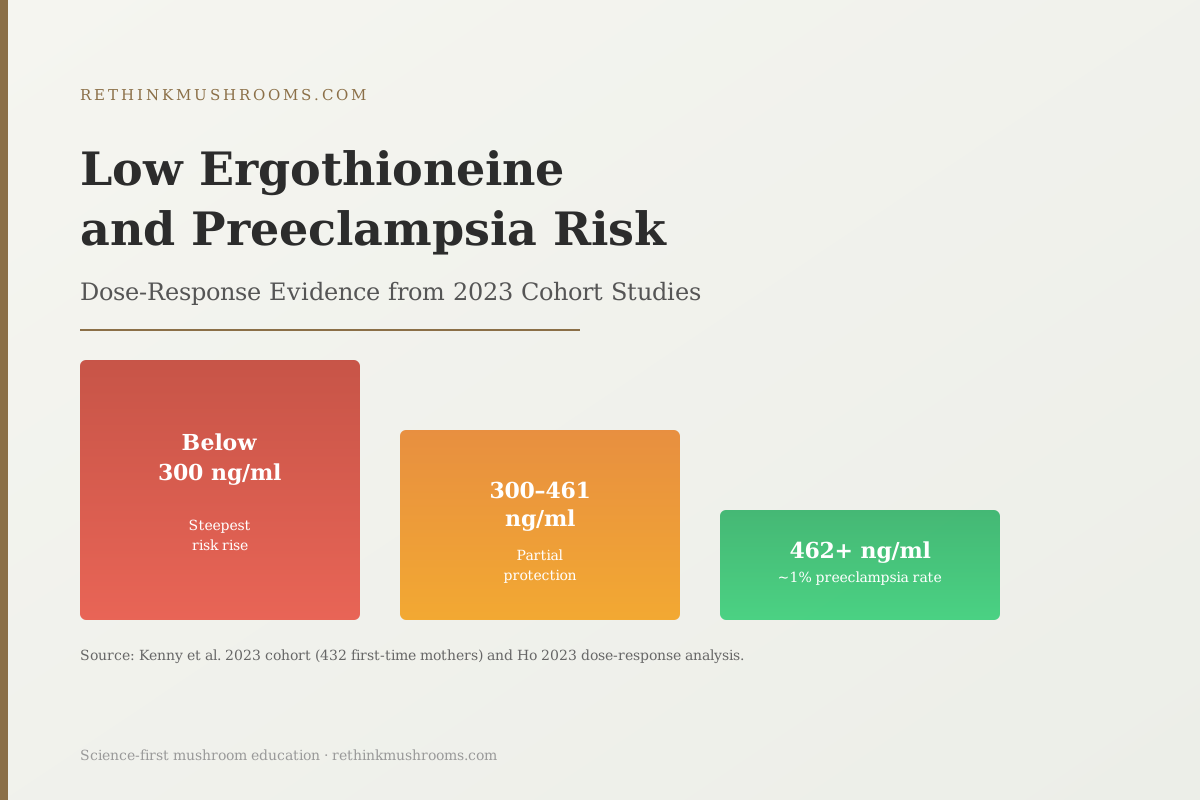
| Plasma Ergothioneine Level | Risk Pattern (Based on Kenny 2023 Cohort) |
|---|---|
| Below 300 ng/ml | Steepest rise in preeclampsia risk; non-linear curve is sharpest here |
| 300–461 ng/ml | Partial protection; risk declining but not at minimum |
| 462 ng/ml or above | Approximately 1% preeclampsia rate; 90th-percentile threshold |
These thresholds come from two 2023 studies that analyzed the same 432-woman cohort: Kenny et al. established the threshold and Ho reanalyzed the dose-response curve. They are observational findings, not clinical reference ranges. No commercial test for plasma ergothioneine is currently available, and these numbers have not been validated in an independent cohort. But the pattern is specific and biologically grounded in a way that distinguishes it from most nutritional associations.
The reason this data is worth examining is that ergothioneine may be the only antioxidant where we have both a specific, quantified human threshold AND animal intervention evidence showing that supplementation causally reduces the same condition in an animal model. That convergence is unusual.
For more on what ergothioneine is and why mushrooms are the primary dietary source, the ergothioneine overview article covers the foundation.
Key Takeaways
- Of 432 first-time mothers, 96 of 97 who developed preeclampsia had plasma ergothioneine below the 90th-percentile threshold of 462 ng/ml (Kenny et al., 2023)
- A dose-response reanalysis (Ho 2023) found a non-linear protective curve: risk drops steeply from low levels to 300 ng/ml, continues declining to 462 ng/ml, then plateaus; non-linearity P=0.012
- The cohort studies cannot establish causation; ergothioneine may reflect overall diet quality rather than being directly protective
- Animal evidence (Williamson 2020) shows supplementation causally reduces preeclampsia features in a rat model; Morillon 2020 confirms a metabolomics-level shift in placental oxidative status
- A 1,162-person mushroom diet RCT (Sun 2020) found statistically significant reductions in preeclampsia and gestational hypertension, providing indirect human dietary evidence
- Low ergothioneine is not a guarantee of preeclampsia; 24% of women without preeclampsia also had levels below the threshold
The Kenny 2023 Number: What It Actually Says
Interpreting the Kenny 2023 finding requires understanding the asymmetry it reveals, not just the headline statistic.
Of 97 women in the cohort who developed preeclampsia, 96 had plasma ergothioneine below 462 ng/ml.[1] This means that above the threshold, preeclampsia was nearly absent. The sensitivity of this association (the proportion of preeclampsia cases captured by depleted ergothioneine) is remarkably high.
The specificity is lower. Of the women who did not develop preeclampsia, 24.2% also had ergothioneine below the same threshold. Low ergothioneine does not reliably predict who will develop preeclampsia; it describes a broad high-risk group within which most women will still have healthy pregnancies. This is the kind of precision that makes ergothioneine potentially useful as a risk stratification tool but not as a diagnostic test.
The important framing: if you are above 462 ng/ml, preeclampsia appears to be rare. If you are below it, your risk is higher than average, but most women in this category will not develop the condition.
The Kenny cohort was limited to first-time mothers, which matters because preeclampsia is more common in first pregnancies. Whether the same thresholds apply in subsequent pregnancies or in populations with very different baseline ergothioneine status (such as populations with high versus low mushroom intake) has not been studied.
The Dose-Response Curve: Why the Shape Matters More Than the Threshold
Ho's 2023 reanalysis of the same cohort goes beyond reporting a threshold to characterizing how risk actually changes as ergothioneine rises.[2]
The key finding is non-linearity. The relationship between ergothioneine and preeclampsia risk is not a straight line where each additional nanogram per milliliter provides equal benefit. The curve is steep at the lower end and flattens at the top. This means:
- The biggest risk reduction comes from moving out of very low levels (below 300 ng/ml) to moderate levels (around 300–400 ng/ml)
- There is still meaningful additional protection in moving from 300 ng/ml to 462 ng/ml
- Above 462 ng/ml, risk appears to have already plateaued at its lowest level
The non-linearity was statistically significant at P=0.012, meaning this curve shape is unlikely to be random variation. This has practical implications: a woman with very depleted ergothioneine (well below 300 ng/ml) has much more to gain from increasing her mushroom intake than a woman already at 350 ng/ml, for whom the absolute risk reduction from further increases would be smaller.
This is the kind of precision that most nutritional research cannot offer. Most nutrients show only a vague dose-association with disease endpoints; Ho's analysis defines specific points on the curve.
The limitation is that it is a secondary analysis of observational data. The shape of the curve reflects the distribution of this specific cohort and may not generalize.
Can Low Ergothioneine Cause Preeclampsia?
The cohort studies are association studies. They cannot distinguish between two very different explanations:
Explanation 1 (causal): Low dietary ergothioneine causes insufficient antioxidant protection in the placenta, which allows mitochondrial oxidative stress to accumulate, driving sFlt-1 release, hypertension, and placental dysfunction that characterizes preeclampsia.
Explanation 2 (confounding): Ergothioneine is a marker of overall dietary quality. Women who eat more mushrooms also eat better in other ways. The real protective factor is the diet pattern, not ergothioneine specifically.
Both could be partially true. Distinguishing them requires either a controlled supplementation trial or genetic analysis (Mendelian randomization studies using OCTN1 genetic variants). Neither has been done in preeclampsia specifically.
The animal intervention evidence provides the strongest argument for Explanation 1. Williamson and colleagues showed in 2020 that giving ergothioneine specifically to preeclamptic rats, in a controlled experimental setting where diet confounding is absent, causally reduced blood pressure, sFlt-1, and fetal growth restriction.[3] The same pathways implicated in human preeclampsia improved with the specific addition of ergothioneine, not a general dietary improvement.
Morillon and colleagues extended this finding metabolomically, showing that ergothioneine treatment shifted the entire oxidative plasma profile of preeclamptic rats toward the profile of healthy animals.[4] This rules out the possibility that ergothioneine is simply a marker for something else in that animal model.
Together, the human cohort data and the animal intervention evidence provide converging lines of evidence without yet constituting proof in humans. The honest answer to "can low ergothioneine cause preeclampsia?" is: the mechanism is plausible, the animal evidence supports it, and the human association is specific. But a human trial is needed before claiming causality.
Why Ergothioneine Is Different From Antioxidant Trials That Failed
Vitamin C and vitamin E supplementation trials in preeclampsia showed early promise in small studies and then failed in large randomized trials. This history makes any antioxidant claim for preeclampsia worth scrutinizing carefully.
Kerley's 2018 systematic review addressed this directly, identifying three specific reasons why ergothioneine may not repeat this pattern.[5]
First, ergothioneine targets mitochondrial reactive oxygen species specifically. Vitamins C and E primarily scavenge aqueous-phase and lipid-phase free radicals; the dominant source of pathological oxidative stress in preeclampsia is mitochondrial, and vitamins C and E are relatively ineffective at mitochondrial protection. Ergothioneine is not.
Second, ergothioneine activates Nrf2, the master antioxidant transcription factor. This triggers an amplified, coordinated response through the body's own antioxidant enzyme systems. Vitamins C and E do not activate Nrf2; they provide direct antioxidant capacity that saturates and cannot amplify.
Third, ergothioneine accumulates in the placenta via the OCTN1 transporter. It does not simply distribute throughout the body; it concentrates precisely where the oxidative stress of preeclampsia originates. Vitamins C and E do not have dedicated transporters targeting the placenta specifically.
These are mechanistic distinctions. They explain why Kerley's review concluded that ergothioneine should be prioritized for human trials over other antioxidants. They do not guarantee that a human trial would succeed.
The Sun 2020 Mushroom Trial: What Human Dietary Data Shows
The closest available human evidence for diet affecting preeclampsia risk through the ergothioneine pathway comes from Sun and colleagues' 2020 randomized controlled trial.[6]
Sun enrolled 1,162 pregnant women and asked the intervention group to consume 100g of mushrooms daily from the pre-pregnancy period through 20 weeks of gestation. The results: statistically significant reductions in gestational hypertension (P=0.023), preeclampsia (P=0.014), gestational diabetes (P=0.047), excessive gestational weight gain (P=0.032), and macrosomia in overweight women (P=0.007).
This is not an ergothioneine-specific trial. Sun's intervention used whole mushrooms, which provide beta-glucans, vitamin D, selenium, and other bioactives alongside ergothioneine. The trial cannot attribute the effect to ergothioneine specifically. It also used Chinese mushroom varieties in a Chinese population; ergothioneine content varies by species and growing conditions.
What it does show is that a dietary change centered on the primary food source of ergothioneine produced the exact outcomes that the cohort data predicts for women above the ergothioneine protective threshold. That alignment between the cohort predictions and the RCT outcomes is meaningful, even if the mechanism cannot be isolated.
For dietary guidance on which mushrooms to eat during pregnancy, how much the evidence supports, and which varieties are safe, the mushroom consumption during pregnancy article covers this in practical detail.
For more on how ergothioneine levels specifically relate to preeclampsia as a potential biomarker and testing possibility, the biomarker article examines the clinical evidence landscape.
What These Numbers Do and Don't Tell You
The ergothioneine-preeclampsia data is unusually specific for nutritional research. But its limitations are real and worth stating clearly.
Low ergothioneine does not predict whether any individual woman will develop preeclampsia. It describes a population-level risk pattern; the individual signal is weaker. Many women with low ergothioneine have healthy pregnancies.
The threshold of 462 ng/ml comes from one cohort of first-time mothers. In a population with systematically higher ergothioneine (higher mushroom intake), the threshold might be different. In populations with additional risk factors, the ergothioneine threshold's predictive value would be confounded.
No dietary recommendation can be made from this data because the relationship between food intake and plasma ergothioneine levels during pregnancy has not been characterized. Eating more mushrooms will likely raise plasma ergothioneine, but by how much, in whom, and over what timeframe is not established.
What the data does suggest: of the nutritional signals associated with preeclampsia risk, ergothioneine is one of the most specific, most mechanistically grounded, and most practically modifiable. The absence of a human intervention trial is the gap that matters most, and for now it remains a gap. For more on the fetal and placental aspects of this research, the placental health article and the fetal development article cover those dimensions.
And because ergothioneine operates through cardiovascular pathways shared with heart disease, including endothelial dysfunction and inflammatory signaling, the protective mechanisms discussed here may extend beyond pregnancy, a connection covered in more depth in the ergothioneine and heart health article.
The Bottom Line
Two 2023 cohort studies establish that low plasma ergothioneine, below a threshold of approximately 462 ng/ml with dose-dependent effects beginning at 300 ng/ml, is strongly associated with preeclampsia risk: 96 of 97 cases in the Kenny cohort had depleted ergothioneine. Animal intervention evidence supports the association being causal. A 1,162-person mushroom diet RCT found statistically significant reductions in preeclampsia. No human supplementation trial has been completed, and the cohort thresholds are not yet clinical reference ranges. Dietary mushroom intake is the only practical ergothioneine intervention currently available.
Frequently Asked Questions
Sources & References
- 1RTHM-01717·Kenny, Louise C et al. (2023). “Relationship between the concentration of ergothioneine in plasma and the likelihood of developing pre-eclampsia..” Bioscience reports.Study breakdown →PubMed →↩
- 2RTHM-01708·Ho, Kwok M (2023). “Dose-related relationship between ergothioneine concentrations and risk of preeclampsia..” Bioscience reports.Study breakdown →PubMed →↩
- 3RTHM-01301·Williamson, Rachel D et al. (2020). “L-(+)-Ergothioneine Significantly Improves the Clinical Characteristics of Preeclampsia in the Reduced Uterine Perfusion Pressure Rat Model..” Hypertension (Dallas.Study breakdown →PubMed →↩
- 4RTHM-01256·Morillon, Aude-Claire et al. (2020). “Effect of L-Ergothioneine on the metabolic plasma profile of the RUPP rat model of pre-eclampsia..” PloS one.Study breakdown →PubMed →↩
- 5RTHM-00968·Kerley, Robert N et al. (2018). “The potential therapeutic effects of ergothioneine in pre-eclampsia..” Free radical biology & medicine.Study breakdown →PubMed →↩
- 6RTHM-01292·Sun, Linlin et al. (2020). “A mushroom diet reduced the risk of pregnancy-induced hypertension and macrosomia: a randomized clinical trial..” Food & nutrition research.Study breakdown →PubMed →↩