Ergothioneine & Pregnancy
1% preeclampsia rate above the protective threshold
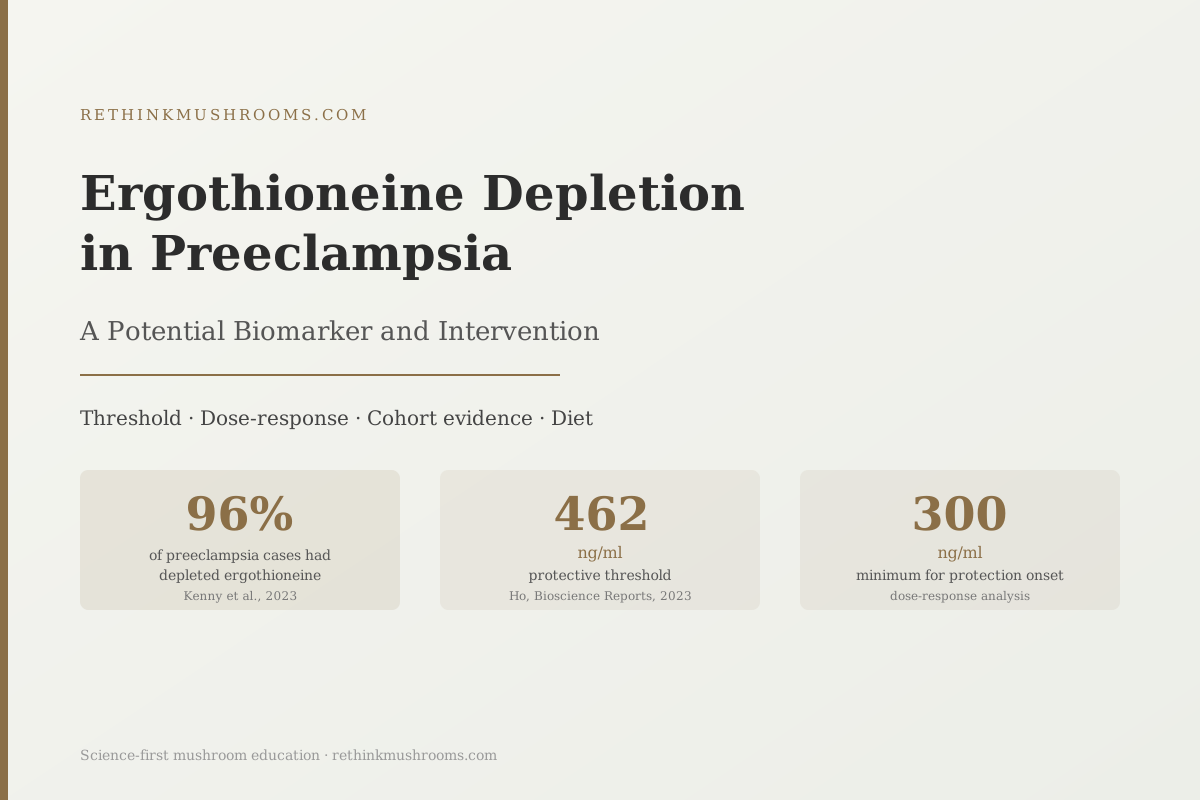
Of 432 first-time mothers, only 1 in 97 women who developed preeclampsia had plasma ergothioneine at or above 462 ng/ml — the apparent protective threshold in a 2023 cohort study.
Kenny et al., Bioscience Reports, 2023
462 ng/ml
plasma level associated with near-zero preeclampsia risk
300 ng/ml
minimum level where protective effect begins, per dose-response analysis
P=0.012
statistical significance of non-linear dose-response curve (Ho 2023)
Kenny et al., Bioscience Reports, 2023
 View as image ↗
Ergothioneine depletion as a preeclampsia biomarker describes a specific and measurable pattern: plasma levels below approximately 300 ng/ml correlate with sharply rising preeclampsia risk, while levels at or above 462 ng/ml were associated with only a 1% preeclampsia rate in a 432-woman cohort. No clinical test for ergothioneine is currently commercially available. But diet — specifically mushroom consumption — is the one modifiable factor that determines plasma ergothioneine levels, making this one of the few emerging pregnancy biomarkers where the proposed intervention is a food.
This article examines the evidence for ergothioneine as a preeclampsia biomarker: the human cohort data establishing the threshold, the dose-response curve defining the protective range, the animal evidence supporting causality rather than mere correlation, and the honest accounting of what is still missing before this translates into clinical practice.
For the foundation of what ergothioneine is and how the body acquires it, the ergothioneine overview article covers the biochemistry and dietary sources.
Key Takeaways
- In a 432-woman cohort (Kenny 2023), only 1 of 97 women who developed preeclampsia had plasma ergothioneine at or above 462 ng/ml — a 90th-percentile threshold above which preeclampsia risk was approximately 1%
- A dose-response reanalysis (Ho 2023) showed protective effects beginning at 300 ng/ml and peaking at 462 ng/ml, with the non-linearity of this curve statistically significant at P=0.012
- The Kenny and Ho findings are observational; ergothioneine may be a marker of overall dietary quality rather than a direct cause of lower preeclampsia risk
- Animal evidence (Williamson 2020, Morillon 2020) supports causality: supplementation in a preeclampsia rat model produced measurable reductions in blood pressure, sFlt-1, and placental oxidative stress
- No commercial ergothioneine blood test is currently available for clinical use; the biomarker remains a research-stage finding
- Diet may be the modifiable factor: mushrooms are essentially the only significant dietary source, and a 1,162-person mushroom diet RCT showed statistically significant reductions in preeclampsia and gestational hypertension
The Kenny 2023 Finding: A Number That Should Have Made More Headlines
In 2023, Kenny and colleagues published a cohort analysis of 432 first-time mothers, measuring plasma ergothioneine levels and tracking which women developed preeclampsia.[1] Of those 432 women, 97 went on to develop preeclampsia.
The finding was striking. Of those 97 women who developed preeclampsia, only 1 — a single individual — had plasma ergothioneine at or above 462 ng/ml, the 90th percentile for the cohort. That means 96 out of 97 preeclampsia cases, or 96%, occurred in women with ergothioneine below this threshold.
The inverse is also informative: of the women without preeclampsia, 24.2% had ergothioneine below the same threshold. Low ergothioneine does not guarantee preeclampsia. Many women with depleted levels remained healthy. But preeclampsia appeared almost exclusively in the depleted group.
The 462 ng/ml figure is not a clinical standard — it is the 90th percentile of the Kenny study population. It may not transfer directly to other populations with different mushroom intake patterns, dietary habits, or genetics. Kenny's study was also observational, which means it cannot establish whether low ergothioneine caused the preeclampsia or whether both are effects of a third factor (poor diet overall, metabolic stress, genetic variation in OCTN1). These are important caveats.
What the study does is establish the clearest quantitative association yet between a specific plasma ergothioneine threshold and preeclampsia risk — in a prospective cohort, with first-time mothers, at a sample size large enough to identify this pattern.
The Dose-Response Curve: Protection Is Not All-or-Nothing
A follow-up analysis by Ho, also published in 2023 in Bioscience Reports, reanalyzed the Kenny cohort to characterize the shape of the ergothioneine-preeclampsia relationship more precisely.[2]
What Ho found was a non-linear dose-response curve. The association between ergothioneine and preeclampsia risk is not a straight line. Instead, risk drops steeply as ergothioneine rises from very low levels to around 300 ng/ml, continues to fall more gradually from 300 to 462 ng/ml, and reaches its floor at the 462 ng/ml threshold. The non-linearity was statistically significant (P=0.012), meaning this curve shape is unlikely to be a chance finding.
This has practical implications. A woman at 250 ng/ml does not have the same risk profile as a woman at 100 ng/ml — both are below the 462 ng/ml threshold, but the lower value is substantially more concerning. The protective effect begins building from around 300 ng/ml, which may be achievable through moderate mushroom consumption.
Ho's analysis is a reanalysis of Kenny's data, not an independent cohort, so it inherits all the same limitations around observational design and population specificity. But it adds a level of mechanistic precision — a specific threshold and a specific curve shape — that distinguishes ergothioneine from most nutrients that show only a vague inverse association with disease risk.
The combination of Kenny 2023 and Ho 2023 gives researchers something unusual in nutritional epidemiology: a quantifiable, dose-dependent threshold with a biologically plausible mechanism behind it.
Non-Linear Dose-Response
Plasma Ergothioneine vs Preeclampsia Risk
Risk does not fall in a straight line. It drops steeply as ergothioneine rises to about 300 ng/ml, keeps falling to the 462 ng/ml threshold, and floors there — where only 1 of 97 preeclampsia cases occurred.
300 ng/mlProtection begins
[2]Ho 2023 · non-linear spline, protective effect from 300 ng/ml onward
462 ng/ml90th-percentile threshold
[1]Kenny 2023 · at or above 462 ng/ml, preeclampsia rate ≈ 1% (1 of 97 cases)
Caveat: the curve shape comes from Ho 2023’s reanalysis of a single observational cohort (Kenny 2023), and the y-axis shows relative risk, not a calibrated per-level probability. Thresholds are research findings, not validated clinical reference ranges.
Source: Kenny 2023; Ho 2023 (see references)
From Correlation to Causation: What the Animal Evidence Adds
The human cohort data cannot determine whether low ergothioneine causes preeclampsia or merely accompanies it. The animal intervention evidence addresses this gap, though imperfectly.
Williamson and colleagues demonstrated in 2020 that ergothioneine supplementation causally reduced preeclampsia features in the RUPP rat model.[3] Rats with surgically induced uterine hypoperfusion, a state that reliably produces hypertension, high sFlt-1, and poor fetal outcomes, were given 25 mg/kg/day ergothioneine. Treated animals showed lower blood pressure, reduced circulating sFlt-1, upregulated placental antioxidant enzymes (Nrf2, SOD-1, PGC-1α, UCP-1), lower mitochondrial reactive oxygen species, and significantly better fetal weights compared to untreated RUPP animals.
This is causal evidence within an animal model: the supplementation was the variable; the improvement was the outcome.
A metabolomics study by Morillon and colleagues examined the same RUPP model from a different angle, looking at the full plasma metabolic profile of preeclamptic animals given ergothioneine versus untreated controls.[4] Ergothioneine treatment shifted the metabolic profile of RUPP animals toward that of healthy non-RUPP controls across multiple markers of oxidative stress. This suggests ergothioneine acts at a regulatory level, not just as a passive free radical scavenger — it changes the biochemical environment in which the placenta operates.
The challenge is that rat preeclampsia is not identical to human preeclampsia. The RUPP model reproduces the hemodynamic and oxidative features of the disease but lacks the immune and genetic complexity of human cases. That said, the biological pathway — mitochondrial reactive oxygen species in the placenta driving sFlt-1 release, hypertension, and fetal growth restriction — is the same pathway implicated in human disease.
For more on what the animal evidence shows specifically about fetal weight outcomes, the fetal development research article covers the full developmental arc.
The Biology Behind the Threshold: Why a Minimum Supply Matters
To understand why there is a specific protective threshold, the underlying biology is important.
Gründemann and colleagues identified OCTN1 (SLC22A4) in 2005 as the dedicated, high-affinity transporter for ergothioneine.[6] OCTN1 is expressed in the placenta and actively imports ergothioneine from maternal plasma into placental cells. When maternal ergothioneine is low, the placenta has less to import, and its antioxidant capacity is correspondingly reduced.
Kerley's 2018 systematic review established the mechanistic framework: preeclampsia is fundamentally an oxidative stress disease of the placenta, and ergothioneine is one of the few antioxidants that specifically targets mitochondrial reactive oxygen species, the predominant source of oxidative damage in placental cells under ischemic conditions.[5] Below a minimum plasma level, there simply is not enough ergothioneine in the placental pool to maintain adequate mitochondrial protection during the metabolic demands of pregnancy.
The threshold at 300 ng/ml may represent the point below which placental ergothioneine concentration falls below the minimum needed to buffer ordinary oxidative stress in pregnancy. The 462 ng/ml level may reflect adequate supply for the larger oxidative challenges that arise when placental blood flow is compromised. These are interpretations from the data, not established clinical facts, but they are biologically coherent.
For a deeper look at OCTN1's molecular biology and why its placental expression matters, the OCTN1 transporter article covers the mechanism in full. For more on how the placental ergothioneine system behaves during pregnancy specifically, the placental health research article covers this in detail.
An Emerging Mechanistic Layer: Senescence and Autophagy
The most recent addition to the mechanistic picture comes from a 2025 review by Kell and colleagues in the Journal of Reproductive Immunology, which proposed that ergothioneine depletion in preeclampsia may also involve impaired placental autophagy (the process by which cells clear damaged components) and accelerated placental cellular senescence (the accumulation of dysfunctional aged cells in the placenta). Both autophagy impairment and premature senescence have been linked to preeclampsia pathology by independent research lines, and Kell's group suggests that mitochondrial ergothioneine depletion may contribute to both through its effects on Nrf2 and PGC-1α signaling.
This paper was not available at the time the studies supporting this article were indexed. It cannot be formally cited here, and it awaits independent replication. But it represents the current frontier of mechanistic thinking: ergothioneine depletion in preeclampsia may act through a broader cellular aging pathway than the simple free radical scavenging model would suggest.
Testing Ergothioneine Levels: Where Clinical Practice Stands
Can a pregnant woman test her ergothioneine levels today?
No. There is no commercially available clinical test for plasma ergothioneine. The measurements in Kenny 2023 and Ho 2023 were performed in research settings using specialized liquid chromatography methods not available in standard clinical laboratories.
The Kenny/Ho thresholds (300 ng/ml minimum, 462 ng/ml for peak protection) are research findings, not established clinical reference ranges. They have been reported from one cohort in one study; independent replication in other populations is needed before clinical thresholds could be defined with confidence.
What does exist is the biological plausibility for why testing would eventually be worth developing. Preeclampsia has very limited early predictive biomarkers. sFlt-1 and PlGF ratios can identify high-risk pregnancies later in gestation, but earlier prediction tools are limited. A dietary biomarker with a defined protective threshold and a straightforward dietary intervention could, in principle, allow early risk stratification during the first trimester.
That clinical application is speculative at present. But the scientific foundation for it — a quantified threshold, a dose-response curve, a plausible mechanism, and animal causality evidence — is more developed for ergothioneine than for most proposed pregnancy biomarkers.
Diet as the Modifiable Factor
The ergothioneine biomarker story differs from most clinical biomarkers in one important way: the factor driving the levels is diet, and the dietary source is specific and practical.
Ergothioneine is found almost exclusively in mushrooms. Common culinary varieties (button, oyster, shiitake, maitake) all provide meaningful amounts. A 100g serving of oyster or king oyster mushrooms can provide several milligrams of ergothioneine. A 1,162-person RCT (Sun et al., 2020) found that 100g/day mushroom intake from pre-pregnancy through 20 weeks produced statistically significant reductions in gestational hypertension (P=0.023) and preeclampsia (P=0.014) — the most direct human evidence linking dietary ergothioneine sources to the conditions the biomarker data predicts.[7]
The plasma levels required for apparent protection — building toward 300 ng/ml at minimum, 462 ng/ml for peak protection — are not established as achievable through specific dietary intakes. The pharmacokinetics of ergothioneine from food to plasma in pregnant women specifically have not been characterized. But the Sun 2020 trial provides indirect evidence that mushroom consumption at food amounts moves pregnancy outcomes in the predicted direction.
For detailed guidance on mushroom consumption during pregnancy, including which types are safe and what the dietary evidence supports, the mushroom consumption article covers the practical side.
For the full preeclampsia risk evidence from the 2023 cohort studies, the preeclampsia risk article examines the Kenny and Ho data in greater depth.
This article is a summary of research and is not medical advice. Preeclampsia is a serious pregnancy complication. Decisions about diet, supplementation, and preeclampsia risk during pregnancy should be made with an obstetric care provider, who can apply established, evidence-based prevention (such as low-dose aspirin for high-risk pregnancies) that ergothioneine does not replace.
The Bottom Line
Two 2023 cohort studies establish ergothioneine as a quantifiable, dose-dependent predictor of preeclampsia risk: 96% of cases occurred in women with levels below 462 ng/ml, and protective effects begin building from around 300 ng/ml. Animal intervention evidence supports causality. No clinical test exists yet, no human supplementation trial has been completed, and population-specific reference ranges are not established. Diet — primarily mushroom consumption — is the only currently available modifiable factor. This is one of the strongest unvalidated leads in obstetric nutritional research.
Frequently Asked Questions
Sources & References
- 1RTHM-01717·Kenny, Louise C et al. (2023). “Relationship between the concentration of ergothioneine in plasma and the likelihood of developing pre-eclampsia..” Bioscience reports.Study breakdown →PubMed →↩
- 2RTHM-01708·Ho, Kwok M (2023). “Dose-related relationship between ergothioneine concentrations and risk of preeclampsia..” Bioscience reports.Study breakdown →PubMed →↩
- 3RTHM-01301·Williamson, Rachel D et al. (2020). “L-(+)-Ergothioneine Significantly Improves the Clinical Characteristics of Preeclampsia in the Reduced Uterine Perfusion Pressure Rat Model..” Hypertension (Dallas.Study breakdown →PubMed →↩
- 4RTHM-01256·Morillon, Aude-Claire et al. (2020). “Effect of L-Ergothioneine on the metabolic plasma profile of the RUPP rat model of pre-eclampsia..” PloS one.Study breakdown →PubMed →↩
- 5RTHM-00968·Kerley, Robert N et al. (2018). “The potential therapeutic effects of ergothioneine in pre-eclampsia..” Free radical biology & medicine.Study breakdown →PubMed →↩
- 6RTHM-00154·Gründemann, Dirk et al. (2005). “Discovery of the ergothioneine transporter..” Proceedings of the National Academy of Sciences of the United States of America.Study breakdown →PubMed →↩
- 7RTHM-01292·Sun, Linlin et al. (2020). “A mushroom diet reduced the risk of pregnancy-induced hypertension and macrosomia: a randomized clinical trial..” Food & nutrition research.Study breakdown →PubMed →↩