Ergothioneine & Pregnancy
5 pregnancy outcomes significantly improved
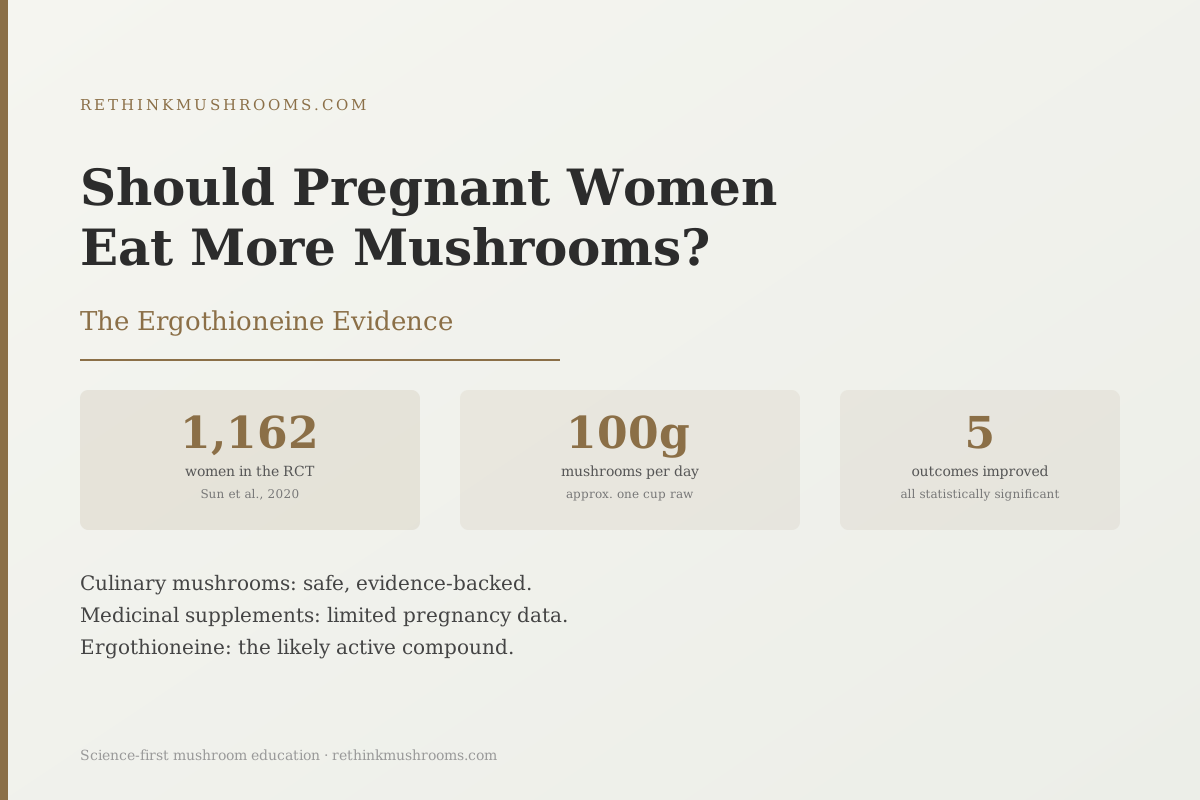
In a 1,162-person randomized trial, consuming 100g of mushrooms daily from before conception through 20 weeks reduced gestational hypertension, preeclampsia, gestational diabetes, excessive weight gain, and macrosomia.
Sun et al., Food & Nutrition Research, 2020
100g/day
mushroom intake used in the RCT; roughly one cup cooked
P=0.014
statistical significance of preeclampsia reduction
EFSA cleared
ergothioneine safe for pregnant and breastfeeding women under proposed uses, 2017
Sun et al., Food & Nutrition Research, 2020
 View as image ↗
In 2020, Sun and colleagues enrolled 1,162 pregnant women in a randomized controlled trial and asked half of them to eat 100g of ergothioneine-rich mushrooms every day, starting before conception and continuing through 20 weeks of pregnancy. The results were statistically significant across five outcomes: reduced gestational hypertension, reduced preeclampsia, reduced gestational diabetes, reduced excessive gestational weight gain, and reduced macrosomia in overweight women.[1]
This is the most direct human evidence available on mushroom consumption and pregnancy outcomes. It is almost entirely unknown in consumer pregnancy media, where mushroom advice typically stops at "cooked mushrooms are allowed." The evidence has moved considerably past "allowed."
The active compound driving these benefits is not definitively established, but the leading candidate is ergothioneine, a sulfur-containing antioxidant that accumulates almost exclusively in mushrooms, concentrates in the placenta via a dedicated transporter, and whose low plasma levels correlate with preeclampsia in human cohort data. For the foundation on what ergothioneine is, the ergothioneine overview article covers the biochemistry and sourcing.
Key Takeaways
- A 1,162-person randomized trial (Sun 2020) found 100g/day mushroom intake from pre-pregnancy to 20 weeks significantly reduced gestational hypertension (P=0.023), preeclampsia (P=0.014), gestational diabetes (P=0.047), excessive weight gain (P=0.032), and macrosomia in overweight women (P=0.007)
- Common culinary mushrooms (button, oyster, shiitake, maitake) are safe during pregnancy and represent the evidence base; medicinal/adaptogenic mushrooms lack pregnancy-specific safety data
- Two 2023 cohort studies (Kenny, Ho) found plasma ergothioneine below 462 ng/ml was present in 96% of preeclampsia cases, providing a mechanism for why mushroom intake might reduce risk
- EFSA reviewed ergothioneine safety for pregnant and breastfeeding women in 2017 and found a sufficient margin of exposure at anticipated dietary intake levels
- The Sun 2020 trial used Chinese mushroom varieties in a Chinese population; the ergothioneine compound is found in all common culinary mushrooms, but species-specific intake data for other populations is limited
- No trial has isolated ergothioneine specifically as the protective agent; mushrooms contain multiple bioactives including beta-glucans, vitamin D, and selenium
Mushroom Safety During Pregnancy: Starting With the Full Picture
Common grocery-store mushrooms are safe and well-studied. Here is where the evidence stands for each category:
| Mushroom Category | Examples | Safety During Pregnancy | Evidence Level |
|---|---|---|---|
| Common culinary | Button, oyster, shiitake, maitake, portobello | Safe; used in the Sun 2020 RCT at 100g/day | High (RCT and regulatory review) |
| Dried/cooked culinary | Any culinary variety, dried or cooked | Safe; ergothioneine is heat-stable | High |
| Medicinal/adaptogenic supplements | Lion's mane, reishi, chaga, turkey tail (supplement form) | Limited pregnancy data; approach with caution | Very low |
| Wild-foraged | Any foraged mushroom | Avoid; identification errors and species variability | No pregnancy data |
| Psilocybin | Magic mushrooms | Contraindicated; active psychedelic with no safety data in pregnancy | Not applicable |
The critical distinction is between culinary mushrooms consumed as food and concentrated medicinal mushroom supplements. The Sun 2020 trial and the ergothioneine research both involve culinary mushrooms eaten as food. Medicinal mushroom supplements are a different category: concentrated, with different bioactive profiles and no pregnancy-specific safety trials.
What Sun 2020 Actually Found: The Numbers Behind the Headlines
The Sun trial enrolled 1,162 pregnant women in China, randomized to a mushroom diet intervention (n=582) or standard diet control (n=580).[1] The intervention group consumed 100g of mushrooms daily starting from the pre-pregnancy period through 20 weeks of gestation.
The full set of statistically significant outcomes:
Gestational hypertension: reduced in the mushroom group (P=0.023)
Preeclampsia: reduced in the mushroom group (P=0.014)
Gestational diabetes: reduced in the mushroom group (P=0.047)
Excessive gestational weight gain: reduced in the mushroom group (P=0.032)
Macrosomia in overweight women: reduced in the mushroom group (P=0.007)
The P values across all five outcomes are statistically significant, and the breadth of the effect (spanning metabolic, vascular, and growth outcomes) suggests that mushroom consumption was exerting a systematic effect on pregnancy metabolism rather than hitting one specific pathway.
What the trial cannot tell us: which component of mushrooms drove the effect. Mushrooms provide ergothioneine, beta-glucans (which support immune function and may affect blood sugar regulation), vitamin D (often deficient in pregnancy), selenium, and various polysaccharides. The trial used whole mushrooms in a diet intervention, not a controlled ergothioneine supplement. Attribution to ergothioneine specifically requires a separate supplementation trial.
The trial was conducted in China using Chinese mushroom varieties and a Chinese study population. Mushroom intake patterns, baseline ergothioneine status, and dietary context in that population may differ from other regions. These are real limitations.
Still, a 1,162-person RCT with statistically significant reductions in preeclampsia is not a finding that should be ignored because of dietary context questions.
Why Mushrooms May Protect Against Preeclampsia: The Ergothioneine Explanation
The most plausible biological explanation for the Sun 2020 findings runs through ergothioneine and its relationship to preeclampsia risk.
Two 2023 studies established that women with low plasma ergothioneine are at substantially higher risk of preeclampsia. Kenny and colleagues found that of 97 women in a 432-woman cohort who developed preeclampsia, 96 had plasma ergothioneine below 462 ng/ml, the 90th percentile of the cohort and the apparent protective threshold.[2] Ho's dose-response reanalysis confirmed the non-linear protective curve: risk drops steeply as ergothioneine rises from very low levels toward 300 ng/ml, with additional protection building toward 462 ng/ml.[3]
Mushrooms are the primary dietary source of ergothioneine. Women eating 100g of mushrooms daily, as in the Sun trial, would be consistently supplying dietary ergothioneine to build plasma levels. If the plasma ergothioneine threshold at 462 ng/ml is genuinely protective, then a diet that reliably provides ergothioneine should shift more women into the protective range.
This is the connection the Sun trial cannot prove by itself but which makes biological sense when paired with the cohort data. The ergothioneine mechanism also explains why preeclampsia and gestational hypertension (both placental oxidative stress conditions) showed the strongest responses in the Sun trial.
For a full examination of the ergothioneine-preeclampsia cohort data, the preeclampsia risk article covers the threshold evidence in depth.
How Ergothioneine Works: The Placental Mechanism
Ergothioneine's protective effect in pregnancy runs through the placenta. The OCTN1 transporter (SLC22A4) is expressed in placental tissue and actively imports ergothioneine from maternal blood, concentrating it where it is needed most.[5] The placenta is one of the most metabolically active organs in the pregnant body, generating substantial oxidative byproducts that must be neutralized continuously.
Ergothioneine in the placenta scavenges mitochondrial reactive oxygen species (the free radicals that accumulate during placental ischemia), activates Nrf2 (the master transcription factor for antioxidant enzyme production), and upregulates SOD-1, PGC-1α, and UCP-1, the specific enzymes that neutralize placental oxidative stress. This is not a generic antioxidant effect; it is targeted placental protection.
A 2002 study by Guijarro and colleagues adds a specific window of protection: in diabetic pregnant rats, ergothioneine supplementation during the embryonic period reduced malformation rates to levels comparable to non-diabetic controls, with additive effects alongside vitamin E.[6] Maternal hyperglycemia generates oxidative stress that disrupts embryo development; ergothioneine appeared to buffer this. This is animal research, not human data, but it suggests ergothioneine's protective role may begin even earlier than the placental phase.
For the full mechanistic picture of ergothioneine and placental health, the placental health research article covers the biology in detail.
What 100g/Day Looks Like in Practice
The Sun 2020 intervention used 100g of mushrooms daily. For practical context:
100g of raw mushrooms is roughly one standard cup, loosely packed. When cooked (which reduces volume dramatically), this becomes approximately a third of a cup. A single serving of a mushroom stir-fry, a mushroom soup, or eggs with mushrooms would provide approximately this amount.
Ergothioneine is heat-stable, meaning cooking does not substantially destroy it. Sauteing, stewing, or roasting mushrooms preserves ergothioneine content. Drying concentrates it. Common culinary varieties available in most grocery stores all provide ergothioneine, though the amount varies by species.
The specific varieties highest in ergothioneine include oyster, king oyster, and porcini mushrooms. Common button mushrooms and shiitake provide meaningful but somewhat lower amounts. Daily variety is not required; any of these cultivated culinary varieties eaten regularly will contribute to ergothioneine intake.
What the trial did not test: whether smaller daily amounts (say, 50g/day) provide partial benefit, or whether intermittent mushroom consumption achieves comparable effects to daily consumption. These questions remain open.
Because ergothioneine content varies substantially by species, the ergothioneine content by mushroom species article provides a detailed species ranking when you want to prioritize which mushrooms to buy. For more on why mushrooms are essentially the only food that contains meaningful ergothioneine amounts, the article on why only fungi make ergothioneine explains the biosynthesis and what that means for dietary sourcing.
Medicinal Mushrooms During Pregnancy: Why the Evidence Is Different
Lion's mane, reishi, chaga, and similar adaptogenic mushrooms have attracted significant attention for their cognitive, immune, and anti-inflammatory properties. The question of whether they are safe during pregnancy is different from the question about culinary mushrooms, and the answer is less clear.
The reasons for caution with medicinal mushroom supplements during pregnancy:
Concentration: Supplements contain concentrated bioactive compounds, not the diluted profile of food-form culinary mushrooms. Higher concentrations mean higher potential for effects and for adverse effects.
Species-specific bioactives: Reishi contains triterpenoids; chaga contains betulinic acid and oxalates. Some of these compounds have not been studied in human pregnancy, and a few have theoretical concerns around immune modulation during pregnancy.
No safety trials: There are no randomized safety trials of any medicinal mushroom supplement in pregnant women. EFSA's 2017 safety clearance applies to ergothioneine as a compound, not to medicinal mushroom extracts as supplement products.[4]
Lack of standardization: Supplement ergothioneine concentrations vary widely between products and are often not disclosed.
This is not a finding that medicinal mushroom supplements are unsafe in pregnancy. It is a finding that the safety data simply does not exist. When safety data is absent for concentrated supplements during pregnancy, the appropriate response is caution.
Culinary mushrooms as food are a different matter entirely: well-characterized, traditionally consumed during pregnancy across many cultures, and now supported by a 1,162-person RCT.
What EFSA Assessed: The Regulatory Safety Picture
In 2017, the European Food Safety Authority's Panel on Dietetic Products, Nutrition and Allergies reviewed synthetic ergothioneine as a novel food ingredient for various populations including pregnant and breastfeeding women.[4]
EFSA calculated a margin of exposure of 610 at a maximum anticipated intake of 1.31 mg/kg/day, a level they concluded was sufficient to consider synthetic ergothioneine safe for pregnant and breastfeeding women under the proposed uses. This means the dose at which concern would arise is 610 times higher than the maximum anticipated intake from food.
This regulatory assessment provides formal backing for what traditional dietary patterns have long suggested: culinary mushrooms and their ergothioneine content are safe during pregnancy at food amounts.
What We Don't Know: The Honest Gaps
The evidence for mushroom consumption during pregnancy is stronger than most people realize, but several important gaps remain:
Attribution is unconfirmed. The Sun 2020 trial used whole mushrooms, and no trial has isolated ergothioneine as the specific protective agent. Beta-glucans, vitamin D, selenium, and other mushroom compounds may contribute.
Population specificity. Sun 2020 was conducted in China. Baseline ergothioneine status, mushroom varieties used, and overall dietary patterns in that population may not be representative. Ergothioneine content varies by species, and the specific varieties used in Sun 2020 were not fully reported.
First-trimester effects. Sun 2020 measured outcomes through 20 weeks, but much of the critical placental development occurs in the first trimester. Whether mushroom intake beginning early in the first trimester matters more than later intake has not been studied.
Dose-response. Whether amounts smaller than 100g/day provide meaningful protection, or larger amounts provide additional benefit, is not known.
No direct ergothioneine supplementation trial. All the human evidence involves dietary mushroom consumption rather than ergothioneine as a supplement in pregnant women. Such a trial would clarify whether ergothioneine specifically is the mediating compound.
For the fetal development evidence across the developmental arc from oocyte to late gestation, the fetal development article covers what animal models show about ergothioneine's effects across pregnancy.
The Bottom Line
The best available human evidence supports eating common culinary mushrooms regularly during pregnancy. A 1,162-person RCT found that 100g/day from before conception to 20 weeks significantly reduced five pregnancy outcomes including preeclampsia and gestational hypertension. The likely mechanism involves ergothioneine supporting placental antioxidant defense, backed by 2023 cohort data establishing a specific protective plasma threshold. Common culinary mushrooms are safe. Medicinal mushroom supplements lack pregnancy-specific safety data and should be approached with caution. The specific protective compound has not been isolated from whole mushroom consumption.
Frequently Asked Questions
Sources & References
- 1RTHM-01292·Sun, Linlin et al. (2020). “A mushroom diet reduced the risk of pregnancy-induced hypertension and macrosomia: a randomized clinical trial..” Food & nutrition research.Study breakdown →PubMed →↩
- 2RTHM-01717·Kenny, Louise C et al. (2023). “Relationship between the concentration of ergothioneine in plasma and the likelihood of developing pre-eclampsia..” Bioscience reports.Study breakdown →PubMed →↩
- 3RTHM-01708·Ho, Kwok M (2023). “Dose-related relationship between ergothioneine concentrations and risk of preeclampsia..” Bioscience reports.Study breakdown →PubMed →↩
- 4RTHM-00920·Turck, Dominique et al. (2017). “Statement on the safety of synthetic l-ergothioneine as a novel food - supplementary dietary exposure and safety assessment for infants and young children, pregnant and breastfeeding women..” EFSA journal. European Food Safety Authority.Study breakdown →PubMed →↩
- 5RTHM-00968·Kerley, Robert N et al. (2018). “The potential therapeutic effects of ergothioneine in pre-eclampsia..” Free radical biology & medicine.Study breakdown →PubMed →↩
- 6RTHM-00090·Guijarro, M V et al. (2002). “Effects of ergothioneine on diabetic embryopathy in pregnant rats..” Food and chemical toxicology : an international journal published for the British Industrial Biological Research Association.Study breakdown →PubMed →↩